Archives for category: Jazz

Joe’s History of Jazz
Lesson 5A

There’s no real delineation between the decades. Those zero years are just easy markers.

In the early 50s, Miles Davis didn’t exactly drop out of the scene, but following his return from a 1949 tour of Paris, fell into heroin addiction. For about four years he performed a bit, recorded quite a lot, and “lived the life of a hustler” (Wikipedia’s phrase – I don’t know what this means in context, however). In the late 1980s I read a biography of Miles that suggested he played in a recording session with Billie Holiday during this period, but I’ve never identified what those recordings might have been. He finally quit cold turkey in 1954. While his work from the late 40s and early 50s (addiction or no) show him to be a musician of incredible talent and vision. I’d argue that from 1955’s first quintet sessions through to 1975’s Agharta and Pangaea live albums, Miles was the center around which everything new in jazz revolved/evolved. (Between 1975 and 1981 he recorded little and didn’t perform in public at all, due primarily to illness and exhaustion. Many of his recordings and performances after returning to the public eye are less innovative and very much of their time, but there are still some intriguing gems in that late work.)

In 1951 he signed with Prestige records and recorded with a revolving cast of musicians that often included Art Blakey on drums and Sonny Rollins on tenor sax. Blakey later led the Jazz Messengers and Rollins led his own bands from 1957 onward.

Harold Arlen’s It’s Only a Paper Moon, from 1951’s Dig with Rollins was a hit in the 40s for Nat King Cole. While Miles’ lines hew to Cole’s vocal version, we get long improvisatory solos from Rollins and Davis.

On the subject of improvisation, in a recent interview with the All About Jazz web site, Kawabata Makoto of the Japanese psychedelic collective Acid Mothers Temple had this to say:

 AAJ: How do you go about staying creative as a musician? What inspires you to play?

 KM: I believe I haven’t created any music. Always, my cosmos teaches me what I should play. I don’t need to be inspired by anybody. I just try to be the best radio tuner for my cosmic that gives me music all the time. I try to play with “self-annihilation.” Any personal, egoistical idea makes the pure music [I think there might be a translation error in that last sentence. -JS]. I have to play without any of my personality or my own ideas. So I’ve tried to be a better tuner to receive and replay— to recreate—this music for people. But if I add any of my ego—my personal ideas of this music—this pure music will be a different thing. For example, if a musician gets any new technique, they want to show it to other people. Then this musician tries to add this new technique to his music. But I believe music must be played without any musicians’ egos. Music must be played as pure!

 While this may apply to certain more recent schools of music than 50s era Miles, Makoto is not the only one to suggest that he is only a conduit for his virtuosity. John Coltrane made similar assertions. It’s worth keeping in mind as we delve into the improvisational nature of jazz as the form moves on from 3-minute recordings to longer forms.

Bluing was recorded at one of two 1951 sessions from which the Dig album was compiled, though originally released as part of the Blue Period 10” album (along with Blue Room and Out of the Blue). At almost ten minutes long, Miles and Rollins both take the space to get into this Davis composition. Rollins’ tenor sax solo starts at about the 4 minute mark. He and Miles alternate for a bit before Jackie McLean’s alto comes in at about 6 minutes. Each one takes a route around the theme before Miles takes it back around the 8th minute. He finally restates the theme, introduced by Walter Bishop’s piano in the opening, in the piece’s closing bars.

Smooch, recorded in 1953 and released on Blue Haze is notable, again, for the line-up. Charles Mingus (who usually plays bass, but plays piano on this track) would soon record a string of influential albums starting with Mingus Ah Um in ’59. Drummer Max Roach, who founded the Debut record label together with Mingus in ’52 ,continued to record and perform with figures including Duke Ellington (1962’s Money Jungle, also with Mingus). Bassist Percy Heath and pianist John Lewis (not on this track, but on the rest of Blue Haze) had co-founded the Modern Jazz Quartet (usually abbreviated MJQ) the previous year and would continue to perform and record under that moniker on and off until the early 1990s.

Around the same time as the Blue Haze recordings, Dizzie Gillespie, Charlie Parker, Mingus, Roach, and pianist Bud Powell released Jazz at Massey Hall, Toronto. The show is remarkable for a number of reasons; one is that it was the last time Gillespie and Parker shared a stage. I’ve included a smoking rendition of Gillespie’s A Night in Tunisia (which you heard first back one of the 1940s entries). Again, we get extended solos from many of the participants – Powell’s is particularly tasty. I’d like to be able to point to the interplay between Powell and Mingus, but in the original release of the album, the bass was overdubbed because it had been too low in the mix. A later reissue removed the overdubbing. I’m pretty sure the one in the Spotify playlist is an overdubbed version.

Django, a Lewis composition and early MJQ recording, is a tribute to Django Reinhardt who passed away in 1953. Despite having no guitar, it has the feeling of some of Reinhardt’s tunes especially in the closing movement. I think it’s fair to say that this song progresses through distinct phases that might be called movements akin to those in a sonata. The song isn’t relaxed but has a distinct lack of hurry that’s very appealing.

Art Blakey, the drummer on the Dig sessions, first recorded under the name Art Blakey and the Jazz Messengers with the Café Bohemia albums recorded in 1955. Their rendition of the 1939 hit What’s New is almost a duet between Doug Watkins’ bass and Horace Silver’s piano – Blakey really only comes to the fore at the end of the song. On the other hand, the band’s rendition of Jimmy Van Heusen’s Like Someone in Love shows off each musician’s talent. Kenny Dorham’s trumpet work is well balanced against Hank Mobley’s sax. Dorham’s another journeyman who led his own small groups and was a sideman for many others. A few years later Mobley would join the Miles Davis Quintet for Someday My Prince Will Come (but I get ahead of myself).

Coming around the other way, we have John Coltrane whose tenor saxophone would grace the work of the first great Miles Davis Quintet from ’55 to ’57, was already recording in the early 50s. Between 1949 and 1951, Coltrane recorded several sessions with Dizzy Gillespie (including one which featured Dinah Washington, which I can’t find the Washington tracks on Spotify), but We Love to Boogie gives a taste of the power he was already showing pretty early in his career. The swinging Used to Be Duke, is from a 1954 stint with Johnny Hodges (an alto sax player who worked with Ellington in the 30s and participated in that great Benny Goodman show at Carnegie Hall). Miles admired Coltrane for, among other things his ability to play both loud and fast, while maintaining complete control of the instrument. You get a taste of that in both of these tracks.

There’s more to say about Coltrane and the other people who played with Miles during this very rich period. In a couple of massive sessions in 1956, Miles and Coltrane, pianist Red Garland, bassist Paul Chambers, and drummer Philly Joe Jones would record enough material for four albums, enough to fulfil Davis’ contract with Prestige and allow him to jump to Columbia Records in ’57.

Next up, however, we’ll visit Billie Holiday’s later work.
Joe’s History of Jazz
Lesson 4C

http://open.spotify.com/user/bishopjoey/playlist/5L3ySZDnsMcniMXfM0kfAV (Scroll down to Sarah Vaughan and Dizzy Gillespie’s version of Loverman.)

In the late 40s, vocal styles changed a bit from the big band-backed style of the pre-war years to something more compatible with bebop. That’s a broad generalization, but let’s go with it for a little bit. Sarah “Sassy” Vaughan, who had played with Earl Hines and Billy Eckstine during the early part of the decade struck out on her own. I’ve found some early recordings with Dizzy and Bird (including another version of Loverman). The thing to listen for with all the vocalists of this period, and possibly in jazz vocalisation in general is for the phrasing. How does the singer play her voice against the melody, both that provided by the instruments, and that in the song? In East of the Sun, listen to how Vaughan plays with the spacing of the words (at 1 minute 20) just before Dizzy’s solo.

I’ve included her version of Nat King Cole’s Nature Boy. What’s interesting about it is that due to another musicians’ strike, she recorded with a vocal choir rather than instrumental accompaniment. In the late 40s, Sassy signed with Columbia and had both critical and commercial successes including with this sweet version of Black Coffee, though Columbia pushed her away from jazz and more towards pop. This was common for the label – Billie Holiday’s earliest Columbia work features angel choirs as does some of Aretha Franklin’s pre-Atlantic work in the early 60s.

Ella Fitzgerald, who had been recording since the 1930s (both ‘pop fluff’ as her 1966 NY Times obituary noted), added scat singing to her style in the mid 40s, in response to bebop’s influence. Scat is primarily wordless vocal improvisation, but the singer must handle it deftly or risk losing the audience to what can come across as nonsense. Cab Calloway and Slim Gaillard generally used scat to humorous effect. I’ve added Slim’s Puerto Vootie to the playlist for a reference, though I’m not sure how much of the song is actual Spanish, and how much is Latin-tinged scat. For her more straight-ahead style, listen to what Ella does on this arrangement of I’m Beginning to See the Light with the Ink Spots. Ella’s My Baby Likes To Bebop has that sense of humour from the origins of scat, but one could argue that what she does on this recording of How High The Moon (she comes in at about 5 minutes 50) is straight-up improvisation. The thing to note is how she’s always in control – you can hear it as well on Flying Home. Her harmony with the other musicians doesn’t stray.

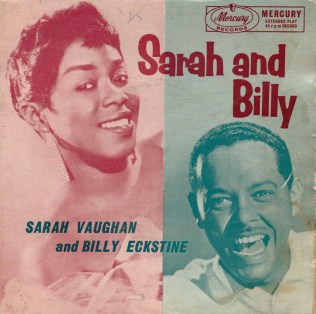
Billy Eckstine is a really interesting case – he toured with Earl Hines in the late 30s/early 40s before forming his own big band, but it was a bop big band and featured at various times Miles Davis, Dexter Gordon, Art Blakey, and Dizzy Gillespie, among others. He played trumpet (Opus X), but was primarily a vocalist, and later focused on ballads. You can hear both sides on two 1946 tracks, Oo Bop Sh’bam and Prisoner of Love. Listen to Blue Moon and You’re All I Need (a duet with Vaughan) to get how beautiful his tenor was.

Another balladeer who started out in the jazz realm was Nathaniel Adams Coles, better known as Nat King Cole. Born in Alabama in 1919 and raised in Chicago, he studied piano, including jazz, gospel, and classical music. He landed in LA in the late 30s, after touring with a Eubie Blake revue and decided to stay. There he formed the King Cole Swingers, later the Nat King Cole Trio, an instrumental combo to which Cole later added his vocal talents. His piano style influenced later musicians including Oscar Peterson, Art Tatum, and Ray Charles. Peterson, also a pianist by trade, later recorded a beautiful album of vocals associated with Cole called With Respect to Nat. The Trio signed with Capitol records in 1943 and had its first hit with Straighten Up and Fly Right.

Next up: More Bop, More Blues.

Joe’s History of Jazz
Lesson 4B
I’ve decided to add the tracks in this lesson to the Jazz 4 playlist covering the war years. Start with Charlie Parker’s Now’s The Time.

Bebop was the new style of jazz that came out of the breakup of the big bands, following the call-up. The progenitors of bebop include saxophonist Charlie ‘Bird’ Parker and trumpeters Miles Davis, and Dizzy Gillespie. The style is characterized by chordal improvisation as opposed to the melodic improvisation of earlier jazz styles. Can I tell you precisely what this means in non-musical terms? Probably not, but “In Bebop an artist would be free to explore whatever improvised melody they saw fit, as long as it fit within the chord structure of the piece.” (emphasis mine)

Bird, Dizzy, MilesParker claims to have come upon this kind of improvisation independently. “According to an interview Parker gave in the 1950s, one night in 1939, he was playing “Cherokee” in a jam session with guitarist William “Biddy” Fleet when he hit upon a method for developing his solos that enabled one of his main musical innovations. He realized that the twelve tones of the chromatic scale can lead melodically to any key, breaking some of the confines of simpler jazz soloing.” (http://en.wikipedia.org/wiki/Charlie_Parker#Bebop)

Because of the musicians’ strike discussed in the last post, there are few if any recordings of the first bebop performances. In November, 1945 Parker did a session for the Savoy label released under the name Charlie Parker’s Reboppers. This session also included Dizzy and Miles both on trumpet, Dizzy and Sadik Hakim on piano, drummer Max Roach, and Curly Russell on bass. These sides would probably have been released on 45s (and possibly 78s even this late). All clock in at less than 3 ½ minutes. You’re not going to get much of a feel for the improvisation going on, but the sound is a real leap from what jazz was holding onto during the war years.

Born in 1920, Parker started playing at the age of 11 and toured with Jay McShann from the age of 18 until McShann was drafted in 1944, and was 25 when these recordings were made.

Between 1945-48, Parker recorded 13 sessions for the Dial and Savoy labels. Ten of these included Miles (once with Miles as bandleader of The Miles Davis All-Stars). Listen to Lover Man – it’s not a very well-preserved recording, but the theme is introduced on piano, and when Parker comes in, he’s already improvising. It’s several bars before he gets to iterating the theme himself. At which point he’s off again. For a contrast, I’ve dropped in a recording of Billie Holiday performing the same song in the same year. (I’m pretty sure this one’s from her February 1946 Jazz at the Philharmonic performance.)

Dizzy performed in a number of bands from the the mid-30s onward, including a stint with Cab Calloway, who didn’t much like Dizzy’s approach to soloing, among other things. Dizzy was sacked in ’41 and worked freelance (including stints with Ella Fitzgerald, and writing for Jimmy Dorsey and Woody Herman).

The next bit of text I had to nick wholesale from the Wikipedia entry because it hits on the origins of bebop and where it sits in the continuum of jazz:

In 1943, Gillespie joined the Earl Hines band. Composer Gunther Schuller said:

… In 1943 I heard the great Earl Hines band which had Bird in it and all those other great musicians. They were playing all the flatted fifth chords and all the modern harmonies and substitutions and Gillespie runs in the trumpet section work. Two years later I read that that was ‘bop’ and the beginning of modern jazz … but the band never made recordings.[9]

Gillespie said of the Hines band, “People talk about the Hines band being ‘the incubator of bop’ and the leading exponents of that music ended up in the Hines band. But people also have the erroneous impression that the music was new. It was not. The music evolved from what went before. It was the same basic music. The difference was in how you got from here to here to here … naturally each age has got its own shit”.[10]

The Hines in question would be Earl ‘Fatha’ Hines we discussed back in the 1920s. Once again, we have that bloody musicians’ strike to blame for not having these essential sounds.

I’ve included several of Dizzy’s songs including “Night In Tunisia”, originally performed with Hines in the early 40s, and covered by dozens of artists.

What’s interesting about these recordings to me is primarily their exuberance. In addition, we have the elbow room Gillespie gives his band members – the longest cut here is only four minutes long but we still get vibraphone and piano solos before Dizzy pulls it all back in.

Between the 30s and the early 50s there was a two-block stretch of 52nd Street (about half a mile) which featured about a dozen clubs. In the post-war period Gillespie taught and worked with a number of upcoming musicians, including the ones already mentioned, and Milt Jackson, John Coltrane, J.J. Johnson, and Yusef Lateef and regularly performed in Norman Granz’ Jazz at the Philharmonic(JATP) performances.

Granz was a producer and promoter who started the JATP series at the LA Philharmonic Auditorium in 1944. “The JATP concerts featured Swing and Bop musicians. They were among the first high-profile performances to feature racially integrated bands, and Granz cancelled some bookings rather than have the musicians perform for segregated audiences.” (http://en.wikipedia.org/wiki/Jazz_at_the_Philharmonic) Happily almost all of these were recorded and released on various labels Granz owned or was contracted to. Tours of the US, Canada, and Europe ran through 1959. The Verve label released a 10-CD set of the complete 1944-49 tours. It’s a sweet collection. Check out Stompin’ at the Savoy, which may not be bebop, per se, but it’s notable for the lineup and the extended solos the various musicians are afforded, given the 12-minute length of the track:

  • Bass – Charles Mingus
  • Drums – Dave Coleman
  • Guitar – Dave Barbour
  • Piano – Milt Raskin
  • Tenor Saxophone – Coleman Hawkins, Corky Corcoran
  • Trumpet – Neal Hefti, Shorty Sherock

Hawkins you’ve met already, but Mingus would be huge – he toured with Louis Amstrong among others in the early 40s, taking a lot of inspiration from Parker’s techniques and would form his own band in the 50s. We’ll be hearing more from him in the next jazz lesson. The other notable member of this crew is Neil Hefti. He mainly played swing and big band music at the time, but made a name as an arranger and composer as well. In the mid-late 40s he played in Woody Herman’s First Herd which was focusing on bebop at the time, and to which he contributed arrangements. Later he found a lot of work in scoring films and TV. When mama Ru and I were kids, we were well familiar with his theme for the Batman series. (http://www.youtube.com/watch?v=UAstFcVDwiI ) I had no idea he’d been working that much earlier.

I note as I write, that today (August 6) would have been Granz’ 95th birthday.

I mentioned Miles Davis a couple of times at the top of this lesson. One could defend the argument that between 1949 and 1975, there was no more important musician in jazz than Miles. His recordings, his bands and band leadership, his performances and his innovations continually reshaped the musical landscape.

The son of a dentist in Illinois, Miles started studying trumpet at the age of 13. By 17, he was sitting in with bands coming through town and was invited to tour with Billy Eckstine’s band (which featured Gillespie and Parker at the time). His parents insisted he continue with his studies. At 18, in 1944, he moved to New York to study at Julliard. He stayed a year, but as he was already gigging in Harlem and getting work, he asked his father’s permission to drop out.

In the mid-40s, as noted, he was recording and touring with Parker’s combos, but split from him in December, 1948. Through much of ’48, he’d been working on a project with arranger Gil Evans that culminated in the performances and recordings of the Miles Davis Nonet (nine-piece band) called The Birth of the Cool.

Cool Jazz tended to be sweeter and more melodic than bebop and was a conscious move away not only from bebop, but also from swing and the much earlier Hot Jazz. The nonet featured the piano and arrangements of another Gillespie alumnus, John Lewis, who would go on to form the Modern Jazz Quartet, saxophonists Gerry Mulligan and Lee Konitz, and drummer Max Roach. Yes, I know I’m just throwing out names, but trust me, we’re already seeing that Miles is pulling in young musicians who would go on to be the leading lights of jazz in the 50s and 60s. (I’m pretty sure the oldest of the nonet’s players during its 18-month lifespan was about 28.)

I’m sure there’s something to be said here about the integrated nature of the nonets, but suffice it to say that for Miles, the talent was everything, skin color – nothing.

Remember Gil Evans’ name, too – in the late 50s and early 60s, Davis recorded several albums with Evans’ orchestra, not one of which isn’t a classic.

Note Kenny Hagood’s vocal on Darn That Dream. This is one of only two vocals on Miles Davis-led recordings, the other being Bob Dorough’s Nothing Like on 1967’s The Sorcerer.

I occasionally mention labels – the nonet made the Birth of the Cool recordings between January 1949 and April 1950 for Capitol, but these were not released until 1956. In the meantime, Davis made several recordings under contract to the Prestige label, and recorded several sessions for Blue Note (released as Volume 1 and Volume 2), and then signed to Columbia. Davis recorded almost exclusively for Columbia for over 30 years.

Joe’s History of Jazz
Lesson 4A
Jazz Goes to War
NB: There are three entries in my look at jazz in the 40s, and the playlist covering all three is linked below. This entry covers the first 13 tracks, though I don’t reference them by name for the most part.

The early 40s might be the last period during which jazz was entirely a pop affair. Going back to Dixieland, it was always possible to take the edge off of a jazz song and make it more palatable. This isn’t a bad thing, in my opinion, but it made for accessibility. Note, also, that by the late 30s, the main/high-earning swing acts were white, and they tended to make the music easy on the ear.

I’m being a little obtuse here – there have always been artists and movements in jazz that take the edge off. In the late 60s and early 70s, for example, the term ‘fusion’ was used to describe a jazz-rock hybrid (like many things in jazz, fusion was pioneered by Miles Davis and his band mates). By the 80s, fusion was almost easy listening and synonymous with the ‘quiet storm’ radio format. I get ahead of myself, but there have always been efforts to make difficult music easy on the ears (and difficult art easy on the eyes, and exotic cuisines easy on the tongue).

There were several threads of jazz during the years of World War 2. The biggest of the big bands often ended up in the USO or at least toured the fronts playing for the troops. But there was a draft and membership in a band wasn’t a dispensation from service. Jack Teagarden lost 17 men to the army in just four months.

And at home there was a 20% entertainment tax imposed – this led to the closing of many of the ballrooms.

The big names continued to play – Glenn Miller for example, toured up until September 1942, announcing at a show in Passaic, New Jersey that he’d be joining the war effort. From then until his death over the English Channel in December of 1944 he served as music director in various military organizations, performing over 800 shows and making many recordings at EMI’s Abbey Road Studios. On the one hand Miller took criticism for draining jazz of its feeling. On the other, many considered the big band era over when Miller joined the war effort. It Must Be Jelly (Cause Jam Don’t Shake Like That) was first recorded by Miller, but underneath Miller’s slick delivery, the song is something more akin to early Louis Armstrong, or Slim & Slam. The St. Louis Blues March was an attempt by Miller to update military music, by taking on a song we already know was made popular about 30 years before.

It would take a bit of research, but I figure the role of Armed Forces Radio in the history of American music could use some discussion. Acts including Count Basie recorded Command Performances throughout the war. My Old Radio (www.myoldradio.com) seems to have quite an archive of these. In the introduction to Basie’s 1943 broadcast, the announcer says “We deal in all kinds of performance: Boogie woogie, symphony, and corny. Also jokes, new, used, and stale. Don’t delay, write today.” Count Basie’s “Dance of the Gremlins” starts at 4:40 here.

Side note: Gremlins were creatures that tinkered with aircraft. Roald Dahl (who flew for the RAF in WWII wrote a story about them, there’s also an episode of the Twilight Zone and a 1943 Bugs Bunny cartoon, ‘Falling Hare’ which defines gremlins as “a constant menace to pilots…who wreck planes with die-uh-boh-lickle sab-o-tay-gee” and also makes a poke at gas rationing.)

Adding to the issues with performing during the war – the entertainment tax, the rationing of rubber and fuel (not to mention the shellac used to make records!), and so forth, there was also a musicians’ strike that lasted from July 1942 to November 1944. The musicians struck over royalties the record companies paid to artists. Musicians didn’t record, but vocalists did and records made before the strike (and during the strike with non-striking vocalists performing the roles of striking musicians) sold quite well. “Over the long term the record companies were not hurt by the strike. In 1941, 127 million records were sold; in 1946, two years after the strike, that number jumped to 275 million and it jumped higher in 1947 to 400 million.” [http://en.wikipedia.org/wiki/1942%E2%80%9344_musicians%27_strike#Consequences]

Note that the strike only had to do with recordings – the main distribution of music moved from live performances and sheet music to both recordings and radio. In 1940, 96% of urban northern households had radios, and even in the rural south, 50% of households had a radio. Those command performances were just a small part of the number of broadcast performances made at the time.

Musicians who continued to have success in the war years included drummer Gene Krupa who made a cameo in the 1941 Barbara Stanwyck film Ball of Fire with his track Drum Boogie (in the playlist sung by Anita O’Day). And it’s also Krupa’s great tom toms on Benny Goodman’s Sing Sing Sing. (Yeah, than song is from ’34, but listen to those drums!) Krupa had been performing since the 20s and in the 30s played with Goodman, but led his own band in the 40s (shrunk down from an earlier orchestra). He’s an example of the older musicians touring because the young men were almost all in uniform.

And with the men all in uniform, all-girl bands toured raising money for war bonds, among other things. One such group was the well-integrated International Sweethearts of Rhythm who toured the entire country, but when in the Jim Crow South had to eat, sleep, and rehearse on their tour bus because no hotel would admit both black and white band members. What such places would have made of the group’s Asian members, I don’t know. (The Apr/May 2013 issue of Bust Magazine has a great article on this crew called No Man’s Band. Alas, not available online.)

Over in Europe, the Nazis banned jazz in the occupied countries, but it managed to thrive. The German propaganda minister called jazz “the art of the subhuman”, but later retooled swing tunes with anti-Jewish, anti-American lyrics. There was, in fact, a jazz group at the Terezin concentration camp which was filmed as part of propaganda insisting that the concentration camps were humane. While trying to find music by the Ghetto Swingers or Eric Vogel, two elements of jazz at Terezin, I found a short film in Italian. I have no idea about the text or whether the music is representative, but it’s still quite moving. The Nazis made a piece of propaganda for the Red Cross in which the Ghetto Swingers performed portraying the concentration camp as more of a resort. (After the film was made, most of those in it were deported to Auschwitz.) The film is available online, but I’ll just link to an audio snippet of their verison of Bei mir du bist schön, made popular in the US by the Andrews Sisters.

Next up: The Rise of Bebop!