
Friends and others recommend musical goodies to me all the time. This is probably not surprising. This morning, my friend Rusty suggests Darkthrone, a black metal/punk band. I’m sure the moment will come when that satisfies my musical desires. On this foggy Friday morning, the music of choice is The Jazz Crusaders at the Lighthouse (the first one recorded in ’62) featuring the recently departed Joe Sample on keys. I know there’s much to be written about the early 60s West Coast sound, but several help files on cost analysis beckon.
Archives for category: Music

I’ve seen Swans five times, Angels of Light twice and Michael Gira solo once. My next Swans gig is in two weeks at the Paradiso and there’ll probably be a review here.
I created this playlist to reflect M Gira’s solo gig earlier this year. It leans heavily on the acoustic goodies in the catalogue. Note that Nowness (Warning: Loud autoplayed video) shares the following on the matter of the band’s sound:
Swans’ seemingly endless touring schedule since their resurrection has seen the band’s reputation grow to the point that they are considered one of the most potent rock acts on the planet: The New Yorker’s Sacha Frere-Jones has hailed them as “one of the most fearsome working live bands.”
Swans: DNA Lounge, San Francisco, 1992.
Swans: Great American Music Hall, San Francisco, 1997. (I passed on the 1995 show because I didn’t really like The Great Annihilator. My loss.
Angels of Light: Great American Music Hall, 1999
Angels of Light: Palac Akropolis, Prague, 2005
Swans: Palac Akropolis, Prague, 2010 (I’d already moved to the Netherlands, but there were no NL tour dates announced when the Prague show went on sale. Worth the price of the flight, but Swans always are.)
Swans: I’ll Be Your Mirror, Alexandra Palace London, 2011.
Swans: Patronaat, Haarlem, 2012. My friends Andre, Mike, and Lucie joined for this one. I’m pretty sure The Seer went on for about 45 minutes. This wouldn’t have been uncommon. Lucie and I stepped up to the bar about midway through. After the show, the other three referred to it as “the song that wouldn’t end” which amused me. I think I was the only one prepared for that.
Michael Gira: MC Theatre, Amsterdam, 2014. Brilliant solo acoustic outing.
Looked up the set lists for the current tour – Already new songs, including this goodie with which they’re opening.
A storm coming together of the blaring horns of swing music, the development of the electric guitar by the late great Les Paul, electric blues out of Chicago, country boogie woogie, independent record labels like Atlantic, Chess (Leonard and Phil Chess – nice Jewish Boys), and Sam Phillips’ Sun Records (home of Jerry Lee Lewis and first label of Elvis Presley before Phillips sold Presley’s contract to RCA). Specialty Records another early big one. This stuff all comes in the 50s.
There are arguments to be made, however, that the origins of rock and roll date back at least to the 30s. I’ve chosen fourteen songs from the Wikipedia early rock and roll page (http://en.wikipedia.org/wiki/Origins_of_rock_and_roll) as examples of nascent rock music.
The songs that were the first rock and roll hits came in the early 50s, but, as noted, there were sounds coming from all over that contributed to the rock and roll sound. And the earliest influences, by some accounts, were recorded in the 20s. The thing to keep in mind, as the article states, is that every opinion is based on the person’s own criteria – there’s no real standard.
Wynonie Harris’ version of Good Rockin’ Tonight, Louis Jordan’s Caldonia, Jimmy Preston’s Rock This Joint are all early moves from swing and R&B to what rock and roll would sound like when polished by people like Sam Philips (founder of Sun Records – we’ll get to him in the next Rock lesson).
It’s hard to discuss early rock and roll without noting that the term often refers to both dancing and sex (which, some have noted, is also true of the term ‘jazz’), but the phrase also has a gospel sense. Sister Rosetta Tharpe’s Rock Me is a spiritual:
You hold me in the bosom / Till the storms of life is over
Rock me in the cradle of our love / Only feed me till I want no more
Then you take me to your blessed home above
(Much later, Jackson Browne’s Rock Me On The Water had a similar usage.)
While Wynonie Harris’ version of Good Rockin’ Tonight definitely has the non-spiritual sense to it, in several stanzas he uses the phrase ‘heard the news’ which is a traditional reference to the gospels.
This weaving together of the sacred and the profane finds its way into many different corners of the rock landscape. Doo Wop and R&B always had the church choir influence – this is where many rock/R&B/soul singers learned to harmonize. Little Richard, Sam Cooke, Aretha Franklin, and Whitney Houston all had gospel backgrounds.
Country blues (also known as folk blues) music has a slightly different feel than the blues we’ve covered in the jazz lessons. It tends to be performed with solo acoustic guitar (and occasionally harmonica). I’ve included Jim Johnson’s Kansas City Blues because you can trace his style down through Hank Williams (the first, not to be confused with country star Hank Williams Jr. and Hank III, his son and grandson) and in one direction to Bob Dylan and the late 50s/early 60s folk scene and on to the boogie of ZZ Top and others in the ‘southern fried rock’ bands of the 70s (April Wine, .38 Special, etc.).
Clarence ‘Pinetop’ Smith’s Pinetop Boogie Woogie has a stride piano base, and mostly has for lyrics instructions to the band to do various things. This format can be heard much later in Ray Bryant’s Madison Time (with which I’m pretty sure you’re familiar) and a whole lot of James Brown (“Can I hit it and quit it?” from Sex Machine, for example).
The Washboard Rhythm Kings’ version of Tiger Rag is notable for being thoroughly unhinged. Note that the music of the jug band tradition (that of turning household objects into cheap musical instruments) would influence musicians in the small folk clubs of the early 60s. In Palo Alto, there was Mother McCree’s Uptown Jug Champions who would soon change their name to the Warlocks and finally to the Grateful Dead.
And here’s an earlier, equally off the hook version of Tiger Rag: http://www.youtube.com/watch?v=nWSnT62X8uA
And a much more recent version, I think from a Les Paul tribute concert featuring Jeff Beck and Imelda May: http://www.youtube.com/watch?v=qy3P7Ry94cQ
Delta blues legend Robert Johnson’s relatively small body of recorded work was mostly unrecognized while he was alive. He died in 1938, and might be the first member of the 27 club, about which more later. Johnson’s complete recordings comprise only 42 recordings (including alternate takes) and fit on two CDs. However, the 1961 reissue, Columbia’s King of the Delta Blues Singers influenced a whole load of musicians including B.B. King, Jimi Hendrix, Eric Clapton, Brian Jones, Keith Richards, and Robert Plant. (Yeah, four of those are white English boys. In a few months I’ll do a lesson on the American Invasion of Britain that predates the British Invasion.)
On these solo blues recordings you can hear what became the twin-guitar approach of four-person rock and roll bands. On I Believe I’ll Dust My Broom, Johnson alternates between playing chords and more rapid individual notes. In most folk/folk blues you generally just get the chords.
It’s not just Johnson’s guitar technique that was influential. The songs themselves were covered by groups across the rock and roll spectrum and have become blues and rock standards.
The rhythms of Bob Willis’ Ida Red would find their way into Chuck Berry’s late 50s hits for Specialty including Maybelline.
To illustrate how swing threads its way into rock and roll, I’ve added two versions of Louis Jordan’s fantastic Caldonia. The first is a piano-based boogie woogie, the second featuring electric guitar. I’ve also included the full version of his 1949 Saturday Night Fish Fry which includes the chorus:
It was rocking / It was rocking
You never seen such scufflin’ and shufflin’
Til the break of dawn
(I think this is an editing together of both sides of the original 78. Not sure.) Of course, using the word rocking in the refrain helps identify it as an early rock record (and was noted as such by Chuck Berry), but that phrase “til the break of dawn” would later haunt more cut-rate hip-hop songs than you can shake a tail feather at.
Arthur Big Boy Crudup’s That’s All Right Mamma was later covered by Elvis Presley for his first single, though Rock Me Mama was originally Crudup’s bigger hit.
You met Nat “King” Cole, in the last jazz lesson. His rendition of Bobby Troup’s Route 66 was a hit in 1946 and was later covered by numerous rock bands including the Rolling Stones (in 1963, I think) and the Replacements (in 1987). Another argument made about rock and roll is that it has two subjects: cars and girls. What made the car part of the argument possible was the post-war expansion of the US highway system. A single highway from Chicago to Los Angeles was well worth singing about.
And finally, we’ve got Jimmy Preston’s Rock This Joint (1949). Like Good Rockin’ Tonight, it has that repeating reference to secular rocking. One story is that this was the track that led Cleveland DJ Alan Freed to apply the term rock and roll to rhythm and blues music as early as 1951. A lot of late 40s R&B which would have been termed race music for the purposes of record charts would also have been unheard by most white audiences until Freed started playing it on his radio show. Of this, more in the next report.
Oh, and there’s one other thing. Teenagers. With America’s post-war affluence and growing middle class, due in part to the GI bill, strong unions, and a very strong economy, young people for the first time had a disposable income and corporations of many kinds were keen to exploit it. This will be a recurring theme as rock and roll becomes a commodity.
Next up: The Labels
Prior to the 1950s, Billie Holiday recorded primarily singles. From 1952 until her death at the age of 44 in 1959, Lady Day recorded ten studio albums and three live albums, primarily for the Verve label (and its Clef subsidiary). She recorded her final album, 1958’s Lady in Satin, for Columbia.
This last period of her life was marked by a lot of personal strife, including abusive relationships, as well as heroin addiction, but even on that final album, she’s well in control of her talents, though her voice had lost a lot of its range.
The thing to remember about these albums is that, unlike her earlier work, these are their own set pieces, not standalone singles, or collections of singles. Of course, this isn’t true only of Billie’s work – it’s the nature of the music business in general in the 1950s– with the advent of LPs, artists, label, and producers began to conceive of pieces listeners would enjoy at a sitting, generally in front of a large console hi-fi system.
By this period, the recording art had become such that the instrumental solos get as much attention as Holiday’s vocals. I don’t think in recording she was ever less than generous with the people who played with her, but on these late albums the band members all get a chance to shine.
1952 Billie Holiday Sings / Recorded: March 26, 1952 (Clef)
This eight-song 10” (extended to 12 and renamed Solitude for the 12” 1956 rerelease) maintains a mostly upbeat take on love with gently swinging arrangements. On the one hand, producer Norman Granz keeps the instrumentation light and Billie’s voice to the front. On the other, her interplay with the musicians, notably Charlie Shaver’s muted trumpet on Solitude and Oscar Peterson’s piano on Blue Moon, highlight how well she used her voice as an instrument in much the way Ella and Sarah Vaughan did. I recall hearing her version I Only Have Eyes For You sometime in the 90s and falling in love with it. I was already familiar with a lot of her work, but only knew the slower 1959 version by the Flamingos.
1953 An Evening with Billi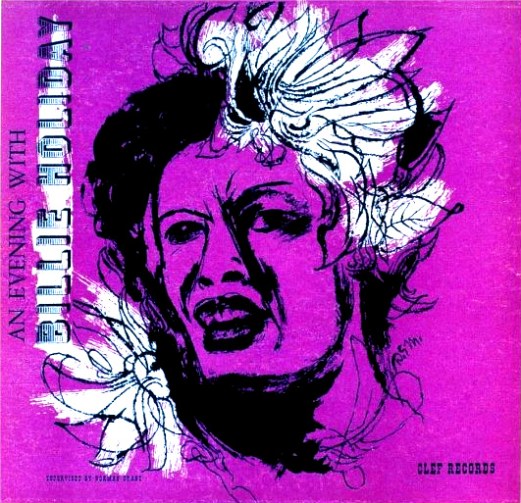 e Holiday / Recorded: April 1, 1952 & July 27, 1952 (Clef)
This is an altogether more down affair than Billie Holiday Sings. Stormy Weather sets the tone – this is a collection of lost love and love on the rocks songs. While My Man, He’s Funny That Way, and Tenderly address love as a good thing, the tempo and timing are as sad as those on opener Stormy Weather. On the other side of the coin, closer Remember addresses a lover who has strayed, but with a much happier the tempo. This track also features a pair of really nice solos from Peterson and Barney Kessel. (At the time Kessel and bassist Ray Brown rounded out the Oscar Peterson Trio, though Kessel only stayed a year.)
1954 Billie Holiday / Recorded: April 1, 1952 & April 14, 1954 (Clef)
As you can see all three of these albums came out of sessions that occurred in a four month period, and with many of the same players on all sessions. That said, the musicians are all at the top of the game. The playlist has all eight tracks because they weren’t obviously available on Spotify in sequence. Listen, in particular to Everything I Have Is Yours. Billie and tenor man Flip Philips are engaging in a sweet dialogue. As with the first two sets, the songs strike a melancholy balance between love and lost love. The closing tracks, however, positively swing. What a Little Moonlight Can Do features another fantastic solo from Peterson and some sweet trumpet work from Charlie Shavers while I Cried For You, a defiant kiss-off to a faithless lover is notable for its building intensity.
1955 Stay with Me / Recorded: February 14, 1955 (Verve)
This seven-song result of a single recording session with Tony Scott’s orchestra and features on side A a couple of longer pieces (each well over six minutes) sandwiching a modern take on Fats Waller’s 1929 hit Ain’t Misbehavin’. (I’ve added a Waller rendition to the playlist as well, for a contrast.) These are strange recordings in that the solos really stretch out. Everything Happens To Me, with its line “I’m just a girl who never looks before she jumps” has the not quite defeated feeling of the classic recordings of Good Morning Heartache and Travelin’ Light off Lady Sings The Blues recorded the following year. The sequencing of the album reflects that of Billie Holiday, with two swingers on side B, I’ve Got My Love To Keep Me Warm and Irving Berlin’s Always, though it closes with a thoughtful rendition of Ellington’s Do Nothing ‘Til You Hear From Me.

