Archives for category: Rock

2003 Sanctuary Records

First of all, The Power To Believe, released in 2003, contains, hands down, my least favorite King Crimson song. Happy With What You Have To Be Happy With is noise without relief and lyrical silliness unmatched in the entire catalogue. And the more I listen to this album, the less I like this song. In the absence of everything else, it’s simply annoying. Belew’s just messing around with words in a way that’s less successful than other such messes. It was okay when it was new, with Elephant Talk. Less so, twenty years on. Another reason Happy rubs me raw is that most of the rest of this album is really intriguing. Eyes Wide Open is one of KC’s most beautiful songs, up there with Matte Kudesai and Cadence and Cascade.

The instrumentals Level V (aka Larks’ Tongues In Aspic, Part V), Dangerous Curves, and Elektrik see Crimson addressing the tour de force they specialize in with some of their greatest vigor. Elektrik takes several turns through the quiet-loud arpeggiation cycle that the KC classic sound relies on, with bits of keyboard thrown in.

Dangerous Curves has this building crescendo, starting with a quiet keyboard line that pulls in first drums and then bass and guitar, the drum fills increasing in volume, almost like a bolero. Like the best Crimson pieces, you want to think it’s one thing and then it hypnotically turns into something else, before returning and showing you that it was never the thing you thought at all.

kc-tptbThe Belew lyric Facts of Life, which closed out side A is another false start on this album.  (Does one even know if this album was sequenced for LP release? Not I.) It’s musically interesting, but lyrically weak. The foolish aphorisms that don’t lead anywhere lead us to believe that Belew was just noodling some more, while giving the illusion of some kind of profundity. ‘Like Abraham and Ishmael fighting over sand/Doesn’t mean you should, just because you can/That is a fact of life…Nobody knows what happens when you die/Believe what you want, it doesn’t mean you’re right/That is a fact of life.’ I think the conclusion the lyrics draw in each verse isn’t supported by the arguments – at a poetic level, it would be more satisfying if he’d left the title phrase out of the sung lyric.

The title track, shared out in four parts, is the most intriguing thing on the album. Part I introduces the album with Belew reciting the text through a vocoder with no accompaniment:

She carries me through days of apathy
She washes over me
She saved my life in a manner of speaking
When she gave me back the power to believe.

Part II opens side 2 as a light percussion/keyboard wash to which bass and guitar later join. The lyrics are the same, still treated, but handled almost as a mantra, a meditation guided by the instrumentation.

Parts III and IV follow Happy and close the album. In part III, the melody and lyrics are pulled apart and given an almost industrial texture, which is interrupted by the classic Robert Fripp lead guitar. Subtitled ‘The Deception of the Thrush’ (a title which shows up on the Level Five EP which preceded this album’s release), those two or three minutes of Fripp taking over might be the most satisfying thing on the album, especially for fans of the classic mid-70s sound.

So, yeah, it’s a whole lot of really good dragged down by two not very interesting songs. And, listen, King Crimson is my favorite band. Those two songs, if they showed up on a Belew Power Trio album, or just about anywhere else, would probably have me hopping gleefully up and down. In the context of an otherwise serious and intellectually engaging album, they get on my nerves. This is still a four-star album, which may give some idea of how the rest of it grabs me. (Note: There’s a tasty new reissue of this one too and it’s on the wishlist in my head.)

I’ve been challenged to review the catalogue of Gentle Giant, a band I’ve only recently been introduced to and about which I know very little. Watch this space.
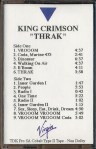
 

1994 Virgin

Just over ten years after the conclusion of the Three of a Perfect Pair tour, a new King Crimson release, featuring a six-man lineup, hit the streets, to much rejoicing. But back up. In 1993, Robert Fripp recorded and toured an excellent album with David Sylvian. Sylvian fronted new wave act Japan, after the demise of which he created some very cool, hard-to-classify downtempo solo albums. A Japan reunion in 1990, under the moniker Rain Tree Crow, did not fly. Robert Fripp had played on an earlier Sylvian solo album (Gone to Earth from 1986) and the new collaboration was successful. The band for the album featured bassist Trey Gunn and drummer Jerry Marotta. (Marotta and Fripp previously worked together on Peter Gabriel’s second solo album and Fripp’s Exposure.) Marotta, however, wasn’t able to tour the album. Enter session percussionist (an ex-Mr. Mister drummer) Pat Mastelotto. Check out this article in which Pat recounts flying to England from California on his own dime to audition for the gig.

At the conclusion of the Sylvian/Fripp tour, Fripp regrouped the King Crimson, augmenting the early 80s quartet of himself, Adrian Belew, Bill Bruford, and Tony Levin with Gunn and Mastelotto. The expanded lineup creates a more interesting sound for certain, though still most definitely Crimson. The first release of this line-up, the Vrooom EP introduces the new four-man rhythm section, an intriguing platform for the interplay of Belew’s and Fripp’s guitars.

Four of the six tracks would be reworked for the full LP release, Thrak. Cage and When I Say Stop, Continue only appear on Vrooom.

Despite the 10-year gap, there’s no grand departure from the earlier sound, save for a greater emphasis, I think, on the intense instrumentals. The 1981-84 quartet didn’t record anything new that had the sheer intensity of the songs Red, Fracture, or Larks’ Tongues In Aspic Pt II. Fripp made a return to this style in the songs Vrooom and Thrak, the latter forming the basis for many of the Thrak tour’s live improvisations. These sonic onslaughts are balanced with the ballad One Time and the funky Sex Sleep Eat Drink Dream which can be seen as descendants of songs like Two Hands and Sleepless respectively.

The Thrak album expands on this balance of the noisy and the quiet. It also features two of KC’s most beautiful tracks, Walking On Air and the aforementioned One Time.

Vrooom opens the album, the arrangement from the EP now divided into two parts, the second bearing the unwieldy title Coda Marine 475. I’ve always been confused that the second song of an hour-long cycle has the word Coda in the title, but there you are. Dinosaur is something of a pop-metal hybrid, like Sleepless or Thela Hun Gingeet, I suppose. Straightforward(ish) lyrics from Belew, ‘I’m a dinosaur, somebody is digging my bones’ might be an attempt to head off judgement of what the band are doing 10 years after their last album, and 25 after their first. (Noting that this is the 50th year of KC, this might be premature.) The song has the sort of soft-loud dynamic that Kurt Cobain (just a few years before) said Nirvana nicked from the Pixies, but it’s also a microcosm of the album as a whole.

Next is the ballad Walking On Air. Belew’s plaintive alto weaves what might be a love song. It’s Crimson, so you can never tell, but it’s one of the two or three most beautiful songs in their catalogue.

The instrumental B’Boom follows. After a short introduction, percussionists Bruford and Mastelotto go head to head. This is the first time KC had had two percussionists since that brief period around the recording of Larks’ Tongues In Aspic and this kind of interplay in Crimson got lost again after this album until Fripp regrouped with three drummers in the front line. The song, at least in its title, brings us back to a long improv performed on the LTIA Tour at the Zoom Club called Z’Zoom. (Note that the Zoom Club gig also included two more improvisations: Zoom and Zoom Zoom which together run for over an hour. The band might be referring back to them in the tracks Vrooom and Vrooom Vrooom. I might have to delve back into that recording.)

The title track, an intense and difficult metal epic follows, oddly reflecting the progression on LTIA from The Talking Drum into Larks’ Tongues In Aspic Part II. On the tour for this album, Thrak formed the basis for many extended improvisations. I’m not sure if I’ll delve into the Thrakattak album, which is comprised of several of these live improvs. I’ve tried before, but it’s an endurance test, sort of like listening to all four sides of Lou Reed’s Metal Machine Music without a break.

Thrak concluded side 1 on the cassette release which makes sense. The second half of the album is balanced as a suite between the two parts of Inner Garden, Radio I and Radio II, three pop songs, and the concluding iterations of Vrooom (Vrooom Vrooom and Vrooom Vrooom: Coda).

Inner Garden I and II, are short, nearly a cappella, vocals from Belew. The first leads into the very funky People, in which Trey and Tony battle out the bass line under a lyric that’s not too far removed from Foreigner’s Women. (‘People bowl, people rock, people pay to see two people box’ vs. ‘Women behind bars, women in fast cars, women in distress, see that woman with no dress.’ You be the judge)

Unlike Walking On Air, One Time is a little harder to grasp lyrically, but Adrian’s vocal is lovely and he doesn’t reach for anything beyond what the song calls for. It’s bookended by Radio I and Radio II which a reminiscent of the dissonant Ligeti pieces used in 2001: A Space Odyssey.

The vocal portion of the album concludes with Sex Sleep Eat Drink Dream, another slice of funk. Listen, what I’m calling funk is probably unfair to both the funk genre and to KC’s progressive metal leanings. This song and People may simply be funky because the bottom end of the songs is emphasised whereas in other pieces on the album, the guitars take precedence. Lyrically, it’s a bit of a word salad, but it’s prog, so that too is okay.

The album concludes with Vrooom Vrooom, a restatement of the Vrooom theme, and Vrooom Vrooom Coda which takes the high end of Coda Marine 475 and turns it inside out. It’s a really odd piece to conclude the album on, but it’s as musically intriguing as just about anything else here.

As I often do when writing these reviews, I’ve listened to the album pretty constantly for the last several days and have become more and more impressed with both the compositions and with the composition of the album as balanced halves. As a CD listener, the balance of things was lost on me when the album came out. I can appreciate what the band were after, even though in the decade since Three of a Perfect Pair, the LP format had slipped away.

I give it four stars.

Next up: The ConstruKction of Light.

Where the Dark and the Light Mingle, the debut album from San Francisco’s Gutter Swan, is a song cycle of covers from across what might be called the Americana tradition. Themes of yearning run through all of the tracks, tinged with the seduction and aftermath of indulgence.

The arrangements are deceptively simple. Loryn Barbeau employs the slightest twang in voice which suits the song choices well. Guitarist Steve Egelman pulls gorgeous melodies out of a six-string.

Wayside/Back in Time and Oxycontin Blues (and later in the album the medley of Carole King’s Way over Yonder and Joan Osborne’s Saint Theresa) delve into the desire to be back in a time before addiction took hold. Simple Man gives us just the heart of the rocker from Lynyrd Skynyrd debut album, transforming the plea for a child’s happiness almost into a prayer. Appropriate given the line, “All that you have is your soul.”

All that need be said of C’mon Billy is that Loryn and Steve do PJ Harvey proud.

The first of two Richard Buckner covers, Oscar Hummel, features another straightforwardly beautiful vocal that belies the violence of the lyrics of a lost traveler who mistakenly finds the home of his enemy. (A search reveals that the lyrics are from Edgar Lee Masters’ Spoon River Anthology, a collection that consists of stories told on headstones.)

This is followed by Beekeeper, a song possibly narrated by a less dead Oscar Hummel ‘You all say I’ve crossed a line, but the sad fact is I’ve lost my mind…All I want is to be left alone, tact from me is like blood from a stone.’

I’m not sure I have a favorite track on the album, but Vocal (supplied by Norwegians Madrugada) is the tale of a possible suicide to which Loryn brings these breathless phrases. Just listen to how she sings ‘Dare not walk through the liiiiight,’ in which light is both salvation and death, howled and then almost whispered as the song ends. *Shudder*

The headlong rush into desire and addiction is best expressed here by their approach to TV on the Radio’s Wolf Like Me. The harmonies in which our narrator is a (were?) wolf seducing red riding hood balance on some sweet fingerpicking. The faster pace on this song is a nice balance to Vocal’s near dirge-like pace.

Way over Yonder/Saint Theresa positions Saint Theresa, another song of an addicted hooker longing to be on the other side of whatever life is offering against a more ambiguous longing for a simple escape. Way down in the hollow is a long way from Way Over Yonder.

gs-wtdatlmWhere the Dark and the Light Mingle concludes with Richard Buckner’s Desire, in which our narrator is done with their last partner, having said too much and too drunkenly, ‘shot my insides out with grief and Mr. Kessler’ and just needs to hit the road. Fed up with life and death and lust and addiction, the road beckons.
Gutter Swan’s two members capture the gauntlet of life, death, love, need, and bit of the supernatural, and so many of the various ways we subvert and support these things. As a collection of songs that work individually, the album succeeds, but it excels as a story. Folk blues, country, singer/storyteller songs woven together. Using such disparate and desperate sources makes something far more compelling than the individual tracks.

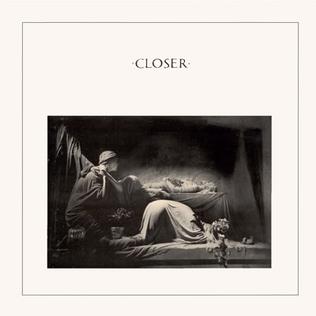
This past weekend included a listen to Joy Division’s Substance (1988) and continued reading of bassist Peter Hook’s Joy Division memoir Unknown Pleasures. I first heard Joy Division in 1987 when I went out record shopping with my friend Natalie. She and I had a lot of overlapping tastes, but she was a proper goth and I was just into the music. I knew a lot of Joy Division-adjacent stuff, but hadn’t heard anything by them. She recommended their second album, Closer. I was 20, living in San Francisco, and (as I would for several years) spent a lot of my time not processing my father’s death the previous year. I was hard to reach and generally hard to communicate with. The thing Joy_Division_Closerabout Closer, and JD in general for me at the time – I knew a little of the history – I’d even seen New Order (the band formed out of the remains of Joy Division) perform. That would have been in 1985 at the Santa Monica Civic – hadn’t heard any of their music prior and the show was boring – listening to live recordings from that period now – yeah, they were a dull live act). I recall playing this album a lot that year, and feeling all kinds of despair associated with it, primarily because I knew of the untimely death of lead singer Ian Curtis. One of my flatmates at the time told me it was familiar and asked if he would have heard something else by the band. It’s possible, I probably told him, but this tastes and mine were quite different. Yeah, I listened intently to Closer, but I didn’t know (yet) their biggest hit, Love Will Tear Us Apart, which was a little weird. But this was before someone could send you an email saying ‘you’ll like this song’ and before you even read the next sentence, you could be listening to the song.
So, yeah, Lawrence probably had heard Joy Division before me, though hipster that I was, I was loath to admit it.

Anyway, Closer threw me into a funk that was hard to escape but I was compelled to listen to it more and more. I bought Substance the following year and found that I especially liked the post-punk stuff (Atmosphere, Love, Dead Souls, These Days), but really didn’t know what to make of the earlier, punkier tracks. Later I’d buy the Short Circuit compilation (which includes At a Later Date recorded when they were still a punk band called Warsaw) on the same day I purchased Iggy and the Stooges’ Metallic KO. The following week, a friend told me the apocryphal tale of Ian Curtis committing suicide on the eve of Joy Division’s first American tour because he believed they’d never make a record as good as Metallic KO. A cursory search indicates that Curtis played Iggy Pop’s The Idiot and watched a Herzog film before taking his own life at the age of 23. His epilepsy wasn’t a secret to those nearest him, though in the late 70s, people didn’t know so well how to be supportive of an epileptic friend.

Hook notes that everything Joy Division recorded was classic – something he credits to band chemistry, youth, and Curtis’ lyrical brilliance. With this in mind, I can probably say that everything JD recorded , especially after An Ideal For Living, supersedes everything on Metallic KO (much as that document of two late shows from the original incarnation of the Stooges, including their last show in 1974, is brilliant in its own twisted way). Whether JD’s work supersedes The Idiot, well that’s a bit subjective.

Later I would have a huge poster of the cover of Closer on my wall, next to a huge poster of the cover of Aladdin Sane. As usual, there’s no real conclusion to this story. Even the fact that I’m reading Hook’s memoir right now is a little random. I purchased it for the kindle months ago when it was probably on offer for 99p, about what it cost to see Joy Division open for the Buzzcocks in 1979. It simply came up when I was scrolling through to find what next to read.

I’d heard of Performance from a couple of different angles. I knew Jagger’s Memo From Turner came out of this movie, and I knew a couple of samples nicked by Big Audio Dynamite for the song E=MC2, which is itself an odd musical tribute to Roeg’s work.
The film is both a continuation of the gangster dramas that had been coming out since the 30s and an influence on movies that came later including In Brugges and Lock, Stock, and Two Smoking Barrels.
The plot has a fairly straightlaced gangster, Chas, going to ground after he kills his boss’ new protégé without authorisation. There’s an interesting subtext going on that his boss and those higher up in the organisation are middle-aged queens while Chas is not only straightlaced, but decidedly straight. Through a turn of luck, Chas overhears of a room in Notting Hill Gate from a musician going on tour who has left his gear and some unpaid rent. Chas shows up at the address and pays off the debt in return for the room. Visiting Notting Hill in the late 60s is quite odd, because the lower-class neighbourhood of that era is full of million quid houses now. Those self same houses.
Mick Jagger plays the house’s owner, retired rock star Turner. In the course of Chas’ stay in the house with Turner and his two lovers, Pherber, played by Keith Richards’ girfriend at the time, Anita Pallenberg (RIP), and Lucy, he discovers a situation that is decidedly Bohemian and sexually open. In order to get into his head, Pherber and Turner dose Chas with mushrooms and from there the movie takes a distinctly psychedelic turn.
Another place I heard of this movie was in conversation with Coil’s Jhonn Balance. I was lucky enough to chat with him after Coil played in Prague in 2002. My friend Chris asked him what the source of the sample ‘We must go further back. Further back and faster’ was from. (The track Further Back and Faster is on the 1991 album Love’s Secret Domain.) Balance referenced this movie and talked about Roeg for a little bit before we moved on to talking about Derek Jarman movies. So this film has been at the back of my mind for over 15 years. Queerness and queer identity were very much at the heart of Coil’s musical identity and the queerness of those who have authority over Chas is not a lost plot point. Chas holds enough fascination for Turner that he feels the need to defend himself from what are fairly subliminal advances on Turner’s part.
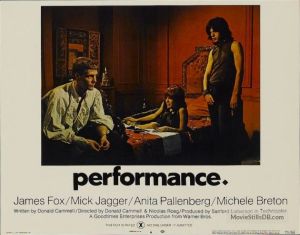
performance-lobby-card The fascination for Balance in this movie possibly included what was essentially a music video inserted in the midst of Chas’s mushroom trip. When Jagger lip syncs Memo From Turner in the offices of the gangsters Chas reports to, it’s not clear who’s experiencing what, but it’s interesting that when the movie was made, the queerness of both the song and the action in this sequence is quite matter of fact. That Chas rejects unspoken advances, as well, is (I think) meant to be interpreted as a shortcoming on his part.
This was not without controversy at the time. The studio refused to release the movie for two years due to graphic sex and violence. My first thought on reading about that was that I’d love to know what the Memo from Warners actually pointed to as problematic. By more recent standards, a few killings and a little sex are considered PG-13 fare by the MPAA, but there are two graphic scenes of gangland violence that were probably more shocking then than they’d be considered now. And unfraught sexuality between two women was also quite shocking. Imagine my surprise to find the image accompanying this review. Initially it was either given the X rating or the studio simply assigned the film an X rating. (Note: All of the other MPAA ratings are trademarked. Only the X rating can be used without MPAA authorisation. I think the idea was that the MPAA didn’t actually want to assign ratings to porno. Porn studios could take the rating and the limited release associated with it. On the other hand, in the early days of the ratings system, movies like Midnight Cowboy and Bilitis which had non-pornographic inclinations could take the rating and the artistic freedom that came with it.)
Regular readers might take my opinion of Chas’ response to Turner’s interest as hypocritical. Didn’t I just recently write that the correct response to the possibility of homosexuality in an interaction should be ‘not a problem’? What’s the difference here? The storytellers of Ready Player One were positing that the homosexual angle was to be avoided where presented. In Performance, however, the storytellers suggest that Chas’ rejection of the possibility is part and parcel of Chas’ rejection of life as a whole.
The ending of the film confused me and the friends with whom I saw the movie. It wraps up rather quickly with the viewer being not quite sure who lives and who dies (despite the writers at Wikipedia seeming very certain of themselves). That said, the movie’s seedy opulence, spot on performances from all concerned, and excellent soundtrack earn this goody four stars.