Archives for category: Rock

So Sunday night’s adventure (as you might have noticed) was the last three acts on the Southern Lord Records Fest at Melkweg, Magma, Unsane, and of course Sunn O))) (being the folks who started and run Southern Lord).

Magma are curious blend of jazz and hard progressive rock. Under various lineups that have only the constant of drummer Stephan Vander, they’ve been doing the work since 1970. Interesting and compelling stuff.

sunn_melkwegUnsane are one of these crews I wish I’d gotten into a long time ago. They’ve been on the circuit for almost 30 years. Hard and sludgy, Unsane have musical elements in common with early Nirvana and Big Black and to a lesser extend The Melvins. When you get folks who’ve been doing the work together for almost 25 years (the current line-up solidified in ’94), there’s a joy in hearing and watching them lock together. (Note to San Francisco / Bay Area friends: Unsane will be at Bottom of the Hill on 1st December. You should go.)

Sunn O))) are a different thing altogether. They perform more as ritual than as rock and roll. The fog, the volume, and the robes the band members wear contribute to this vibe. Vocalist Attila Csihar took center stage and, for want of a better word, intoned for about ten minutes to increasing volume and fog before the other band members (guitarists Stephen O’Malley and Greg Anderson, and two people working keyboards.) For all the flowing of the sound between the instruments and the vocalists, it seems to be a pretty tightly constructed set these days. (Alas, while I recognised various pieces, I couldn’t tell you what they’re titled.) I’ve seen them once before, at Paradiso on the Monoliths and Dimensions tour and the most interesting aspect of the gig was noticing a brass instrument on the stage and being afraid of what they might do with it. (The volume at a Sunn O))) is such that you both hear it and feel it in your bones.) I don’t recall that anyone did anything more than brandish it. There was a trombone stood next to one of the keyboardists, stage left, and it added a lovely counterpoint to one of the pieces. However, as with last night’s gig, I had to leave early not to be on the very slow train back to Leiden. One of these days I will witness one of their gigs to its conclusion. All in all, a great set.

Sadly, I rushed out in order to make my train and didn’t stop at Unsane’s merch counter at all. And I didn’t have my wits about me at Sunn O)))’s. I bought a t-shirt and a vinyl copy of Kannon (their very beautiful 2015 release). I should also have bought a vinyl copy of the 2008 live album Domkirke.
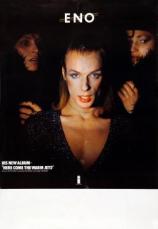
Brian Eno – Here Come The Warm Jets – 2017 half-speed master reissue.
When I first purchased this album on CD in 2002 or so, I knew three of the songs. Driving Me Backwards and Baby’s On Fire appear on the Ayers/Cale/Eno/Nico live album (which I originally purchased for the Velvet Underground connection, not the Roxy/Soft Machine connections). Album opener Needles In The Camel’s Eye is used over the opening credits of Todd Haynes’ criminally underrated Velvet Goldmine.
eno_jetsAnd there’s a reason Haynes used it: That opening rush of instrumentation (which accompanies a rush of glam-rocking teenagers chasing a pop star) pulls the listener right in. The intrigue doesn’t let up through the album’s 42 minutes. Lyrically, it’s almost all (in the words of Blank Frank) incomprehensible proverbs, but musically it’s a gorgeous grab-bag of styles, the way the best glam albums were back in ’73. This new remastering does a wonderful job of separating the musical components so that you can hear the strange fuzzed out guitar on the title track as something separate from the drums, keyboards, and the vocals (which are still too indistinct to figure out).
Aside from those songs, I mostly knew Eno for a lot of non-pop work – ambient work like Tuesday Afternoon (and Music For Airports), production jobs (U2, Devo, Bowie), and his collaboration with David Byrne, My Life In The Bush Of Ghosts. And as I write that, I realise I knew bits of 801, Bauhaus’ cover of Third Uncle, and a good bit of the first Roxy Music album. I’m pretty sure I bought Roxy’s debut the same day I acquired Warm Jets and, for the same reason – a bunch of its songs are used in Velvet Goldmine as well.
I wish I could be more articulate, but there’s nothing about this album’s 10 tracks that isn’t insanely cool. Occasionally I find myself annoyed with albums on which each track is faded out, as if neither the musicians nor the producer knew where the song ended. HCTWJ is the opposite – every track knows what it’s doing – there are crossfades between songs – like how Some Of Them Are Old weaves right into the the title track at the end of the album. On Some Faraway Beach (the original opener of side two, here the opener of side three), a slow piano-based track which ends abruptly on a strange but clear keyboard run is followed by rocker Blank Frank, but the transition between them has always felt absolutely purposeful to me. Blank Frank is another revelation here in terms of the clarity of the instruments. Keyboards and drums and guitars all seem to be in competition, but they’re all winning. Oddly, this song does fade out, but over only five or six seconds. The martial drums that anchor the next track, Dead Finks Don’t Talk (apparently a kiss-off to Bryan Ferry) work their way through some very strange guitar work before surrendering to a blast of distorted synthesizer which concludes just where it needs to.
Two thumbs up. Go buy it.
(Eno’s other three mid-70s rock albums, Taking Tiger Mountain (By Strategy), Another Green World, and Before and After Science have also been reissued on vinyl with the half-speed master treatment. I’m sure those are tasty too, but I don’t love those albums quite as much as I love this one.)

After two pretty flawless major label releases, 1985’s Oil & Gold and 1986’s Big Night Music, Island Records wanted a hit. At the time, I’d heard some of their music but nothing I could have identified as them. Go Bang! came out several months before I moved in with a flatmate who played me the glory of Oil & Gold. I don’t think I heard Big Night Music until about 1991. So really, I knew of them by reputation only. I was working at Rainbow Records on Stanyan and the store manager was very keen on hearing it the day it came in. I recall feeling the affair was all too disco (which I definitely did not appreciate for another ten years or so), not helped by the first single, a mostly faithful cover of KC and the Sunshine Band’s Get Down Tonight. I’m pretty sure the manager was disappointed too.

As they’re touring this year for the first time in forever, I’ve started to dig into the catalogue. Go Bang! is the only album I didn’t have in some form or another and which isn’t available on Spotify. Four quid and a week in the post, and some fine Amazon seller has me taken care of. Whereas Oil & Gold is balanced about half and half with hard tracks like Nemesis and softer tracks such as The Only Thing That Shines, and Big Night Music tends very much to the jazzy, Go Bang! is almost entirely hard dance music. Only Nighttown and the closer, Dust and a Shadow hint at Shriekback’s downtempo tendencies.

It’s not as though the album isn’t recognizably Shriekback, though. Producer Richard James Burgess (Spandau Ballet’s Journeys to Glory, Adam Ant’s Strip) has maintained most of their signature sound – Barry Andrews’ tenor augmented with the female voices heard on the previous releases, the bass. Even going back to their stripped down earliest releases, the bass and the funk were always prominent

s-gbLyrically, side one has more of the depth found in their earlier work. I can’t really tell if they arranged the tracks for LP release or CD, but major releases still came out on vinyl at the time. After Nighttown, side two has the disco 1-2-3 of the title track, Big Fun, and the aforementioned KC and the Sunshine Band cover. Big Fun has big horns and lyrics about going out and (long before Daft Punk) getting lucky. The chorus of Well-e-o, well-e-o here we go / We got a bite like a pit bull yeah we don’t let go / Well-e-o, well-e-o under the sun / Everybody looking for…big fun doesn’t really suggest the seriousness of purpose the band was known for. On the other hand, the bass and the brass are used to good effect. Even considering the lyrical silliness of Big Fun, the only real embarrassment of the album is the rap that Andrews injects into Get Down Tonight. (All one can say is that it was a thing at the time.)
Dust and a Shadow very much harkens back to the sound of Oil & Gold, to the point where back to back, it sounds like a brasher but inferior reworking of This Big Hush.

At a meagre 32 minutes, it’s a sugary and tasty confection, but not the perfection found in their other work.


I don’t recall why I first bought The Age of Plastic by the Buggles. I might have heard Video Killed The Radio Star; it might have been because I knew the Yes connection, though I’m pretty sure I knew the album before the Drama tour (which my sister saw, but I did not). Al of that said, it had a huge impact on me. I played it quite a lot when I was 13 or 14. I’m quite sure I knew it well before we had MTV. Those eight songs were all mini movies in my head, the way the best pop is. (One track is indeed about a real movie studio, Elstree.) The fact that they’re all quite sci-fi as well appealed to my teenage literary tastes.

Much later I found the Bruce Woolley version. Woolley co-wrote it with Trevor Horne, and released a more guitar-heavy version with a crew called The Camera Club, which also featured a pre-Age of Wireless Thomas Dolby and Matthew Seligman. The most recent issue of Mojo (#283) has interviews with Woolley, Horne, and Geoff Downes who was the other half of the Buggles. At the close of the article, it’s mentioned that Woolley has recorded a new version with Polly Scattergood. It’s a very beautiful, slower, lower interpretation that reminds me of why the original excited me so much when I was a kid. (Keep an eye out in the vid for Thomas Dolby.)

After replacing Jon Anderson and Rick Wakeman for one album (Drama) and ill-fated tour (Horne didn’t have Anderson’s range or vocal stamina and on the later dates especially, his voice was a liability), the Buggles released a second album, Adventures In Modern Recording, but had already gone their separate ways before its release.

Horne went on to produce a stack of classic albums (Welcome to the Pleasuredome, The Lexicon of Love, 90125, Seal, Dear Catastrophe Waitress, and Who’s Afraid of the Art of Noise to name a few) and Downes founded Asia and took prog rock into that weird 80s pop direction. Asia’s a weird animal, too. Downes was the only consistent member (in fact there was one lineup of Asia that even he wasn’t in on) of almost 30 who have passed through, but at different times it was fronted by John Wetton and Greg Lake (both ex-King Crimson among many other bands).

When John Wetton passed away, I flitted through a bunch of videos of ELP and Asia and King Crimson and came across a fantastic concert he and Downes performed in a church which featured a gorgeous arrangement of Elstree. (Track four on this video.)

But back to The Age of Plastic. Giving it another listen now (and it’s a pretty consistent part of my listening – I don’t think a year goes by that it doesn’t come up in the rotation), I’m both 13 again and trying (as I still do with the music I love) to get my friends to hear its brilliance, and the 50 year old wannabe rock historian. More often than not, my friends thought I was enthusing on The Bugaloos, anyway.

The music is almost entirely keyboard/synthesiser-based, but the arrangements are impeccable and multi-layered. Considering the new wave acts of the time, the arrangements put them more in the category of disco (when there were still live string sections) and the intricate productions of Joe Meek. Johnny On The Monorail has both a disco bassline an almost a surf-like hook, and a 70s folk guitar bridge.

Horne is quoted in the album’s wikipedia page as having wanted to make music like Elton John was doing, but didn’t feel he had the chops. He then heard Kraftwerk and learned ‘you didn’t even have to emote’ to make hit songs. That said, all of the musicians had been working for most of the decade (Downes, Horne, and Woolley all worked with a singer named Tina Charles who had several hits, for example), so it’s not a surprise that the album has so many facets. It still rates five stars with

A stronger effort in many ways than Trisector, but more lyrical weakness. Lines like ‘Mathematics / Just so “wow” it brooks belief’ (from track 2, ‘Mathematics’) are more common than one would like to admit. On the other hand, there a lot of musically strong numbers – track 3, ‘Highly Strung’ is one of those – Hammill, Banton, and Evans seem to be finding their places as a trio in a way that wasn’t evident on Trisector (even though the three had been playing together for decades).

Opener, Your Time Starts Now, is almost theatrical with sweeping organ fills, and big concepts about how the addressee hasn’t been getting on with it, but now must.

vdgg-agin-cdIt’s a poppier affair, at least in terms of song length. Five tracks clock in under three minutes; only four break five; and only one breaks six.

Snake Oil certainly speaks to the current dystopian zeitgeist, ‘Brainwashed and bound to believe in the orthodox text, slogans on t-shirts, / the punters can’t wait to be told
what to think of next’, from a slightly different angle to 2005’s Every Bloody Emperor.

Side note – I posted that song on FB last week and my mother shared it out. If even my mother (who loves Leonard Cohen, but otherwise listens to musical theatre, classical music, and a lot of NPR) would give Van Der Graaf a try, what would it take to get that song up on the charts?)

Smoke has a funky keyboard opening that slides in and out of something nearly disco (in a good way), but after slipping into something even weirder, they decided not to take it very far. Despite the line ‘You held your inattention’, two and half minutes is as far as they decided to take it before segueing into 5533, another song ostensibly about something mathematical (‘As the primacy of digits ticks the boxes / So the codes that they unlock begin to run’).

A Grounding In Numbers closes with All Over The Place, which might be as good a title for the album as the one they used. The longest track on the album, it leads with a nice harpsichord melody (that might be a counterpoint to the organ of Your Time Starts Now) but the whole song is still a little piecemeal, like they felt they had to do something proggy and multi-sectional.