Archives for category: Rock

Having finished A Dylan A Day a few weeks ago, there was a request to take on A Van Der Graaf Generator A Day.

Here’s the first: AVDGGAD 01 – The Aeresol Grey Machine (1969)

Main man Peter Hammill made much of his reputation as a guitarist, so it’s a little odd that this first VDGG album is so keyboard heavy.

Lyrically, the whole album is something of a mindfuck. Here’s an almost but not quite track-by-track…

Orthenian St. is ostensibly about an averted accident on an icy road. Part I closes with a nice Neu-like repetition (yes – I know that Neu! came later) before slipping back into folk-prog. The same motorik feel comes back around at the end of part II

Running Back has some nice flute going on and studio echo that reminds me of what Jonathan King did on some of the tracks on the first Genesis recordings. Its lyrics seem to be about a relationship the narrator has returned to after trying to leave.

The much harder Into A Game has the narrator pushing a partner away who is trying to return (Now we’re into a game / And it’s all a bit strange / But familiar too / The rules never change / I know it, but do you?). Its closing features some nicely improvised jazz piano.

Now this is the place where listening to a continuous medium such as a CD (or single track video) shows up how different it was to listen to a recording with two sides. Side B opens with the title track, a 47-second music-hall takeoff reminiscent of I Want To Marry A Lighthouse Keeper (used in A Clockwork Orange, but probably not an influence on the later VDGG track A Plague of Lighthouse Keepers). It just sounds really weird coming after Into A Game. The jarring is similar to that produced by Sergeant Peppers’ side 2 inner groove and the alarm at that follows The Wanderer on U2’s Zooropa.

vdgg-agmSide two is otherwise dedicated to the kind of lyrical mythology that prog and sub-par fantasy novels became famous/infamous for. Aquarians and Necromancer both have silliness like ‘My form is mystic, but my heart is pure / You’d better believe what I say / I am the Necromancer’, but particularly on the latter, the drumming and synth work are quite intriguing.
Octopus is a little less like that, but is still an interesting example of early prog rock.
The version of the album I found on Vevo is taken (I think) from the German reissue which closes with The People You Were Going To and Firebrand. The first of these is an odd address to another person much like Running Back. It’s more of a straight up folk rock piece than what otherwise populated side two. On the other hand, Firebrand is most definitely another one of those heavy keyboard, heavy mythology pieces of fantasy rock. The vocals are histrionic and the lyrics…well, the chorus goes like so:
“I ride an icy stallion, fire at each end
and poison at the centre;
you won’t hear my words as I scream into the darkness:
his plans are like a firebrand,
his plans are like a firebrand.”

The closing of the song makes reference to a couple of folks named Njal and Hildiglum. I had to look them up – they come out of an 10th century Icelandic saga. Much like Peter Gabriel did with The Fountain of Salmacis a couple of years later, Hammill seems to have lifted the lyrics nearly wholesale from the older text.

All in all, quite a satisfying album, though I think I’d prefer to have heard just the album either as it was released or as it was sequenced by the band. I give it ****.

Setlist:
Larks’ Tongues in Aspic, Part One
Pictures of a City
Meltdown
Hell Hounds of Krim
The ConstruKction of Light
Banshee Legs Bell Hassle
Easy Money
Level Five
Epitaph
The Talking Drum
Larks’ Tongues in Aspic, Part Two
Starless
E: In the Court of the Crimson King
E: 21st Century Schizoid Man

As with most previous incarnations of King Crimson, the latest is a lineup of insanely talented musicians. In this case, the band is trying to take on the aspects of its entire history. Noting that Crimson is whatever guitarist and bandleader Robert Fripp says it is, it’s impressive to see and hear them incorporate several tracks from the band’s 1969 debut, In the Court of the Crimson King. The title track, added on this tour hadn’t been performed by the band since 1971; 21st Century Schizoid Man wasn’t played by the 80s incarnation, but has been a mainstay since the Thrak tour in 1996. (I saw them on that tour in Berkeley and Adrian Belew introduced it saying ‘I don’t think we’ve played this here before.’) Epitaph was added to the set last month, having not been performed since the initial tour for the album in 1969.

At the other end of the timeline are tracks from the final studio albums of the Adrian Belew-fronted editions of the band, an instrumental version of the title track of 2000’s ConstuKction of Light and Level Five from 2003’s The Power to Believe (between 2003 and 2010, there were a couple of tours with Belew and line-up changes, but no albums), and new pieces Hell Hounds of Krim and Meltdown.

While the renditions of Epitaph and Crimson King were both faithful, and sound very much of their time, Schizoid Man, with its combination of improvisation, treated vocals, and heavy guitar has always been the earliest example of jazz metal. Pictures of a City dates from 1969 as well, though it didn’t appear on record until the following year’s In the Wake of Poseidon. This is the only other track from King Crimson’s early progressive period in the set. The three albums that followed Crimson King all featured Mel Collins on saxophones and flutes, and the current tour is the first Collins has played with the band since 1972. (Not that he hasn’t been busy enough – his CV includes work with Camel, Roger Waters, and some Crimson-related acts including 21st Century Schizoid Band.)

The heart of the set, for me, were the pieces from the ’72-’74 golden age. Following the tour for 1972’s Islands, Fripp disbanded the group (one could cite ‘creative differences’), only to reform it a few months later with two percussionists, Bill Bruford from Yes and an absolutely insane bloke named Jamie Muir; John Wetton (bass/vocals); and David Cross (violin/mellotron). The three albums recorded by variations on this lineup, Larks’ Tongues in Aspic, Starless and Bible Black, and Red are classics, recently reissued in 15+ CD sets that include as much related live material as the band have in their archives. Following Red, there was no tour as Fripp disbanded the crew again. (This time it had a lot to do with an absolutely lousy record contract – lousy even by the standards of the time, from what I’ve read.)

Between ’74 and about 1980, Fripp appeared on a number of projects – producing Peter Gabriel’s second solo album, his own solo album Exposure, projects with Brian Eno, David Bowie’s Heroes album, Talking Heads’ Fear of Music, and a crew called The League of Gentlemen (with Sarah Lee who would join Gang of Four and Barry Andrews who was between XTC and Shriekback). LoG recorded one album in the runout groove of which was etched ‘The Next Step is Discipline’. Discipline was to be the name of Fripp’s next band which consisted of Fripp, Bruford, Tony Levin (bass, about whom more below), and Adrian Belew (guitar/vocals). When it came down to it, Fripp decided this was the next incarnation of King Crimson and retained the name Discipline only in the title of that lineup’s first album.

Belew is a gregarious character whose had already worked with Zappa, Bowie (the Heroes tour and Lodger album), and Talking Heads among others. He fronted the various lineups of KC between 1981 and 2008. These included the three different lineups that recorded Discipline, Beat, and Three of a Perfect Pair between ’81 and ’84, Vrooom and Thrak in the mid-90s and The ConstruKtion of Light and The Power to Believe between 2000 and 2003. Fripp decided he was after something else with the new group and did not invite Belew along. Oddly, Belew has fronted The Crimson ProjeKct with all six members of the Stick Men (Levin, Mastelotto [about whom more below as well], and guitarist Markus Reuter) and The Adrian Belew Power Trio. These shows leaned heavily on the 81-84 material as well.

The title track of Red, another piece of proto-heavy metal, and Larks’ Tongues in Aspic Part 2 were mainstays of KC sets from the 1981 reformation onward, but Starless (also from Red, but containing the refrain ‘Starless and bible black’) hadn’t been performed until this tour since the tours that led up to Red’s recording in ’74. The Talking Drum was a mainstay of the double-trio lineup of the mid-90s and briefly in 2008.

The current incarnation of King Crimson is an interesting bunch. Fripp as always seated upper right on guitar. Next is Jakko Jakszyk on guitar and vocal. Jakko has worked on an large number of projects since the early 80s including stints with Level 42 and Tom Robinson and work with a pre-Porcupine Tree Gavin Harrison. In 2001 he joined with members of the earliest KC incarnations to form 21st Century Schizoid Band. In 2010 he worked with Fripp on an album that, with contributions from Collins, Harrison, and Tony Levin became A Scarcity of Miracles, which is very much in the KC vein.

Tony Levin on bass and Chapman stick has been in most KC lineups since 1981. He first worked with Fripp on Peter Gabriel’s second solo album (which Fripp produced), and played on Fripp’s 1978 solo album Exposure. Next to Levin on the top row of the stage stood Mel Collins surrounded an array of horns.

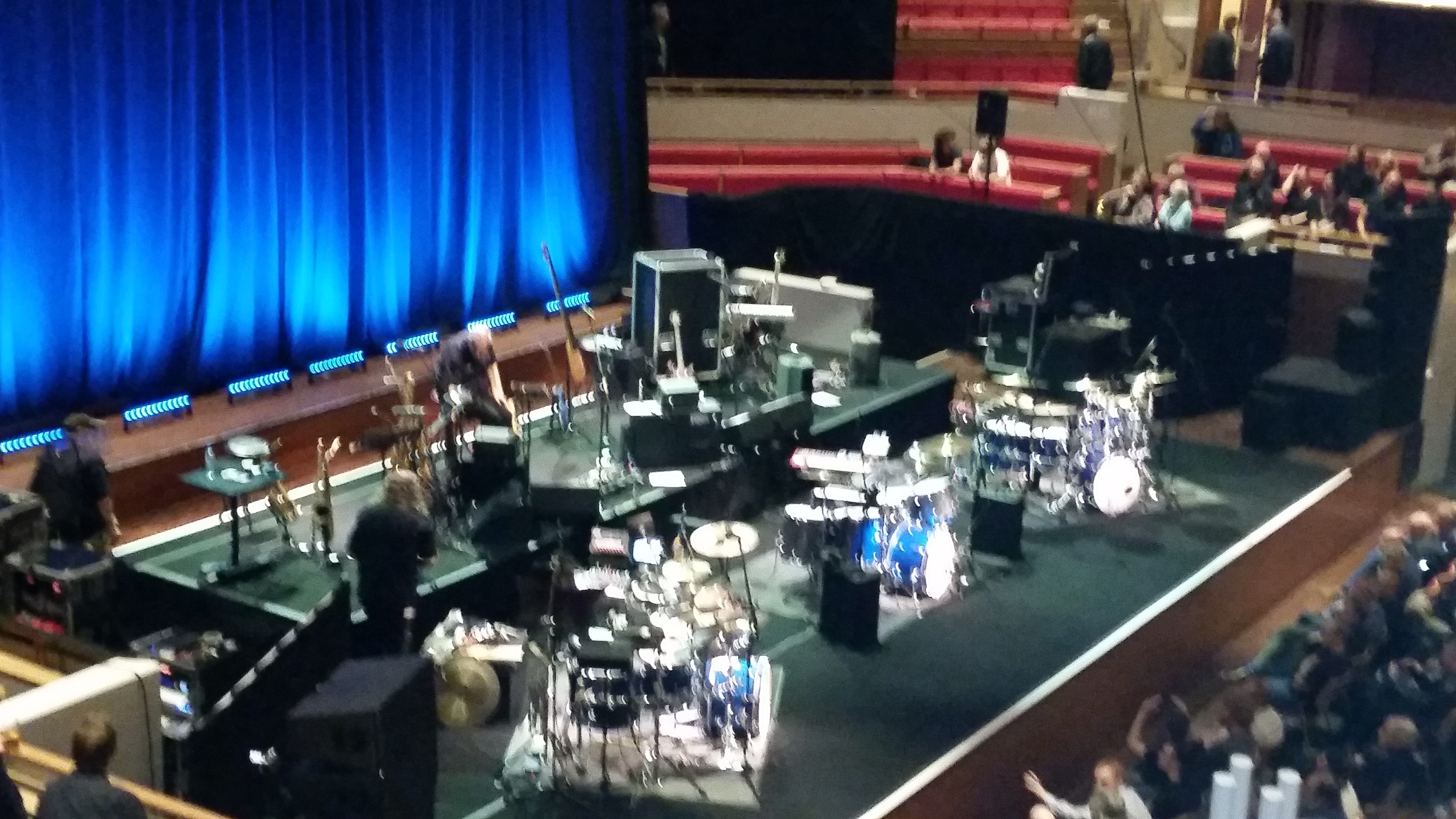
 The front row of the stage on this tour is populated by three drummers. On the left is Pat Mastelotto who has recorded since the early 80s (including as a founding member of Mr. Mister who had two #1s that you might recall). He and Harrison both recorded with Barbara Gaskin in the early 80s. He’s been with Crimson since the mid-90s. Front and centre is one who might be the oddest member, Bill Rieflin. Rieflin is best known in some circles for his participation in a number of 90s era industrial acts including Ministry, Pigface, and KMFDM. However, he was also in The Minus Five with REM’s Peter Buck and took to the drumkit for REM’s last couple of albums/tours. His short-lived Slow Music Project featured Buck and Fripp. And finally, in front of Fripp, Gavin Harrison. At 52, Harrison is the youngest member of the current lineup, and is possibly best known for his membership in Porcupine Tree since 2002. He’s been a professional musician since the early 80s as well and has been in KC since 2008.

Mastelotto is the most physical and almost manic, while Harrison is the most fluid of the drummers. In the opening piece  of the set, Mastelotto took on the crazy percussion work originally done by Jamie Muir. (See this version from 1973 – Muir’s the one with the Van Dyke; Bruford is the one in overalls.) Watching Harrison’s playing is almost like watching water flow. While none of the three is an imprecise player, Rieflin is the most precise in terms of stature and attention. Sitting bolt upright most of the time, he looked almost uncomfortable, but worked with great synergy with the other two drummers and with the rest of the band. The band requested that the audience make no recordings or photos during the show and for the most part this was respected. Alas, the band has been vigilant about taking down videos posted from the tour. Early on, there was a medium-quality clip of 21st Century Schizoid Man that featured Harrison’s gorgeous drum solo. I have high hopes that a professional video or audio recording of this tour will be released sometime in the not too distant future.

In my last entry in this occasional history, I made the claim that the Yardbirds were the most important band of the 60s in term of their lasting influence through the 70s. Why? The main reason is that three of the four most influential guitarists (and possibly musicians) that came out of rock and roll passed through this band: Jimmy Page went on to form Led Zeppelin; Clapton formed Cream, Blind Faith, and Derek & the Dominoes before embarking on a prolific solo career; and Jeff Beck’s technique has been respected and imitated throughout rock music despite a less prolific/critically lauded output following his collaborations with Rod Stewart. Beck’s 70s power trio Beck, Bogart, and Appice possibly matched Cream for sheer brilliance.

Note: Most influential != greatest

The fourth would be Jimi Hendrix. We’ll get to him in a future post.

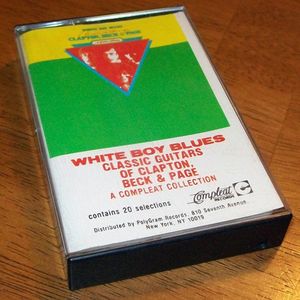
whiteboybluesI also discussed in the last post something of the love these bands had for the old blues artists. What I didn’t know is that many of them played with the blues greats when they toured England. I recently read Ian MacLagan’s autobiography. MacLagan was a keyboardist in a number of bands (including The Small Faces and The Faces (the latter of which featured Rod Stewart on vocals) with whom he’s most closely associated, the Rolling Stones, The New Barbarians, and in the last decade or so, Billy Bragg -Alas he passed away a couple of months ago. MacLagen got his start with an act called The Muleskinners. He discusses first a missed opportunity to back Howlin’ Wolf (the agent told them a date that was a week early and they had to hustle to get enough petrol to get back to London from Sheffield).

“We got another chance to play with The Wolf later though, when Marquee Artists brought him, Sonny Boy Williamson and Little Walter over from the States. As a rule, the Yardbirds backed Sonny Boy, and if they weren’t available, the Authentics got the job. This pecking order for backing blues legends ended when it eventually reached The Muleskinners. We didn’t mind. We were more than honoured to get the chance to meet and play with such fabulous players. Let’s face it, we had a lot to learn and who better to learn it from than the greats?” (All the Rage, Kindle edition, Location 793.) )

Clapton’s path is interesting: He ditched the Yardbirds claiming they were abandoning their blues roots. Fair enough. His tenure in John Mayall’s Bluesbreakers provides much evidence of his dedication to the form. The weird thing is, he took this side trip into psychedelia with Cream. Cream didn’t last long as a band (less than two years, IIRC), but they produced four or five classic albums. Cream’s bassist, Jack Bruce passed last year, though most thought drummer Ginger Baker would be the first to go. As with almost all the songs on Fresh Cream, Bruce supplied lead vocals. Blind Faith only released one, but it’s also six tracks of classics.

Read the rest of this entry »

I gotta say, I had forgotten how good Dramarama’s Cinema VeriteShe's so subliminal was. I bought it in ’86 or so after seeing them open for the Psychedelic Furs at the Warfield. They were the epitome of the absolute cool the 19 year old me could not hope to achieve. Bought the album, taped it, and played it loads. I know I got sick of how much Anything, Anything got overplayed, to the exclusion of so much other good stuff they produced both on this and on subsequent albums. Not having heard it in a few years (possibly only once or twice in the last 12 years – it doesn’t get airplay on NL on CZ radio, as far as I can tell), listening to it again tonight, I hear the brilliance in it. “I got wasted, she got mad, called me names and she called her dad,” captures the immaturity associated with love and desire and how it’s all wrapped up with possession and that desperate ned to hold on to someone captured in the refrain “I’ll give you candy, give you pills, anything you want, hundred dollar bills.”

They married some of the lowlife dinginess of the Velvet Underground’s third album to a sparkling 70s power pop aesthetic.And while Anything, Anything got the airplay, it’s not the only perfect pop song on the album. The pounding tom-toms that open Visiting the Zoo introduce a song of fuzztone guitar artistry that Cheap Trick would have been proud to own.

At a time when the VU were still in legend status – in the mid-80s Lou Reed was still growing up in public and hadn’t made the elder statement of New York – Dramarama closed side A with Femme Fatale, imbuing it with a combination of sadness and bemusement, perhaps at the gap between the warnings to a suburbanite dropped in mid-60s New York and the harder first-person experiences of the originals on the album. (Note that Cinema Verite‘s cover sports Edie Sedgwick, about whom Femme Fatale was written.)

The album’s other cover, David Bowie’s Candidate (an album cut from 1974’s Diamond Dogs) opens the more varied side B. It’s an odd choice, but helps the band lay claim to the glam sensibility that dominates the second half of the album. The piano introduction to Some Crazy Dame reflects that, though the song is squarely in the seedy downtown category, as its subject seems to be a porn starlet (“She’s on camera she’s an actress now / Such charisma on the mattress now”).

When I say the second side has a glam sensibility, I might mean that stylistically, the second side wanders somewhat. Etc’s cryptic lyrics (“30 biscuits on 30 plates / Different colors cause they were made on different dates”) supported by a lead bass line are followed by the almost folk of Transformation, the introduction for which wouldn’t have been out of place on a 70s era Styx or Andrew Gold album, ditto for its guitar solo. All I Want is nearly a proper punk song, whereas the solo acoustic closer Emerald City almost feels like a folk song. The drugged haze of lyrics such as “I’m lost in a sweet dream / I’m living on chocolate ice cream / I’m letting off my steam” indicates that all is still not well

Nearly thirty years later, I still give it four stars. While Cinema Verite, and follow-up, Box Office Bomb are available on iTunes, only the subsequent studio albums are available on Spotify.

You can enjoy all of CV on youtube, however: https://www.youtube.com/watch?v=x59-cFofXu8

More Origins – Sam Philips, Leonard Chess, and the early labels

Remember what I said in the first rock and roll lesson about it being all about cars and girls? The first is why Hot Rod Race and Rocket 88 are important. Rocket 88 is also the first hit appearance by a bloke named Ike Turner. The history books (not to mention Ike’s ex-wife Tina Turner) tell us that Ike was a right bastard. He was, however, instrumental in a number of hits, primarily with Tina.

As Muddy Waters sang, The blues, they had a baby, and they called it rock and roll. We’ve already looked at the proto-rock and roll of the late 40s and early 50s. By the time the 50s really got going, there was the blues-based stuff coming out of Chicago and country-based stuff coming out of Memphis – cities we’re already well familiar with from the birth of Jazz.

Note: Not all of the tracks on the playlist get mention here, but give them all a listen because versions of them show up later in rock history. Start listening here with Boogie in the Park.

Hank Ballard and the MidnightersImportant goodies here are the Dominoes’ Sixty Minute Man and Hank Ballard’s Work With Me Annie because, to be blunt, they’re among the first popular songs to be about sex without masking the matter or making any apologies for it. The Dominoes (whose vocalist Clyde McPhatter later founded the Drifters) and Hank Ballard and the Midnighters recorded for the Syd Nathan’s King label out of Cincinnati. James Brown recorded for King or one of its subsidiaries from 1956 until 1971. (I’ve done a little bouncing around the internet for info on Mr. Nathan. With a name like that, he was probably tribe. This is supported by the notation that he’s buried in Judah Touro, a Reform cemetery in Cincinnati.

The first records released in what became the King group of labels were country and hillbilly records popular with transplants from Appalachia and R&B records sold to blacks who’d moved up from the South. The label was racially integrated, but this seems to be because there were two markets for music product and Nathan was willing to sell to both. I’ve included a couple of Bull Moose Jackson tracks as examples of early hits on the King label. Good Blues Tonight is an interesting take on Wynonie Harris’ 1948 Good Rockin’ Tonight. Big Ten Inch Record will come up again when we look at the hard rock of the 1970s and how much that was influenced by old blues.

Sam Philips had a similar idea to Nathan’s. As I’ve mentioned before, the pop industry has a habit of taking songs by black artists and having white artists perform them. This probably started early in the jazz era, but Sam Philips, the founder of Sun Records (and also the guy who recorded Rocket 88) is also credited with the line “If I could find a white man who had the Negro sound and the Negro feel, I could make a billion dollars.” Theory is, he found that man in Elvis Presley. Alas, a couple of years after signing Elvis, he sold the contract to RCA for 35 grand, and never did so well again. Elvis recorded for RCA for over 20 years, until his death in 1977. And while RCA may not have made a billion off of Elvis while Elvis was alive, over the last 55 years, they might very well have done so.

Sun Records of Memphis Tennessee calls itself the place “Where Rock and Roll was Born,” and there’s something to be said for that. Elvis got his start there. So did Carl Perkins, Jerry Lee Lewis, and Roy Orbison. Orbison left early on because songs like Ooby Dooby weren’t what he wanted to base his career on.

With those names, Philips should have done much better for himself, but lacked, it seems, a certain business acumen.

Big Mama Thornton’s Hound Dog and Junior Parker’s Mystery Train are the original hits performed by black artists that were later early hits for Elvis Presley. Big Joe Turner’s Shake Rattle and Roll was later a hit for Bill Haley.

Another Sun artist, Little Milton, left for Chess records. Based in Chicago, the Chess group (Chess, Checker, Cadet, Argo and one or two others) specialised in blues, R&B and early rock and roll. Howlin’ Wolf, Muddy Waters, Willie Dixon, Chuck Berry, and Bo Diddley all recorded for Chess. Dixon also wrote a lot of the hits for other Chess artists including Muddy’s You Shook Me and Howlin’ Wolf’s Little Red Rooster.

The Chess brothers were Jewish immigrants from Poland who settled in Chicago in the late 1920s, and like Nathan, had no trouble making and selling records of all kinds to all audiences willing to buy. That said, Chess, as you might gather from the bit above, was the home of the blues in the early 50s. Bo Diddley, however, was one of the main progenitors of rock and roll. In recent years, many have referred to ‘the Bo Diddley beat’ that he made popular in songs such as Hey Bo Diddley and that has been used to great effect in rock and roll ever since. One could also argue that Say Man is one of the first hip-hop songs. Its use of the dozens predates the insults traded by rap artists in the 1980s by three decades.

Specialty Records, founded in 1946 out of Los Angeles wasn’t a large label, but a few more cornerstones of rock and roll are found there. Among other folks, Little Richard recorded his first hits there (before his first retirement from rock and roll in 1958 or so).

Founded by Arthur Rupe, another nice Jewish boy (this time from the suburbs of Pittsburgh), Specialty’s releases reflected Rupe’s love for R&B and gospel. Jimmy Liggins recorded Drunk and Cadillac Boogie in the late 40s and you can hear that jump style that Louis Jordan and Louis Prima popularized. Liggins’ brother Joe Liggins also had hits in the late 40s, notably with The Honeydripper. Larry Williams and Lloyd Price had hits for Specialty that were later recorded by the early British Invasion bands including Lawdy Miss Clawdy by the Beatles. I’ve included Price’s #1 hit version of Stagger Lee as one of literally hundreds of versions of this story of gambling, sex, and murder. (Published in 1911, the earliest recorded version is from 1923.)

(Sidenote: Hound Dog was a Leiber/Stoller composition – Jerry Leiber and Mike Stoller were two young white (and Jewish) guys, Leiber from Long Island, Stoller from LA who wrote a number of hits in the 50s. When the label they started was bought by Atlantic Records, the two were hired to continue writing. Hits they had there include Ben E. King’s Stand By Me, The Coasters’ Charlie Brown, and the Drifters’ On Broadway.)