
Considering ‘Cleanness’, translated by Marie Borroff, amongst other things. Borroff has published translations of all of the works found in the manuscript containing ‘Gawain and the Green Knight.’ In this essay, I reference The Gawain Poet Complete Works, published by W.W. Norton & Company, 2011.
In her introduction to the collected translations, Dr. Borroff presents her credentials as deriving from her study of philology and her work as a poet. Her introduction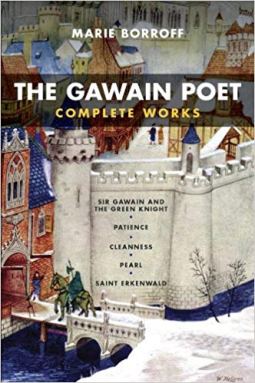 s and notes also evince a strong Christian background. Born in 1923, PhD 1956 Yale, English professor (first such at Yale). Does the fact that she was in her 70s when she undertook ‘Cleanness’ have bearing? Possibly.
Her translation of ‘Cleanness’ was first published in 2001 which, by my reckoning, is awfully late for such a work to be introduced and explicated with references to sodomy and sins of the flesh being the those things most abhorrent to G-di. The poet, she tells us, was ‘devout, deeply thoughtful, and offers a window on one version of medieval Christianity.’ii The issue isn’t that she’s explaining the poet’s position as such, but that she does so without much comment. To be fair, the first sentence of the poem’s introduction indicates that of the five available works by the poet, ‘Cleanness’ ‘is the least accessible to the modern reader.’ This might be her concession to the gap between medieval doctrinal Christian morality and modern acceptance of multiple sexualities.
After retelling the parable of the wedding feast from the Gospel of Matthew, the poet tells us ‘Uncleanness is the one sin that rouses G-d to merciless anger. Lines 193-204 earn no footnote, but set the stage for the main sections of the poem. Indeed, one could, as Borroff suggests in her introduction to the poem, read these lines as the poem’s thesis:
But I have listened long and hard to many learned clerks,
And in writings well reasoned read it myself,
That the peerless Prince who in paradise rules
Is displeased at every point appertaining to sin.
But I have never seen it set down in a book
That He punished so impatiently the people He had made,
No avenged Him so violently on vice or on sin,
Nor so hastily did harm in the heat of His anger,
Nor so severely and swiftly sought to destroy
As for filth of the flesh that fools have practiced.
The poet quickly addresses The Fall of the Angels, The Fall of Man, and The Corruption of Adam’s Progeny followed by a detailed retelling of the story of the Flood. Before moving on to a lengthy treatment of the destruction of Sodom, the poet provides another Warning Against Uncleanness. The warning concludes:
But when the folk fall into foul deeds of defiling lust
He loathes so that lewdness, He lashes out at once,
Cannot bear to hold back, but abruptly strikes,
And that was openly proven by a punishment once.
That last line obviously refers to the Flood. The poet does a very clear job of retelling the story of Lot, his daughters, and G-d’s angels at the gates of Sodom. He isiii quite clear that the desire of the men of Sodom for the angels is unacceptable in the eyes of G-d, but presents Lot’s offer of his virgin daughters without any judgment. Lot tells the men of Sodom, when they demand the angels a second time:
My abode here is blessed by two beauteous daughters;
They live with me alone – no lover has had them;
None seemlier dwell in Sodom, though I say so myself.
They are ripe and ruddy fleshed; they are ready for men;
To embrace such bonny maids will bring you more pleasure.
I bestow them with my blessing, that are buxom and blithe,
And lie with them as you like, and let my guests be.
The men of Sodom reply that Lot is a newcomer, though in Sodom he has grown rich. Regarding Lot’s offer, Borroff makes no comment. Her omission suggests that the Sodomites’ rejection of the female is sufficient demonstration of how they have earned G-d’s wrath.
Without evidence, she also suggests that the punishment suffered by Lot’s wife has something to do with her salting the meal served to their guests. In a footnote (p.91), she writes, ‘According to the version of the story that most closely resembles the poet’s, the angels visited Lot during Passover, and that is why Lot insisted that they be served unleavened bread, containing neither yeast nor salt…It seems clear from the poet’s treatment of the story that he had read one or more of the Jewish commentaries on Genesis, presumably in Latin translation.’
Her assertion that Lot was entertaining the angels during Passover is as patently ridiculous as the presence of whole loaves of bread on the table of the Last Supper, a not uncommon sight in medieval/renaissance depictions. The story of Lot predates the Exodus by multiple generations. (Quickly: Lot is Abraham’s nephew. Abraham is the grandfather of Jacob who brought his entire household into Egypt at the end of the book of Genesis. At the beginning of the second book of the bible, Exodus, we learn that the generation of Jacob’s offspring (14 children) were all deceased, but their descendants had multiplied such that pharaoh was alarmed. This is the beginning of the story that culminates in the Jews’ escape from Egypt. It is this story that is told at Passover each year. The event that the Passover holiday commemorates hadn’t occurred at the time of the destruction of Sodom.)
But, listen. I’m an atheist bisexual and a non-practicing Jew. My passing interest in Christian doctrine derives from my study of English literature and a desire for accurate allusions in my own writing. I might be the wrong person to criticize Borroff’s ignorance or omissions with regard to her presentation of the work in question. I came of age in the 1980s and studied literature (including her go-to translation of ‘Gawain’) at San Francisco State at the height of the AIDS crisis, so I have a certain bias.
My own sense of morality enables me (and entrusts me) to side with victims of sexual assault, and at the very least look askance at those who commit assault or stand by when assault (or invitation to assault) occurs. Angel of the Lord or no. Consensual sex, regardless of parts, is up to those participating. I come at this poetry from the firm belief that we must be clear and open about who we are in order to give strength to those who are increasingly persecuted. These are treacherous bloody times in which to be dishonest and not open to the needs of those without choice. If being public about who I am comes by way of literary examination, so be it.
The question is perhaps, ‘Does the poetic translator bear a responsibility to question such a stark moral dichotomy?’ Does the editor bear some responsibility in this regard. I say yes to both, but only partly because the poems aren’t necessarily presented as doctrinal texts. In many ways they reflect doctrine, certainly. Borroff says that the poet’s suggestion that G-d taught sexual pleasure to mankind is outside Christian doctrine because it ‘omits…the intention on the part of both man and woman to conceive a child’ (p.41):
When two were tied together with true minds and hearts,
Between a man and his mate would mount such delight
That the pure joys of Paradise could scarce prove better
…
The blaze of love between them so bright and so fierce
That all the mishaps on earth could not hold back its heat.
I find ‘Cleanness’ to be problematic not only for its treatment of sexuality but for the implicit comparison of men to the holy vessels of the Temple. It’s no secret that women are responsible, biblically speaking, for the ills of the world (Do I need to rehash Eve giving the apple to Adam?), but the poet takes this assertion to the next level in his retelling of the story of Balthazar.
After an interlude instructing how to emulate Christ’s purity, nearly half the poem is spent retelling the story of the Babylonian exile. It’s a leap from the mythology of the first book of the bible to an event that is documented both in the bible and elsewhere, with a firm date in the 6th century BCE. We learn first how the last king of Jerusalem and Judea ‘used abomination, bowing to idols / And prized little the laws he should loyally have kept.’ G-d therefore uses Babylonian king Nabugodonosor (Nebuchadnezzar) to destroy Jerusalem, raze the temple, and enslave the Jews. Nabugodonosor is mostly loyal to G-d, and he never uses the treasures taken from the Temple of Solomon. When his son Balthazar inherits the throne, he orders the holy vessels of the temple be brought out during a drunken feast. In retaliation for this sin, G-d invites the Persians to sack Babylon and kill Balthazar, much as He had invited Nebuchadnezzar to sack Jerusalem and kill or enslave its inhabitants.
The poet implicitly equates Balthazar’s sin with that of the Sodomites and of Noah’s contemporaries; the poet equates the desecration of men through sins of the flesh with that of those cups from the temple. Men are the holy vessels and women are as nothing, even to the point of being raped by those same men. Is it any wonder women are repressed in the Church, and in orthodox Judaism for that matter?
Leaping forward a couple of centuries, Jonathan Edwards, in his sermon ‘Sinners in the Hands of an Angry G-d’ (1741) exemplifies the same kind of disdain of those considered sinners as the poet of ‘Cleanness’, though Edwards spreads the damnation around. He also ascribes to G-d a kind of infinite wrath that the poet only hints at. It’s a guess that most faithful in these times would find that kind of wrath unlikely.
“And it shall come to pass, that…all flesh come to worship before me, saith the L-rd. And they shall go forth and look upon the carcasses of the men that have transgressed against me; for their worm shall not die, neither shall their fire be quenched, and they shall be an abhorring unto all flesh.” (Isaiah 66:24) It is everlasting wrath. It would be dreadful to suffer this fierceness and wrath of Almighty G-d one moment; but you must suffer it to all eternity. There will be no end to this exquisite horrible misery. When you look forward, you shall see a long for ever, a boundless duration before you, which will swallow up your thoughts, and amaze your soul; and you will absolutely despair of ever having any deliverance, any end, any mitigation, any rest at all. You will know certainly that you must wear out long ages, millions of millions of ages, in wrestling and conflicting with this almighty merciless vengeance; and then when you have so done, when so many ages have actually been spent by you in this manner, you will know that all is but a point to what remains.iv
While the excesses described have been mirrored elsewhere (A Portrait of the Artist as a Young Man, for example), it is reflected more obviously (in my reading) in works of cosmic horror and performed by creatures from outside the realm of Christian mythology. The eternal torments meted out by G-d to the unbaptised and unsaved in Edwards’ sermon are similar to those inflicted on the narrator of I Have No Mouth and I Must Screamv, forced to perform unspeakable acts by an omnipotent intelligence.
Assuming that the poems of the manuscript are all by the same poet, he presents a vision of heaven in ‘Pearl’ that offers biblical basis for the afterworld as earned by what the Puritans would later call The Elect.
‘Pearl’ sets forth what is essentially an ecstatic dream vision that assumes the dreamer and the reader will achieve, or can achieve, this heaven by staying on the path of righteousness. Borroff is clear and consistent in providing the biblical sources for the poem, specifying the translations used and obviously works from the assumption that the poet wasn’t being somehow satirical. From my perspective, being at this late date more familiar with the Old Testament than the New, I find the poet’s take on G-d’s perspective, even as Jesus was supposed to have been the answer to and resolution of Mosaic law, a little hard to take.
What we come away with is that while G-d can be forgiving and recognise the human struggle for grace, there are places where the L-rd’s ways are not our own, but distinctly reflect human prejudices. And, yes, we should be over that by now, except that they’re set forth in the holy books.
Occasionally I read, and utter, the opinion that those who preach against homosexuality should also heed the other dictates of the Old Testament, especially those set out in the book of Leviticus. Have you mixed cotton and linen in the same fabric, eaten shellfish (or cheeseburgers), had sex outside of marriage? These all earn punishments similar to those for homosexuality. The argument is that while Jesus is the way and the light and is the new embodiment of the law set down in the Old Testament, not all of the old sins hold equal weight. There seems to be a distinction drawn between what is immoral and what is simply illegal.
As I’m considering how to conclude this, I’ve come across an opinion in the NY Timesvi that suggests the prohibition against homosexuality in Leviticus was originally a prohibition against homosexual incest, but later editors fudged it. Biblical scholar Idan Dershowitz argues that the glosses on a couple of sentences seem to contradict or subvert what might have been the more limited earlier prohibition. While it is nice to see this matter considered, what preachers old and new (including the poet of ‘Cleanness’) are elucidating is not the specific legal prohibition, but the evidence in the earlier stories that specifies what G-d Himself finds odious.
The problem is that all of our understanding of human biology; of the nature of love, lust, and desire; and of the importance of living in honesty with oneself goes head on with two thousand years of anti-gay interpretation of scripture. The power of that interpretation undermines any other way of looking at scripture and practicing most established versions of Christianity.
i I follow here the Jewish tradition of not spelling out the complete name of G-d or any of its synonyms.
ii I’m unable to find the reference – I’m pretty sure it was in the general introduction to the volume.
iii I operate from an unfounded assumption that the poet is male.
 I’d never seen

 Joe Jots