Bloomberg News posted a rather disingenuous editorial comparing Bill Clinton to Donald Trump, the idea being that Trump is simply presenting a grotesque version of the Clinton presidency.
The upshot is that the sex scandals entrapping Trump are as unforgivable as those that Bill Clinton subjected us to back in the 90s, and that somehow because Dems gave Clinton a pass, we should do the same for Trump. I call bullshit. Loud and Clear. I won’t give Trump a pass for ostensibly the same issue (infidelity) for a great number of reasons. One is that Trump’s payouts push us into obstruction of justice territory that Clinton’s simply didn’t.
But let me back up. There’s some merit to this argument that it’s the same thing. For all his impropriety, if the allegations even of rape against Bill Clinton are true (and that’s a hard thing to write, given how loudly we howled in his defense back in the 90s), in general he had the interests of the country and its underclasses at heart. At least some of the time. The health care battle, in the history of those times goes head to head with welfare ‘reform’ and his Supreme Court choices get in the ring with the death warrant he signed during the ‘92 campaign. Yeah, he did dozens of things wrong from my liberal pacifist armchair perspective.
However, what devolved from the Clinton presidency onward was an intractable right wing that had only the interest of the the wealthy and the evangelical in mind and the continuation of their own power. Part of the issue is that the Democrats (as an organization, not an affiliation) have the same faults and predilections as the right, but never had what it took to separate the workers’ interests from the worker’s evangelical leaning in the public imagination. I’m not sure how it evolved that the best interests of the worker no longer lay with that of other workers. (Howard Zinn, if I recall rightly, explains that historically it dates back to slavery/reconstruction when whites in power peddled the line to the landless/luckless whites that ‘you may be trash, but at least you’re not black.’)
Fostering that seemed to hold things together. Oddly this was the Dems’ position, not the Republicans’. It wasn’t until Nixon that the Republicans took hold of Dixie. While it was a Republican that presided over the Union in the Civil War – the Dixiecrats held the south until a Southern white democrat signed the Civil Rights Act. It took the Dems 100 years to lose the South and Republicans have only tighetned their stranglehold in the last 50.
But it’s not unremarked upon that no matter what, both Republicans in legislatures and Democrats vote against the interests of the poor. Nine times out of ten, if not more. I’m not sure that’s just a recent New Democrat (the American equivalent of the UK’s New Labour) or if it dates further back than Clinton’s election. My suspicion is that recent statistics on the matter would be borne out if we applied them in every decade to the founding of the union.
I’ve said before that Clinton was a bastard (our bastard, sure), but we knew when he signed off on Rudy Ray Rector’s death penalty at the start of the ‘92 campaign, that he could be either disgustingly calculating or outright heartless. I think the left trusted it to be the former, because it’s somehow well-known that someone against the death penalty could never be president. I pulled the lever for him twice, because 12 years of Reagan/Bush were enough. And because in ‘96, Dole got the nomination because it was his turn, not because he was the best Republican for the job. Not saying he wasn’t the better man, but I wasn’t ready to question my own liberal ideology. (I’ve been ready enough in recent years, but 21st century American conservatism turns my stomach. So I’ll keep my lunch, thanks. And American Liberalism is firmly in Reagan territory at this point anyway.)
So all that noise above about Bill Clinton is simply to say that I, and possibly my fellow liberals, are not blind to his faults, and that we knew what we were getting into. He was as opportunistic a politician as any other, but no matter what bullshit was thrown at him with regards the so-called scandals of the time, he wasn’t found to be absolutely crooked. This is the key distinction between Clinton (and the Lewinsky affair which finally brought him to impeachment) and Trump (and his various scandals): we know that Trump is crooked. We know because he doesn’t release his tax returns; we know because the one lawyer he keeps close makes payoffs to keep stories from the newspapers; we know because several who did work for him came forward during the campaign to say he reneged on contracts; we know by the skeezy way he talks about his daughter.
I’m going to move from the differences between Trump and Clinton to the greater issue of how our recent presidents differ in similar ways.
Valerie Plame penned an interesting editorial on the pardon of Scooter Libby this week. Libby was the only person charged (and convicted) in the outing of Agent Plame as a covert agent in 2003. His situation plays into the essential what-aboutism of the Bloomberg editorial – Under Bush II and Trump, the worst elements of the party have twisted the agenda of the president. While we may have disagreed quite strenuously with Clinton’s policies, behaviour, and agenda, we didn’t doubt his grasp of policy and his understanding of how his actions would resonate in the geopolitical arena.
For example, when he joined in the bombing of the former Yugoslavia, he knew what the effects might be and he was aware of the historical context in which the war was taking place. (More on this in a moment.) When Rumsfeld and Cheney dragged us into Iraq, President Bush knew that we in the public knew that he was well out of his depth and had no idea what the fuck he was doing. (My apologies: Take a moment to diagram that sentence if you need to.) He told us as much during the campaign, that he was taking on the greatest minds of his daddy’s administration to guide him. The problem was then, as now, the massive conflicts of interest. Has anyone measured how much Dick Cheney’s fortune increased due to Halliburton’s Iraq/Afghanistan war contracts? Just for a start?
Cheney knew the effects of what was going to happen and apparently didn’t give a good goddamn.
Did anyone who mattered in the Shrub White House grasp the history of the region well enough to know the can of worms we were opening? In the public arena, they showed that they didn’t care. The impression they delivered was that eventually the oil would flow and its profits would flow back to the US, that they didn’t care about the war’s time line – the past history didn’t matter – the future would justify it, that they didn’t understand the distinctions between Shias and Sunnis and Kurds (the Yazidi didn’t even figure into the public equation at the time), that somehow all the ethnic hatreds that were held in check by Saddam Hussein would evaporate once we, um, liberated the place.
Clinton at least gave the impression that he cared about what was going to happen. With Bush and Trump, we don’t see that they understand the effects or that they care.
The Bloomberg editorial points out that one of the several parallels between Trump and Clinton is that when Clinton was in the hot seat regarding the Lewinsky scandal, he tried to divert attention by ordering a bombing raid, in Bosnia if I recall rightly. Trump, under slightly more pressure this week after a massive three-venue no-knock raid on that attorney I mentioned, and Trump pulled the same maneuver (possibly at the behest of Fox News), and sent soldiers to bomb Syria. The fact remains that there was feck-all for the independent counsel to nail Clinton on, despite the Republicans’ insistence there was (echoed later with all of the Benghazi bullshit flung at an unflappable Hillary Clinton when she was Secretary of State). The investigation finally got him for a blowjob, making the US the laughingstock of the western world. Bloomberg’s editorial suggests that the odd possibility that Trump might be brought down by a sex scandal somehow makes Trump’s presidency equal to Clinton’s. Of course I call bullshit.
Preet Bharara, in a recent interview with former Homeland Security secretary Jeh Johnson discussed Johnson’s efforts with President Obama to close the prison at Guantanamo Bay. Regarding Republican arguments against closing the prison, Preet asked ‘Do you think the Republicans were acting in good faith?’ This is the question I’m trying to parse with regards Bush’s actions, Clinton’s, and Trump’s. Did they then and do they now act in good faith?
And what do I mean when I use that phrase? I mean that what a politician says in public aligns with what they say in private, with what they promised to the public constituency on the campaign trail, and with a professed belief system. That’s a good start.
And I think that in general, the Dems have acted in better if not good faith to the extent they could, with the proviso that as politicians, they’re performing ethical balancing acts all of the time.
Trump, from my perspective, does not act in good faith, even in faith to what he’s said himself even a week before (viz his tweets about Syria within the month of April, 2018). Bush might have been an actor in good faith, but his advisors were not, and they not he were the government at the time. The fact remains that for the eight years of his residency at 1600 Pennsylvania Ave., he was a figurehead, and most folks knew that.
An example of the good faith/bad faith discussion is the health care debate of the first two years of Obama’s first term. Obama and the Democrats acted in as good faith as they could, to the point of compromise on the most basic of principles, finding middle ground for every one of the Republicans’ arguments, and still we were shafted. One could argue that the Republicans in congress were acting in good faith, but their faith was to the insurance companies, hospital conglomerates, and drug manufacturers. By my definition above, this isn’t good faith. And in the end, not a single red tie voted for the bill. And then they proceeded to sabotage it in the courts.
There wasn’t a credible Republican atop the 2008 ballot, John McCain having chosen the most unqualified VP since, um, Dan Quayle in 1988. Eight years of Bush/Cheney had worn us out on wars and lies and there was readiness for change, to be sure, but Sarah Palin was another example of the Republican party acting in bad faith. Palin was barely qualified for the job she had, like Bush (and Trump), didn’t read much, and could barely answer very simple questions. McCain and the Republican party played us for fools when they thought (and rightly so, obviously, given that Obama’s victory wasn’t precisely a landslide – solid, but it was no 1984 Reagan over Mondale trouncing) we would buy her pretty face over Obama’s obvious experience. Acting in good faith in the political realm requires some modicum of honesty – the whole ‘Democrats are coming for your guns’ canard comes into play here. Palin, in the midst of the Republican sabotage of Obama’s relatively modest agenda had the gall to utter the phrase ‘How’s that hopey-changey thing working out for you?’ as if she wasn’t spending all of her (at the time excessive) on-camera Fox News time subverting rather than adding something constructive to the debate. Had McCain chosen someone credible to join him on the ticket, things might have been different. But we got the grifter instead.
McCain, Mitt Romney, Bob Dole, and Hillary Clinton all have in common that their candidacies came about because it was their turn. They’d risen high enough in the party to be considered the de facto candidates. And they lost because they worked on the assumption that they didn’t have to fight. History might suggest (from more objective distance than we have yet) that Dole and Romney would have made for better history. Would the tea party have dragged Romney through it the way they did John Boehner? I suggest it’s possible, but counterfactual. Hillary Clinton might have lost the selection anyway given Jim Comey’s October Surprise, and the astounding amount of Russia-orchestrated fight against her, but the fight within the party to subvert Mr. Sanders didn’t help matters. She herself was also acting in bad faith.
And there is, of course, the bad faith of the media: Every venue that put Trump on camera acted in bad faith. He’d spent much of the previous decade proving himself an actor (on his TV show), and a political player of astoundingly bad faith. His insistence on the illegitimacy of Obama’s presidency did as much as anything else to sabotage that presidency in the eyes of the electorate. Even with that in mind, the news stations put him literally center stage to spew his schoolyard BS over people of actual political experience. Note: No love lost between me and any of the people running for the Republican nomination in 2016, but giving Trump center stage over and over again legitimized his brand of campaigning.
And we bought it. To try to circle this back to my original thought, it’s not that Trump’s presidency is simply Clinton’s repeated as farce. No, Trump in his personal, political, public, and private dealings is the apotheosis of fifty years of bad faith governance from the Republican party, epitomized by the savaging of the American working class.

 This was a fair risk because their friends were dying. (I would so love to be able to say that I took the risks, but I lived safely then and rarely demonstrated, and generally only when it was safe. I won’t rewrite my own history.) Friends and lovers were dying horrible, lonely, painful deaths. Let’s not forget that the opportunistic infections associated with AIDS were slow and had few treatments. And there was no cure on the horizon.
 However, this evinces the kind of whataboutism that makes political discussion today such a bloody fraught proposition. The gist is that occasionally white people are refreshed in the fears for themselves and their children that POCs live under all the expletivedeleted time. This is something that happened in Florida this month – nice suburban white high school terrorized by a young man with a gun irrationally marching through what should have been a safe space to learn and grow. Black Americans going about their daily business should expect and experience not being harassed or killed without probable cause, right? And I’m engaging in a variation of the same whataboutism, I suppose. A recent parallel is the Netflix dramatization of Margaret Atwood’s The Handmaid’s Tale. Again, not an original though on my part, but in Atwoods’ vision of the future, white women are treated the same way black women have been treated in America for centuries. I’m sure I’m not the only one to draw this comparison between Atwood’s fiction and the news treatment of our various tragedies. This situation is wrapped up in a lot of other American situations including the school to prison pipeline, Riker’s Island, and the stop-and-frisk policies all over the country.
 I think this might be another one of those cases where a politician is saying outrageous things to distract the public from what’s really going on. I honestly don’t know what Theresa May’s agenda is. She’s not as transparent as say Jeremy Hunt. We know he’s trying to crush the doctors’ unions because of the massive amount of money that will come his way from a privatised NHS. May? Perhaps I just don’t know enough about her. But at the moment she’s making noise that rather than leave the EU, Britain should just leave the European Convention on Human Rights. (Let’s not entertain, for the moment, the fact that membership in the EU requires membership in the ECHR.)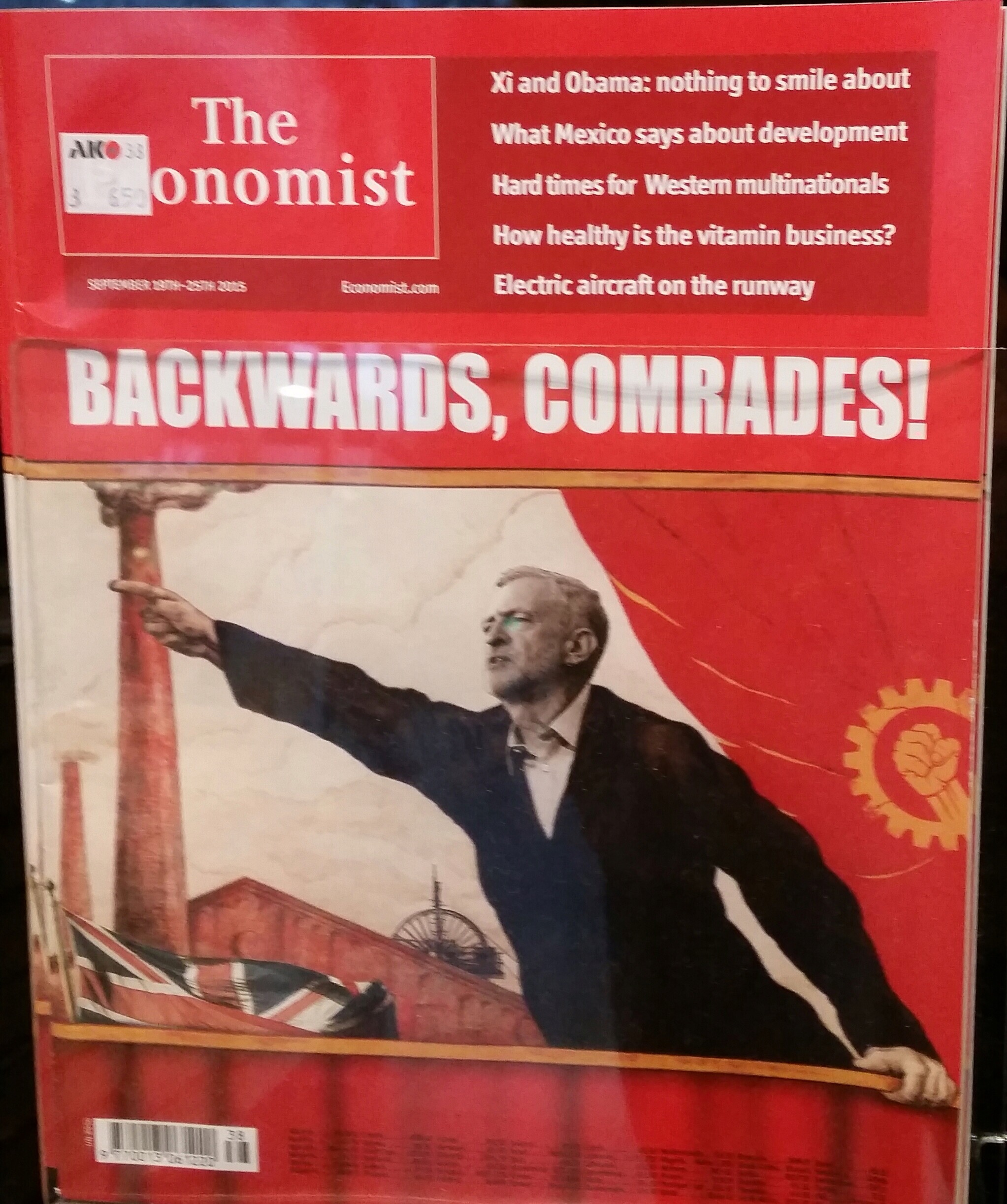
 Joe Jots