Archives for category: Politics

ETA: Please read Nedra’s very thoughtful response to this in the comments. She’s on the ground and doing the work in Jerusalem and has a far clearer view of these things than I do.

Again, I’m writing from the perspective of profound ignorance that blights all of us who choose our media bubbles and stick to them. (Disclaimer: My preferred news sources include the BBC, The Guardian, The Washington Post, and Rachel Maddow. If I get my act together this year, I hope to add nu.nl, NOS Journaal, and at least one other Dutch source.)
In response to my last post, my mother referred to a friend of the family, a liberal Jewish woman who made aliyah (Note to the goyim: To make aliyah as a Jew is to emigrate to Israel) and lives in one of the settlements. Mum’s wish is that I get in touch with this friend who has on the ground experience and for a variety of reasons doesn’t fit the stereotypes, but ‘says things like “Palestinians teach their children to hate”‘.

This phrase has always struck a nerve with me. Yes, among the Palestinians are those who attack Israeli settlers and soldiers and who fire explosives from Gaza into those settlements. And the entire population suffers IDF (Israeli Defence Force) response far out of scale with the initial attack. 

And it has happened over and over and over again.

We Jews have an interesting history with occupying powers that predates our history as one. By the (hundreds of?) thousands we endeavoured to escape the pogroms of the late 19th century. We all know what happened to those who didn’t escape, but with almost the regularity with which we tell the story of Passover, we retell the story of the Warsaw Ghetto Uprising. We tell of how the Jews of Warsaw were forced into smaller and smaller spaces and had their resources systematically cut off, and of how valiantly the Jews of the ghetto fought against the Nazis. ‘One shudders to think that it required a quarter of a million Jews to give their lives, for the remainder to understand the reality of the situation and come to the right conclusions,’ wrote one Shmuel Winter as documented on the Yad Vashem web site dedicated to the uprising (http://www.yadvashem.org/yv/en/exhibitions/warsaw_ghetto_testimonies/index.asp).

This is the crux of the matter. When we were systematically restricted in World War II, we finally rose up. We glorify those who finally rose up and shudder through the tears of 20/20 hindsight at the meekness with which we suffered the slow approach of our destruction. I don’t have my copy of Night to hand, but Eli Wiesel described the situation in the Romanian village in which he was raised similarly. The villagers could see what was happening and talked about emigrating (to Palestine, generally), but few made the leap because that village had been their home for a thousand years.

I know I’m simplifying the matter, but wasn’t Palestine the home of these people for a thousand years before the Zionist movement and the establishment of Israel? Yes, their children are taught to hate the occupying power. We glorify our meekness, but wish we had hated sooner. Perhaps something could have been done. One of the problems is that Israel insists on the right to the territory that comes from greater military strength rather than the might that derives from diplomacy and its attendant hard work. 

https://youtu.be/ngQyzSez4cM

Colonial histories, from the liberal perspective, often berate the colonising power for the length of time it took it to leave. Britain’s long occupation of India and Rhodesia (and, for that matter, Palestine) are cases in point. France in Algeria, Belgium in the Congo, the US in any great number of places – North Dakota at the moment comes to mind. And I berate Israel for the same reason. It’s long since been time to make a solution. Blaming the occupied population for their resistance isn’t productive. 

It might look from the air like the Burning Man festival. It’s a gathering in the desert, but at 81,000 inhabitants in 2015, this gathering exceeds the population of Black Rock City by approximately 12,000 people. This is Zaatari refugee camp in Jordan. Last September, at the height of the Syrian crisis, Israel refused to take refugees from the conflict. PM Netanyahu claimed Israel was ‘too small‘. (That link points to the NY Times, but a google search on ‘Israel refuses Syrian refugees also provides links to the LA Times, Al Jazeera, and the Daily Mail in the first ten hits.) During the endgame last month the Israeli government had agreed to take a few. Netanyahu announced, ‘We see the tragedy of terrible suffering of civilians and I’ve asked the Foreign Ministry to seek ways to expand our medical assistance to the civilian causalities of the Syrian tragedy, specifically in Aleppo where we’re prepared to take in wounded women and children, and also men if they’re not combatants.’

I’ve possibly mentioned before that I’m Jewish by birth and have great love for the holy land and look forward to visiting there again, some day. However, I cry whenever enough Israelis vote for Netanyahu to put him back into office. He’s spent several decades fighting for Israel’s right to pariah-hood amongst the family of nations. At the moment they could have taken the moral high ground and admitted the refugees from one of this century’s more insane conflicts, he said no. Whenever there has been a chance to move towards peace, he increases the state of war. The main exponent of this behaviour has been the war on Israel’s Palestinians. (This subject is far more complicated than I present it and I know that in my idealism, I miss a lot of salient issues. I’ve consistently missed the point on this issue for well over 30 years, and I probably won’t stop now.) 

On the one hand there’s the treatment of the residents of the Gaza Strip, an insane piece of real estate sandwiched between the Negev desert, Egyptian Sinai, and a small piece of Mediterranean beachfront. Every couple of years, that area heats up and some idiots fire rockets from the strip into Israeli settlements on the West Bank. In reprisal, the IDF rolls in tanks and destroys another part of the Strip. Note that Israel blockades the Gaza Strip from receiving a great number of things including construction materials such as concrete. Rebuilding after these invasions, from what I gather, is well nigh impossible.

On the other hand, there are those settlements I mentioned. The ones the UN condemned last week or the week before, when, for the first time in 40 years, the US didn’t use its veto power to support Israel’s ‘right’ to construct Jewish settlements in the occupied West Bank. The history of the settlements is well documented. For a very long time, I argued that Israel won the West Bank fair and square in 1967 and should have the right to do with it as it pleases. Of course, this ignores the fact that for 19 years the area we now call the West Bank had been in Jordanian hands, and Jordan had done feck-all to integrate the Palestinian population. When Israel occupied this area (and The Golan Heights and the Sinai Desert) at the end of the Six-Day War, there was already. The issue that refugees of the previous two wars for Israel’s right to exist (’48 and ’56) had deprived the residents of the area of houses to which the only indication the houses had ever existed were the keys the refugees and their descendants still cherished. The Israeli occupation of the West Bank precipitated its own refugee crisis for which Lebanon also provided the real estate for refugee camps.

I’m going to piss some people off here, not the least of whom are family members and friends who have made aliyah. At this point, the settlements are an abhorrent Israeli echo of Germany’s early 20th century claim to ‘lebensraum’ in northern Czechoslovakia. Netanyahu said last year that Israel is too small. The problem isn’t that Israel is too small; it’s that Israel thinks too small. Too small to do the right things for peace in a time of war, too small to say repudiate decades of No with a resounding yes, too small to give of its bounty instead of taking again.

As I said, I know this is more complicated than that. I’m well aware of how crazily hateful Israel’s enemies have been since the first shaking of the British Mandate. Remember, though, that Israel managed to make peace with Egypt and to establish diplomatic relations with Jordan. The process of peace is slow, but it was working. However, hate is easy and taking and holding the moral high ground is hard. An argument could probably be made that if the US hadn’t invaded Iraq, and perhaps had worked against the inflammation of the late 90s intifada, then we might be much closer. As I said, it’s really complicated. And dreams of what could have been are just that. Working with the now is much harder.

Beer: Brewdog Punk IPA // Music: Muslimgauze: Intifaxa

Well, the electoral college failed yesterday to do what it was put in place to do – to save the republic from the election of a madman, demagogue, or simply one unqualified to hold the office.
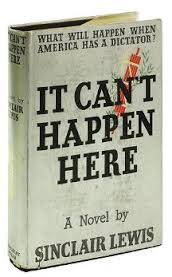
it-cant-happen-hereAnd we now have all three, plus his coterie of supremely unqualified department heads. No, they’re all qualified, and sworn, to destroy the very agencies they’ve been chosen to lead. There’s the treasonous way in which he was ‘elected’ and the questionably legal means by which the Trump organisation has prevented effective recounts in states he ‘won’ by small margins.
I’m not the only Cassandra predicting that fascism has finally come to the US. I’d like to believe I’m wrong. I’d love to be proven wrong, but all evidence seems to point to the last nails being hammered into the coffin of the American experiment.
And the election of someone who can be baited in less than 140 characters to say and do things that are (to say the least) diplomatically unsound at a time of such global uncertainty, leads me to consider (not for the first time) that if we’re not already in World War III, we’re not far from it. The assassination of Russia’s ambassador to Turkey yesterday would indicate a step closer to that horrible scenario if it weren’t for a weird history of assassinations of Turkish diplomats. (I hadn’t recalled the spate of these things that occurred in the 70s and 80s, but Rachel Maddow enumerated them on last night’s programme.)
It’s possible that the fall of Aleppo might signal something resembling the fall of Poland in 1939, but history doesn’t repeat that cleanly, and obviously no one has signed on to an agreement that would only now precipitate a wider conflict. Given Russia’s role in both Syria and in the US election, it’s not as though we’d be entering on the opposing side at this point.
The Trump election and Farage’s victory in the Brexit vote and a few other western political occurrences seem to argue for a rise in right-wing populism. Austria managed not to elect a fascist leader president a few weeks ago in a runoff election and the victory of a gent to the left was hailed as a triumph of sanity. Yeah, but the fascist still got 47% of the vote. And now that same fascist, Heinz-Christian Strache, is in talks with Trump’s new national security adviser. In the last couple weeks Geert Wilders, the bleach blond leader of the Dutch fascists (Partij Voor Vrijheid – the party for freedom, whatever that means) has been seeing a rise in his prospects. Elections for the Dutch lower house (tweede kamer) occur next year. I need to do some research, but I think that the current PM is not running again.
And, in the category of fascist power grabs, we have that craziness in North Carolina. Republican governor loses race, so Republican legislature passes a bunch of laws stripping the new governor of most of the governor’s power, just in time for the outgoing guy to sign them.

…About how we never/all saw this coming. But a few folks did. And it’s been brewing for 4, 8, 36 years. Or longer. A couple of months ago, about when Hillary’s ‘basket of deplorables’ comment was making the rounds, I remembered Mitt Romney’s ‘binders of women’ reference from one of his 2012 debates with Obama. Mitt was monumentally out of touch, and not half the orator Obama is, but he was making a valid point: He knew that he needed to improve the gender balance in his administration and he told his key players to bring him some CVs to work with.

And the left nailed him to the wall over it.

Don’t get me wrong: I preferred to have the Obamas’ grace, dignity, and gravitas in the White House these last eight years. In retrospect, I wondered what more could have gotten done had it been Romney working with his own party. Mind you, the GOP might have done to him what they did to John Boehner.

I had my first conversation about the election with the gentleman at the dry cleaner this afternoon. We were talking in English because my Dutch is lousy, and he said ‘Congratulations on your new president,’ without irony that I could detect. We chatted for a few minutes and he indicated a low opinion of Mrs. Clinton. It wasn’t the time or the place to get into it with him, maar na negen jaren ben ik nog nooit zo gemotiveerd om nederlands te leren. (After nine years, I’ve never been so motivated to learn Dutch.)

I do hope we survive the next four years, but I fear for the republic.

I think this might be another one of those cases where a politician is saying outrageous things to distract the public from what’s really going on. I honestly don’t know what Theresa May’s agenda is. She’s not as transparent as say Jeremy Hunt. We know he’s trying to crush the doctors’ unions because of the massive amount of money that will come his way from a privatised NHS. May? Perhaps I just don’t know enough about her. But at the moment she’s making noise that rather than leave the EU, Britain should just leave the European Convention on Human Rights. (Let’s not entertain, for the moment, the fact that membership in the EU requires membership in the ECHR.)
Her position, according to The Guardian, is that the ECHR has tied Britain’s hands with regard deportation of extremists such as Abu Hamza and Abu Qatada, ‘and does nothing to change the attitudes of governments like Russia’s when it comes to human rights.’
This is where I usually stop reading when these things come up. The point of human rights conventions is to bind the signatories to be better at this stuff than non-signatories. The bottom line is that it doesn’t matter what any other country does when it comes to human rights. The UK decided at a certain point to be one of the good guys in this regard and say, ‘We will respect very basic human rights and will treat all with due process.’
It’s a very short document, clocking in at just 55 large-print pages, many of which are taken up with repetitions of ratification and depository information. Life, liberty, security, prohibition of torture, and prohibition of slavery all appear on the first page. The other basics, including due process, right to thought, expression, religion, privacy, and assembly come on the next seven pages. The next 16 cover the court itself. The balance covers the various protocols on human rights and freedoms. Interesting bit: In 1983, when the death penalty was abolished under Protocol 6, there was an addendum specifying that the death penalty could be imposed under certain circumstances in time of war. In 2002 this addendum was rescinded under Protocol 13.
With this in mind, it’s BS about other countries keeping us from doing what’s right (not just what’s right according to treaties we’ve signed) that got people so worked up when Dick Cheney said we had to torture to get information out of supposed bad guys. No, we don’t. We’re better than that, and have signed conventions (in that case, The Geneva Convention, but the idea is the same) as outward signs that we strive always to be better than that. Except when our leaders say, ‘Nah, we don’t have to be better – we’re exceptional.’ Or some such noise.
May was discussing Britain’s ECHR responsibilities in the context of a speech ostensibly supporting continued EU membership. She went on to say, however, ‘The states now negotiating to join the EU include Albania, Serbia and Turkey – countries with poor populations and serious problems with organised crime, corruption, and sometimes even terrorism. We have to ask ourselves, is it really right that the EU should just continue to expand, conferring upon all new member states all the rights of membership?’ Good question, I suppose, but the UK has an equal say in the admission of other countries to the EU. Organised crime and corruption weren’t issues when Italy and Greece joined. Or perhaps not to the same extent. She just wants some to be more equal than others.
May went on to say that Britain should be able to draft and amend at its own bills of human rights that apply to Britons. Again, we’re better than that. (Yes, I’m an American married to an English woman and say ‘we’ even though I have few rights to call myself a Brit. According to one friend, knowing why the M25 is called The Road To Hell is sufficient.) We should be able to look Europe and the world in the eye and say that the rights we enjoy should be available to all and that we’ll fight for that to be so. (It demeans weasels to say that May is trying to weasel Britain out of her responsibilities under UCHR.)
A week or so ago I read a screed denouncing new film versions of The Jungle Book and naming Rudyard Kipling a racist expletivedeleted. This article quoted extensively from Kipling’s poem The White Man’s Burden. Yeah, racist to the core with its references to colonised peoples as ‘half-devil, half-child’. The title itself makes us modern progressives cringe at the thought that whiteness alone made one group responsible for bringing others to modernity. What Kipling was arguing for, however, is that those who consider themselves civilised ‘fill the mouth of famine and bid the sickness cease’ even as others, no matter what we name them ‘bring all (y)our hope to naught.’ Yes, it’s terribly racist to name those others ‘sloth and heathen folly’, but the burden Kipling lays upon us is to do the work. In the Jewish tradition, there’s the concept of Tikkun Olam, heal the world. Get out and do the work of peace, of healing, of working for the safety of the disadvantaged. While Kipling names both the objects of the work and its obstacles with terms we consider abhorrent now (and were, in truth, abhorrent in 1899), the call is to be the good guy and do the work of making the world better.
May, on the other hand, is calling on Britain, do default on its obligations to better itself and contribute to the betterment of the European collective.