Archives for category: Politics

http://www.theguardian.com/world/2015/oct/30/more-than-20-dead-missile-attack-iranian-refugee-camp-baghdad
It’s a strange and dangerous time we’re living in. The article indicates that those killed  in this missile attack in Iraq were members of the MEK, an Iranian opposition group welcomed into Iraq by Saddam Hussein in the early 80s. No source in the article blames Iran, save for a member of the same group based in Paris. She’s adamant that all concerned know  it was Iran who made the strike.
Now that there’s a power vacuum in Iraq, those opposed to the government of Iran there are sitting ducks. (Much like the Kurds in Turkey and Syria now that Russia has joined the fighting there.) With the Revolutionary Iranian government a welcome party at talks about the future of Syria, and with a newly negotiated agreement between Iran and the US a done deal, it seems they have taken a free hand with regards their opponents. And as the MEK are right next door, they were an easy target. The situation reminds me of how Stalin got rid of Trotsky, but while Trotsky was easy to find and relatively easy to off, his murder was committed at close range with a small tool. The MEK was hit with missiles – they weren’t even given the benefit of looking their attackers in the eye. 

While I’ve been a reluctant supporter of the agreement to bring Iran in from the cold, I have a friend who has recently moved from Los Angeles to Jerusalem and she’s been adamant that this agreement is bad for the region and gives tacit support to the mullahs who have spent the 35 years since the revolution calling for the annihilation of Israel. This seems to be the first strike against foes outside Iran’s borders in a very long time. 

And, yeah, as noted above, the Russians are providing air support for Assad in his war against his own people. Dan Carlin recently noted that Putin is at least being forthright about wading in. (If you don’t listen yet to Dan Carlin’s Common Sense, I can’t recommend it highly enough.) He’s making a case for Russian legitimacy as a player in the region and in the current conflict. The US hasn’t been able to train a dozen fighters in the battle against Assad. We don’t even know what that means. Assad’s foes include long time opponents of the regime and new players like ISIS. The West doesn’t know how to distinguish these and hasn’t really made an effort to do so. Carlin makes the case that this is what accounts for the power vacuum in most of the places associated with the Arab Spring including Libya, Egypt, and, yeah, Syria.

And, as I’ve noted, none of this is new. Some of the issues date back to before World War I, others are closely related to other civil wars in the region – Lebanon’s for example. This is gonna sound like a hard left turn into one of my music posts, but bear with me for a minute. In 1984 (when Lebanon fell into chaos), The Human League released a single called The Lebanon. It was the first US single off Hysteria, and their first US flop in about 3 years. Part of the problem was the guitars, and part was the title. In England, that country nestled between Syria, Israel, and the Mediterranean Sea has an article. In the US, it’s simply called Lebanon. The lyrics are fairly simplistic, offering a verse each to a man who joins the army and a woman who simply recalls when life was easier, and a chorus that asked ‘Who will have won when the soldiers have gone / From the Lebanon’. I was in high school at the time working at an independent record store.  My boss asked me if I thought it would be a hit. I thought perhaps it would be top 30, as it didn’t have the bounce of Mirror Man or Don’t You Want Me. It peaked at 62.  Looking as deeply as Wikipedia offers into the history of Lebanon’s civil war (which lasted 15 years), it’s a surprise Syria didn’t sink into chaos a long time ago, but the factions in Lebanon were far more diverse and featured only a supporting cast from Syria.

I think brinigng Lebanon into my discussion is simply a way of saying the madness of Iran striking opponents in Iraq, and Russia taking out Syria’s opponents in Syria (not to mention of few of Turkey’s in Turkey who just happen also to be opponents of ISIS as well) is merely an extension of hte madness that region has experienced for decades.
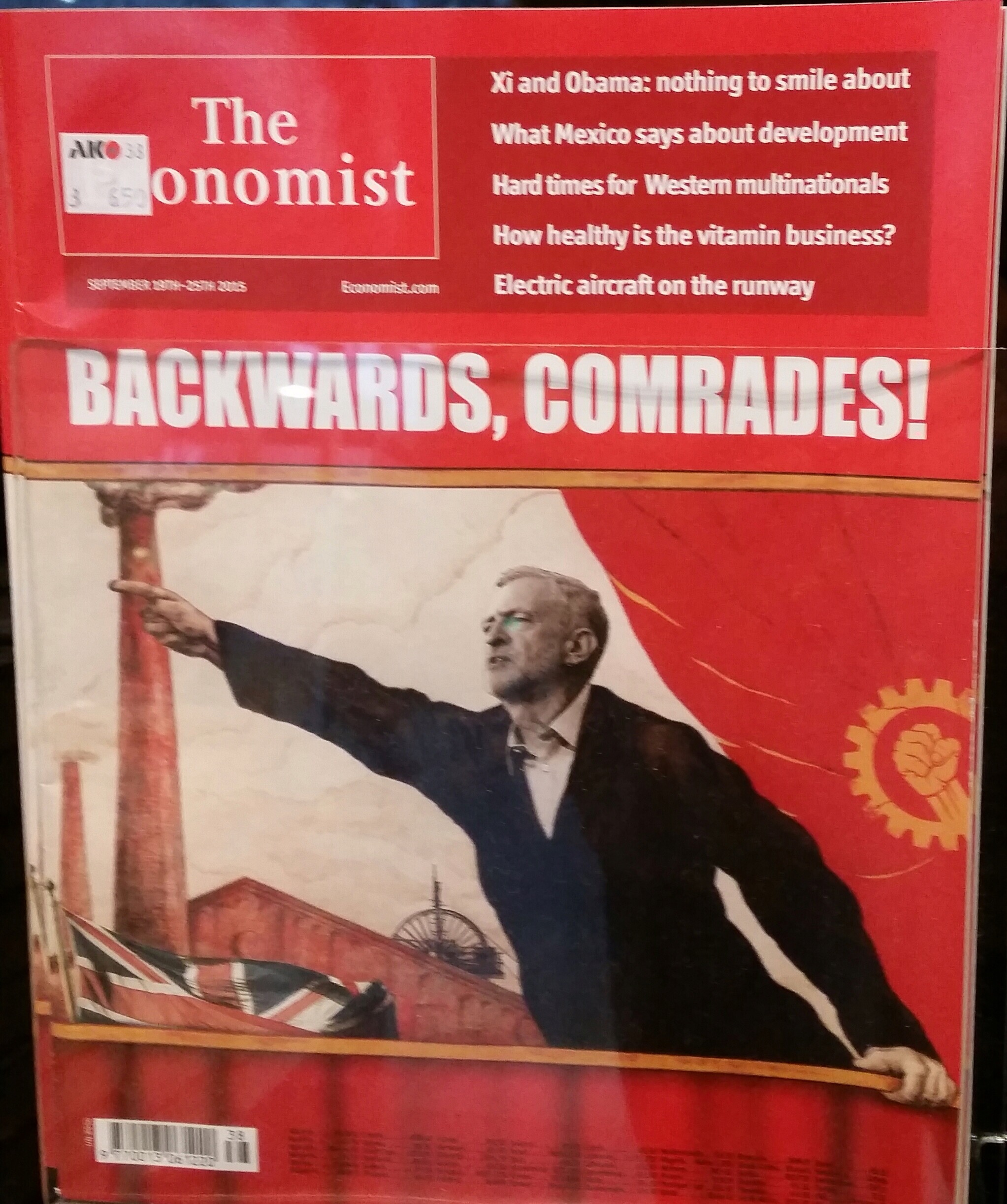
Corbyn election shows Labour’s delight in losing, says Italian PM. Okay,  based entirely on this article, I don’t think Italy’s unelected prime minister, Matteo Renzi, is in a position to comment on Corbyn’s electability. (If I’m reading his history correctly, while Mayor of Florence, Renzi earned the leadership of the Democratic party – as such, he forced the PM, Enrico Letta, to resign last year in his own favour. https://en.m.wikipedia.org/wiki/Matteo_Renzi
He says it has nothing to do with Blairite or anti-Blairite. Well,  yes it does.
He’s left of centre,  but ‘takes on trade unions and forges alliances with conservatives to further his agenda.’ How has he done that? From the same wikipedia article, his ‘government brought the Jobs Act before Parliament, which provided for, among other things, the abolition of Article 18 of the Workers’ Statute, which protected workers from unlawful dismissal.’
Sounds like a Blairite to me. And that means someone who will claim the mantle of working for the working class to line his own pockets and forge his own legacy. Yes, I’m partisan about these things.

Clinton and Blair did the same thing and spent much of their times in office screwing the workers to the delight of Wall Street and London City bankers. And paving the way for Republican/Tory successors.

Blair took the UK into Iraq when no one else in the EU saw reason in it. This did wonders for the arms dealers and helped create the ISIL we’re fighting now. It did not help the working population of Great Britain.

Renzi refers to ‘the last one to be called Red,’ Ed Milliband, as if being branded anything at all by the Daily Mail is something to run from. The thing to run from is selling out your constituency. Blair’s natural constituency, as far as I can tell, was quite similar to Cameron’s, but he claimed to be Labour. Renzi’s words and actions (as reported by the Guardian) put him in the same category. Left by name, good ol’ public schoolboy by predilection.

His policies are not entirely without merit. I’ll note that he sacked the leaders of state-owned companies who weren’t meeting expectations, rather than privatising the companies outright (the way Blair and his successors did). He then replaced them with women. A positive move.

When Renzi praises Cameron for standing up to the refugee flood at Britain’s gates, he again betrays those who should be the focus of the leadership of the left, not to mention that of the free world.

And about that headline, ‘delight in losing’ is a clickbait quote. Heaven forbid Labour voters simply vote for someone who appeals to their better angels. In America, we have huge swaths of the electorate voting not only against their better angels but against their own self-interest.

In some additional fairness to Renzi, that same Wikipedia article also mentions his opposition to austerity measures which is always a good thing in a minister claiming to be on the side against the bankers.

That phrase is displayed over a beautiful Danse Macabre in Fuessen, Germany. Spoken by Death, it means ‘Say Yes, Say No, Dance We Must. In the context of Medieval morality, it makes perfect sense. The rich, the poor, the virtuous, and the vicious all die eventually, and as such were taught what might lay beyond. 
I recently wrote about the town of Mittenwald in which a museum display indicated that the museum used to be on Jew’s Lane, but that in 1938, the name was changed. Walking through Rothenburg, Germany was a little bit different than walking through Mittenwald. At various places, one could see evidence of the former Jewish community there. Judengasse still exists – or exists again – with a plaque indicating the lane as the site of the community that was first expelled in 1520. A plaque in the garden that had once been the Jewish cemetery ‘commemorate[s] our fellow Jews who were expelled between 1933 to 1938 from Rothenburg’. Only since 1990, according to a few such plaques, has excavation of the town’s Jewish past been addressed in earnest. 
Note that Rothenburg is an ancient, well-kept town on the Romantic Road. It attracts a large number of tourists from around the world. For some reason, the region is very popular with the Japanese – enough so that signs indicating places or events of interest are posted in German, English, and Japanese. 

As Rachel and I wandered through this medieval town’s historical re-enactment weekend (commemorating since 1974 a victory that occurred in 1274), and relieved the Kathe Wohlfart shoppe of about 150 euros worth of Christmas tree decorations, and heard tourists speaking English, German, French and Japanese, I asked her ‘Why here and not Mittenwald? Why does this town pay more than lip service to its historic Jewish community (and that community’s destruction – at least twice)? Her answer was short and to the point: ‘American tourists.’ [Note: I’m a secular Jew from the US married to a secular Christian from England.]

She had a good point. Mittenwald hosts a lot of tourists – any established town in the Tyrol region will do well with tourists from Germany, Italy, and Austria, but not necessarily beyond, except for the participants in the annual nordic sports competitions. Attendants at those won’t have much time for sightseeing, is my guess.
But we’re at it again. At the moment it’s the damning of refugees from the Middle East and Africa in the press and social media, not those fleeing the Nazis. Perhaps Rev. Niemoller’s cry about speaking out for the ones everyone is speaking against before there’s no one left to speak out for you will make itself heard through the din. Now the Germans are calling for the EU to divide up the refugees teeming (and dying) on its shores somehow equally, and take care of them. [Note: NOT migrants – they haven’t left their home countries by choice – nor are they likely to be able to return any time soon. They’re seeking refuge. The hint’s in the name.] 
Now there are a lot of reasons Germany is better equipped economically and otherwise to absorb a large number of refugees than Greece or some of the other member states. [An argument might be made that supporting large-scale refugee intake programmes in Greece in exchange for – I dunno – debt relief maybe, makes a lot of sense. It’s for another blog, however.] The quartet that gets on my nerves right now are the so-called Visegrad states: Poland, Hungary, Slovakia, and the Czech Republic. These countries are fighting both against the tide of refugees, but against EU efforts to address the issue. The former US ambassador to Hungary, Eleni Kounalakis, wrote an interesting NY Times editorial on the matter this week  in which she asserts that the Hungarian authorities have been stirring up anti-refugee sentiment since this crisis was in its infancy. The thing is, these countries have had native populations of Roma (aka ‘gypsies’ – a derogatory term) for centuries. When one speaks of the 11 million victims of the Holocaust, Jews made up the majority at six million, but the number of Romani victims is variously estimated at between 220,000 to 1,500,000. Since WWII, the Visegrad countries have made little or no effort to integrate this group into society, regularly demonising them and occasionally going so far as to engage in forced sterilisation. [Oddly similar to how the US has treated poor African Americans at various times and how Australia has treated its aboriginal population. Homework: Compare and contrast.] The main issue is that parties in these countries already have a history of demagoguing an underclass to cover for their various stances and policies. Or simply to whip up hate and drum up votes. We’re doing it in the US right now, and my adopted home of the Netherlands has its own bastards in this regard. They’re all playing the same game that’s epitomised in a joke making the rounds: A billionaire, six white unemployed white people, a black person stand at a table with a dozen donuts. The billionaire takes eleven donuts and tells the white people, ‘Look out – the black guy’s gonna take your donut.’
  Many Hungarians and people all over the world who are addressing refugee crises [we haven’t seen much of the US border with Mexico in the press lately, but trust me, that situation hasn’t changed] know what needs to be done now – normal people are offering up their homes and resources to help people in need. Of course these aren’t the ones in the news. While we have to hear from the Viktor Orbans, Donald Trumps, Nigel Farages, Petra Laszlos, and Rita Verdonks of the world first, we’ve danced this dance before and really don’t need to dance it again.

Tom Robinson exhorted his audience members to ask one question when they heard a politician on TV, ‘Why is this bastard lying to me?’[1] This question came to mind when I read the response of Governor Bobby Jindal (R-Louisiana) to the US Supreme Court’s decision that recognized same-sex marriage without reservation. Jindal had this to say on Fox News, ‘My Christian faith teaches me marriage is between a man and a woman…Already Christian businesses are facing discrimination if they don’t want to participate in wedding ceremonies that violate their sincerely held beliefs’[2]

In the last few years, this phrase has crept into US legal discourse and made a pernicious mockery of the original constitutional distinctions between faith and civic responsibility.

My first response was,’ If I never hear the disingenuous phrase ‘sincerely held religious belief’ in a legal context again, it will be too bloody soon. The way it has weaseled its way into our discourse makes my skin crawl.’

scottish-highland-cow-5371276But why? Why does this phrase make me so uncomfortable? Part of it is that I’m not religious, but was raised to appreciate the dictum of Article VI of the Constitution, that ‘no religious Test shall ever be required as a Qualification to any Office or public Trust under the United States’.

Jindal continued. ‘We need to stand up for our First Amendment[3] rights. The court trumped our 10th Amendment[4] rights by overturning states’ decisions.’

In his treatise On Bullshit. Harry G. Frankfurt argues that the person who lies and the person who tells the truth both have an interest in the truth, whereas the one who bullshits is interested only in furthering his or her own interest, without regard to facts:

Since bullshit need not be false, it differs from lies in its misrepresentational intent. The bullshitter may not deceive us, or even intend to do so, either about the facts or about what he takes the facts to be. What he does necessarily attempt to deceive us about is his enterprise. His only indispensably distinctive characteristic is that in a certain way he misrepresents what he is up to.[5]

Jindal wasn’t lying, but he was bullshitting. This is the main issue I have with much of today’s political discourse, not to mention the religious demagoguery with which it often skips hand in hand. When politicians start saying that a decision should be scrapped because it goes against ‘sincerely held religious beliefs’, they’re engaging in BS. The truth or falsehood or pertinence of the matter is not at issue. What is at issue is the speaker is saying what is necessary to advance his own agenda, whatever that might be. In this case, that agenda seems to be Jindal’s presidential aspiration.

At what point does the invocation of an SHRB sink to the level of BS? To me, it’s a matter of whether the expression seeks to expand or contract the rights of others. In social media, I first expressed my disgust with Jindal’s position rather obliquely. A friend replied with reference to Sikhs and the right to incorporate traditional garb into school uniforms. From my perspective this is not a matter of sincere religious belief impinging on my right to do anything, and I support the student’s choice of attire.

When the Supreme Court rules, for example, that an employer can deny employees medical insurance coverage of any kind based on SHRB, this to me is BS on two levels. First, it’s a willful misinterpretation of the legislation in question (the Affordable Care Act) and it contracts the rights of the employee. My feeling is that an employer should never have had the ability to override the private decisions of those in his employ, and there’s probably legal precedent for expanding the right of the employee to keep his or her life outside of work a separate entity. (On my part this might be a misreading of various aspects of the Civil Rights Act. Title VII covers discrimination of various kinds.)

But the case I’m working from here, the decision in Burwell v. Hobby Lobby involves an employer pushing back against a law for whatever reason, and convincing a majority of the nine justices of the SC to give his position legal status. The decision itself might stink of bull if the justice’s opinion doesn’t reflect an honest reading of the law as it relates to legal and constitutional precedent.

Why does this decision stink? The ruling states that ‘the mandate was not the least restrictive way to ensure access to contraceptive care, noting that a less restrictive alternative was being provided for religious non-profits.’[6] Which of the court’s six male justices knew of the unsigned injunction they would hand down three days later, vacating this alternative? Of those six, five voted with the majority in Burwell.

While the justices told the truth as it stood in the moment: the religious non-profit method was in effect and could be used. It stinks because the honesty of the statement was only a means for the court’s majority to vacate part of the ACA without taking responsibility for it.

Does it matter that they didn’t sign the decision, that they didn’t defend their work? Had there been no signed dissent, I think it might. But I’m not writing about cowardice here. In her Wheaton College v. Burwell dissent, Justice Sotomayor recognised the BS of the Hobby Lobby ruling, ‘Let me be absolutely clear: I do not doubt that Wheaton genuinely believes that signing the self-certification form is contrary to its religious beliefs. But thinking one’s religious beliefs are substantially burdened … does not make it so.’[7]

Precisely.

Finally, I want to offer the truly cynical option that honesty and dishonesty are always side effects of discourse. Playwright David Mamet once offered, ‘[N]o one ever speaks except to obtain an objective. That’s the only reason anyone ever opens their mouth, onstage or offstage. They may use a language that seems revealing, but if so, it’s just coincidence, because what they’re trying to do is accomplish an objective.’[8]

I admit under duress that I’m only sensitive to BS when it serves those who argue against my sincerely held political positions, and am less sensitive to it when it serves my positions.


1. New Year’s eve, 1989-90, London, though I have a feeling it was his intro to one song or another, possibly Up Against the Wall, at most shows.

2. http://insider.foxnews.com/2015/06/29/bobby-jindal-gay-marriage-ruling-left-wants-our-first-amendment-rights (retrieved 5 July 2015)

3. Congress shall make no law respecting an establishment of religion, or prohibiting the free exercise thereof; or abridging the freedom of speech, or of the press; or the right of the people peaceably to assemble, and to petition the Government for a redress of grievances.

4. The powers not delegated to the United States by the Constitution, nor prohibited by it to the States, are reserved to the States respectively, or to the people.

5. Frankfurt, Harry G. On Bullshit. Princeton, NJ: Princeton University Press, 2005.

6. https://en.wikipedia.org/wiki/Burwell_v._Hobby_Lobby_Stores,_Inc. (retrieved 5 July 2015)

7. Quoted in “Female Justices Issue Scathing Dissent In The First Post-Hobby Lobby Birth Control Exemption”, http://www.businessinsider.com/sotomayor-ginsburg-kagan-dissent-wheaton-college-decision-supreme-court-2014-7#ixzz3f25DaMex (retrieved 5 July 2015)

8. David Mamet, The Art of Theater No. 11, interviewed by John Lahr, http://www.theparisreview.org/interviews/1280/the-art-of-theater-no-11-david-mame (retrieved 5 July 2015)

In my last entry in this occasional history, I made the claim that the Yardbirds were the most important band of the 60s in term of their lasting influence through the 70s. Why? The main reason is that three of the four most influential guitarists (and possibly musicians) that came out of rock and roll passed through this band: Jimmy Page went on to form Led Zeppelin; Clapton formed Cream, Blind Faith, and Derek & the Dominoes before embarking on a prolific solo career; and Jeff Beck’s technique has been respected and imitated throughout rock music despite a less prolific/critically lauded output following his collaborations with Rod Stewart. Beck’s 70s power trio Beck, Bogart, and Appice possibly matched Cream for sheer brilliance.

Note: Most influential != greatest

The fourth would be Jimi Hendrix. We’ll get to him in a future post.

whiteboybluesI also discussed in the last post something of the love these bands had for the old blues artists. What I didn’t know is that many of them played with the blues greats when they toured England. I recently read Ian MacLagan’s autobiography. MacLagan was a keyboardist in a number of bands (including The Small Faces and The Faces (the latter of which featured Rod Stewart on vocals) with whom he’s most closely associated, the Rolling Stones, The New Barbarians, and in the last decade or so, Billy Bragg -Alas he passed away a couple of months ago. MacLagen got his start with an act called The Muleskinners. He discusses first a missed opportunity to back Howlin’ Wolf (the agent told them a date that was a week early and they had to hustle to get enough petrol to get back to London from Sheffield).

“We got another chance to play with The Wolf later though, when Marquee Artists brought him, Sonny Boy Williamson and Little Walter over from the States. As a rule, the Yardbirds backed Sonny Boy, and if they weren’t available, the Authentics got the job. This pecking order for backing blues legends ended when it eventually reached The Muleskinners. We didn’t mind. We were more than honoured to get the chance to meet and play with such fabulous players. Let’s face it, we had a lot to learn and who better to learn it from than the greats?” (All the Rage, Kindle edition, Location 793.) )

Clapton’s path is interesting: He ditched the Yardbirds claiming they were abandoning their blues roots. Fair enough. His tenure in John Mayall’s Bluesbreakers provides much evidence of his dedication to the form. The weird thing is, he took this side trip into psychedelia with Cream. Cream didn’t last long as a band (less than two years, IIRC), but they produced four or five classic albums. Cream’s bassist, Jack Bruce passed last year, though most thought drummer Ginger Baker would be the first to go. As with almost all the songs on Fresh Cream, Bruce supplied lead vocals. Blind Faith only released one, but it’s also six tracks of classics.

Read the rest of this entry »