Archives for category: UK

The Guardian’s Northern Ireland page has nearly a dozen articles right now related to Lyra McKee, the journalist shot dead by the so-called New IRA on Holy Thursday. (here, here, here, here, here, here, here, here, here) I’ve got several different kinds of grief over this murder that I’m not sure what to do with.

I think credit goes to Belfast TelegraphMany are expressing hope that in the wake of her death, some collaboration might occur between the various groups in NI and that perhaps the political parties will see through their differences and get something done. Talks between the DUP (the party that’s also propping up Mrs May in Westminster) and Sinn Fein broke down almost two and a half years ago and the province has been without a government ever since. (Though it seems talks may yet happen. Link at the bottom.)

I’ve been jabbering in support of Irish unity for decades, generally without enough of a grasp of the history or of human nature to make more than an emotional dent in the matter. Today, however, I say that the New IRA, the Provisional IRA, the straight-up old-fashioned IRA and any other group using terrorist measures to achieve their goals have got to go.

First: These measures don’t work. All through the Troubles and even in the 21 years since the Good Friday Agreement, these organizations (with the help of Unionist groups, don’t get me wrong – ain’t no love lost between me and the folks who foist Marching Season on us every year) have only succeeded in keeping much of NI from seeing any kind of dividend from all the years of fighting. (Note my earlier comment about my grasp of all the history surrounding this being weak. I can analyze the bejesus out of James Joyce, but I’m honestly buggered if I can makes sense of the last 200 years in Ireland.)

Second: I know that the immediate (hypothetical) disappearance of these groups will do nothing to heal literally hundreds of years of pain associated with the occupation of Ireland. Occupation. Complicated word, that. Civil War? Police Action? This is too short a rant to address what the situation should be called. I’m pretty sure that dissertations have been written on just that.

What has to go is mealy-mouthed bull like that coming from New IRA. The statement quoted by the Guardian reads:

“On Thursday night, following an incursion on the Creggan by heavily armed British crown forces which provoked rioting, the IRA deployed our volunteers to engage. We have instructed our volunteers to take the utmost care in future when engaging the enemy, and put in place measures to help ensure this.

“In the course of attacking the enemy Lyra McKee was tragically killed while standing beside enemy forces. The IRA offer our full and sincere apologies to the partner, family and friends of Lyra McKee for her death.”

This won’t do. It simply won’t do. ‘Our volunteers’ killed indiscriminately. ‘Our volunteers’ went heavily armed into a riot zone and started firing, but couldn’t figure out how to hit the ones wearing the uniform of their enemy. And fired enough rounds that recordings show someone picking up shell casings.

This won’t do. Peace at this late date doesn’t come through the cowardice evidenced by this statement.

And what else won’t do? In the event the goals of the various IRAs are actually met, I’d like to believe that the government of Dublin would do its own utmost to make sure these folks hold no position and that the ones who lead these volunteers will see justice.

I probably hope beyond hope.

I composed the text above a few hours ago and now see (also in the Guardian – honest, I do read other news sources) that a deal has been reached for further power-sharing talks. As I say, hope springs eternal.

I know that everything I write about below is much more complicated than I present. Please keep this in mind.

ETA: The population of Northern Ireland is complicated. I use the phrase ‘majority English’ below, but the colonisation of NI includes a lot of Scots (known as Ulster Scots) who were granted lands confiscated from fleeing Gaelic nobility in the early 17th Century. My English brother-in-law indicates that refusal to grant the Ulster Scots language equal footing with Irish Gaelic is a sticking point in the peace process.

The situation in Ireland with regards to the backstop and one part of the island belonging to the UK while the rest of the island is its own republic exists because of history, that nightmare from which it is increasingly difficult for any of us to awake. At the time of Irish independence, earned by a full-on uprising before and after WW1 (and put on hold so the Great War could actually be won) , the six counties in the north (two thirds of the province of Ulster) voted to stay in the UK based on the fact that they had majority English population. This is a remnant of 250-plus years of English colonization of the island.

Oliver Cromwell went over in the 1600s to subdue the Catholics. Cromwell wasn’t just a protestant of the high church Henry VIII C of E variety – Catholic in all but name, but a Puritan. He’d shown his animus towards Catholics by engineering the beheading of England’s Catholic monarch, Charles I. (Dante might have placed Cromwell in the ninth circle of Hell, reserved for traitors.) So from sometime in the 17th century through the 19th, Charles Stewart Parnell notwithstanding, the English had been subduing a different nation – the same as they’d done with Scotland. (The Acts of Union with Scotland were enacted in 1707 and are also a really complicated matter. The Acts of Union with Ireland were enacted in 1800.)

All of that said, there was apparently enough fear or some such witlessness in what became Northern Ireland, that the peace deal included leaving six of Ireland’s 32 counties in the UK. The engineered Irish Famine of the 1840s and 50s also had something to do with the population imbalance. Engineered? Yes. The majority Catholic population were barred for two centuries from owning or leasing land and only in 1829 could they sit in their own parliament. The landowners exported the food that could have fed the native population during Black ’47 and the years that followed. You can read up yourselves on the mass evictions of Irish tenants by English landowners at the time. Is it any wonder a million emigrated and another million died?

https://www.youtube.com/watch?v=nTO7nXw4StY

So after the partition and the independence of what became the Irish Free State and later the Republic of Ireland in 1921, there are still factions wanting to unify the entire Island as the Republic of Ireland. The IRA is part of that. Sinn Fein is another (and often referred to as the civilian arm of the IRA). Yes, terrorists, we know. We’ve seen the movies. Friends and family of mine lived through some of the attacks on English soil in the 1980s. It’s not as though the Irish didn’t/don’t have a grievance though. I always point to the beastliness of Marching Season – that period of each year when when the Orange orders – protestants – in Scotland and Northern Ireland march through Catholic neighbourhoods to commemorate William of Orange’s victory in the Battle of the Boyne in 16 effing 90.

This is an obvious extension of the cry one hears these days that “we” won World War II, we can survive Brexit. ‘”We” were victorious over the Catholics 330 years ago, so we get to shove it down their throats now.’

If some merry band of undereducated nationalist shits did that in my back yard each year, I’d feel like terrorising them back as well. So now we have this situation where 20 years after an agreement was worked out to bring some measure of peace to the island, there’s a very good chance of it all falling apart. Just as America has the very small Mitch McConnell blocking legislative progress, this situation has the very small Arlene Foster, whose Northern Ireland DUP is propping up Mrs. May’s government, blocking the possibility of moving forward with a relatively peaceful solution. (She has help, of course, from May, and Corbyn, and a large number of people who will get very rich once the UK is out from under the EU’s regulatory heel.)

Yeah. The Democratic Unionist Party. Founded by Ian Paisley, a man who made his name by opposing Catholic civil rights in Northern Ireland, and in fact opposing any kind of peace process (including the Good Friday accords) and who refused to share power with the Catholics for nine years after the accords were signed. The DUP is also involved in the creation of two paramilitary units to oppose the peace process. Not really folks who have the best interests of the peace-loving members of the Northern Irish populace at heart.

The peace established by the Good Friday Agreement was earned in part by softening the border between Northern Ireland and the Republic. Possible because the sides are (for a few more weeks at least) both members of the European Union. The border, which as a few have pointed out, runs down the middle of streets and in some cases through people’s houses, is porous enough that people from each side go to work on the other – without border checks, which of course were common in the years before due to there being terrorist factions.

Make some kind of peace with the group at war, and many of those problems go away. Take the peace away – by exiting without actual plans from the organization that brokered and helped to maintain it – and the problems come back, especially when nothing has been done to redirect the energy of all that Marching Season implies.

Do I need to mention the idiocy of the BBC’s John Humpreys asking Ireland’s Europe Minister Helen McEntee why the Republic doesn’t rejoin the UK?

I met a woman from Dublin last week who is of the opinion that she *might* see a unified Ireland in her lifetime. That’s been my hope, as an amateur Celtophile, for decades. There are those for whom the hope of a united Ireland has been the hope of centuries.

England’s colonies, of which Ireland was obviously one, are former for several good reasons. None of those reasons include England leaving because staying was wrong. England has always outstayed her welcome and with the betrayal that is Brexit, she has outstayed her welcome on the last bit of the Emerald Isle she yet holds.

Links:

Donald Tusk: ‘special place in hell’ for those who backed Brexit without plan
Brexit: May’s pledge on Irish border threatens to reopen Tory rift
Ireland dismisses suggestion it should quit EU and join UK
https://en.wikipedia.org/wiki/Battle_of_the_Boyne
https://en.wikipedia.org/wiki/Acts_of_Union_1707
https://en.wikipedia.org/wiki/Acts_of_Union_1800

MP Ben Bradley wants to ‘fix Tory image problem’ according to a massively disingenuous BBC Newsbeat article. According to the young conservative MP for Mansfield, the Tories’ problem is that they’re perceived by the young as being old, grey, and boring. He wants to appeal to ‘Young people, people from ethnic minorities who just don’t vote for us’. He’s pushing for conservatives from popular culture to get the message out. The article goes on to say that ‘any improvement in image would have to be backed up by policy.’income_inequality

You can see the problem here, right? Tory policies that appeal to young voters are pretty thin on the ground. The article cites ‘The Conservatives cut housing benefits for 18 to 21-year-olds, introduced a lower minimum wage for under-25s and is the only major party against lowering the voting age to 16.’ Well, there’s a start. What else?

How about hard Brexit? Voters under 50 voted overwhelming to remain in the EU. (18-24s did so by a 3-1 margin; 56% of 25-49s voted remain.) All current evidence points to the Tories staying on that very unpopular highway despite all the signs advising them to turn off.

Brexit, like the recent US tax plan, is a boondoggle for the already very wealthy. The reason the government is pushing it so hard, despite the referendum having been clearly an advisory measure (see the first paragraph here, is because there’s so much money to be made getting Britain out from under EU regulatory regimes. It’s not as though the boot is onerous, just that it’s portrayed as such by whiny-ass bitches like Rupert Murdoch. Murdoch’s media empire was massively pro-Brexit. Why? When Anthony Hilton of the Evening Standard asked Rupert Murdoch why he was so opposed to the European Union, he replied, ‘That’s easy. When I go into Downing Street they do what I say; when I go to Brussels they take no notice.’

That’s several other articles that have already been written by folks better at this than I am. Laurie Penny, for example.

What does this have to do with what young people want? Young people want a government that acts in the interests of all citizens and does so with transparency. Simple.

What else do young people want? They want for the parties in power to act with resolve against keeping them in poverty. A fully functioning and fully funded NHS and reasonable/zero tuition fees are absolutely at the heart of this.

Reasonable secondary education tuition fees. You know, the ability to leave college not ass-deep in debt. Anywhere in the Tory manifesto? Of course not. If every second 23 year old already owes one of the banks nearly 30,000 pounds, the banks are happy. (Personal history: Tuition fees were introduced in the California public college/university system by Ronald Reagan when he was governor. Once the fee was introduced, it only went up. The CSU system’s tuition increased about 300% in the four years I attended (1985-1989) and is now almost USD 6000 per year. The UC system is over USD 12000 per year.

However, when the banks are happy, Tory campaigns are funded. One can’t expect the current government to rescind that.

And the NHS? Chronically underfunded under the Tories for almost seven years. Setting the NHS up for failure seems to be the Conservative party’s national sport. And they’re winning. They set up metrics like getting some percentage of A&E patients seen in under four hours that they then don’t fund the service to meet. And the papers all bemoan how poorly the NHS is doing. The rest of the world sees in this an obvious ploy. Set the NHS up to fail and then sell it off to the lowest bidder. Worked out beautifully for the Royal Mail as well, but the Royal Mail is only tangentially related to the real world health of its users.

What else? Safe housing estates. Because young people don’t just think only about themselves (all the stupid cracks about Millennials aside), they want for the people amongst us with the least to at least be safe in their own flats. You’d think that’d be a no-brainer, especially after the Grenfell tragedy. Nope, we’re not going to do anything to require property owners to make sure they’re buildings aren’t twenty-story fire traps. Thanks for asking.

Other things? How about a rail system that doesn’t gouge the young commuter (who may no longer be able afford to live near the city they work in) out of a large chunk of their pay packet. Well, nationalization isn’t going to happen, but rail networks that work for commuters and not shareholders? Too much to ask. I suppose the manifesto’s commitment to putting 40 billion pounds into improving Britain’s transport over the next decade is nothing to sneeze at, though it’s a drop in the bucket compared to the rail companies’ revenue. In 2016 alone, one parent of Govia Thameslink (operator of Gatwick Express, amongst other services) saw revenues of 3.4 billion. And because of privatization, Govia Thameslink is only one of about 20 different rail operators in the UK.

So, to recap: The way to appeal to the young is to champion and implement policies that affect them and the people they see around them positively rather than negatively. It’s quite simple, but the Tories know who butters their crumpets, and it’s not the youth of Britain.

I think this might be another one of those cases where a politician is saying outrageous things to distract the public from what’s really going on. I honestly don’t know what Theresa May’s agenda is. She’s not as transparent as say Jeremy Hunt. We know he’s trying to crush the doctors’ unions because of the massive amount of money that will come his way from a privatised NHS. May? Perhaps I just don’t know enough about her. But at the moment she’s making noise that rather than leave the EU, Britain should just leave the European Convention on Human Rights. (Let’s not entertain, for the moment, the fact that membership in the EU requires membership in the ECHR.)
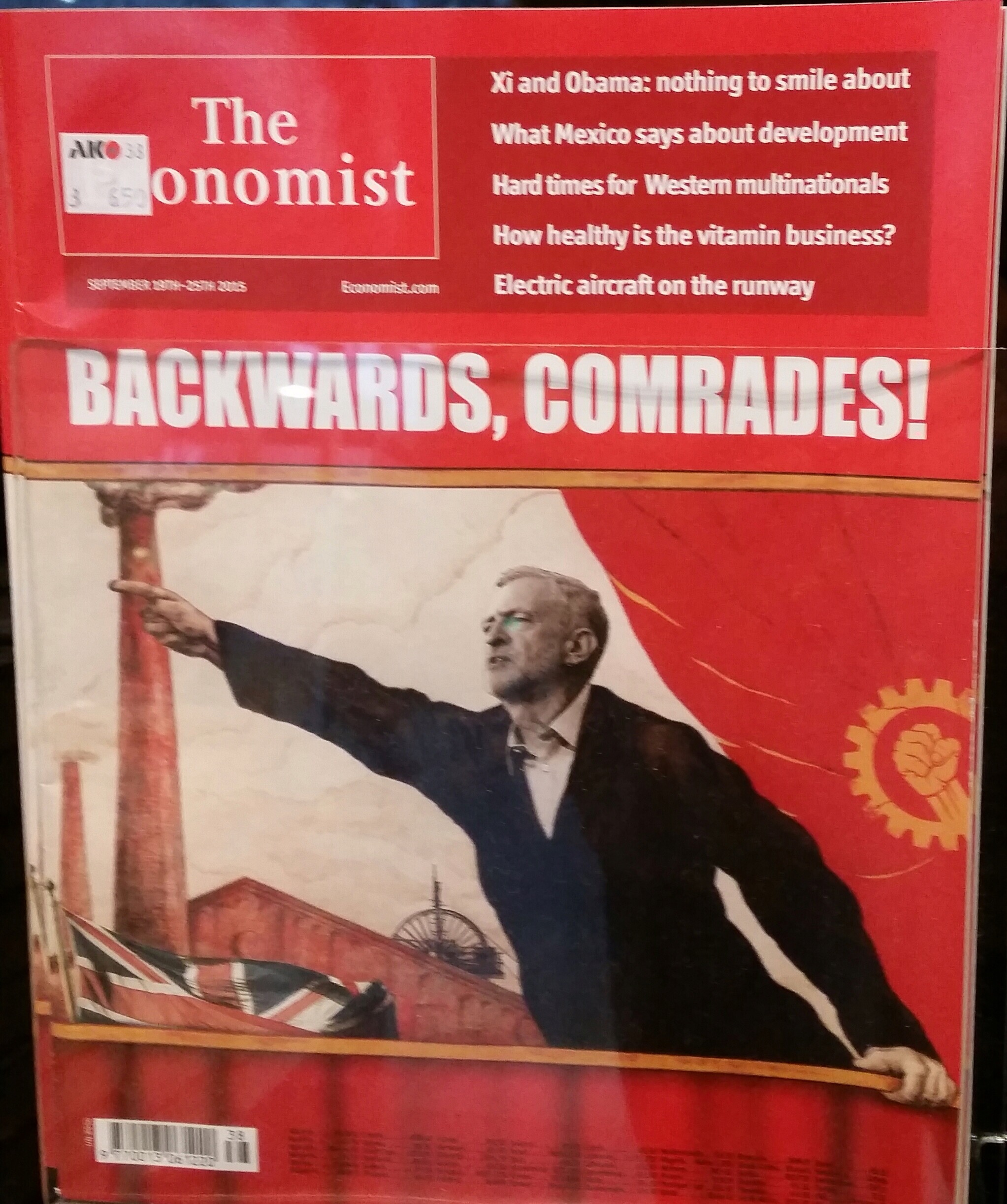
Her position, according to The Guardian, is that the ECHR has tied Britain’s hands with regard deportation of extremists such as Abu Hamza and Abu Qatada, ‘and does nothing to change the attitudes of governments like Russia’s when it comes to human rights.’
This is where I usually stop reading when these things come up. The point of human rights conventions is to bind the signatories to be better at this stuff than non-signatories. The bottom line is that it doesn’t matter what any other country does when it comes to human rights. The UK decided at a certain point to be one of the good guys in this regard and say, ‘We will respect very basic human rights and will treat all with due process.’
It’s a very short document, clocking in at just 55 large-print pages, many of which are taken up with repetitions of ratification and depository information. Life, liberty, security, prohibition of torture, and prohibition of slavery all appear on the first page. The other basics, including due process, right to thought, expression, religion, privacy, and assembly come on the next seven pages. The next 16 cover the court itself. The balance covers the various protocols on human rights and freedoms. Interesting bit: In 1983, when the death penalty was abolished under Protocol 6, there was an addendum specifying that the death penalty could be imposed under certain circumstances in time of war. In 2002 this addendum was rescinded under Protocol 13.
With this in mind, it’s BS about other countries keeping us from doing what’s right (not just what’s right according to treaties we’ve signed) that got people so worked up when Dick Cheney said we had to torture to get information out of supposed bad guys. No, we don’t. We’re better than that, and have signed conventions (in that case, The Geneva Convention, but the idea is the same) as outward signs that we strive always to be better than that. Except when our leaders say, ‘Nah, we don’t have to be better – we’re exceptional.’ Or some such noise.
May was discussing Britain’s ECHR responsibilities in the context of a speech ostensibly supporting continued EU membership. She went on to say, however, ‘The states now negotiating to join the EU include Albania, Serbia and Turkey – countries with poor populations and serious problems with organised crime, corruption, and sometimes even terrorism. We have to ask ourselves, is it really right that the EU should just continue to expand, conferring upon all new member states all the rights of membership?’ Good question, I suppose, but the UK has an equal say in the admission of other countries to the EU. Organised crime and corruption weren’t issues when Italy and Greece joined. Or perhaps not to the same extent. She just wants some to be more equal than others.
May went on to say that Britain should be able to draft and amend at its own bills of human rights that apply to Britons. Again, we’re better than that. (Yes, I’m an American married to an English woman and say ‘we’ even though I have few rights to call myself a Brit. According to one friend, knowing why the M25 is called The Road To Hell is sufficient.) We should be able to look Europe and the world in the eye and say that the rights we enjoy should be available to all and that we’ll fight for that to be so. (It demeans weasels to say that May is trying to weasel Britain out of her responsibilities under UCHR.)
A week or so ago I read a screed denouncing new film versions of The Jungle Book and naming Rudyard Kipling a racist expletivedeleted. This article quoted extensively from Kipling’s poem The White Man’s Burden. Yeah, racist to the core with its references to colonised peoples as ‘half-devil, half-child’. The title itself makes us modern progressives cringe at the thought that whiteness alone made one group responsible for bringing others to modernity. What Kipling was arguing for, however, is that those who consider themselves civilised ‘fill the mouth of famine and bid the sickness cease’ even as others, no matter what we name them ‘bring all (y)our hope to naught.’ Yes, it’s terribly racist to name those others ‘sloth and heathen folly’, but the burden Kipling lays upon us is to do the work. In the Jewish tradition, there’s the concept of Tikkun Olam, heal the world. Get out and do the work of peace, of healing, of working for the safety of the disadvantaged. While Kipling names both the objects of the work and its obstacles with terms we consider abhorrent now (and were, in truth, abhorrent in 1899), the call is to be the good guy and do the work of making the world better.
May, on the other hand, is calling on Britain, do default on its obligations to better itself and contribute to the betterment of the European collective.

Corbyn election shows Labour’s delight in losing, says Italian PM. Okay,  based entirely on this article, I don’t think Italy’s unelected prime minister, Matteo Renzi, is in a position to comment on Corbyn’s electability. (If I’m reading his history correctly, while Mayor of Florence, Renzi earned the leadership of the Democratic party – as such, he forced the PM, Enrico Letta, to resign last year in his own favour. https://en.m.wikipedia.org/wiki/Matteo_Renzi
He says it has nothing to do with Blairite or anti-Blairite. Well,  yes it does.
He’s left of centre,  but ‘takes on trade unions and forges alliances with conservatives to further his agenda.’ How has he done that? From the same wikipedia article, his ‘government brought the Jobs Act before Parliament, which provided for, among other things, the abolition of Article 18 of the Workers’ Statute, which protected workers from unlawful dismissal.’
Sounds like a Blairite to me. And that means someone who will claim the mantle of working for the working class to line his own pockets and forge his own legacy. Yes, I’m partisan about these things.

Clinton and Blair did the same thing and spent much of their times in office screwing the workers to the delight of Wall Street and London City bankers. And paving the way for Republican/Tory successors.

Blair took the UK into Iraq when no one else in the EU saw reason in it. This did wonders for the arms dealers and helped create the ISIL we’re fighting now. It did not help the working population of Great Britain.

Renzi refers to ‘the last one to be called Red,’ Ed Milliband, as if being branded anything at all by the Daily Mail is something to run from. The thing to run from is selling out your constituency. Blair’s natural constituency, as far as I can tell, was quite similar to Cameron’s, but he claimed to be Labour. Renzi’s words and actions (as reported by the Guardian) put him in the same category. Left by name, good ol’ public schoolboy by predilection.

His policies are not entirely without merit. I’ll note that he sacked the leaders of state-owned companies who weren’t meeting expectations, rather than privatising the companies outright (the way Blair and his successors did). He then replaced them with women. A positive move.

When Renzi praises Cameron for standing up to the refugee flood at Britain’s gates, he again betrays those who should be the focus of the leadership of the left, not to mention that of the free world.

And about that headline, ‘delight in losing’ is a clickbait quote. Heaven forbid Labour voters simply vote for someone who appeals to their better angels. In America, we have huge swaths of the electorate voting not only against their better angels but against their own self-interest.

In some additional fairness to Renzi, that same Wikipedia article also mentions his opposition to austerity measures which is always a good thing in a minister claiming to be on the side against the bankers.