Archives for category: United States

I should write something about the truck murder of four young Israeli soldiers by a Palestinian to provide balance of some sort to my recent pro-Palestinian posts. There’s not much to say. The attack was despicable as was the praise heaped on the attacker by Hamas.

A couple of days I started taking some notes towards a discussion of the fascism coming to roost in the US. This was before the latest reports of Trump’s Manchurian nature, coming in the form of possible compromising photographs of Trump with prostitutes in a Moscow hotel. It hasn’t mattered in months how much he’s said and done that positively disgusts most of America. For all her faults, and all the sleaze of her presidential campaign, Hilary Clinton is 100 times the president Trump could ever hope to be, but for a few nasty issues.
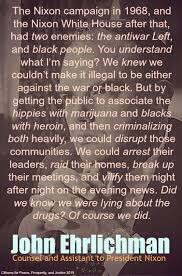
An essay I read a couple of years ago asserted that no Republican president since Eisenhower had taken office without the shadow of treason. Nixon subverted the peace talks in Vietnam; Reagan made deals with Iran that subverted negotiations to release the US hostages; George W. Bush rode in on Sandra Day O’Connor’s vote to shut down the Florida recount. (Poppy Bush seems to have defeated Michael Dukakis fair and square. The two justices he put on the Supreme Court, David Souter and Clarence Thomas, voted on opposite sides of Bush v. Gore.) Of course I can’t find the reference now.

(On Nixon: he lost by a hair in 1960, won by a hair in ’68 and only because RFK was assassinated and Humphrey wasn’t up to the task, and committed treasonous acts to win in ’72. Only for those did he and his administration pay. The text in the sidebar doesn’t even come into play, nor does it acknowledge some of the good Nixon did, such as signing the bill to create the soon to be gutted Environmental Protection Agency.)

We seem to have forgotten in the last two months about the highly questionable razor thin margins by which Trump supposedly won key battleground states. Were the actions of election officials treasonable? Possibly. Were the goons challenging every effort at a recount in Michigan. (This is another case of having read an article on the subject and now finding only articles on the challenges to Jill Stein’s recount efforts. My Google-fu has never been great. I gotta start bookmarking those articles.)

Are partisan gerrymandering and the implementation of onerous voter ID laws treasonous? Probably not. Are they (small-d) democratic? Absolutely not. And the fact that many states are gerrymandered now to the point that ten times more votes are needed to elect a Democrat than to elect a Republican now pretty much guarantees Republican majorities in those legislatures and in the federal government. I fear for our ability to recover the country from that imbalance.The allegations of Russian involvement in the election certainly point to treasonous offences on the part of the Republican party. James Comey sitting on this information but releasing that idiotic non-report regarding (again) Secretary Clinton’s emails days before the election certainly points to a misdeed if not an actual crime.

And I would mind the state of affairs less if Republicans behaved honourably. If they took legislative proposals and debated them on their merits. If they worked with the executive branch in good faith. For the last eight years they’ve taken the position that thwarting the president and the needs of the people, as long as it kept some other group happy (insurance companies, bankers, oil companies, racist constituents, for example) was fine. And it’s not as though left-wing legislators were acting that far to the left. It’s become astoundingly rare for any legislation that benefits the working class to make any headway at the federal level. This page is in support of a petition to challenge federal corruption, but the study it quotes finds that public opinion has little to no effect on what actually gets passed into law. Not surprising, but terribly troubling.

Last night I saw Watch on the Rhine with Bette Davis and Paul Lukas from 1943. It’s an interesting counterpoint to Casablanca in which an American woman and her German husband and their three children return to the woman’s home in Virginia in 1940 to connect with family members. The husband fought against Franco in Spain and had been fighting against Hitler’s forces in Germany and Austria trying to keep the resistance alive. The conflict involves a dissolute Romanian count who hangs out at the German embassy and tries to blackmail our hero. While it covers similar ground, Watch on the Rhine lacks Casablanca‘s emotional growth and romantic punch. And the acting (or perhaps the direction) isn’t as good, though Lukas won best actor at the Oscars that year for his role. That said, its clarion call to get on the right side of the battle and to keep fighting is unmistakeable.

I’m not sure I have a point right now, and if I do, it’s that the times ahead are going to get worse before they get better and I’m confounded if I know how we’re going to get out the other end with any kind of national soul intact. And the battle lines are being drawn.
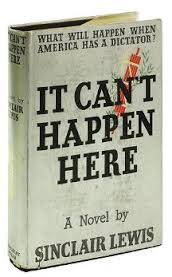
Well, the electoral college failed yesterday to do what it was put in place to do – to save the republic from the election of a madman, demagogue, or simply one unqualified to hold the office.
it-cant-happen-hereAnd we now have all three, plus his coterie of supremely unqualified department heads. No, they’re all qualified, and sworn, to destroy the very agencies they’ve been chosen to lead. There’s the treasonous way in which he was ‘elected’ and the questionably legal means by which the Trump organisation has prevented effective recounts in states he ‘won’ by small margins.
I’m not the only Cassandra predicting that fascism has finally come to the US. I’d like to believe I’m wrong. I’d love to be proven wrong, but all evidence seems to point to the last nails being hammered into the coffin of the American experiment.
And the election of someone who can be baited in less than 140 characters to say and do things that are (to say the least) diplomatically unsound at a time of such global uncertainty, leads me to consider (not for the first time) that if we’re not already in World War III, we’re not far from it. The assassination of Russia’s ambassador to Turkey yesterday would indicate a step closer to that horrible scenario if it weren’t for a weird history of assassinations of Turkish diplomats. (I hadn’t recalled the spate of these things that occurred in the 70s and 80s, but Rachel Maddow enumerated them on last night’s programme.)
It’s possible that the fall of Aleppo might signal something resembling the fall of Poland in 1939, but history doesn’t repeat that cleanly, and obviously no one has signed on to an agreement that would only now precipitate a wider conflict. Given Russia’s role in both Syria and in the US election, it’s not as though we’d be entering on the opposing side at this point.
The Trump election and Farage’s victory in the Brexit vote and a few other western political occurrences seem to argue for a rise in right-wing populism. Austria managed not to elect a fascist leader president a few weeks ago in a runoff election and the victory of a gent to the left was hailed as a triumph of sanity. Yeah, but the fascist still got 47% of the vote. And now that same fascist, Heinz-Christian Strache, is in talks with Trump’s new national security adviser. In the last couple weeks Geert Wilders, the bleach blond leader of the Dutch fascists (Partij Voor Vrijheid – the party for freedom, whatever that means) has been seeing a rise in his prospects. Elections for the Dutch lower house (tweede kamer) occur next year. I need to do some research, but I think that the current PM is not running again.
And, in the category of fascist power grabs, we have that craziness in North Carolina. Republican governor loses race, so Republican legislature passes a bunch of laws stripping the new governor of most of the governor’s power, just in time for the outgoing guy to sign them.

…About how we never/all saw this coming. But a few folks did. And it’s been brewing for 4, 8, 36 years. Or longer. A couple of months ago, about when Hillary’s ‘basket of deplorables’ comment was making the rounds, I remembered Mitt Romney’s ‘binders of women’ reference from one of his 2012 debates with Obama. Mitt was monumentally out of touch, and not half the orator Obama is, but he was making a valid point: He knew that he needed to improve the gender balance in his administration and he told his key players to bring him some CVs to work with.

And the left nailed him to the wall over it.

Don’t get me wrong: I preferred to have the Obamas’ grace, dignity, and gravitas in the White House these last eight years. In retrospect, I wondered what more could have gotten done had it been Romney working with his own party. Mind you, the GOP might have done to him what they did to John Boehner.

I had my first conversation about the election with the gentleman at the dry cleaner this afternoon. We were talking in English because my Dutch is lousy, and he said ‘Congratulations on your new president,’ without irony that I could detect. We chatted for a few minutes and he indicated a low opinion of Mrs. Clinton. It wasn’t the time or the place to get into it with him, maar na negen jaren ben ik nog nooit zo gemotiveerd om nederlands te leren. (After nine years, I’ve never been so motivated to learn Dutch.)

I do hope we survive the next four years, but I fear for the republic.

The DecodeDC podcast aired a discussion (episode 67) with English economist Richard Reeves of the Brookings Institution who talks about ways to measure the (in)equality of opportunity in America. His study divides the population into slices of 20% each – families who are in the top 20% of earners (about $150,000/year for a family of four) are 1s, the next 20% are 2s and so forth. The research found that if you’re a 1, your children will also be 1s and if you’re a 5, your children will remain in that state as well. Not too counter-intuitive, these days. He then brings up the obvious point that  there are several gaps: Marriage, Education, Neighourhood, and Race, like so:

  • Children raised by  two parents are more likely to move up than children raised by one.
  • Children raised by parents who earn degrees are more likely to move up.
  • Children raised in poor neighbourhoods are more likely to stay in them
  • Non-white children are more likely to remain in their quintiles or slip into lower ones than white children.

What I missed from the podcast clip (but is well-covered in Reeves’ own reporting below) was how these numbers have changed over the last hundred years.

income_inequalityMy guess was that 100 years ago, the numbers were a little better than they are now – mobility of immigrant populations especially was based a lot on making it by the sweat of their labours. However, poor blacks were more likely to remain poor blacks. There was probably a little more mobility in the post-WW1 boom time for non-blacks, but this was probably exaggerated, much as the mobility of the late 90s mini-boom was.

The period I’m most interested in is from 1945-1990, during which time there was a great deal more mobility and a much smaller gap between the richest and the poorest. The gap started to expand again during the Reagan years, but I think the real damage of his policies came after he left office. There were inklings in the Clinton years that things were going to go horribly wrong in the inequality department, but they only hit high gear in the Bush Jr. years.

Reeves goes into much greater detail regarding the history in his essay Horatio Alger: Equality, Opportunity, and the American Dream: ‘In the first half of the 20th century, after the closing of the frontier, the rapid growth of the nation slowed, with the result that both income and wealth gaps widened to European proportions, and the engines of upward mobility stalled.’

Post-WW2, the combination of social mobility programmes like the GI bill, and relatively high rates of taxation at the top of the scale meant that there was a bit more mobility, but that the wealth gap was much smaller.

As noted, the inequality trends returned with the Reagan years, but their trajectory was stunted somewhat by the stronger economy of the Clinton years. Bush Jr.’s tax cuts and financial deregulation (begun in the 90s – some of the fault does go back to Clinton) did in what was left of general upward mobility.

So those are some of the big political issues that affect the gap, but every day we see things that are built to make it bigger. Easy credit is one – possibly non-existent 100 years ago, but everywhere in the US today. (My ex worked in secure card customer service back in the 90s – people who had no business with plastic in their wallets were bankrupting themselves. There has been no effective tightening of those rules in the intervening 20 years either.)

Another one is health insurance. While Obama’s done astounding work making the cost of insurance lower and easier to bear for many, health insurance firms have always been for-profit ventures and this has exploded in the last 25 years or so. A business that raises rates even 10% year on year and predicates itself on denying the service it purports to be selling is not health, but is likely to be very profitable if the service it sells is required. Even if you pay into the system, in states that haven’t implemented ACA, one good accident can bankrupt you. (Combine that with the ever-relaxing rules on gun ownership and the goose that lays the golden eggs just got a dose of fertility drugs.)

Note that big medicine has fought single-payer health in the US for over 100 years. Didn’t think the argument went back that far? Franklin Pierce vetoed a bill calling for federally funded asylums for the blind, deaf, and insane in 1854. Both Theodore and Franklin Roosevelt supported plans for state-funded or federally funded health schemes which the American Medical Association opposed. The AMA and the insurance industry opposed Medicare and Medicaid, but President Johnson managed too push those through in the 60s. And all attempts to expand on those propositions has been vehemently opposed ever since. Even the summaries in Wikipedia of this fight churn the stomach.

The Tories have been taking these ideas and running with them. How to get more money out of the pockets of the middle classes in return for next to nothing? Privatise national health. For decades, everyone has paid into the NHS and for the last decade or so the NHS has been shrinking its services. My in-laws live in an area of scattered small villages. There used to be a good hospital relatively nearby. Shut. Should there be an emergency in any of half a dozen villages, and possibly more, it’s at least an hour to the nearest major hospital.

Have their taxes gone down? No. And even if they had, the whole point of health insurance (at the national or private level) is that of collective risk. And bearing a collective burden for the greater good. Sort of like vaccination, but that’s another discussion.

I’ve probably discussed tuition fees before – Ronald Reagan instituted tuition payments on the public college/university system in California back in the 60s. These were still low when I enrolled at San Francisco State University in 1985. $300/term for the first year. When I left in 1989, my final semester cost $1300. It’s now about $6300 per term. In the UK, all of the universities were free until Cameron found another way to reward the bankers. My wife’s degree from Cambridge had no tuition. She had to be brilliant enough to get in, but family wealth wasn’t a consideration. Now? £9000/term. Add interest to those student loans, and it’s a windfall.

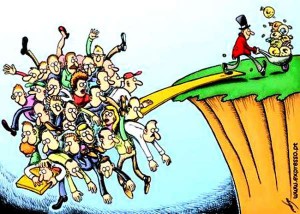
So, yeah, the movement of wealth from the bottom rungs to the top is, among other things, about college, credit, and coronary risk. It’s also about the ownership of legislatures and electoral processes by moneyed interests (whose wealth isn’t decreasing).


In a New Yorker book review (16 Feb, 2015), Nathan Heller describes the places of several nordic countries on various happiness indices. He offers some reasons why these peoples measure their own happiness so positively (good schools, free tuition, effectively free health care, an unfrayed safety net, before offering the opinion of Michael Booth, author of The Almost Nearly Perfect People, that the services one receives in exchange for an upper tax rate of over 70% are ‘patchy’.

Heller delves deeper into Booth’s arguments, pointing to alcohol consumption, employment rates, bureaucracy, and cuisine, and ultimately shreds both Booth’s approach (let an expert speak at length, then quote without fact-checking and present everything in a quasi-Innocents Abroad ‘aren’t these foreigners quaint’ fashion) and his conclusions. Finally he moves from discussing Booth’s take on Scandinavia to an assessment of the current changes to the social order in many of these countries as a result of immigration and rising inequality.

While it’s a shame that the welfare state aspect of many such countries is being undercut by US-style “free-market” “improvements” (see the privatisation of the rail system and tuition requirements at formerly free higher education facilities in the UK, for example, not to mention the pillage of the NHS that not even Maggie Thatcher would have dreamed of), these things are not trivial. I’m not the first to suggest that I don’t mind my taxes paying for education even though I don’t have children: I don’t want to live in a society surrounded by the uninformed. The review describes a Swedish couple, the wife of which didn’t pay any tuition to become a neurosurgeon. Fantastic. I’d rather any doctor I see to have gone through medical school on merit and without the worry of how to pay back hundreds of thousands of dollars/euros/etc. in student loans.

The introduction of tuition to previously taxpayer-funded universities is a tradition pioneered by Ronald Reagan when he was governor of California and, as noted, now followed by Cameron and his cronies in the UK. Like the privatisation of the rails and the NHS, it is nothing but a transfer of wealth from the lower and working classes to the bankers and other members of the 1%. Calling it anything but a handover to the City of London is to miss the point.

Rachel Maddow this week told of how Wisconsin’s Governor Walker is on a quest to slash funding for his state’s renowned public university system by hundreds of millions of dollars. Same thing. Please the bankers, and your next campaign is funded.

At the same time, Germany is offering free tuition to its universities to anyone who can pass the entrance exams. My sister told me of a couple she knows with two kids, eight and ten, if I recall rightly, who are moving there, though this new plan does not require German residency or citizenship. Language, yes, but if you can get in, Berlin will pay your tuition.

This is the choice we’re after – we can educate and take care of the next generations or we can continue to mess it up. In the US, the war on education has taken a number of forms – one the age-old battle against teachers’ unions and the despicable salaries we pay to those who spend the vast majority of their waking hours either looking after our children or finding ways to make sure they know enough to get to the next level. Another is the fight against teaching science in all its forms, but primarily the teaching of evolution. I share the belief that no questions for which science provides an answer have been better answered by religion. (I’m sure there’s a better quote from someone like Sagan or Tyson, but that’s the gist.) In some regions, I’m distinctly in the minority and 90 years after the Scopes trial, we’re still fighting the same battle.

Yes, I’ve gone from discussing free education to useful education, but surely these things go hand in hand. We had a short period during which we as a culture recognised not only a right to an education, but a responsibility to educate the next generation. It’s possible that period ran only from the GI Bill to (in California) Proposition 13, but with the slashing of tax revenues from a variety of places (Governor Brownback’s Kansas fiasco being a major one), public education takes a big hit.

The upshot of this is that people in states with very high tax rates are still happier and better off by a number of measures than those in the low-tax United States. My guess is that a secure education and worry-free medical care play a very large role in that.