I’d not read Hunter Thompson’s Fear and Loathing in Las Vegas in at least twenty years and I’m not sure if before this week I’d ever actually finished the thing. Now I have, and on a certain level, I think I might be too old for it. It’s one of those books like Catcher in the Rye and possibly On the Road that are best enjoyed before the sheer irresponsibility of the story in the telling is too obvious. In the heart of Thompson’s drug-addled tale of not reporting on two events for which his alter ego Raoul Duke is paid, he makes a stunning indictment of what has become of the American Dream™.

In one of the novel’s more cogent paragraphs, Thompson spells out the moment when Hell’s Angels faced off on the Oakland/Berkeley border with anti-war protesters in 1965, somewhat to the detriment of the nascent anti-war movement and to the greater detriment of the American Left in general. Later, he starts discussing those Timothy Leary took down with him, followers ‘who thought they could buy Peace and Understanding for three bucks a hit’ , certain that some one or some thing was ‘tending the light at the end of the tunnel’ (p. 178).

He goes on to gather several leaders together who followed in the failure of Leary to unite the movement: Jesus, Manson, Hell’s Angels leader Sonny Barger, and concludes with the book’s most potent idea, ‘…no point in looking back. The question, as always, is now…?’ Whatever we’re going to do, we have to do it, rather than bemoaning that we haven’t.

While I put Duke and Dr. Gonzo’s tales of their American nightmare in an unfavourable bucket with Kerouac and Salinger (both of whom wrote some brilliant, long-lasting work, just not those novels for which they’re best remembered), another comparison that comes to mind is Sterne’s Sentimental Journey through France and Italy. In a similar way to Sterne, Thompson invites us into a series of vignettes that insist to the reader that they’re actually going somewhere, but don’t ever really make it there. Whereas Sterne’s volume ends without ever getting to Italy (as promised in the title), and possibly in the middle of a sentence, Thompson ends his without ever producing (as far as the reader can tell) the articles his character promised. The expectation from a book that is at least tangentially about writing is that there will be a submission and maybe even a reaction to it. Thompson subverts this by his alter ego barely attending or participating in the events he goes to Las Vegas to cover. To be fair, there is one extended sequence in which Duke and his attorney, Dr. Gonzo, attend one of the presentations of the National District Attorneys Association’s Conference on Narcotics and Dangerous Drugs (thoroughly ripped, as the two characters are for the entirety of the book), so our expectations are only partially subverted.
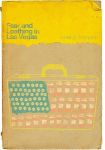
FandLinLVSubtitled A Savage Journey to the Heart of the American Dream, what strikes the reader (or at least this reader) about Fear and Loathing in Las Vegas is the savagery with which Thompson/ Duke treats primarily the female characters and really most of the book’s secondary characters. One way of looking at the nastiness of the interactions with the waitress in the chapter ‘Back Door Beauty & Finally a Bit of Serious Drag Racing on the Strip’ is that Thompson wants to implicate all of us in the nastiness that America became after the “Main Era” ended. The Main Era is what he names that time in the 60s when ‘You could strike sparks anywhere. There was a fantastic sense that whatever we were doing was right, that we were winning’ (p. 68). He continues, ‘We had all the momentum; we were riding the crest of a high and beautiful wave. So now, less than five years later, you can go up on a steep hill in Las Vegas and look West, and with the right kind of eyes you can almost see the high-water mark – that place where the wave finally broke and rolled back.’ (I love the idea of a ‘steep hill in Las Vegas,’ a place in the middle of a desert and nearly as flat as The Netherlands.)

So that moment of mind-altered optimism was undone, or undid itself through subverted protest, Nixon’s treachery, an unwinnable war, and the crackdown of the original war on drugs that Nixon instigated with the help of Elvis Presley. But in the retelling, Thompson says, yes, it all fell apart and to a one, even me, we became nasty and crass.

Thompson shares that, beyond the Strip, you find ‘the shoddy limbo of North Vegas…out there with the gunsels, the hustlers, the drug cripples and all the other losers,’ and here Duke and Gonzo drop into the North Star Coffee Lounge for late night eats. Their waitress, extensively described as, ‘large in every way, long sinewy arms, and a brawler’s jawbone…A burned out caricature of Jane Russell: big head of dark hair, face slashed with lipstick and a 48 Double-E chest that was probably spectacular about twenty years ago…but now she was strapped up in a giant pink elastic brassiere that showed like a bandage through the sweaty rayon of her uniform, (p. 158)’ finds herself on the receiving end of a pass from Gonzo, a napkin with ‘Back Door Beauty’ scrawled on it. On receipt, she lays into our heroes with vitriol. Duke just watches while Gonzo deflects the waitress’ accusations and cuts the receiver off the pay phone with a switchblade when she threatens to call the cops.

Duke understands that Gonzo has struck a nerve, ‘The glazed look in her eyes said her throat had been cut. She was still in the grip of paralysis when we left,’ but doesn’t comment or dissuade Gonzo from his behaviour. We as readers follow along, but Thompson not only lets his narrator off the hook, he relates the events that follow as being drawn verbatim from a tape recording transcribed by the editor. He doesn’t give Duke the opportunity to respond and lets himself off the hook at the same time.

From a wider perspective, Thompson’s after roping the reader into some kind of complicity. The more you enter the heads and the behaviours of the main characters the less you can say that you’re not part of the great destruction being wrought. Thompson attempts, through the excess of his protagonists, to separate the freaks – the ones who stepped out of the mainstream before that wave receded – from the normals who flock for whatever reason to Las Vegas’s casinos from the rest of the country. However, through that excess, he implicates all who see themselves on some version of the correct side of that divide. To what we now call coastal elites as well as those citizens of flyover states, Thompson seems to say: ‘You’re all in on this. We’re all in on this. Through silence or engagement. And I’m in on it as well.’

I’m not sure that this is what the man who famously asserted, ‘I wouldn’t advocate drugs, alcohol, violence, or insanity to anyone, but they’ve always worked for me’ meant to imply.

I wanted to add something about how Thompson’s anti-Nixon stance (against all hypocrisy propounded and promoted by the Nixon White House) had come back to taunt him when George W. Bush was selected for a second time, and might have contributed to his suicide a month into Shrub’s second term, but this doesn’t seem to be borne out by a suicide note which indicated that 67 was ‘17 years more than [he] needed or wanted.’ On the other hand, In October 2004, Thompson wrote: ‘Nixon was a professional politician, and I despised everything he stood for—but if he were running for president this year against the evil Bush–Cheney gang, I would happily vote for him.’ Six months after Thompson’s death, there was a hell of a memorial.

I missed that jazz musician/composer/poet Cecil Taylor passed away last week at the age of 89. I’ve listened to some of his music (and will listen more today), but not very much. I did see him perform his poetry one night at a tiny art/music venue in San Francisco called the Luggage Store Gallery. The performance was scheduled for after a sold out music gig somewhere else in the City and started late. LSG was on the second floor of a building on near 6th on the south side of Market. I lived at the time in a tiny studio right on the corner, so gigs there were easy for me. Usually experimental music of various kinds. I saw Henry Kaiser, Steev Hise, John Tchicai and a dozen others over the two years I lived in that neighbourhood, in a room that was probably zoned for no more than 100 people. It was generally brightly lit – as the name implies, it was a place for displaying art as much as for music, but the track lighting would be turned down for performance.  Taylor brought along several musicians to a packed gallery – they played percussion while he read this insane poetry sat at a desk in front of them. I was writing a lot of poetry at the time and watching and listening, I knew I had a long way to go. From what I can tell, he lived his art and his artistic life to the fullest. Here’s an example from a couple of years later…

In which the atheist rants at some length without conclusion on matters of religious hypocrisy.

There’s this thought I’ve had about huckster preachers who scam their congregations and promise eternal rewards for handing over their temporal earnings. This is just a matter of public-facing behaviour of those who claim to be generally christians.

In these cases, they, it seems to me, can’t actually be ‘real’ Christians – they can’t actually believe in the afterlife they preach. If they did, they would obviously live their lives differently (rich man / camel / eye of needle – you know the drill) knowing that a vengeful god would have it in for them at the other end of things.

I throw around vague terms but the people I mean include American preachers who lead megachurches and live in mansions, Catholic priests who collect tithes for Rome but whose congregations live in poverty. And a few other types.

Those who believe in deathbed conversions have to step carefully given how easy it is for death to sneak up without warning.

Do I have a philosophical case to make regarding the benefits of atheism or living a Christian life without the hypocrisy of those of the cloth? Great question.

Listen. I’ll say it again. I’m a lapsed Jew with occasional tendencies towards Christian imagery in my writing and a firm belief that Jesus was a nice Jewish boy who got in with the wrong crowd but eventually made good. In addition, I’m fond of end of the world apocalyptic movies like The Omen and that one with Schwarzenegger from the 90s.

On the other hand, I carry animus towards exploitative religions and religious behaviour no matter their origins. Anyone who works against the protection of the young / the helpless / those in danger or in harm’s way is, however, working against the tenets of basic biblical teaching. The same holds for government officials who vote against the best interests of people in favour of corporations but show up in church on Sunday as if the latter cleansed them of the former – not doing the Lord’s work, really.

What does the huckster who leads such a congregation actually believe? Is there some special feeling that the afterlife of their preaching will be theirs anyway, despite the harm? I’m reminded of an article I read years ago about the tobacco industry. The writer was at an industry convention and there were cigarettes by the carton simply on display. ‘May I take one of these?’ ‘Of course, take two.’ In this moment, the writer realised the executives he was interviewing didn’t themselves smoke and he asked them about it. The reply, ‘No, we leave that to the stupid and the n****ers.’ (I’m 80% certain the article was in Rolling Stone, and probably in the early 1990s.)

Is this how megachurch preachers see their congregants? Live by actual biblical teaching? Nah, we’ll leave that to the gullible. We’ve got ours, jack. It seems to me that if you believe in a Christian version of the afterlife, then bilking followers (and at the far end of the spectrum, preaching actual hate) will keep you from that promised land. If you do believe, then doing good works, is the key.

There’s a strain of Christian philosophy in which what the believer believes has more weight than what the believer does in determining entrance to the afterlife of choice. If you believe a certain way, then your works aren’t necessary to get into heaven and that if you don’t believe, no amount of work you do will get you there.

Brother Andre Marie over at catholocism.org (note – there’s a bias here) suggests that the fundamentalist (Calvinist/Lutheran/Baptist) view is that faith is sufficient, whereas the Catholic take is that humans must participate in their salvation by doing good works. Faith alone is insufficient. The Jewish take (as emphasized in the Haggadah, read at Passover) is that we tell the story of Exodus as ‘what the L-rd did for me when he brought us out of Egypt’, thereby acknowledging the deity and taking part in our own salvation.

Again, I’m an atheist. I haven’t studied divinity (though I do have a friend with a degree in the subject and should corner her on her thoughts on the matter) and my reading of the bible tends to be to make sure I get an allusion correct rather than using it as words to live by. That said, as one who is at least aware of the tradition of rabbinic debate on all kinds of topics, this kind of concept slicing makes sense as brain-stretching thought exercises. However, it is the worst kind of game playing when you’re talking about making life better or worse in the now for large (if not huge) numbers of people.

The main reasons to practice a religion include community, indoctrination, desire for salvation, utility as a guide for living, the existence of a supreme deity gives meaning or structure to life. All quite good and meaningful. The issue becomes where the organisation of religion oversteps into the lives of believers/followers. The Catholic requirement of confession is an aspect of this – belief and inclusion in the community include giving priests all the secrets of the community to hold. Those who don’t confess are shunned and those who know the secrets of those in power are compelled to release them at personal risk, the seal of the confessional notwithstanding. From the outside, it’s another tool of coercive behaviour. From the inside?

I also know that there are issues with writing about religion as a monolithic thing. One is that I don’t want to consider religion as a block of problems intractable of solution. For many, religion/faith *is* the solution. I want to consider merit in the teachings of religion and not discount what it provides to many. This goes hand in hand with rejecting Burroughs’ tenet in Words of Advice for Young People. ‘Don’t trust a religious SOB. Get it in writing.’

I’m beyond the age at which I find this humorous or useful anymore. It’s a matter of contempt – holding a person to be beyond worth due to professed belief or membership in a group. I may find that in examining the subject from the position of contempt will open me to accusations of intolerance. This is worth considering too.

I’m not easygoing when it comes to religion. I’m adamant about my agnosticism – I don’t have blind faith in a god of any kind. It falls in the category of religion not providing a better answer to questions that have been answered through application of the scientific method. I generally don’t put my trust in that which doesn’t subject itself to repeatability. (I know that there are some interesting limits to this as discussed in Adam Conover’s interview with oncologist Azra Raza.)

Each person has the choice to follow or not follow leaders, be they religious or secular, to parrot the BS found in social media, and to hold those with differing views in contempt. Bloody conservatives, stupid liberals, gun owners, and firearms absolutists being current objects of contempt in the matters of how we as humans at this late date hold others to be outside the pale of discussion.

god-hates-flagsThe issue I want to examine in greater depth is how those in positions of religious leadership preach one thing, or one set of things, based on salvation and faith in one interpretation of a set of teachings but flout the same standards, often flagrantly. The obvious example is the Westboro Baptist folks who quote a couple passages of Leviticus to preach a gospel of hate and derision.

The question of whether one can condemn the gay to hell both in this life and the next based on one bit of Leviticus, but still eat lobster is at the heart of this discussion.

If kashrut, polycotton blends, and interaction with men during menstruation are no longer matters of much contention and attention, then why homosexuality?

Of course, the reason is that homosexuality is a distraction from all the rest of what the huckster does that is obviously sin. ‘But I’m not gay – that’s the worst thing – this is what keeps the nation from being a shining city on the hill.’ And oddly, you end up with antigay preachers who are also practicing sodomites, hypocrisy being another aspect of hucksterism.

There’s obviously more to consider, but I wanted to get these notes out of my notebook and into the blogosphere.

E’G/Warner Bros., 1984

One could argue that the three albums by the Fripp/Bruford/Levin/Belew lineup, and especially the last two, have the flavour of Belew’s solo albums of the time, just featuring legendary supporting players, but that’s really not fair. For all of the bits of it that are very much of their moment, there’s also a lot of that transcendent KC magic here. The more I listen to it, the more falls together and achieves a kind of unity that Discipline has, but that I feel Beat lacks.

Addressing the album song by song doesn’t do it justice. As a work, the pieces fall together quite effectively.

The Left Side

king-crimson-3-of-a-perfect-pairOpening with four vocal tracks, none of which (on the face of it) is that demanding on the listener. Title track/opener, Three of a Perfect Pair is an interesting one because it stayed in King Crimson/Crimson ProjeKct set lists well into the 21st century, and as a fan, it’s easy to find that it’s just a little overplayed. Belew is right to be impressed with his ability to play the guitar in one time signature and sing in another, but it’s only because he’s the vocalist that this makes him unique in the band. The song itself being about the breakdown of a relationship seems an apt one as this incarnation of KC was on the verge of collapse at the end of the Beat sessions (and after the tour for this album, these four would not reconvene for 10 years).

Model Man, oddly, presents us with another relationship song in which the narrator begs for understanding (‘imperfect in a word…but I give you everything I have’) from the one who always has him on edge (‘look[ing] for the sights…the symptoms…the slight calm before the storm).

Sleepless, the single that should have been a hit. Warners even ponied up for a video in which everyone seems a little uncomfortable. The song is the most distinctly new wave of the album (especially the Clearmountain remix which was used instead of the original on the first pressings of the album). The interplay of the rhythm section is what I find most interesting about this song.

Man with an Open Heart should have been both a single and a hit. Of the four lyric tracks on the album, three address relationship issues and this one seems especially personal. Its changing time signatures anchor it in the KC universe as well.

The most surprising aspect of this album (and Beat for that matter) is how far in the shadows Robert Fripp seems to be. His guitar work through Discipline is always the most distinctive aspect of a KC recording. However, with Nuages (That Which Passes, Passes like Clouds), the instrumental that closes the Left Side, Fripp’s voice comes to the fore. It feels like one of his soundscapes as it flows through the ears, but has a rather non-cloudlike feel for a song with its title. It’s anchored by an almost underwater-feeling percussion.

The Right Side consists of three interesting instrumentals and a decidedly different vocal.

Industry is almost an extended meditation that relies heavily on the interplay between Fripp and Levin. It works on one level, as a continuation of Nuages, not the opening of a different suite of songs. It’s structured more as a bolero – each instrument building in intensity and than slipping away again.

Dig Me, welcomes Belew’s voice back into the fray with an oddly sad follow-up to the previous album’s opener, Neal and Jack and Me. In this episode, what was once a proud automobile stretching out on the open highway is now rusting, unhinged, and what ‘was deluxe becomes debris’. On a certain level, it’s of a piece with the relationship songs on the Left Side, but is also markedly different.

No Warning feels like a more pure KC improv, but kept short and to the point. It has the energy of one of those moments where the band just locks together.

And then there’s the album’s closer, Larks’ Tongues in Aspic Part III. It’s an oddly titled jam that doesn’t seem of a piece with the other two songs that are its namesake. After more than twenty years of listening to this album (as with all the other entries in this series of reviews), never so diligently and with such interest as I have in the last week, I’ve never quite gotten what it was about this composition that invited adding it to the other two. And I’m still not, but I’ve got a feeling there’s something in the musical structure that lends itself or was consciously taken for that reason.

Sleepless has long been my favourite track on the album for purposes of sheer grooving. Of the vocals I’m now more drawn to Man With An Open Heart than I ever was before. I’m not sure I have a favourite of the instrumentals – they all feel of a single piece.

Next up: Vrooom and Thrak, but I’m going to take a KC break first.

E’G/Warner Bros., 1982

I’m honestly not sure what to make of this album as a whole. Beat has the same hard/weird/beautiful combination that we’ve come to know and love from King Crimson, but it also leans heavily on the New York sound of its predecessor. I first had this on CD in about 1987 and I recall listening to a few tracks a lot and not knowing what to do with others. I didn’t have a lot of King Crimson context, but loved Heartbeat when it was on the radio when I was in high school. I at least had a little to go on with Neal and Jack and Me. Two Hands is beautiful, but the instrumentals kind of baffled me. It might be the weakest of the early 80s trilogy and (at least according to Wikipedia) was difficult to make. Belew and Fripp went head to head and Fripp was ready to call it a day on this version of the Crims, but they got it together and toured (and recorded another album).

Discipline pointed at a thematic fascination with the Beat generation writers (The Sheltering Sky), and this album continues with it. Opener, Neal and Jack and Me namechecks Jack Kerouac and Neal Cassady in its title. While the lyrics seem to have the point of view of the cars the titular characters drove in On The Road, they could also be spoken by Carolyn Cassady, lover of both whose memoir Heart Beat was published in 1976. A film version was released in 1980.

Which brings us to track two, Heartbeat, which seems to be a love song or a lost-love song. For me it was an evocation of intertwined love and lust and made me want to be landed with someone, which I mostly wasn’t in high school and college. While band members have suggested that this track and side 2’s Two Hands shouldn’t have been on the album, they’re both quite beautiful. They’re just not really King Crimson songs. (Belew would rerecord Heartbeat for his 1990 solo album Young Lions, though I don’t recall that version being wildly different.)

Sartori in Tangier, the album’s first instrumental takes its title from both Kerouac’s Satori in Paris and the city of Tangier where many of the Beats lived, including Paul Bowles, author of the novel The Sheltering Sky. For being only three and a half minutes, it still has the structure of a Crimson multi-part epic. Tony Levin’s Chapman Stick into leads into a strange combination of downtown funk and middle eastern rhythms. Stick Men (Levin and Pat Mastelotto’s project with Markus Reuter) have been performing a version of this recently that works quite well.

Oh, and here’s a really intense rendition which (based on the opening still) is from a Japanese date on the Beat tour. Seems that the string battle is just between Levin and Fripp, because Belew is on percussion.

NC_HB_Germany_1980Side one closes out with Waiting Man, another distinctive Belew vocal which like the title track of the follow-up album seems to have the vocals in one time signature against instrumentation in another. Bill Bruford’s drumming on this piece (as with a lot of the percussion in this period of KC history) seems to owe a bit to Steve Reich’s phase works such as 1971’s Drumming.

Side 2 opens with Neurotica which is an odd combination of spoken word in the style of Thela Hun Ginjeet and something much jazzier. I find the vocal portion, which describes or lists animals roaming the city (heat in the jungle indeed) to be less interesting than the music.

Two Hands wraps a fairly sparse arrangement around a lyric by Belew’s then wife Margaret. The strange point of view (I am a face in the painting on the wall / I pose and shudder and watch them from the foot of the bed) gives the song this weird voyeurism. From one perspective, an outsider of sorts recognizes love in the pair he (she?) sees. From another, the narrator of the song is watching people he doesn’t necessarily know make love. Again, an odd addition to the Crimson catalog.

The Howler poises a generally funky bassline against some rather interesting noise in the service of a relatively abstract lyric. The band doesn’t seem to know quite what to do with it and the song fades out. I imagine that a few live workouts would have made the song more interesting.

The album closes with Requiem, an improvisation in which the members of the band seem to be playing at cross purposes. This isn’t uncommon in KC improvs, but the fadeout at the end seems to indicate that this was going to be the last song of this version of the band. Fripp pulled it together and they gathered for another tour and album.

Next up: Three Of A Perfect Pair.