Island/Atlantic/Vertigo Records, 1970
Produced by Robert Fripp and Pete Sinfield

The first of many massive personnel changes in the Crimson camp occurred when Greg Lake met Keith Emerson at a King Crimson/The Nice double bill at the Fillmore in San Francisco in December, 1969. After that show and Emerson and Lake decided to hook up and with Carl Palmer and they recorded their first album the following summer. Wikipedia is not helpful in explaining why Ian MacDonald and Michael Giles left the band after that American tour as well, but even with all of these changes, Poseidon remains an even more cohesive album (IMVHO) than Court. Part of the reason is that Pete Sinfield is still handling lyrics, Lake sings on all but one of the album’s vocal tracks, and McDonald cowrote two tracks, the single Cat Food and side 2’s epic instrumental The Devil’s Triangle.

The album is bookended with three parts of a song called Peace – A Beginning opens side 1; A Theme and An End open and close side 2. The second tracks on each side are the two straight up rockers, Pictures of a City and the single Cat Food, and the album is rounded out with a couple of more progressive propositions.

Pictures of a City evolved out of A Man, A City, performed on the Crimson King tour and found in multiple versions on the Epitaph collection of those 1969 concerts. Musically it’s roped in from the clatter of those early performances into something a bit tighter. In the earlier versions, there’s room for a sax solo, and some stretched out interplay between the musicians. On the studio album, it’s a distinctly less free (as in jazz, not beer) proposition.

Side 1 continues with the thinly arranged ballad Cadence and Cascade, sung on the album by Gordon Haskell, but for which there’s a Greg Lake vocal version included as a bonus track on later releases. The sparse arrangement keeps the instruments from tripping over/crashing into one another, but leaves room for the individuality of the guitar and a sweet flute solo from Mel Collins. On the other hand, Haskell’s voice really doesn’t do the song justice – he doesn’t hit the high notes or master the low notes the way Lake did.
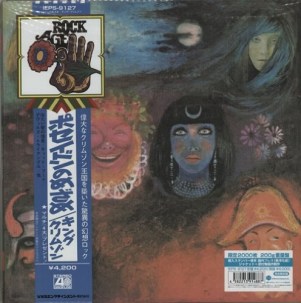
king-crimson-wake-jpThe title track closes out side 1. I think the band was going for something like Epitaph – musically, the song has the flow and drama of the earlier song with those smooth mellotron lines connecting the piece together. Lyrically however, it’s one of those songs that (and I paraphrase mellotron master Mike Dickson – I just can’t find the source – it’s in the notes for one of the songs on mellotronworks II) make prog rock fans say, ‘I don’t listen for the lyrics’. Sinfield seems to be after the grandeur of the drama between heroes and rulers and peasants in war, but each stanza has multiple subjects, whereas in Epitaph, we had only a tortured ‘I’ to give the song its emotional weight. The song is crushed under the weight of Bishop’s kings, Harvest hags, Heroes, Magi, and Harlequins.

After the resonant acoustic solo of Peace – A Theme, Cat Food roars in. More jazz than progressive, this was the song that grabbed me most when I first listened to this album in the 90s. My emotional response was to the weird, almost new wave instrumentation. The piano lines are reminiscent of the work Mike Garson was doing with David Bowie at the time with that right-hand madness. I’m not surprised the label used it for the single – it’s the tightest of the songs and the vocals are clear and mostly untreated. On the other hand, it’s the most unrepresentative song of the early work. (Listening now, I’m surprised it didn’t return to active service in the Adrian Belew years – it has some of his offbeat humour, both musically and lyrically.)

The Devil’s Triangle is a proper three-part instrumental epic which fades into some long mellotron chords, adds martial drums and some other stuff. The third part of the song (‘The Garden of Worm’) is very neatly separated from the previous section by a wind effect that fades to silence. The same martial drums are accompanied by whistles maybe and then a harpsichord shows up. Describing a song like this is very much in the ‘dancing about architecture’ category. Some bits are jazz, and some bits are just noise, and it’s mostly unlike anything else except when the occasional chord points out that this band evolved from Giles Giles and Fripp and another segment repeats a piece of the previous LP’s title track. Just for a moment, those Ah-ah-ahs show up, before Peace – An End. I hear the thematic reason for having the three parts of Peace show up evenly placed on the album, but the a cappella intro is almost as jarring to the ear as the opening chord of Pictures of a City after Peace – A Beginning. It might be done on purpose, but it doesn’t make for consistent listening, not that I’m asking for consistent listening from King Crimson. Honest!)

Overall, I give it a solid four stars. Next up? Lizard.

Island Records/Atlantic Records 1969 Produced by King Crimsonking-crimson-in-the-court-of-the-crimson-king-4-ab
The signal blast that opens this album’s opening track, 21st Century Schizoid Man, is the announcement that there may still be insanity in the Fripp camp, but it is not cheerful. The improvisational center of the song with its nearly uncontrolled horns lays it out, as do the sections in which the time signatures shift without seeming to hint at any plan before roping it all back in. Fripp and company (this time Michael Giles, Greg Lake, Ian MacDonald, and lyrics by Pete Sinfield) are engaging in what sounds like a proto-fusion jazz experiment.
And almost as soon as it starts, it’s over.
The new recording of I Talk to the Wind, more reliant on the flute than on the Judy Dyble / GGF version recorded the previous year, is more complex and more controlled. The interplay of the instruments hints at the band’s wider ambitions than the silliness found on Cheerful Insanity.
Following the proto-jazz metal of Schizoid Man, this song’s pastoral arrangement is unexpected, but it’s thematically of a piece with the opener. The alienation of Schizoid Man’s last verse ‘Blind man’s greed / Poets starving, children bleed / Nothing he’s got he really needs’ dovetails with ‘On the outside, looking inside, what do I see / Much confusion, disillusion, all around me’. Just because it’s sung clearly with pleasing music doesn’t mean it’s not the same character.
There’s an argument to be made that the opener is an id-driven, gut-level response to the times and to the madness of the world in general. It’s the only musically heavy track on the album and a strange thing to open an otherwise soft album with. But in the sense of the album, it’s perfect. The first listeners must have been struck by the contrast between Schizoid Man’s coda and the opening of I Talk to the Wind, but, again, the themes of the album are supported by its calm. The emotional response to the world’s insanity, when articulated to communicate woe, is lost on the world. ‘My words are all carried away…the wind cannot hear.’ The pun of having a wind instrument carry the song wouldn’t be worth the bother if the song didn’t hold together. (Question though: Can someone sing the lyrics to Pete Shelley’s Homosapien to the tune of this song? ‘Said the shy boy to the coy boy…’ This would amuse me greatly.)
Epitaph, which closes side 1, is the album’s fulcrum and thematic and musical heart. Our narrator looking at the world and seeing its fate ‘is in the hands of fools’ sounds eerily timely. Balancing the possibility of survival (‘If we make it, we can all sit back and laugh’) with an honest assessment of the possibility of destruction (‘Yes I fear tomorrow I’ll be crying’), we know from the title where the song things the scales will fall.
Side 2’s first track, Moonchild, opens with a folk song subtitled The Dream, which after a couple of minutes slips into several minutes of nothing much, for want of a a more articulate reaction. Subtitled ‘The Illusion’, this is the least interesting stretch of music, possibly in the entire KC canon. It’s almost a surprise to hear the opening notes of the album’s title track which follows. I find this a little sad, because the lyric portion of the song is so beautiful.
Finally, In the Court of the Crimson King. The album’s title track has a weird structure moves from folky to jazzy to full on progressive before we knew what that meant. The lyrics about fire witches and puppets might indicate that the schizoid man has finally gone from close to the edge to over it and possibly towards peace in his own head. Musically the band is still playing games with both rock and roll and free improvisational jazz, while taking what it needs from the folk and classical traditions that were the wellspring of the UK progressive sound. The Dance of the Puppets, which takes us through the last two minutes of the album presents a strange coda which only in the last moments pulls back into the song’s musical theme.

Next up: In the Wake of Poseidon.

MP Ben Bradley wants to ‘fix Tory image problem’ according to a massively disingenuous BBC Newsbeat article. According to the young conservative MP for Mansfield, the Tories’ problem is that they’re perceived by the young as being old, grey, and boring. He wants to appeal to ‘Young people, people from ethnic minorities who just don’t vote for us’. He’s pushing for conservatives from popular culture to get the message out. The article goes on to say that ‘any improvement in image would have to be backed up by policy.’income_inequality

You can see the problem here, right? Tory policies that appeal to young voters are pretty thin on the ground. The article cites ‘The Conservatives cut housing benefits for 18 to 21-year-olds, introduced a lower minimum wage for under-25s and is the only major party against lowering the voting age to 16.’ Well, there’s a start. What else?

How about hard Brexit? Voters under 50 voted overwhelming to remain in the EU. (18-24s did so by a 3-1 margin; 56% of 25-49s voted remain.) All current evidence points to the Tories staying on that very unpopular highway despite all the signs advising them to turn off.

Brexit, like the recent US tax plan, is a boondoggle for the already very wealthy. The reason the government is pushing it so hard, despite the referendum having been clearly an advisory measure (see the first paragraph here, is because there’s so much money to be made getting Britain out from under EU regulatory regimes. It’s not as though the boot is onerous, just that it’s portrayed as such by whiny-ass bitches like Rupert Murdoch. Murdoch’s media empire was massively pro-Brexit. Why? When Anthony Hilton of the Evening Standard asked Rupert Murdoch why he was so opposed to the European Union, he replied, ‘That’s easy. When I go into Downing Street they do what I say; when I go to Brussels they take no notice.’

That’s several other articles that have already been written by folks better at this than I am. Laurie Penny, for example.

What does this have to do with what young people want? Young people want a government that acts in the interests of all citizens and does so with transparency. Simple.

What else do young people want? They want for the parties in power to act with resolve against keeping them in poverty. A fully functioning and fully funded NHS and reasonable/zero tuition fees are absolutely at the heart of this.

Reasonable secondary education tuition fees. You know, the ability to leave college not ass-deep in debt. Anywhere in the Tory manifesto? Of course not. If every second 23 year old already owes one of the banks nearly 30,000 pounds, the banks are happy. (Personal history: Tuition fees were introduced in the California public college/university system by Ronald Reagan when he was governor. Once the fee was introduced, it only went up. The CSU system’s tuition increased about 300% in the four years I attended (1985-1989) and is now almost USD 6000 per year. The UC system is over USD 12000 per year.

However, when the banks are happy, Tory campaigns are funded. One can’t expect the current government to rescind that.

And the NHS? Chronically underfunded under the Tories for almost seven years. Setting the NHS up for failure seems to be the Conservative party’s national sport. And they’re winning. They set up metrics like getting some percentage of A&E patients seen in under four hours that they then don’t fund the service to meet. And the papers all bemoan how poorly the NHS is doing. The rest of the world sees in this an obvious ploy. Set the NHS up to fail and then sell it off to the lowest bidder. Worked out beautifully for the Royal Mail as well, but the Royal Mail is only tangentially related to the real world health of its users.

What else? Safe housing estates. Because young people don’t just think only about themselves (all the stupid cracks about Millennials aside), they want for the people amongst us with the least to at least be safe in their own flats. You’d think that’d be a no-brainer, especially after the Grenfell tragedy. Nope, we’re not going to do anything to require property owners to make sure they’re buildings aren’t twenty-story fire traps. Thanks for asking.

Other things? How about a rail system that doesn’t gouge the young commuter (who may no longer be able afford to live near the city they work in) out of a large chunk of their pay packet. Well, nationalization isn’t going to happen, but rail networks that work for commuters and not shareholders? Too much to ask. I suppose the manifesto’s commitment to putting 40 billion pounds into improving Britain’s transport over the next decade is nothing to sneeze at, though it’s a drop in the bucket compared to the rail companies’ revenue. In 2016 alone, one parent of Govia Thameslink (operator of Gatwick Express, amongst other services) saw revenues of 3.4 billion. And because of privatization, Govia Thameslink is only one of about 20 different rail operators in the UK.

So, to recap: The way to appeal to the young is to champion and implement policies that affect them and the people they see around them positively rather than negatively. It’s quite simple, but the Tories know who butters their crumpets, and it’s not the youth of Britain.

So this month, I’ll be diving into the studio recordings of King Crimson. I’ve been a fan since the early 80s and have seen them perform four times. (I’ll see them again in July. Woot!) I considered reviewing the albums alphabetically rather than chronologically, but was dissuaded.

While Robert Fripp is the only constant in almost 50 years of KC, both Giles brothers appeared on either or both of the first two KC albums.

There are two ways to consider this album, neither of them very useful. One way is to look for aspects of it that point to what Michael Giles and Robert Fripp would do the following year with In the Court of the Crimson King. The fact is that very little of Cheerful Insanity resembles anything in the first few years of KC. The other way to look at is to consider where it falls in the music being made at the same time. This is more helpful, I suppose, because there are bits of the album that resemble early Moody Blues, early Pink Floyd, generic English folk rock and its proggy offspring (Genesis, Jethro Tull, Yes).

I first heard this album sometime in the mid-90s when I was collecting as best I could anything with Fripp’s name on it. I couldn’t hear anything in it (and still don’t) that resembles the weirdness of that late-70s/early 80s period when he’d been applying that arpeggiating guitar technique to everything he touched (including, for example, the stylings of the first and third Roches LPs. And much as I enjoyed that early prog, Cheerful Insanity just didn’t cut it.

Part of the issue I had was that a very young Fripp only wrote three of the songs. Little Children on side A suggests why Fripp left the lyrics to others after that. This song is notable for vocals provided by The Breakaways who famously backed Petula Clark and Cilla Black on several singles.

GGFSuite No. 1 and Erudite Eyes, which close side B have a more Frippish feel to them than the rest of the album. Suite No. 1, which clocks in at just under six minutes, starts with some Paganini-like runs that are joined by bass and keyboard, but after a minute and a half or so, the baroque gymnastics are replaced with a piano/strings/vocals arrangement that brings to mind the Chi-Lites’ Have You Seen Her. This segment is followed by a harpsichord-guitar duet which is followed by a reprise of the Paganini. A single track broken into three possibly unrelated forms, pulled together by a reprise of the theme? The application of jazz theory to folk motifs is one of the main threads of early progressive rock – it’s just weird to hear it applied so strangely.

Erudite Eyes is really the only song that points to the musical strangeness that was to come. It begins as a waltz, turns into a polka, returns to waltz-time and moves into improvised psychedelic strangeness before the second minute is up.

Lyrically, the whole affair is pretty strange. Newly-Weds suggests the discord of couples keeping up with the Joneses (He worries all day about wolves at his door…but on the other hand, she’s got a ring). One In A Million’s look at a man ‘content with the things at the moment, except the yellow line by the pavement’ echoes Revolver-era Beatles (Eleanor Rigby, Taxman).

The biggest issue I have with the whole album is the interspersed comedic numbers. Most of the songs on side A are bookend with episodes of The Saga of Rodney Toady, a ‘sad young man’ who girls run away from at school dances and whose parents are ‘fat and ugly’ and tell him that will ‘meet a fat and ugly girl just like Rodney’s mother and they would get married.’ These interludes don’t speak back to the music and actually detract from enjoying the album.

Side B’s songs are interspersed with repetitions of the sentence ‘I know a man and his name is George’ spoken in the correct order once and then in permutations (Know I George his name and a man, for example) and in increasingly annoying voices. One could argue that the rearrangements of the words reflect the possibilities inherent in the structured and random mutations of music that lie at the heart of King Crimson’s most intriguing work (for me, this includes tracks like Fracture, Level 5, and Starless).

After this album was released, Peter Giles left, and Ian MacDonald and Judy Dyble (late of Fairport Convention) joined and they made a collection of high quality home recordings released in 2001 as The Brondesbury Tapes. This collection is mainly notable for Dyble’s vocal on an early version of I Talk to the Wind. Soon after, Greg Lake joined and the Crimson King was born.


Without too much comment, this is what I read last year. Mostly sci-fi/fantasy. I tend to read for amusement when I go to sleep and sometimes on the train in the mornings on the way to work. And in the middle of the night. My preference for midnight reading is for very light as I'm prone to nightmares. Hence there's not much that's too heavy…
Books 2017
1. The Locksley Exploit by Philip Purser-Hallard
The second book in the Devices Trilogy, a modern setting of the Arthurian conflicts with a heavy helping of Robin Hood. Quite good stuff.
2. Written in Dead Wax by Andrew Cartmel
Humourous mystery with interesting notes of vinyl addiction for those who collect records. Apparently it's the first in a series, but I didn't feel the need to buy the next ones.
3. The Red Thumb Mark (A Dr Thorndyke Mystery) by R. Austin Freeman
Thorndyke was an early Sherlock Holmes knockoff narrated by a Dr. Watson knockoff. The collected works might have set me back 99p.
4. Katherine by Anya Seton
One of my sister's and #1 niece's favourites. Well-researched historical romance about the mistress of John of Gaunt who was the ancestress of several centuries of English monarchs.
5. Year Zero by Rob Reid
Another cheap sci-fiesque read that might have been a Humble Bundle purchase. Amusing tale of Intergalactic music copyright infringement.
6. False Covenant by Ari Marmell
The second Widdershins novel – good, but I was bummed that he killed off a character I really liked. So bummed, that I decided not to move on to the next.
7. Parable of the Talents by Octavia Butler
8. Parable of the Sower by Octavia Butler
Really good speculative fiction about the origins of space travel with a good dollop of dystopianism that looks like the early Trump years. Scary as heck.
9. Aftermath – Life Debt by Chuck Wendig
The second of his novels that bridge episodes six and seven of the Star Wars saga. Good stuff.
10. Moonglow by Michael Chabon
Latest offering from the author of Kavalier and Clay. Narrator tells of his grandfather's adventures in WW2 and the early atomic/space age. Four stars.
Read the rest of this entry »