…About how we never/all saw this coming. But a few folks did. And it’s been brewing for 4, 8, 36 years. Or longer. A couple of months ago, about when Hillary’s ‘basket of deplorables’ comment was making the rounds, I remembered Mitt Romney’s ‘binders of women’ reference from one of his 2012 debates with Obama. Mitt was monumentally out of touch, and not half the orator Obama is, but he was making a valid point: He knew that he needed to improve the gender balance in his administration and he told his key players to bring him some CVs to work with.

And the left nailed him to the wall over it.

Don’t get me wrong: I preferred to have the Obamas’ grace, dignity, and gravitas in the White House these last eight years. In retrospect, I wondered what more could have gotten done had it been Romney working with his own party. Mind you, the GOP might have done to him what they did to John Boehner.

I had my first conversation about the election with the gentleman at the dry cleaner this afternoon. We were talking in English because my Dutch is lousy, and he said ‘Congratulations on your new president,’ without irony that I could detect. We chatted for a few minutes and he indicated a low opinion of Mrs. Clinton. It wasn’t the time or the place to get into it with him, maar na negen jaren ben ik nog nooit zo gemotiveerd om nederlands te leren. (After nine years, I’ve never been so motivated to learn Dutch.)

I do hope we survive the next four years, but I fear for the republic.

I hadn’t seen Casablanca in several years when I started this little essay, save for the clip of the Marseillaise which I always pull up on Bastille Day (but before that horrible attack in Nice). I watched it again on a flight back from the US a few weeks ago, though, to make sure my notes made sense.

As we get to know Rick Blaine, the facts of his life come in drips. We learn that he lives by his own code which is honourable but not in the most conventional sense, that he’s carried a torch for a woman he never expected to see again, and that he’s on the run from the US for an arms-related issue. (This is tricky because what we learn from Laszlo is that he fought in Spain on the side of the Loyalists. Is that sufficient to put him on the wrong side of the US? We don’t really know the reason he’s on the run.

He’s anti-fascist on principle, and seems to thrive where there’s little in the way of order.
Having been in Paris at the time of the initial occupation, he packed up for French-administered Morocco and set up Rick’s Cafe Americain, expecting he’d be able to do business there for the duration. The Americans hadn’t taken sides and didn’t look set to do so.

The movie came out in November, 1942, so about a year after US entry into the war. But when precisely does it take place? We get one hint: in a stupor, Rick asks his friend Sam ‘If it’s December 1941 in Casablanca, what time is it in New York?’ only to receive the answer, ‘My watch stopped.'(What is the nature of their relationship? They’ve been together for several years, and Sam is something more than an errand runner, pianist, and drinking buddy, but he’s those things too.)CasablancaJP

Having identified the ‘beginning of a beautiful friendship’ with the French police captain, we can guess that either the next day or the day after that, Casablanca will hear the news of the attack on Pearl Harbor and Rick will be back in the war.

As we near the 75th anniversary of US entry into World War II (and shortly after that, the 75th anniversary re-release of the film), we find ourselves on a similar precipice. There’s a whole lot of war going on, but we’ve not formally declared World War III. Does Brexit signify that the UK (the Untied Kingdom?) will enter hostilities with Turkey and Russia on a different side than the US and the EU? For example.

In 1991, I was oh so certain that we wouldn’t get out of the 20th century without another great war. I think I figured that by the time I turned 50 we’d be at the other side of it, not just getting ready to enter it. But, as I’ve argued elsewhere (and not originally), we’ve spent the last century fighting the ongoing skirmishes of WW1. Alliances shift, but we’re still keen to be at war. Just because we can’t picture an Anglo-Russian invasion of Iran today doesn’t mean equally strange alliances aren’t afoot. In that category of unintended consequences (you know, everything that’s going on in the Middle East that was predicted in 2002 in some form or another), the results of the Brexit referendum are just all of a piece.

Every time I skim social media, there’s a link to some new atrocity (all the places we’re bombing or the bombing of which we’re financing) or case of legislative poor judgement (today’s example is France banning the burkini – let’s alienate all the people we really don’t want to alienate, shall we?). Each one leads me to the conclusion that the war is just going to get closer even if we don’t declare it. Happily sat in relatively unharmed Nederland, I can claim my own neutrality. At what point to I have to declare which side I’m on?

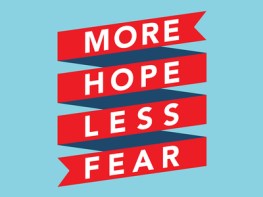
So I’ve had a couple of interactions recently in which the people I’ve been talking to have indicated that they didn’t support a cause because of one face or another of that cause in the media. In one case, a friend in Britain is on the fence about the EU referendum on Thursday but dislikes the negative campaigns on both sides. (Image below nicked from Stephen Watt on Facebook.)

  
Disclaimer: My bias might be obvious. For a variety of reasons I support the UK remaining in the EU. There’s a personal interest in that my residency in the Netherlands is currently tied to being the partner of a non-Dutch EU citizen. My partner is English. Should push come to shove, we both have ways to stay in the Netherlands (where we purchased a house four years ago), but she’s not keen to give up her UK citizenship either.

That said, my friend who dislikes the negative campaigns on both sides is one of the sharpest tacks and has been roped in to the media version of the campaign. The problem is that those who can afford to get their position across to you in the media are arguing their own interests, not those of (in this case) the people of Britain. And I’m not the first person to note that the very rich these days won’t be affected negatively no matter the outcome, but they stand to gain quite a lot if the vote is in favour of leaving. Boris Johnson, for example, might pull off being the UK’s next prime minister. Rupert Murdoch sells lots of papers whipping people into hatred of some group or other (in this case, immigrants). He’s been quoted as follows: ‘When I go into Downing Street, they do what I say. When I go to Brussels, they take no notice.’ Murdoch’s papers aren’t denigrating EU membership on their front pages daily because of any principled editorial stand; they’re doing so because British leaders are afraid of how they’ll be portrayed. (Note: This is one of the reasons I like Jeremy Corbyn: He could give a monkey’s what the tabloids call him – he’s got bigger issues to tackle. I’m also an old-school lefty.)

Somewhat less recently, a family member in the US expressed exasperation and some degree of hostility at the Black Lives Matter movement. Said family member is damned smart, politically savvy, and almost as left as I am. She’s for Hillary and I’m for Bernie (for what that’s worth). I’m not so steeped in the US media as this person, and my understanding of BLM is that it’s a movement consisting of a large number of people with different agendas, different levels of media savvy, and a whole lot of frustration, anger, and grief. It’s not a monolith anymore than the Republican or Democratic parties are monolithic. A news outlet showing a few images of Black people with BLM placards protesting or trying to disrupt a gathering is doing nothing more than selling advertising. And those people with the placards aren’t any more clones of one another than Howard Cosell is a clone of Roy Cohn just because they’re both dead white men.

One more example: A few years ago during riots in England, a photo made the rounds of a young man in a hooded sweatshirt and jeans kicking in a shop window. It was only after about a week of seeing this one photo repeated in several stories as if it was representative of the behaviour of multiple people, that I saw an uncropped version of the same image: One person indeed kicking in a window surrounded by about 20 photographers. 

Again: What you see in the papers and on the news reflects the interests of the people who own the media or have bought a portion of its time, not yours. 

I think this might be another one of those cases where a politician is saying outrageous things to distract the public from what’s really going on. I honestly don’t know what Theresa May’s agenda is. She’s not as transparent as say Jeremy Hunt. We know he’s trying to crush the doctors’ unions because of the massive amount of money that will come his way from a privatised NHS. May? Perhaps I just don’t know enough about her. But at the moment she’s making noise that rather than leave the EU, Britain should just leave the European Convention on Human Rights. (Let’s not entertain, for the moment, the fact that membership in the EU requires membership in the ECHR.)
Her position, according to The Guardian, is that the ECHR has tied Britain’s hands with regard deportation of extremists such as Abu Hamza and Abu Qatada, ‘and does nothing to change the attitudes of governments like Russia’s when it comes to human rights.’
This is where I usually stop reading when these things come up. The point of human rights conventions is to bind the signatories to be better at this stuff than non-signatories. The bottom line is that it doesn’t matter what any other country does when it comes to human rights. The UK decided at a certain point to be one of the good guys in this regard and say, ‘We will respect very basic human rights and will treat all with due process.’
It’s a very short document, clocking in at just 55 large-print pages, many of which are taken up with repetitions of ratification and depository information. Life, liberty, security, prohibition of torture, and prohibition of slavery all appear on the first page. The other basics, including due process, right to thought, expression, religion, privacy, and assembly come on the next seven pages. The next 16 cover the court itself. The balance covers the various protocols on human rights and freedoms. Interesting bit: In 1983, when the death penalty was abolished under Protocol 6, there was an addendum specifying that the death penalty could be imposed under certain circumstances in time of war. In 2002 this addendum was rescinded under Protocol 13.
With this in mind, it’s BS about other countries keeping us from doing what’s right (not just what’s right according to treaties we’ve signed) that got people so worked up when Dick Cheney said we had to torture to get information out of supposed bad guys. No, we don’t. We’re better than that, and have signed conventions (in that case, The Geneva Convention, but the idea is the same) as outward signs that we strive always to be better than that. Except when our leaders say, ‘Nah, we don’t have to be better – we’re exceptional.’ Or some such noise.
May was discussing Britain’s ECHR responsibilities in the context of a speech ostensibly supporting continued EU membership. She went on to say, however, ‘The states now negotiating to join the EU include Albania, Serbia and Turkey – countries with poor populations and serious problems with organised crime, corruption, and sometimes even terrorism. We have to ask ourselves, is it really right that the EU should just continue to expand, conferring upon all new member states all the rights of membership?’ Good question, I suppose, but the UK has an equal say in the admission of other countries to the EU. Organised crime and corruption weren’t issues when Italy and Greece joined. Or perhaps not to the same extent. She just wants some to be more equal than others.
May went on to say that Britain should be able to draft and amend at its own bills of human rights that apply to Britons. Again, we’re better than that. (Yes, I’m an American married to an English woman and say ‘we’ even though I have few rights to call myself a Brit. According to one friend, knowing why the M25 is called The Road To Hell is sufficient.) We should be able to look Europe and the world in the eye and say that the rights we enjoy should be available to all and that we’ll fight for that to be so. (It demeans weasels to say that May is trying to weasel Britain out of her responsibilities under UCHR.)
A week or so ago I read a screed denouncing new film versions of The Jungle Book and naming Rudyard Kipling a racist expletivedeleted. This article quoted extensively from Kipling’s poem The White Man’s Burden. Yeah, racist to the core with its references to colonised peoples as ‘half-devil, half-child’. The title itself makes us modern progressives cringe at the thought that whiteness alone made one group responsible for bringing others to modernity. What Kipling was arguing for, however, is that those who consider themselves civilised ‘fill the mouth of famine and bid the sickness cease’ even as others, no matter what we name them ‘bring all (y)our hope to naught.’ Yes, it’s terribly racist to name those others ‘sloth and heathen folly’, but the burden Kipling lays upon us is to do the work. In the Jewish tradition, there’s the concept of Tikkun Olam, heal the world. Get out and do the work of peace, of healing, of working for the safety of the disadvantaged. While Kipling names both the objects of the work and its obstacles with terms we consider abhorrent now (and were, in truth, abhorrent in 1899), the call is to be the good guy and do the work of making the world better.
May, on the other hand, is calling on Britain, do default on its obligations to better itself and contribute to the betterment of the European collective.

A couple of Sundays ago, Rachel and I visited the city of Groningen which is hosting the David Bowie Is exhibit at the main museum. The museum is directly across from the train station, but after a two-plus hour train ride from Leiden, we needed lunch before our entry time and walked towards the town center.

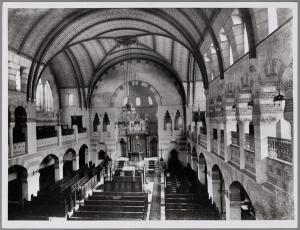
As we walked to lunch we passed this synagogue, having had no idea it existed. Overview Groningen synagoge, ca. 1939Note that I had one goal for the day, and that was the museum exhibit. I had no reason to look further into what the town had to offer. Had I given the Groningen page in Lonely Planet Netherlands a peak, I would have taken note. So it was a surprise. Had we taken a different little lane into town, I never would have seen it. A sandwich sign in front announced hourly tours from 1pm until 5. At 4 we entered and requested a tour in English and shortly after a woman whose English was passable started to tell us about the building’s history we were joined by another half-Jewish couple and learned much of the following.

In 1916, the Groningen Jewish community numbered about 3000 and the previous synagogue was unable to seat weekly attendance in excess of 600 worshipers, so they hired an architect to design a new building. Oddly the architect was not Jewish, but he had a wide range of influences. Rachel (who was raised in the Church of England) has been in a few synagogues with me and when our guide asked, what’s strange about this one, her answer was immediate and accurate: ‘It’s shaped like a church.’ And indeed it has a nave and a transept, and a dome at the intersection. In addition, there are elements of Spanish mosques as well such as the alternating light and dark brickwork of the arches on the second level.

The tour itself, after the history lesson, was sort of Judaism 101, but the history of the building was quite interesting. Many of the original artifacts were destroyed, but the building itself was simply used for storage (What did they store here? The answer, ‘As far as we can tell, confiscated radios mostly,’ elicited a sigh of relief. After the war, it spent several decades as a laundry, but funding to reconsecrate it as a synagogue was successfully raised in the early 1980s.

We visited the mikveh which was discovered much later. The baths had been tiled over in the years since WWII and the architectural designs had long since been lost, but being an orthodox synagogue, it was known there had to be a mikveh somewhere. Just off to one side and just barely, as far as I could tell, within the property of the synagogue.

At this point there’s enough of a community in and around Groningen to justify services twice per month. I don’t remember the number precisely, but of a pre-War population of over 3000, something less than 50 returned. From what I gather, the synagogue in Leiden (which I’ve never visited, and which does not share a welcoming sandwich board with tour hours on a Sunday morning) also has services only about twice per month. The liberal synagogue in the Hague is a little more community-facing with weekly services, but I’ve only visited that one once as well.

Rachel commented that it would have been great to share the Groningen venue with my folks when they last visited. Perhaps next time.