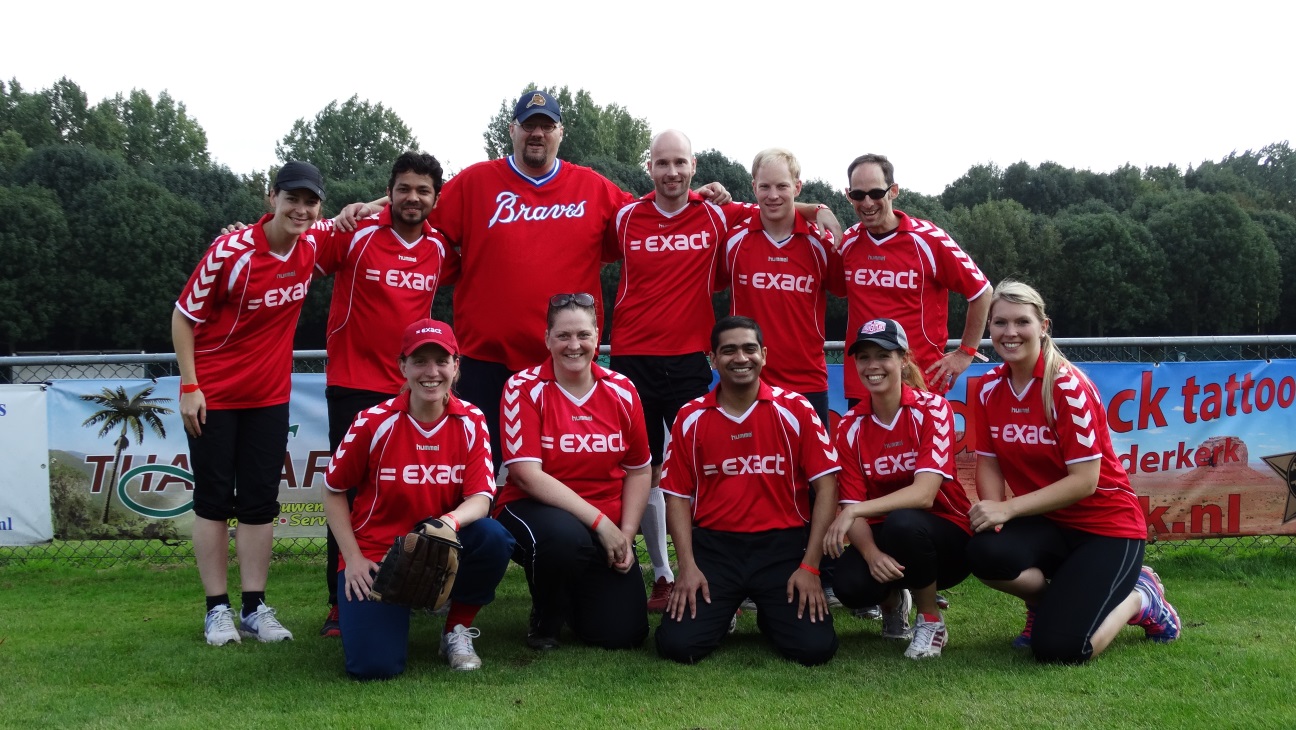
Today’s adventure was a softball tournament – one of my colleagues arranged a team from our company and practice time. We never had all of us on the practice pitch at the same time, but we did learn a few moves. A couple on the team play on other teams, a couple have a history playing cricket, one generally plays tennis. Despite our lack of together time, we managed pretty well. There were nine teams in the tournament of varying levels of skill. One team we played had a fantastic infield game. And they beat us handily.

softball_20140913

Interesting rules: the normal three strikes and you’re out, four balls and you walk, but instead of three out, all nine batters have a chance before switching to the outfield. The games lasted 45 minutes.

So each team got to play four games. We had lost two when the last round came up. Whereas the other teams we’d been up against had either practiced more than we had or less, but all three of them were pretty competent. The last team was comprised of young men from, I’m guessing, the local group home. The pitcher was pretty good, but in general they needed a little extra help. Still a lot of fun, but kind of weird.

Between the various games, I managed two singles, one run, and an RBI, but there was a fly ball in the second or third game that I should have caught, but I let it drop. Gotta try harder on those next time. (Note that we actually had 11 batters,though only the nine fielders – for this reason some of us only batted in two innings out of three.

All in all great fun. There’s another on October 11 which I’m pretty sure I’ll miss.

A note from today’s Skimm:

Syria…Well, hello there…The government of President Assad (the man Obama says ‘must go’) thinks it’s great if the US crushes ISIS but only if the US coordinates with the Assad administration. Rock meet hard place. Meanwhile, the rebels – the ones Obama hopes to support – think airstrikes could do a lot more harm than good.

September 12, 2014

I use the word We a lot in this entry. I’m not sure who I mean by We. The United States, certainly. American citizens as participants in the remnants of the American experiment in democracy, absolutely. Citizens of Western Democracies (tm?) as a whole, definitely. Citizens of the world who hate the idea of getting into another war or cheerleading for it, or who are indeed ready to go out and fight it. A hundred years after the opening of the War to End Wars, The Great War, The World War (to which we had to add a number when 25 years later we let it all happen again. When I say We, I mean all of these things.

13 years on, we’re doing it again. Of course there were those who knew in 2001 that we were going to war and all we needed was the pretext. The facts behind what happened with those four airplanes are documented. The missteps, the selling of the wars, the anger as we went to war unprepared are all in the record.

And we’re doing it again. For all the same reasons and many more, to be sure. Though in this year that the War celebrates its bar mitzvah, for it is male, there is little doubt, the army is definitely better prepared. Though I don’t suppose Donald Rumsfeld could have rammed the thing through quite so well had he prepared the armed forces first.

ISIS, ISIL, IS, The Caliphate. Whatever you want to call it, it’s not only our baby, it’s going to be very difficult to defeat with any integrity. ISIS has declared its opposition to the government in Syria, making it our ally, no? But the group beheads American journalists on video, making it our enemy.

We talk on occasion of Syrian moderates. Who are these moderates? The ones Senator McCain thought he was meeting several months ago who were fighting against Bashad’s forces? It came out this week that those moderates were members of IS, and are happily using the photo op McCain provided them in their press releases.

Why war, over an over and over again? Why all the isms (militarism, sexism, racism, fascism). The bottom line from my point of view, and this isn’t any kind of original thought, is that it’s lucrative to gin up cases for war and hatred. From the small-town bullshit in Ferguson, MO where the city financed itself on the backs of poor citizens terrorised for years by the police force, back to the late 19th century agreements that led to the Great War and forward to the idiotic arm-twisting that created the Versailles Treaty and the back room discussions that formed both it and Sykes-Picot.

Yeah, the agreement between the UK and France that divvied up their colonies in the Middle East and Africa into all those weird shapes with all the very straight lines. Iraq? The Lebanon? Syria? Iran? Palestine? Saudi Arabia? Yeah, Those didn’t exist before the 20th century. And divvying them up like that was (again) to the financial benefit of a few and to the detriment of millions. What was it British Petroleum used to be called?

Follow the money. A few people got very very rich and many people got moderately wealthy off the wars we started in 2001. Dick Cheney is one good example, but there are many in the Bush administration. The creation of American Security Theater benefitted a great many people as well. Industries that were doing well suddenly did amazingly well.

And please don’t go all Godwin on me here when I bring up that Hitler distinguished the system he was creating from fascism by suggesting it should be called Corporatism – the joining of the the mechanisms of industry with those of state.

The selling of the Iraq II is well documented, but the thing didn’t happen in a vacuum. It wasn’t that those in power ginned up the case for war in the aftermath of the destruction of the World Trade Center. If you believe the gent who writes The Far Left Side, what happened to WTC was part of the planning for the wars. So many questions got pushed aside and so much protest unanswered. Source: http://farleftside.com/2011/9-2-11-911-unforgotten.html

And now American Democracy has had 13 years of Free Speech Zones and the absolute gutting of the principles upon which the country was supposedly based. I try to keep in mind Howard Zinn’s assertions that the US based itself not life, liberty and the pursuit of propertyhappiness, but those were the slogans that sold a system that benefitted the few and disenfranchised the many. Jefferson’s Declaration of Independence reflected his own self-interest, as did the Constitution (agreed upon in secret conferences from which no written minutes were released) that of its creators.

I’ve seen Swans five times, Angels of Light twice and Michael Gira solo once. My next Swans gig is in two weeks at the Paradiso and there’ll probably be a review here.

I created this playlist to reflect M Gira’s solo gig earlier this year. It leans heavily on the acoustic goodies in the catalogue. Note that Nowness (Warning: Loud autoplayed video) shares the following on the matter of the band’s sound:

Swans’ seemingly endless touring schedule since their resurrection has seen the band’s reputation grow to the point that they are considered one of the most potent rock acts on the planet: The New Yorker’s Sacha Frere-Jones has hailed them as “one of the most fearsome working live bands.”

Swans: DNA Lounge, San Francisco, 1992.
Swans: Great American Music Hall, San Francisco, 1997. (I passed on the 1995 show because I didn’t really like The Great Annihilator. My loss.
Angels of Light: Great American Music Hall, 1999
Angels of Light: Palac Akropolis, Prague, 2005
Swans: Palac Akropolis, Prague, 2010 (I’d already moved to the Netherlands, but there were no NL tour dates announced when the Prague show went on sale. Worth the price of the flight, but Swans always are.)
Swans: I’ll Be Your Mirror, Alexandra Palace London, 2011.
Swans: Patronaat, Haarlem, 2012. My friends Andre, Mike, and Lucie joined for this one. I’m pretty sure The Seer went on for about 45 minutes. This wouldn’t have been uncommon. Lucie and I stepped up to the bar about midway through. After the show, the other three referred to it as “the song that wouldn’t end” which amused me. I think I was the only one prepared for that.
Michael Gira: MC Theatre, Amsterdam, 2014. Brilliant solo acoustic outing.

Looked up the set lists for the current tour – Already new songs, including this goodie with which they’re opening.

A storm coming together of the blaring horns of swing music, the development of the electric guitar by the late great Les Paul, electric blues out of Chicago, country boogie woogie, independent record labels like Atlantic, Chess (Leonard and Phil Chess – nice Jewish Boys), and Sam Phillips’ Sun Records (home of Jerry Lee Lewis and first label of Elvis Presley before Phillips sold Presley’s contract to RCA). Specialty Records another early big one. This stuff all comes in the 50s.

There are arguments to be made, however, that the origins of rock and roll date back at least to the 30s. I’ve chosen fourteen songs from the Wikipedia early rock and roll page (http://en.wikipedia.org/wiki/Origins_of_rock_and_roll) as examples of nascent rock music.

The songs that were the first rock and roll hits came in the early 50s, but, as noted, there were sounds coming from all over that contributed to the rock and roll sound. And the earliest influences, by some accounts, were recorded in the 20s. The thing to keep in mind, as the article states, is that every opinion is based on the person’s own criteria – there’s no real standard.

Wynonie Harris’ version of Good Rockin’ Tonight, Louis Jordan’s Caldonia, Jimmy Preston’s Rock This Joint are all early moves from swing and R&B to what rock and roll would sound like when polished by people like Sam Philips (founder of Sun Records – we’ll get to him in the next Rock lesson).

It’s hard to discuss early rock and roll without noting that the term often refers to both dancing and sex (which, some have noted, is also true of the term ‘jazz’), but the phrase also has a gospel sense. Sister Rosetta Tharpe’s Rock Me is a spiritual:

You hold me in the bosom / Till the storms of life is over
Rock me in the cradle of our love / Only feed me till I want no more
Then you take me to your blessed home above

(Much later, Jackson Browne’s Rock Me On The Water had a similar usage.)

While Wynonie Harris’ version of Good Rockin’ Tonight definitely has the non-spiritual sense to it, in several stanzas he uses the phrase ‘heard the news’ which is a traditional reference to the gospels.

This weaving together of the sacred and the profane finds its way into many different corners of the rock landscape. Doo Wop and R&B always had the church choir influence – this is where many rock/R&B/soul singers learned to harmonize. Little Richard, Sam Cooke, Aretha Franklin, and Whitney Houston all had gospel backgrounds.

Country blues (also known as folk blues) music has a slightly different feel than the blues we’ve covered in the jazz lessons. It tends to be performed with solo acoustic guitar (and occasionally harmonica). I’ve included Jim Johnson’s Kansas City Blues because you can trace his style down through Hank Williams (the first, not to be confused with country star Hank Williams Jr. and Hank III, his son and grandson) and in one direction to Bob Dylan and the late 50s/early 60s folk scene and on to the boogie of ZZ Top and others in the ‘southern fried rock’ bands of the 70s (April Wine, .38 Special, etc.).

Clarence ‘Pinetop’ Smith’s Pinetop Boogie Woogie has a stride piano base, and mostly has for lyrics instructions to the band to do various things. This format can be heard much later in Ray Bryant’s Madison Time (with which I’m pretty sure you’re familiar) and a whole lot of James Brown (“Can I hit it and quit it?” from Sex Machine, for example).

The Washboard Rhythm Kings’ version of Tiger Rag is notable for being thoroughly unhinged. Note that the music of the jug band tradition (that of turning household objects into cheap musical instruments) would influence musicians in the small folk clubs of the early 60s. In Palo Alto, there was Mother McCree’s Uptown Jug Champions who would soon change their name to the Warlocks and finally to the Grateful Dead.

And here’s an earlier, equally off the hook version of Tiger Rag: http://www.youtube.com/watch?v=nWSnT62X8uA

And a much more recent version, I think from a Les Paul tribute concert featuring Jeff Beck and Imelda May: http://www.youtube.com/watch?v=qy3P7Ry94cQ

Delta blues legend Robert Johnson’s relatively small body of recorded work was mostly unrecognized while he was alive. He died in 1938, and might be the first member of the 27 club, about which more later. Johnson’s complete recordings comprise only 42 recordings (including alternate takes) and fit on two CDs. However, the 1961 reissue, Columbia’s King of the Delta Blues Singers influenced a whole load of musicians including B.B. King, Jimi Hendrix, Eric Clapton, Brian Jones, Keith Richards, and Robert Plant. (Yeah, four of those are white English boys. In a few months I’ll do a lesson on the American Invasion of Britain that predates the British Invasion.)

On these solo blues recordings you can hear what became the twin-guitar approach of four-person rock and roll bands. On I Believe I’ll Dust My Broom, Johnson alternates between playing chords and more rapid individual notes. In most folk/folk blues you generally just get the chords.

It’s not just Johnson’s guitar technique that was influential. The songs themselves were covered by groups across the rock and roll spectrum and have become blues and rock standards.

The rhythms of Bob Willis’ Ida Red would find their way into Chuck Berry’s late 50s hits for Specialty including Maybelline.

To illustrate how swing threads its way into rock and roll, I’ve added two versions of Louis Jordan’s fantastic Caldonia. The first is a piano-based boogie woogie, the second featuring electric guitar. I’ve also included the full version of his 1949 Saturday Night Fish Fry which includes the chorus:

 It was rocking / It was rocking
You never seen such scufflin’ and shufflin’
Til the break of dawn

(I think this is an editing together of both sides of the original 78. Not sure.) Of course, using the word rocking in the refrain helps identify it as an early rock record (and was noted as such by Chuck Berry), but that phrase “til the break of dawn” would later haunt more cut-rate hip-hop songs than you can shake a tail feather at.

Arthur Big Boy Crudup’s That’s All Right Mamma was later covered by Elvis Presley for his first single, though Rock Me Mama was originally Crudup’s bigger hit.

You met Nat “King” Cole, in the last jazz lesson. His rendition of Bobby Troup’s Route 66 was a hit in 1946 and was later covered by numerous rock bands including the Rolling Stones (in 1963, I think) and the Replacements (in 1987). Another argument made about rock and roll is that it has two subjects: cars and girls. What made the car part of the argument possible was the post-war expansion of the US highway system. A single highway from Chicago to Los Angeles was well worth singing about.

And finally, we’ve got Jimmy Preston’s Rock This Joint (1949). Like Good Rockin’ Tonight, it has that repeating reference to secular rocking. One story is that this was the track that led Cleveland DJ Alan Freed to apply the term rock and roll to rhythm and blues music as early as 1951. A lot of late 40s R&B which would have been termed race music for the purposes of record charts would also have been unheard by most white audiences until Freed started playing it on his radio show. Of this, more in the next report.

Oh, and there’s one other thing. Teenagers. With America’s post-war affluence and growing middle class, due in part to the GI bill, strong unions, and a very strong economy, young people for the first time had a disposable income and corporations of many kinds were keen to exploit it. This will be a recurring theme as rock and roll becomes a commodity.

Next up: The Labels

It’s an old story and one I’m reading a lot these days. Several people recently have gone off Facebook in part or in whole for reasons that have mostly to do with the hatred and inanity of what passes for commentary.

For my part, it’s more a matter of how much time it takes up. I don’t drink much or take drugs, but I’m pretty sure FB is my addiction and I’m keen for it to take up less of my life.

And really, what do I do over there? I share posts other people write or goofy images other people create. And lists of the tunes that I’ve listened to whilst I run. I can do that over here, too, but am required, perhaps, to write something cogent about the matters rather than just say, read this thing I just read. It’s cool.

And don’t get me started about the massive amounts of click bait.

Occasionally I write something of my own, but I’m not nearly as prolific as I would like to be – FB makes things much easier than LiveJournal ever did. I’d like for my online presence to be much more about the writing skills I actually possess. These have been mostly geared to writing about music for my nieces, and not nearly enough fiction, though that’s what I really enjoy writing when I sit down to do it.

While on holiday recently, I started writing stories that may end up being the introduction to a novel. Note please that I have bits of perhaps a dozen unfinished novels in my files, so I don’t have high hopes. Yet. Usually I write the first bits by hand and run into contradictions and inconsistencies which I iron out once I put the notes into an editable format. And then I fiddle around with them for a bit and eventually get bored and start writing something else.

Well, I’m mostly done transcribing and should really get down to business with it, especially as my writing group will be meeting shortly. (I’m currently well amused with HanxWriter and am doing much of my Facebook blues. with it and copying into other files so that I can do something useful with the texts, as it only exports to PDF. I’m using it even as I write this. I like the old typewriter sounds and the output is pretty cool.)

It used to be that I accompanied my blog posts with a notation of the music played during the writing. This evening it was Pat Metheny’s Tap: Book of Angels Vol. 20. (Book of Angels is a series of compositions by John Zorn recorded by a number of different artists. Metheny’s is sublime.)