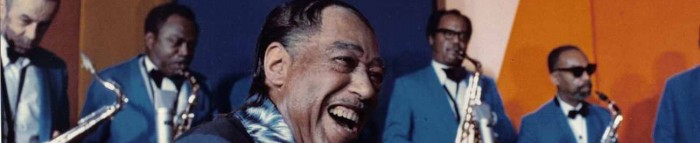
Joe’s History of Jazz
Lesson 3B – The Swing Era – Part 2

In the previous entry, I should have made reference to the 1927 film The Jazz Singer. This picture is notable for a number of reasons. Primarily, it was the first full-length movie with synchronized sound and images, and is generally called the first ‘talkie’. From what I gather, the plot goes something like this: son of a cantor doesn’t want to follow in dad’s footsteps, he wants to sing jazz. Son wants one thing; dad wants another. Big disagreement follows, but with some kind of reconciliation at the end. Jolson, himself a nice Jewish boy from Lithuania (who grew up in DC, as did much of my family) performed in blackface both in his own act and in the movie. The thing is, Jolson didn’t actually sing (much) jazz. Coming out of the early 20th century vaudeville scene, he used his strong tenor mostly in the service of sentimental ballads. Even his version of Alexander’s Ragtime Band seems to have the jazz feeling drained from it.

(Side note A: The release of The Jazz Singer is the crux of the action in Singin’ In The Rain. Gene Kelly’s character is working on a silent film that takes place in pre-revolution France (if I recall correctly) and the studio says, because of The Jazz Singer’s success, Kelly’s new film has to be a talkie too. His co-star however, has a lousy Brooklyn accent she can’t overcome.)

(Side note B: The 1980 remake starring Neil Diamond also features little music that could be called jazz. Diamond, another nice Jewish boy, sings pop and rock in his main career and didn’t stretch it out for the movie either. That said, I skip tracked the soundtrack while I was writing this, and it’s really quite good stuff.)

Jolson performed in several other movies, including The Singing Kid with Cab Calloway in which he and Calloway sang a parody of the Jolson style called I Love To Singa. Calloway started performing in the 20s, but hit it big in the 30s at (among other places) the Cotton Club, where his band stood in for a touring Duke Ellington. He recorded throughout the 30s (and beyond), but his first hit was 1931’s Minnie the Moocher, which he was still performing in the 1980 movie The Blues Brothers. I’ve also included a big band recording of his track Jumpin’ Jive which served as the title track for new wave singer Joe Jackson’s exploration of jump and swing music in 1981. (That’s not entirely fair – Jackson’s early albums are distinctly new wave, but from 1982’s Night and Day onward, he refused pigeonholing.)

Meanwhile, across the pond, jazz was going in a different direction in Paris where guitarist Jean “Django” Reinhardt formed Quintette du Hot Club de France in 1934 with violinist Stephane Grapelli. A lot has been written about Django’s style which was influenced by having lost two fingers on his left hand as a result of a fire that burned much of his body. He had to re-teach himself how to play and created fingerings that used two fingers instead of the four that most guitarists use. The Quintette, interestingly, was originally made up of string players who would use their instruments to add percussion. Horns and piano are present on many recordings, however.

You can get a feeling listening to Django’s take on WC Handy’s St. Louis Blues (performed by Louis Armstrong back in lesson 1) of how jazz evolves. Parts of it feel like a tango, and very little of it feels like the blues anymore.

According to Wikipedia, the Quintette performed and recorded with a number of American musicians who visited Paris in the 30s including Coleman Hawkins and a “jam session and radio performance” with Louis Armstrong. A quick web search for a surviving recording of this session has yielded no results.

Slim Gaillard, another interesting cat who got his musical start in the 30s, first recorded as half of the duo Slim and Slam with bassist Slam Stewart. Their first hit was Flat Foot Floogie, which was covered by several others including Benny Goodman. Gaillard continued to perform well into 1980s (including an appearance in the 1986 film Absolute Beginners). Gaillard is notable primarily for his humour and for singing in several different languages, including Yiddish and Vout, a language of his own invention for which he wrote a dictionary. I’ve also included Ferdinand the Bull, which seems to have been inspired by the book we all know and love. Pay particular attention to how Slam’s bowed bass solo sounds almost like a Dixieland trombone solo.

Stewart would go on to work with notables including pianists Art Tatum and Erroll Garner, Benny Goodman, and Fats Waller. We’ll hear more from these combos in the next entry.

Gaillard wasn’t necessarily a key figure in jazz, but he (along with Calloway and Louis Jordan in the jump/swing world) answer Frank Zappa’s musical question Does humour belong in music very much in the affirmative. As jazz evolves, it’s easy to lose sight of the humour as technique, improvisation, and the journey through the music seem to overtake the joy that intrinsic in the making of the music.

One player who straddles the swing and post-swing eras is the aforementioned Art Tatum who had been playing for several years and earning the interest of musicians such as Ellington, Armstrong, and Fletch Henderson. I’m pretty sure his first recordings are the ones here with Adelaide Hall. It’s a little tough, but try to listen to the piano behind Hall’s vocal gymnastics on You Gave Me Everything But Love. Later on, Tatum eschewed playing in groups in favour of solo work, feeling that others couldn’t really keep up with him.

I’ve had the following paragraphs about music publishing waiting to be used for several weeks, but haven’t been able to incorporate it into my looks into the various artists and their interconnections. The main thing is that bands and singers brought jazz to popular compositions – the products of the Brill Building and other Tin Pan Alley houses weren’t necessarily jazz to start with.

Tin Pan Alley – Wikipedia shares that in the Big Band era, the song publishers in places like the Brill Building would send “song pluggers” to the white band leaders and to radio stations to sell the latest songs. So bands like Goodman’s, the Dorseys’, and Miller’s got first crack at songs composed there by folks like the Gershwins, Johnny Mercer, and Irving Berlin. The thing about Tin Pan Alley, though, is that the songwriters/lyricists/composers worked in whatever idiom was popular. Broadway, movie revues (think Ziegfeld Follies, for example) and the Big Bands, the popular (pop) music of the 30s and 40s. Later Tin Pan Alley efforts would be more in the pop vocal realm. Acts like the Drifters (On Broadway), Neil Sedaka (Calendar Girl), and The Monkees (Pleasant Valley Sunday, I’m a Believer) all had hits with Brill Building songs. (Another sidenote to bring this full circle – Neil Diamond, who wrote I’m A Believer and three other Monkees hits, was a Brill Building song writer before his own hits as well.)

Next time, Big Bands Go To War!

Joe’s History of Jazz
Jazz 3A – The Swing Era Part 1

Historically, the 1930s are called The Great Depression, which began with the crash of the stock market in October, 1929. The exuberance of the Jazz Age started to drain away with the fortunes of much of the country, though the repeal of the 18th Amendment ending Prohibition in December of 1933 breathed new life into the scene.

The recording industry, at the onset of the Depression went into great decline and really didn’t pick up again until about 1935 when Swing really took off. In Jazz history, the decade of the 1930s is called The Swing Era and the Age of the Big Bands. In fact, the popularity of swing music continues all the way through WWII.

Duke Ellington, who makes a national name for himself in this period, is joined by Jimmy and Tommy Dorsey, Benny Goodman, Cab Calloway, and Glenn Miller. In Paris at this time, we see a European jazz sound emerge with such names as Django Reinhardt, Stephane Grappelli, and Josephine Baker adding to the chanson of Edith Piaf.

It’s hard to pin swing down. Technically, this form features “accented triplets (shuffle rhythm), suitable for dancing” (http://en.wikipedia.org/wiki/Swing_time#Transcription). Swing time (in terms of time signature) indicates 6/8, 9/8 or 12/8, though an argument is made that that the shuffle rhythm applied to music played in common time (4/4, but you knew that) is sufficient. It’s the swing feel that matters. The steps in swing dancing (to the extent that I managed to learn them) involve counts of 4.

Swing music comes from three distinct angles:

  • Musicians and band leaders themselves composed their own tunes,
    Ellington, Dorsey, Miller’s In The Mood
  • Bands arranging songs originally composed for Broadway shows in the swing style,
    The Gershwins’ songs from Girl Crazy were especially popular in the early 30s; many of Cole Porter’s Broadway songs were jazz hits (and continue to be standards).
  • Composers from outside both of those threads – Tin Pan Alley in Manhattan where professional songwriters had their offices dating back to the 1880s. Noted Tin Pan Alley composers include the Gershwins, Irving Berlin, Jerome (Show Boat) Kern, and Porter.
    Not far away from Tin Pan Alley sits the Brill Building where Goffin and King, Lieber and Stoller, Greenwich and Barry, Sonny Bono, Pomus and Shuman, and Phil Spector composed hits in the 50s and 60s. (There’s a playlist to be had just of the fantastic songs to come out of that one piece of real estate. I’m pretty sure at least one recent Broadway musical was inspired by those songs).

Clarinettist and band leader Benny Goodman (tracks 1-4) was known as The King of Swing. Interestingly, Goodman (born in 1909) was the son of a Polish tailor and a Lithuanian girl who met in Baltimore before moving to Chicago. As a Chicago teenager, he was in a band with Bix Biederbecke. In the late 1920s he recorded in bands with Glenn Miller and Tommy Dorsey and in the early 30s made recordings with (among others) drummer Gene Krupa, and vocalists Jack Teagarden and Billie Holiday.)

In 1934, Goodman contracted with NBC to perform on the weekly Let’s Dance program. In order to have enough music, he arranged to purchase swing arrangements from composer/bandleader Fletcher Henderson. King Porter Stomp (track 1) was a hit in 1935.

Now before reading the Wikipedia article on Benny Goodman, I was familiar with his work – I had a few albums including 1956 recordings of two Mozart pieces for clarinet recorded with the Boston Symphony. I even taped a postcard image of Goodman to my clarinet case (I took lessons in the 90s from a member of the SF Opera’s orchestra – alas not a smidge of his talent rubbed off on me). That said, I had not heard of this breakthrough 1938 performance at Carnegie Hall (The following is lifted right from Wikipedia – there’s no escaping the full original quote):

 The concert began with three contemporary numbers from the Goodman band—”Don’t Be That Way,” “Sometimes I’m Happy,” and “One O’Clock Jump.” They then played a history of jazz, starting with a Dixieland quartet performing “Sensation Rag”, originally recorded by the Original Dixieland Jazz Band in 1918. Once again, initial crowd reaction, though polite, was tepid. Then came a jam session on “Honeysuckle Rose” featuring members of the Count Basie and Duke Ellington bands as guests. (The surprise of the session: Goodman handing a solo to Basie’s guitarist Freddie Green who was never a featured soloist but earned his reputation as the best rhythm guitarist in the genre—he responded with a striking round of chord improvisations.) As the concert went on, things livened up. The Goodman band and quartet took over the stage and performed the numbers that had already made them famous. Some later trio and quartet numbers were well-received, and a vocal on “Loch Lomond” by Martha Tilton provoked five curtain calls and cries for an encore. The encore forced Goodman to make his only audience announcement for the night, stating that they had no encore prepared but that Martha would return shortly with another number.

By the time the band got to the climactic piece “Sing, Sing, Sing“, success was assured. This performance featured playing by tenor saxophonist Babe Russin, trumpeter Harry James, and Benny Goodman, backed by drummer Gene Krupa. When Goodman finished his solo, he unexpectedly gave a solo to pianist Jess Stacy. “At the Carnegie Hall concert, after the usual theatrics, Jess Stacy was allowed to solo and, given the venue, what followed was appropriate,” wrote David Rickert. “Used to just playing rhythm on the tune, he was unprepared for a turn in the spotlight, but what came out of his fingers was a graceful, impressionistic marvel with classical flourishes, yet still managed to swing. It was the best thing he ever did, and it’s ironic that such a layered, nuanced performance came at the end of such a chaotic, bombastic tune.”[27]

This concert has been regarded as one of the most significant in jazz history. After years of work by musicians from all over the country, jazz had finally been accepted by mainstream audiences. Recordings were made of this concert, but even by the technology of the day the equipment used was not of the finest quality. Acetate recordings of the concert were made, and aluminum studio masters were also cut.

That would have been something to attend. After learning of these recordings, I didn’t listen to much else for a while. One O’Clock Jump was a signature tune for Count Basie and Sing Sing Sing became (and might already have been) Goodman’s own signature tune.

One thing to listen for in the three tracks I’ve selected is that you can feel the swing in the mid-tempo arrangement of One O’Clock Jump, the relatively slow Body and Soul and the very fast Swingtime in the Rockies.

New Jersey native William James “Count” Basie (tracks 5 and 6) spent the mid-20s cutting his teeth on the vaudeville circuit. In the 30s his band featured vocalist Billie Holiday who already had a career in her own right. Sadly they never recorded together. From his early recordings, I’ve shared Roseland Shuffle and his own take on One O’Clock Jump.

Duke Ellington, who you’ve already met, spent the early 30s primarily performing on radio and on tour. That said, he had hits in this period, notably with It Don’t Mean a Thing (If It Ain’t Got That Swing [track 7]). This would be a signature number for Ellington long into his career (a 1961 recording with Louis Armstrong is particularly tasty) as well as for artists including Nina Simone and Ella Fitzgerald. (And the phrase “it don’t mean a thing” sneaks into some weird places including industrial band Skinny Puppy’s 1996 song Death.)

Vocalists

I’m not sure the addition of vocalists to swing/jazz acts was anything that new in the 30s. What may be new is that many of the vocalists in the 30s and later (as noted regarding Billie Holiday above) started as guests with existing acts went on to have careers of their own.

Ethel Waters (track 8) actually got her start in the teens, working the same clubs as Bessie Smith. In the 20s, she sang both pop and blues. (Columbia had a ‘race music’ series – it’s probable that all the big labels separated music marketed to whites from music marketed to others. Billboard, prior to the rock and roll era had ‘race music’ charts.) In the 30s she sang at the Cotton Club as well as in an Irving Berlin Broadway revue.

Smith was still touring in the early 30s, though in some obscurity. Her last recordings were made with John Hammond (who was starting to record Billie Holiday at the same time) in 1933 and these sessions included some attempts at swing, but Hammond himself preferred the blues work in these sessions and those are the sides that were released. Bennie Goodman and Jack Teagarden are both listed as performing on these sessions. (tracks 9-12)

Hammond’s an interesting one to bring in. He’d recently graduated Yale (and in 1933 this meant you were male and white), but insisted when he could on using integrated bands on his records and pushed white band leaders to bring in black musicians. (http://en.wikipedia.org/wiki/John_H._Hammond#Career) He made his name primarily as a producer, and almost exclusively for the Columbia label to which he signed such talents as Holiday, and later Bob Dylan, Leonard Cohen, and (after his retirement) Stevie Ray Vaughn.

Billie’s recordings in the 30s, however, were mostly for smaller labels, but under her own name. Indeed, at one time the name on the records was Billie Holiday and Her Orchestra. In 1937 she did sweet versions of the Gershwins’ Let’s Call The Whole Thing Off and They Can’t Take That Away From Me (the latter usually associated with Sinatra though many have recorded it). (tracks 13 and 14)

Louis Prima, a trumpeter and vocalist who would continue to record and perform swing music well into the 1960s made his first recordings in the mid-30s with Joe Venuti and later with Pee Wee Russell before forming the Louis Prima Jump Band. (Perhaps you know the song I Wanna Be Like You from Disney’s The Jungle Book? Yeah, that’d be Louis Prima as the king of the orangutans.) (tracks 15-17)

In 1939, Harry James (a trumpeter in that Benny Goodman Carnegie Hall show) contracted a young Frank Sinatra to sing with his orchestra. They recorded a number of tracks, that year, but in November of that year, James released Sinatra from his contract so that he could accept an offer from the much bigger Tommy Dorsey. (track 18)

In the next instalment we’ll hear from Reinhardt and Grapelli, Cab Calloway, Ella Fitzgerald, Al Jolson and quite a few others.

Joe’s History of Jazz
Lesson 2
The Jazz Age

After World War 1, jazz went through something of an explosion. Author F. Scott Fitzgerald coined the term The Jazz Age with his 1922 short story collection Tales of the Jazz Age. The period was also known as The Roaring Twenties. (If some of my comments seem pedestrian, please recall that original audience of these posts is a pair of young teenagers.)

Prohibition, enacted via the 18th Amendment was another factor in the growth of jazz. Because pubs and bars were closed, speakeasies,venues selling illegal alcohol, proliferated and the entertainment in these clubs tended to be jazz. Radio broadcasts from 1922 onward expanded the reach of jazz from the clubs to the general public.

And then there was the touring. “In 1919 Kid Ory’s Original Creole Jazz Band of musicians from New Orleans played in San Francisco and Los Angeles where in 1922 they became the first black jazz band of New Orleans origin to make recordings.” (http://en.wikipedia.org/wiki/Jazz#1920s_and_1930s). Ory’s Creole Trombone has a definite Dixieland feel to it, but there’s a lot here that became standard in jazz. You can hear the theme develop in the first half of this 3-minute track and then listen for improvisations on the theme by several band members before resolving the theme in the last 15 seconds or so.

Hot Jazz took a leap in Chicago with Joseph Nathan “King” Oliver, a composer and cornet player who developed his technique with the mute. He also taught Louis Armstrong. Oliver started his career in New Orleans but left the south in 1918 for Chicago. (There’s probably a dissertation or two on how racism influenced the development of music in the north in the period before the Civil Rights era.) I’ve chosen Oliver’s Room Rent Blues as the theme of what to do when you can’t make the rent seems to come up regularly (cf John Lee Hooker’s John L’s House Rent Boogie; Bessie Smith’s House Rent Blues). Room Rent Blues also has a really sweet clarinet solo.

A note on instrumentation. In jazz, eventually every instrument in the orchestra came to take part. As noted in the last lesson, banjos were central to Dixieland but fell out of favor somewhat, though Oliver and Ory both called their groups Creole Jazz Bands and you’ll hear banjo and the Dixieland flavour in general in their work. The whole of the brass and woodwind sections, guitar, piano, violin, stand-up and double bass and a variety of drums all find their ways in.

And there are probably several dissertations on women in jazz. Bessie Smith, who was primarily a blues singer, came to prominence in this period. Lil Hardin (who later married Louis Armstrong) played piano with King Oliver. Josephine Baker found her initial fame in the 20s in Paris. (We’ll hear more from her in one of the next lessons.) Bessie Smith’s career is notable in a jazz context for a couple of reasons. First off is that stylistically jazz and blues music are fairly inextricable at this time. She also recorded with a large number of jazz musicians including Louis Armstrong and Coleman Hawkins. She started performing in 1913 and landed a recording contract with Columbia in 1923. Moonshine Blues (1924) was composed by Ma Rainey, with whom Smith performed in the 1910s.

Jazz, like R&B, and later rock and roll, was a primarily black musical form which found much of its popularity when performed by white musicians. Sometimes this works to good effect, sometimes it can be rather embarrassing. That said, the man who carried the title The King of Jazz in the 1920s was a white bandleader named, no joke, Paul Whiteman. An argument can be made that the jazz his orchestra performed is rather anemic and generally catered to a conservative white audience. Note that his bands tended not to be integrated and they played from written arrangements (http://en.wikipedia.org/wiki/Rhapsody_in_Blue#Is_it_jazz.3F). On the other hand, at various times his band featured notables such as Bix Biederbecke, Bunny Berigan, and Jack Teagarden. His vocalists included Bing Crosby and Billie Holiday. Whiteman’s most interesting contribution to music (not just jazz) lies in his commission of George Gershwin’s Rhapsody in Blue (track 4, a recording which I’m pretty sure features Gershwin himself on piano).

Gershwin (and his brother, lyricist Ira Gershwin) wrote primarily for the theater, but his works include the jazz ballet An American in Paris and the score for Porgy and Bess, which itself spawned the jazz standards I Loves You Porgy and Summertime. Rhapsody in Blue takes jazz into the orchestral realm with its various movements while maintaining room for improvisation. For example, Gershwin didn’t write the score for the piano solo until after the first performance. (http://en.wikipedia.org/wiki/Rhapsody_in_Blue#Premiere) I can imagine Gershwin’s “wait for nod” notation made Whitehead rather nervous, given that his band members always had scores in front of them.

Folks from the earlier decades of jazz continued to have success as well. Jelly Roll Morton’s Red Hot Peppers notably struck with a recording of King Oliver’s Doctor Jazz (track 5).

Leon Bismark “Bix” Beiderbecke taught himself trumpet and found success with a crew called the Wolverines who had a long engagement at a speakeasy in Ohio. He recorded his own composition Davenport Blues (track 6) under the name Bix and His Rhythm Jugglers in 1925. He went on to play in Whiteman’s orchestra, but a combination of Whiteman’s heavy touring schedule and his own alcohol dependence led to his death of pneumonia at the age of 28 in 1931.

However the biggest players, especially during the late 20s, were Louis Armstrong, Earl “Fatha” Hines (who collaborated with Armstrong), and Duke Ellington.

Hines started his career as accompanist to Louis Deppe, a Pittsburgh vocalist in 1920. By 1924 he had already toured much of the country with Carroll Dickerson, a jazz violinist and band leader (Jazz violin? Yeah. Later on I’ll share some Stephane Grapelli, a French jazz voilinist whose career lasted from the 1930s to the 90s.) who would shortly incorporate Armstrong into his act. Well, read one way, that’s the case. Read another, it sounds like Armstrong and Hines turned Dickerson’s band into the first of Armstrong’s Hot Fives. Hines at this time, about 1927, took over piano duties previously performed by the aforementioned Lil Hardin. Weather Bird (track 7) comes from a 1928 recording session.

Hines’ band in the late 20s, comprising from 15 to sometimes 28 musicians, played Al Capone’s Grand Terrace three to four shows per night, six or seven nights a week, often broadcast live. It doesn’t seem as though those early broadcasts have been preserved, however At the Apex Club, with clarinettist Jimmie Noone, seems to document a small combo appearance from around this period (Apex Blues, track 8).

Armstrong started playing cornet as a child, playing seriously while doing stints in the New Orleans Home for Colored Waifs. King Oliver was a mentor, and Armstrong’s first big break was taking Oliver’s place in Kid Ory’s band (everything’s connected!), but shortly followed Oliver up to Chicago and joined his band. After a stint with Fletcher Henderson in New York, Armstrong returned to Chicago where he formed and recorded with the Hot Five and Hot Seven combos. He concluded the 20s in the orchestra of a Fats Waller review called Hot Chocolates, from which he recorded (What Did I Do to Be So) Black and Blue (track 9) several times. As previously noted, we’ll be hearing more from Armstrong in the coming decades.

Edward Kennedy “Duke” Ellington was raised in Washington DC near Dupont Circle. (In the original version of this lesson, I note the proximity of Dupont Circle to where several of my/my nieces’ relatives grew up/live.) He spent the late 1910s playing society balls and embassy parties in DC and Virginia before moving up north. A 1923 gig in Atlantic City, NJ led to what became a 4-year engagement at the Hollywood Club in New York. In 1927 King Oliver turned down an offer for his group to be the house band at the Cotton Club in Harlem, an offer Ellington didn’t refuse. In the late 20s Ellington’s band recorded under several names including The Washingtonians. I’ve included the early hit East St. Louis Toodle-Oo (track 10) because it was the first Ellington composition I ever heard (on Steely Dan’s 1974 album Pretzel Logic).

Oh, and listen, another song about getting dosh to the landlord, Rent Party Blues (track 11), recorded by Duke Ellington and the Jungle Band in 1929.

I realise looking at this list that it’s quite blues heavy, so I’ve pulled a couple more 1929 Ellington recordings, the Jungle Band’s Harlemania (track 12) and A Night at the Cotton Club (Parts 1 and 2) (tracks 13 and 14) which comprises The Cotton Club Stomp, Misty Mornin’, Goin’ To Town, and Freeze and Melt. These have the feeling of live recordings, but they don’t have the feeling of a band with the freedom to stretch beyond the 3 1/2-minute limitation of a 10” 78 rpm record. My guess is that those concert broadcasts would have had more of the improvisation heard later on recordings like Ellington’s 1940 Live at Fargo, recorded direct to 16” 33 1/3 rpm acetates on which several tracks run over 5 minutes.

We’ll definitely be hearing more from, as Stevie Wonder called him, “the king of all, Sir Duke” as well.

Next up: The Swing Era!

Earlier this year I started compiling a history of jazz at the request of my nieces in California. So far there are six lessons which bring us through the rise of Bebop.I hope to post them here on a regular schedule, but knowing me. A lot of my facts are garnered from that font of all wisdom, Wikipedia. I try to source my quotes and factoids, but occasionally I fail. Apologies in advance. Comments, corrections, criticisms, and questions are always welcome.

Note also that the target audience for these posts are a pair of teenagers. Sometimes I’ll sound like a junior high school teacher.

Joe’s History of Jazz
Lesson 1
Jazz Origins

A music critic (whose name is lost to history) once noted that “talking about music is like singing about economics.” In the 70s this was updated to “Writing about music is like dancing about architecture.” (http://quoteinvestigator.com/2010/11/08/writing-about-music/) The fact remains that learning about music is best done in the experience of music.

The origins of jazz can be traced to the music of pre-abolition slave gatherings, post-abolition minstrel shows, and the interchanges in the late 19th century between African-American musicians and those who had developed Afro-Caribbean musical forms. (A twice-daily ferry ran between New Orleans and Havana at the time. My guess is this ferry ran until Castro’s revolution in 1959.) The big difference between the two is that slaves in the American south where not allowed to use drums, whereas Africans in the Caribbean were able to maintain the drumming traditions brought over from Africa.

It starts in New Orleans, though others might argue that St. Louis, MO deserves the credit. Others will argue for Memphis. Later on, jazz will have centers all over the US – Chicago, New York, San Francisco, even Los Angeles (a most un-jazzy town, if you ask me). There are periods, one could argue, in which the purest jazz could only be found in Europe. Mind you, “pure” jazz sounds to be almost an oxymoron. Jazz is muddy, crazy, claims multiple inheritance, and is very hard to pin down.

The earliest recognizable jazz music includes ragtime and the blues in the 1890s and Dixieland from the period around World War I, though the forms of ragtime appeared as early as 1860 (!) in the music of a half-Jewish, half-Creole gent from New Orleans named Louis Moreau Gottschalk. Gottschalk performed extensively throughout the US, Caribbean, and South America before his death in 1869 (track 1).

Note that the term ‘ragtime’ does not indicate a time signature (as waltz time is 3/4, for example). “The defining characteristic of ragtime music is a specific type of syncopation in which melodic accents occur between metrical beats.” (http://en.wikipedia.org/wiki/Ragtime#Musical_form)

While Scott Joplin is the best-known proponent today of ragtime, he was far from the only one (and Joplin himself was prolific in other musical forms as well, including opera). Tom Turpin’s Harlem Rag (track 4), for example, was the first rag published by an African American. Whole books on the subject of music publishing have been written and much of the history of popular music is wrapped up in publishing and rights ownership. Suffice it to say that in the 1890s, publishing referred primarily to sheet music. Vess Ossman, a white banjo player and dance band leader, recorded popular versions of rags in the first decade of the 20th century, including the Buffalo Rag (track 3), another Tom Turpin composition. The Mississippi Rag (track 2), is considered the first ragtime composition, was published in 1897.

W.C. Handy was one of the first to document the blues, which evolved out of 19th century spirituals and work songs, publishing St. Louis Blues (track 9) in 1912. She’s a Mean Job Blues and Gulf Coast Blues (tracks 7 and 8) are examples of Handy’s own work. I preferred Armstrong’s take on St. Louis Blues to the Handy recording I found.

Other early published blues songs include Jelly Roll Morton’s Jelly Roll Blues (track 5, a band version featuring banjo and clarinet, and track 6 a solo piano version, composed 1905, published 1915). To my ears, however, this is more ragtime than blues.

“The basic 12-bar lyric framework of a blues composition is reflected by a standard harmonic progression of 12 bars in a 4/4 time signature. The blues chords associated to a twelve-bar blues are typically a set of three different chords played over a 12-bar scheme.” (http://en.wikipedia.org/wiki/Blues#Form) Note also the AAB rhyme scheme in vocal blues.

Memphis Blues (track 10) is sometimes considered the first published blues, it’s also argued to be more of a cakewalk, one of the precursors of ragtime. (http://en.wikipedia.org/wiki/Jazz#Within_the_context_of_Western_harmony) I’d argue that Handy’s St. James Infirmary (track 11) straddles blues and what became jazz better than some of Handy’s other songs.

Dixieland includes elements of both blues and ragtime and is sometimes called Early Jazz or Hot Jazz. Louis Armstrong had early combos called the Hot Fives and Hot Sevens, perhaps for this reason. (You’ll hear Armstrong’s name a lot in these little essays as he was one of the earliest jazz performers and had a long and prolific career.) “The term Dixieland became widely used after the advent of the first million-selling hit records of the Original Dixieland Jass Band in 1917.” (http://en.wikipedia.org/wiki/Dixieland#History) You can hear both ragtime and blues in their recordings. It seems to me that Satanic Blues (track 12) is really neither, but it sounds almost as quintessentially Dixieland as When the Saints Go Marching In.

When the Saints Go Marching In (track 13) was traditionally a funeral march. In the funeral music tradition of New Orleans, often called the “jazz funeral”, a band accompanying the coffin to the cemetery would play The Saints as a dirge. On the way back, the band would switch to the familiar “hot” or “Dixieland” style. You can hear a small taste of that dirge in Pete Fountain’s version, though I have heard versions which make the distinction much clearer.

Next: The Jazz Age.

A couple of years ago, I wrote a relatively long short story called Crutch. I’ve reworked it a couple of times, but I also know that there’s a lot of information and a lot of back story that might make it more interesting. I also know that if I set a goal of posting a page or two here every week, then I’ll  have the impetus to polish it into something quite nice.

Getting off the front of the bus and mostly sober now, the young man doesn’t much heed the apology of the trench-coated woman who knocks his leg with her cane as they take different directions. He’s still in his head trying to recall the name of a song the DJ at the club recommended.

The late spring night is warm and moonless, but he can only see a few stars between the white light of the sodium lamps and the porch lights triggered by the motion sensors everyone seems to have bought in the last few years. He continues in the same direction the bus had been traveling while she in dark soft boots turns right at the corner. The sweat of a night spent almost entirely on the dance floor encrusts his tight black t-shirt and his short black hair no longer holds its gelled spikes. A well-worn denim jacket hangs limply from an elbow. He keeps to the lit parts of the pavement although he sees no one about regardless who would help should there be trouble.

He doesn’t notice the trench coated woman fall in step into the shadows behind him. He remembers the fire that took out three of the houses on the next corner, where his apartment building now stands. He remembers the hook and ladder and the heat and the permeating smell of kerosene.

Turning up his own block, his heart starts to pump harder than it had all night as if, he thought, someone had spiked his last whiskey with a great hit of niacin. He wonders if the boyfriend of that dreadlocked girl he’d talked up had slipped him one. Nearing the gate to his apartment complex, he gasps a last time, trying to wrap a fist around his heart, and falls in a quiet heap to the pavement.

No lights come on as the trench-coated woman hurries to the young man and examines the wound she’d given his leg. She sees a trickle of blood, but the wound is otherwise clear. Clicking a radio on her wrist, she says crisply, “Number 12 down, boss.”

Creative Commons Licence
This work is licensed under a Creative Commons Attribution-NonCommercial-NoDerivs 3.0 Unported License.