Archives for posts with tag: King Crimson

So this month, I’ll be diving into the studio recordings of King Crimson. I’ve been a fan since the early 80s and have seen them perform four times. (I’ll see them again in July. Woot!) I considered reviewing the albums alphabetically rather than chronologically, but was dissuaded.

While Robert Fripp is the only constant in almost 50 years of KC, both Giles brothers appeared on either or both of the first two KC albums.

There are two ways to consider this album, neither of them very useful. One way is to look for aspects of it that point to what Michael Giles and Robert Fripp would do the following year with In the Court of the Crimson King. The fact is that very little of Cheerful Insanity resembles anything in the first few years of KC. The other way to look at is to consider where it falls in the music being made at the same time. This is more helpful, I suppose, because there are bits of the album that resemble early Moody Blues, early Pink Floyd, generic English folk rock and its proggy offspring (Genesis, Jethro Tull, Yes).

I first heard this album sometime in the mid-90s when I was collecting as best I could anything with Fripp’s name on it. I couldn’t hear anything in it (and still don’t) that resembles the weirdness of that late-70s/early 80s period when he’d been applying that arpeggiating guitar technique to everything he touched (including, for example, the stylings of the first and third Roches LPs. And much as I enjoyed that early prog, Cheerful Insanity just didn’t cut it.

Part of the issue I had was that a very young Fripp only wrote three of the songs. Little Children on side A suggests why Fripp left the lyrics to others after that. This song is notable for vocals provided by The Breakaways who famously backed Petula Clark and Cilla Black on several singles.

GGFSuite No. 1 and Erudite Eyes, which close side B have a more Frippish feel to them than the rest of the album. Suite No. 1, which clocks in at just under six minutes, starts with some Paganini-like runs that are joined by bass and keyboard, but after a minute and a half or so, the baroque gymnastics are replaced with a piano/strings/vocals arrangement that brings to mind the Chi-Lites’ Have You Seen Her. This segment is followed by a harpsichord-guitar duet which is followed by a reprise of the Paganini. A single track broken into three possibly unrelated forms, pulled together by a reprise of the theme? The application of jazz theory to folk motifs is one of the main threads of early progressive rock – it’s just weird to hear it applied so strangely.

Erudite Eyes is really the only song that points to the musical strangeness that was to come. It begins as a waltz, turns into a polka, returns to waltz-time and moves into improvised psychedelic strangeness before the second minute is up.

Lyrically, the whole affair is pretty strange. Newly-Weds suggests the discord of couples keeping up with the Joneses (He worries all day about wolves at his door…but on the other hand, she’s got a ring). One In A Million’s look at a man ‘content with the things at the moment, except the yellow line by the pavement’ echoes Revolver-era Beatles (Eleanor Rigby, Taxman).

The biggest issue I have with the whole album is the interspersed comedic numbers. Most of the songs on side A are bookend with episodes of The Saga of Rodney Toady, a ‘sad young man’ who girls run away from at school dances and whose parents are ‘fat and ugly’ and tell him that will ‘meet a fat and ugly girl just like Rodney’s mother and they would get married.’ These interludes don’t speak back to the music and actually detract from enjoying the album.

Side B’s songs are interspersed with repetitions of the sentence ‘I know a man and his name is George’ spoken in the correct order once and then in permutations (Know I George his name and a man, for example) and in increasingly annoying voices. One could argue that the rearrangements of the words reflect the possibilities inherent in the structured and random mutations of music that lie at the heart of King Crimson’s most intriguing work (for me, this includes tracks like Fracture, Level 5, and Starless).

After this album was released, Peter Giles left, and Ian MacDonald and Judy Dyble (late of Fairport Convention) joined and they made a collection of high quality home recordings released in 2001 as The Brondesbury Tapes. This collection is mainly notable for Dyble’s vocal on an early version of I Talk to the Wind. Soon after, Greg Lake joined and the Crimson King was born.


Cross_Jackson_20170519

David Cross and David Jackson

So I saw this gig announced a few months ago after I’d spent several weeks listening to almost the entire Van Der Graaf Generator catalogue. David Cross played violin on Starless and Bible Black and Larks’ Tongues In Aspic by King Crimson. Jackson played horns with VDGG for most of their run. So, yeah, two incredible musicians who had each been in the game for more than 45 years. It was a gig I didn’t want to miss. Especially given the recent resurgence of King Crimson, I was quite surprised that the gig was far from sold out. Fine, I’ll take middle front at this relatively small club. (When packed, Boerderij can hold an audience of 750 or so and my guess is there were about 300 there.) To open, Cross and Jackson came out alone and traded a little humour before taking on Starless Loops from the recent Cross/Robert Fripp album of improvisations on the Starless theme, Starless Starlight. After a few more pieces, they played another from Starless Starlight. There’s one ripple of chords from Starless that always gives me the shivers and did again when Cross played it Friday night. My friend Corniel, who joined me for the gig complained that it would have been better for him if they’d just played and not joked around so much. There’s some merit to that argument, as the joking detracted from their sheer expertise. Their duo work owed more to improvisational jazz than to the progressive rock they’re best known for. After a 30-minute set, they took a break before coming back with the full David Cross Band.

In the main set, the band played several numbers from the new (very good) album, The Sign of the Crow including Starfall, the title track, Rain Rain and The Pool. Current vocalist Jin Wilde has a very interesting voice (having come out of a dance music background, it seems) handles the new stuff quite well. His tenor is well suited to the music, generally. The band’s set includes (and if the 2008 live album I bought at the merch counter is anything to go by, has included for a long time) three King Crimson songs: Exiles (from Larks‘), Starless (from Red), and the encore 21st Century Schizoid Man (from In The Court of the Crimson King). The last of these featured Greg Lake on vocals, and the other two John Wetton. On these songs, Wilde doesn’t seem to take ownership. He seems to be trying to sing like Wetton, but his voice is too different. The band, however, quite made up for it. After Exiles, the band left the stage to drummer Craig Blundell who did an appropriately hair-raising solo. (Blundell has played with numerous folks including Steve Wilson.) The band returned playing George Martin’s Theme One (recorded in ’72 by Van Der Graaf Generator) before a slightly ragged Starless. Paul Clark and his Gibson Flying V are very very good and he doesn’t try to be Robert Fripp. After a quick moment back stage they closed with an appropriately wild Schizoid Man. I wasn’t expecting it and was well impressed. (Someone commented on Blundell’s facebook page that Crimson currently has three drummers and was impressed with how well he did his part solo.)

Overall a great evening with a couple of bona fide legends.

I don’t recall why I first bought The Age of Plastic by the Buggles. I might have heard Video Killed The Radio Star; it might have been because I knew the Yes connection, though I’m pretty sure I knew the album before the Drama tour (which my sister saw, but I did not). Al of that said, it had a huge impact on me. I played it quite a lot when I was 13 or 14. I’m quite sure I knew it well before we had MTV. Those eight songs were all mini movies in my head, the way the best pop is. (One track is indeed about a real movie studio, Elstree.) The fact that they’re all quite sci-fi as well appealed to my teenage literary tastes.

Much later I found the Bruce Woolley version. Woolley co-wrote it with Trevor Horne, and released a more guitar-heavy version with a crew called The Camera Club, which also featured a pre-Age of Wireless Thomas Dolby and Matthew Seligman. The most recent issue of Mojo (#283) has interviews with Woolley, Horne, and Geoff Downes who was the other half of the Buggles. At the close of the article, it’s mentioned that Woolley has recorded a new version with Polly Scattergood. It’s a very beautiful, slower, lower interpretation that reminds me of why the original excited me so much when I was a kid. (Keep an eye out in the vid for Thomas Dolby.)

After replacing Jon Anderson and Rick Wakeman for one album (Drama) and ill-fated tour (Horne didn’t have Anderson’s range or vocal stamina and on the later dates especially, his voice was a liability), the Buggles released a second album, Adventures In Modern Recording, but had already gone their separate ways before its release.

Horne went on to produce a stack of classic albums (Welcome to the Pleasuredome, The Lexicon of Love, 90125, Seal, Dear Catastrophe Waitress, and Who’s Afraid of the Art of Noise to name a few) and Downes founded Asia and took prog rock into that weird 80s pop direction. Asia’s a weird animal, too. Downes was the only consistent member (in fact there was one lineup of Asia that even he wasn’t in on) of almost 30 who have passed through, but at different times it was fronted by John Wetton and Greg Lake (both ex-King Crimson among many other bands).

When John Wetton passed away, I flitted through a bunch of videos of ELP and Asia and King Crimson and came across a fantastic concert he and Downes performed in a church which featured a gorgeous arrangement of Elstree. (Track four on this video.)

But back to The Age of Plastic. Giving it another listen now (and it’s a pretty consistent part of my listening – I don’t think a year goes by that it doesn’t come up in the rotation), I’m both 13 again and trying (as I still do with the music I love) to get my friends to hear its brilliance, and the 50 year old wannabe rock historian. More often than not, my friends thought I was enthusing on The Bugaloos, anyway.

The music is almost entirely keyboard/synthesiser-based, but the arrangements are impeccable and multi-layered. Considering the new wave acts of the time, the arrangements put them more in the category of disco (when there were still live string sections) and the intricate productions of Joe Meek. Johnny On The Monorail has both a disco bassline an almost a surf-like hook, and a 70s folk guitar bridge.

Horne is quoted in the album’s wikipedia page as having wanted to make music like Elton John was doing, but didn’t feel he had the chops. He then heard Kraftwerk and learned ‘you didn’t even have to emote’ to make hit songs. That said, all of the musicians had been working for most of the decade (Downes, Horne, and Woolley all worked with a singer named Tina Charles who had several hits, for example), so it’s not a surprise that the album has so many facets. It still rates five stars with

Setlist:
Larks’ Tongues in Aspic, Part One
Pictures of a City
Meltdown
Hell Hounds of Krim
The ConstruKction of Light
Banshee Legs Bell Hassle
Easy Money
Level Five
Epitaph
The Talking Drum
Larks’ Tongues in Aspic, Part Two
Starless
E: In the Court of the Crimson King
E: 21st Century Schizoid Man

As with most previous incarnations of King Crimson, the latest is a lineup of insanely talented musicians. In this case, the band is trying to take on the aspects of its entire history. Noting that Crimson is whatever guitarist and bandleader Robert Fripp says it is, it’s impressive to see and hear them incorporate several tracks from the band’s 1969 debut, In the Court of the Crimson King. The title track, added on this tour hadn’t been performed by the band since 1971; 21st Century Schizoid Man wasn’t played by the 80s incarnation, but has been a mainstay since the Thrak tour in 1996. (I saw them on that tour in Berkeley and Adrian Belew introduced it saying ‘I don’t think we’ve played this here before.’) Epitaph was added to the set last month, having not been performed since the initial tour for the album in 1969.

At the other end of the timeline are tracks from the final studio albums of the Adrian Belew-fronted editions of the band, an instrumental version of the title track of 2000’s ConstuKction of Light and Level Five from 2003’s The Power to Believe (between 2003 and 2010, there were a couple of tours with Belew and line-up changes, but no albums), and new pieces Hell Hounds of Krim and Meltdown.

While the renditions of Epitaph and Crimson King were both faithful, and sound very much of their time, Schizoid Man, with its combination of improvisation, treated vocals, and heavy guitar has always been the earliest example of jazz metal. Pictures of a City dates from 1969 as well, though it didn’t appear on record until the following year’s In the Wake of Poseidon. This is the only other track from King Crimson’s early progressive period in the set. The three albums that followed Crimson King all featured Mel Collins on saxophones and flutes, and the current tour is the first Collins has played with the band since 1972. (Not that he hasn’t been busy enough – his CV includes work with Camel, Roger Waters, and some Crimson-related acts including 21st Century Schizoid Band.)

The heart of the set, for me, were the pieces from the ’72-’74 golden age. Following the tour for 1972’s Islands, Fripp disbanded the group (one could cite ‘creative differences’), only to reform it a few months later with two percussionists, Bill Bruford from Yes and an absolutely insane bloke named Jamie Muir; John Wetton (bass/vocals); and David Cross (violin/mellotron). The three albums recorded by variations on this lineup, Larks’ Tongues in Aspic, Starless and Bible Black, and Red are classics, recently reissued in 15+ CD sets that include as much related live material as the band have in their archives. Following Red, there was no tour as Fripp disbanded the crew again. (This time it had a lot to do with an absolutely lousy record contract – lousy even by the standards of the time, from what I’ve read.)

Between ’74 and about 1980, Fripp appeared on a number of projects – producing Peter Gabriel’s second solo album, his own solo album Exposure, projects with Brian Eno, David Bowie’s Heroes album, Talking Heads’ Fear of Music, and a crew called The League of Gentlemen (with Sarah Lee who would join Gang of Four and Barry Andrews who was between XTC and Shriekback). LoG recorded one album in the runout groove of which was etched ‘The Next Step is Discipline’. Discipline was to be the name of Fripp’s next band which consisted of Fripp, Bruford, Tony Levin (bass, about whom more below), and Adrian Belew (guitar/vocals). When it came down to it, Fripp decided this was the next incarnation of King Crimson and retained the name Discipline only in the title of that lineup’s first album.

Belew is a gregarious character whose had already worked with Zappa, Bowie (the Heroes tour and Lodger album), and Talking Heads among others. He fronted the various lineups of KC between 1981 and 2008. These included the three different lineups that recorded Discipline, Beat, and Three of a Perfect Pair between ’81 and ’84, Vrooom and Thrak in the mid-90s and The ConstruKtion of Light and The Power to Believe between 2000 and 2003. Fripp decided he was after something else with the new group and did not invite Belew along. Oddly, Belew has fronted The Crimson ProjeKct with all six members of the Stick Men (Levin, Mastelotto [about whom more below as well], and guitarist Markus Reuter) and The Adrian Belew Power Trio. These shows leaned heavily on the 81-84 material as well.

The title track of Red, another piece of proto-heavy metal, and Larks’ Tongues in Aspic Part 2 were mainstays of KC sets from the 1981 reformation onward, but Starless (also from Red, but containing the refrain ‘Starless and bible black’) hadn’t been performed until this tour since the tours that led up to Red’s recording in ’74. The Talking Drum was a mainstay of the double-trio lineup of the mid-90s and briefly in 2008.

The current incarnation of King Crimson is an interesting bunch. Fripp as always seated upper right on guitar. Next is Jakko Jakszyk on guitar and vocal. Jakko has worked on an large number of projects since the early 80s including stints with Level 42 and Tom Robinson and work with a pre-Porcupine Tree Gavin Harrison. In 2001 he joined with members of the earliest KC incarnations to form 21st Century Schizoid Band. In 2010 he worked with Fripp on an album that, with contributions from Collins, Harrison, and Tony Levin became A Scarcity of Miracles, which is very much in the KC vein.

Tony Levin on bass and Chapman stick has been in most KC lineups since 1981. He first worked with Fripp on Peter Gabriel’s second solo album (which Fripp produced), and played on Fripp’s 1978 solo album Exposure. Next to Levin on the top row of the stage stood Mel Collins surrounded an array of horns.

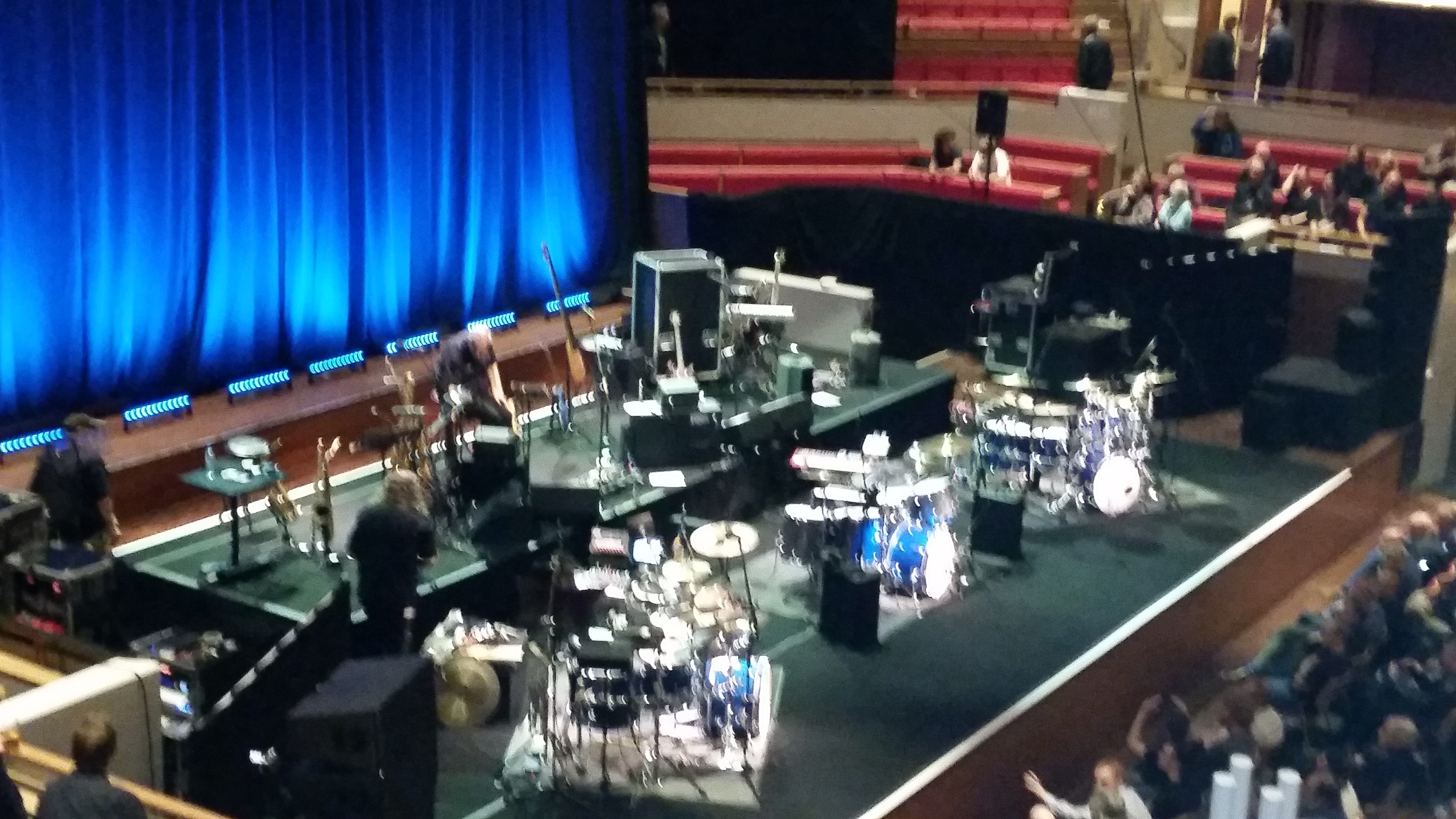
 The front row of the stage on this tour is populated by three drummers. On the left is Pat Mastelotto who has recorded since the early 80s (including as a founding member of Mr. Mister who had two #1s that you might recall). He and Harrison both recorded with Barbara Gaskin in the early 80s. He’s been with Crimson since the mid-90s. Front and centre is one who might be the oddest member, Bill Rieflin. Rieflin is best known in some circles for his participation in a number of 90s era industrial acts including Ministry, Pigface, and KMFDM. However, he was also in The Minus Five with REM’s Peter Buck and took to the drumkit for REM’s last couple of albums/tours. His short-lived Slow Music Project featured Buck and Fripp. And finally, in front of Fripp, Gavin Harrison. At 52, Harrison is the youngest member of the current lineup, and is possibly best known for his membership in Porcupine Tree since 2002. He’s been a professional musician since the early 80s as well and has been in KC since 2008.

Mastelotto is the most physical and almost manic, while Harrison is the most fluid of the drummers. In the opening piece  of the set, Mastelotto took on the crazy percussion work originally done by Jamie Muir. (See this version from 1973 – Muir’s the one with the Van Dyke; Bruford is the one in overalls.) Watching Harrison’s playing is almost like watching water flow. While none of the three is an imprecise player, Rieflin is the most precise in terms of stature and attention. Sitting bolt upright most of the time, he looked almost uncomfortable, but worked with great synergy with the other two drummers and with the rest of the band. The band requested that the audience make no recordings or photos during the show and for the most part this was respected. Alas, the band has been vigilant about taking down videos posted from the tour. Early on, there was a medium-quality clip of 21st Century Schizoid Man that featured Harrison’s gorgeous drum solo. I have high hopes that a professional video or audio recording of this tour will be released sometime in the not too distant future.