Archives for posts with tag: Robert Fripp

Island/Atlantic/Vertigo Records, 1970
Produced by Robert Fripp and Pete Sinfield

The first of many massive personnel changes in the Crimson camp occurred when Greg Lake met Keith Emerson at a King Crimson/The Nice double bill at the Fillmore in San Francisco in December, 1969. After that show and Emerson and Lake decided to hook up and with Carl Palmer and they recorded their first album the following summer. Wikipedia is not helpful in explaining why Ian MacDonald and Michael Giles left the band after that American tour as well, but even with all of these changes, Poseidon remains an even more cohesive album (IMVHO) than Court. Part of the reason is that Pete Sinfield is still handling lyrics, Lake sings on all but one of the album’s vocal tracks, and McDonald cowrote two tracks, the single Cat Food and side 2’s epic instrumental The Devil’s Triangle.

The album is bookended with three parts of a song called Peace – A Beginning opens side 1; A Theme and An End open and close side 2. The second tracks on each side are the two straight up rockers, Pictures of a City and the single Cat Food, and the album is rounded out with a couple of more progressive propositions.

Pictures of a City evolved out of A Man, A City, performed on the Crimson King tour and found in multiple versions on the Epitaph collection of those 1969 concerts. Musically it’s roped in from the clatter of those early performances into something a bit tighter. In the earlier versions, there’s room for a sax solo, and some stretched out interplay between the musicians. On the studio album, it’s a distinctly less free (as in jazz, not beer) proposition.

Side 1 continues with the thinly arranged ballad Cadence and Cascade, sung on the album by Gordon Haskell, but for which there’s a Greg Lake vocal version included as a bonus track on later releases. The sparse arrangement keeps the instruments from tripping over/crashing into one another, but leaves room for the individuality of the guitar and a sweet flute solo from Mel Collins. On the other hand, Haskell’s voice really doesn’t do the song justice – he doesn’t hit the high notes or master the low notes the way Lake did.
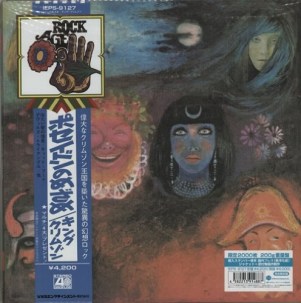
king-crimson-wake-jpThe title track closes out side 1. I think the band was going for something like Epitaph – musically, the song has the flow and drama of the earlier song with those smooth mellotron lines connecting the piece together. Lyrically however, it’s one of those songs that (and I paraphrase mellotron master Mike Dickson – I just can’t find the source – it’s in the notes for one of the songs on mellotronworks II) make prog rock fans say, ‘I don’t listen for the lyrics’. Sinfield seems to be after the grandeur of the drama between heroes and rulers and peasants in war, but each stanza has multiple subjects, whereas in Epitaph, we had only a tortured ‘I’ to give the song its emotional weight. The song is crushed under the weight of Bishop’s kings, Harvest hags, Heroes, Magi, and Harlequins.

After the resonant acoustic solo of Peace – A Theme, Cat Food roars in. More jazz than progressive, this was the song that grabbed me most when I first listened to this album in the 90s. My emotional response was to the weird, almost new wave instrumentation. The piano lines are reminiscent of the work Mike Garson was doing with David Bowie at the time with that right-hand madness. I’m not surprised the label used it for the single – it’s the tightest of the songs and the vocals are clear and mostly untreated. On the other hand, it’s the most unrepresentative song of the early work. (Listening now, I’m surprised it didn’t return to active service in the Adrian Belew years – it has some of his offbeat humour, both musically and lyrically.)

The Devil’s Triangle is a proper three-part instrumental epic which fades into some long mellotron chords, adds martial drums and some other stuff. The third part of the song (‘The Garden of Worm’) is very neatly separated from the previous section by a wind effect that fades to silence. The same martial drums are accompanied by whistles maybe and then a harpsichord shows up. Describing a song like this is very much in the ‘dancing about architecture’ category. Some bits are jazz, and some bits are just noise, and it’s mostly unlike anything else except when the occasional chord points out that this band evolved from Giles Giles and Fripp and another segment repeats a piece of the previous LP’s title track. Just for a moment, those Ah-ah-ahs show up, before Peace – An End. I hear the thematic reason for having the three parts of Peace show up evenly placed on the album, but the a cappella intro is almost as jarring to the ear as the opening chord of Pictures of a City after Peace – A Beginning. It might be done on purpose, but it doesn’t make for consistent listening, not that I’m asking for consistent listening from King Crimson. Honest!)

Overall, I give it a solid four stars. Next up? Lizard.

So this month, I’ll be diving into the studio recordings of King Crimson. I’ve been a fan since the early 80s and have seen them perform four times. (I’ll see them again in July. Woot!) I considered reviewing the albums alphabetically rather than chronologically, but was dissuaded.

While Robert Fripp is the only constant in almost 50 years of KC, both Giles brothers appeared on either or both of the first two KC albums.

There are two ways to consider this album, neither of them very useful. One way is to look for aspects of it that point to what Michael Giles and Robert Fripp would do the following year with In the Court of the Crimson King. The fact is that very little of Cheerful Insanity resembles anything in the first few years of KC. The other way to look at is to consider where it falls in the music being made at the same time. This is more helpful, I suppose, because there are bits of the album that resemble early Moody Blues, early Pink Floyd, generic English folk rock and its proggy offspring (Genesis, Jethro Tull, Yes).

I first heard this album sometime in the mid-90s when I was collecting as best I could anything with Fripp’s name on it. I couldn’t hear anything in it (and still don’t) that resembles the weirdness of that late-70s/early 80s period when he’d been applying that arpeggiating guitar technique to everything he touched (including, for example, the stylings of the first and third Roches LPs. And much as I enjoyed that early prog, Cheerful Insanity just didn’t cut it.

Part of the issue I had was that a very young Fripp only wrote three of the songs. Little Children on side A suggests why Fripp left the lyrics to others after that. This song is notable for vocals provided by The Breakaways who famously backed Petula Clark and Cilla Black on several singles.

GGFSuite No. 1 and Erudite Eyes, which close side B have a more Frippish feel to them than the rest of the album. Suite No. 1, which clocks in at just under six minutes, starts with some Paganini-like runs that are joined by bass and keyboard, but after a minute and a half or so, the baroque gymnastics are replaced with a piano/strings/vocals arrangement that brings to mind the Chi-Lites’ Have You Seen Her. This segment is followed by a harpsichord-guitar duet which is followed by a reprise of the Paganini. A single track broken into three possibly unrelated forms, pulled together by a reprise of the theme? The application of jazz theory to folk motifs is one of the main threads of early progressive rock – it’s just weird to hear it applied so strangely.
Erudite Eyes is really the only song that points to the musical strangeness that was to come. It begins as a waltz, turns into a polka, returns to waltz-time and moves into improvised psychedelic strangeness before the second minute is up.

Lyrically, the whole affair is pretty strange. Newly-Weds suggests the discord of couples keeping up with the Joneses (He worries all day about wolves at his door…but on the other hand, she’s got a ring). One In A Million’s look at a man ‘content with the things at the moment, except the yellow line by the pavement’ echoes Revolver-era Beatles (Eleanor Rigby, Taxman).

The biggest issue I have with the whole album is the interspersed comedic numbers. Most of the songs on side A are bookend with episodes of The Saga of Rodney Toady, a ‘sad young man’ who girls run away from at school dances and whose parents are ‘fat and ugly’ and tell him that will ‘meet a fat and ugly girl just like Rodney’s mother and they would get married.’ These interludes don’t speak back to the music and actually detract from enjoying the album.

Side B’s songs are interspersed with repetitions of the sentence ‘I know a man and his name is George’ spoken in the correct order once and then in permutations (Know I George his name and a man, for example) and in increasingly annoying voices. One could argue that the rearrangements of the words reflect the possibilities inherent in the structured and random mutations of music that lie at the heart of King Crimson’s most intriguing work (for me, this includes tracks like Fracture, Level 5, and Starless).

After this album was released, Peter Giles left, and Ian MacDonald and Judy Dyble (late of Fairport Convention) joined and they made a collection of high quality home recordings released in 2001 as The Brondesbury Tapes. This collection is mainly notable for Dyble’s vocal on an early version of I Talk to the Wind. Soon after, Greg Lake joined and the Crimson King was born.


Setlist:
Larks’ Tongues in Aspic, Part One
Pictures of a City
Meltdown
Hell Hounds of Krim
The ConstruKction of Light
Banshee Legs Bell Hassle
Easy Money
Level Five
Epitaph
The Talking Drum
Larks’ Tongues in Aspic, Part Two
Starless
E: In the Court of the Crimson King
E: 21st Century Schizoid Man

As with most previous incarnations of King Crimson, the latest is a lineup of insanely talented musicians. In this case, the band is trying to take on the aspects of its entire history. Noting that Crimson is whatever guitarist and bandleader Robert Fripp says it is, it’s impressive to see and hear them incorporate several tracks from the band’s 1969 debut, In the Court of the Crimson King. The title track, added on this tour hadn’t been performed by the band since 1971; 21st Century Schizoid Man wasn’t played by the 80s incarnation, but has been a mainstay since the Thrak tour in 1996. (I saw them on that tour in Berkeley and Adrian Belew introduced it saying ‘I don’t think we’ve played this here before.’) Epitaph was added to the set last month, having not been performed since the initial tour for the album in 1969.

At the other end of the timeline are tracks from the final studio albums of the Adrian Belew-fronted editions of the band, an instrumental version of the title track of 2000’s ConstuKction of Light and Level Five from 2003’s The Power to Believe (between 2003 and 2010, there were a couple of tours with Belew and line-up changes, but no albums), and new pieces Hell Hounds of Krim and Meltdown.

While the renditions of Epitaph and Crimson King were both faithful, and sound very much of their time, Schizoid Man, with its combination of improvisation, treated vocals, and heavy guitar has always been the earliest example of jazz metal. Pictures of a City dates from 1969 as well, though it didn’t appear on record until the following year’s In the Wake of Poseidon. This is the only other track from King Crimson’s early progressive period in the set. The three albums that followed Crimson King all featured Mel Collins on saxophones and flutes, and the current tour is the first Collins has played with the band since 1972. (Not that he hasn’t been busy enough – his CV includes work with Camel, Roger Waters, and some Crimson-related acts including 21st Century Schizoid Band.)

The heart of the set, for me, were the pieces from the ’72-’74 golden age. Following the tour for 1972’s Islands, Fripp disbanded the group (one could cite ‘creative differences’), only to reform it a few months later with two percussionists, Bill Bruford from Yes and an absolutely insane bloke named Jamie Muir; John Wetton (bass/vocals); and David Cross (violin/mellotron). The three albums recorded by variations on this lineup, Larks’ Tongues in Aspic, Starless and Bible Black, and Red are classics, recently reissued in 15+ CD sets that include as much related live material as the band have in their archives. Following Red, there was no tour as Fripp disbanded the crew again. (This time it had a lot to do with an absolutely lousy record contract – lousy even by the standards of the time, from what I’ve read.)

Between ’74 and about 1980, Fripp appeared on a number of projects – producing Peter Gabriel’s second solo album, his own solo album Exposure, projects with Brian Eno, David Bowie’s Heroes album, Talking Heads’ Fear of Music, and a crew called The League of Gentlemen (with Sarah Lee who would join Gang of Four and Barry Andrews who was between XTC and Shriekback). LoG recorded one album in the runout groove of which was etched ‘The Next Step is Discipline’. Discipline was to be the name of Fripp’s next band which consisted of Fripp, Bruford, Tony Levin (bass, about whom more below), and Adrian Belew (guitar/vocals). When it came down to it, Fripp decided this was the next incarnation of King Crimson and retained the name Discipline only in the title of that lineup’s first album.

Belew is a gregarious character whose had already worked with Zappa, Bowie (the Heroes tour and Lodger album), and Talking Heads among others. He fronted the various lineups of KC between 1981 and 2008. These included the three different lineups that recorded Discipline, Beat, and Three of a Perfect Pair between ’81 and ’84, Vrooom and Thrak in the mid-90s and The ConstruKtion of Light and The Power to Believe between 2000 and 2003. Fripp decided he was after something else with the new group and did not invite Belew along. Oddly, Belew has fronted The Crimson ProjeKct with all six members of the Stick Men (Levin, Mastelotto [about whom more below as well], and guitarist Markus Reuter) and The Adrian Belew Power Trio. These shows leaned heavily on the 81-84 material as well.

The title track of Red, another piece of proto-heavy metal, and Larks’ Tongues in Aspic Part 2 were mainstays of KC sets from the 1981 reformation onward, but Starless (also from Red, but containing the refrain ‘Starless and bible black’) hadn’t been performed until this tour since the tours that led up to Red’s recording in ’74. The Talking Drum was a mainstay of the double-trio lineup of the mid-90s and briefly in 2008.

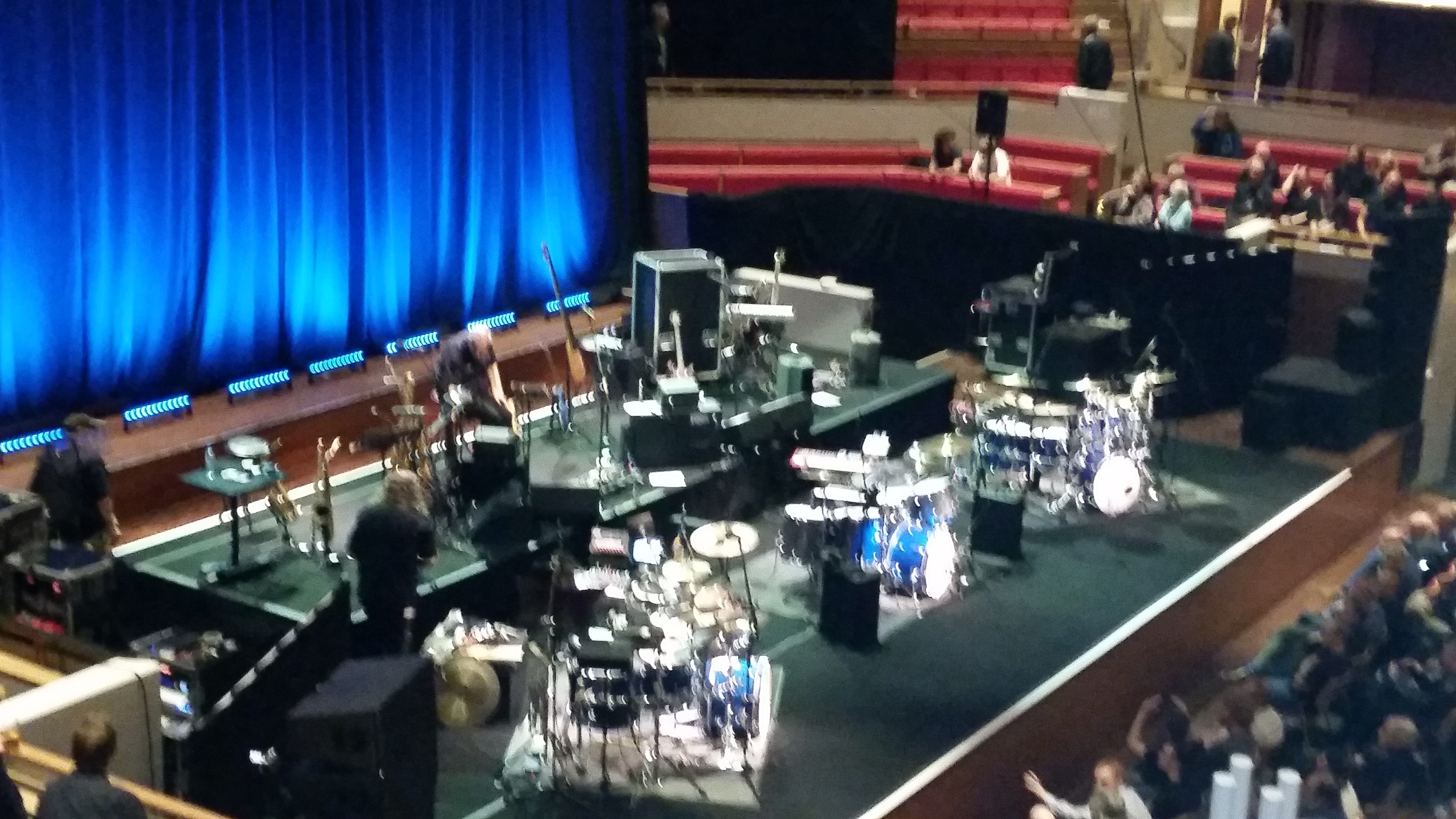
The current incarnation of King Crimson is an interesting bunch. Fripp as always seated upper right on guitar. Next is Jakko Jakszyk on guitar and vocal. Jakko has worked on an large number of projects since the early 80s including stints with Level 42 and Tom Robinson and work with a pre-Porcupine Tree Gavin Harrison. In 2001 he joined with members of the earliest KC incarnations to form 21st Century Schizoid Band. In 2010 he worked with Fripp on an album that, with contributions from Collins, Harrison, and Tony Levin became A Scarcity of Miracles, which is very much in the KC vein.

Tony Levin on bass and Chapman stick has been in most KC lineups since 1981. He first worked with Fripp on Peter Gabriel’s second solo album (which Fripp produced), and played on Fripp’s 1978 solo album Exposure. Next to Levin on the top row of the stage stood Mel Collins surrounded an array of horns.

 The front row of the stage on this tour is populated by three drummers. On the left is Pat Mastelotto who has recorded since the early 80s (including as a founding member of Mr. Mister who had two #1s that you might recall). He and Harrison both recorded with Barbara Gaskin in the early 80s. He’s been with Crimson since the mid-90s. Front and centre is one who might be the oddest member, Bill Rieflin. Rieflin is best known in some circles for his participation in a number of 90s era industrial acts including Ministry, Pigface, and KMFDM. However, he was also in The Minus Five with REM’s Peter Buck and took to the drumkit for REM’s last couple of albums/tours. His short-lived Slow Music Project featured Buck and Fripp. And finally, in front of Fripp, Gavin Harrison. At 52, Harrison is the youngest member of the current lineup, and is possibly best known for his membership in Porcupine Tree since 2002. He’s been a professional musician since the early 80s as well and has been in KC since 2008.

Mastelotto is the most physical and almost manic, while Harrison is the most fluid of the drummers. In the opening piece  of the set, Mastelotto took on the crazy percussion work originally done by Jamie Muir. (See this version from 1973 – Muir’s the one with the Van Dyke; Bruford is the one in overalls.) Watching Harrison’s playing is almost like watching water flow. While none of the three is an imprecise player, Rieflin is the most precise in terms of stature and attention. Sitting bolt upright most of the time, he looked almost uncomfortable, but worked with great synergy with the other two drummers and with the rest of the band. The band requested that the audience make no recordings or photos during the show and for the most part this was respected. Alas, the band has been vigilant about taking down videos posted from the tour. Early on, there was a medium-quality clip of 21st Century Schizoid Man that featured Harrison’s gorgeous drum solo. I have high hopes that a professional video or audio recording of this tour will be released sometime in the not too distant future.