
I’d not read Hunter Thompson’s Fear and Loathing in Las Vegas in at least twenty years and I’m not sure if before this week I’d ever actually finished the thing. Now I have, and on a certain level, I think I might be too old for it. It’s one of those books like Catcher in the Rye and possibly On the Road that are best enjoyed before the sheer irresponsibility of the story in the telling is too obvious. In the heart of Thompson’s drug-addled tale of not reporting on two events for which his alter ego Raoul Duke is paid, he makes a stunning indictment of what has become of the American Dream™.
In one of the novel’s more cogent paragraphs, Thompson spells out the moment when Hell’s Angels faced off on the Oakland/Berkeley border with anti-war protesters in 1965, somewhat to the detriment of the nascent anti-war movement and to the greater detriment of the American Left in general. Later, he starts discussing those Timothy Leary took down with him, followers ‘who thought they could buy Peace and Understanding for three bucks a hit’ , certain that some one or some thing was ‘tending the light at the end of the tunnel’ (p. 178).
He goes on to gather several leaders together who followed in the failure of Leary to unite the movement: Jesus, Manson, Hell’s Angels leader Sonny Barger, and concludes with the book’s most potent idea, ‘…no point in looking back. The question, as always, is now…?’ Whatever we’re going to do, we have to do it, rather than bemoaning that we haven’t.
While I put Duke and Dr. Gonzo’s tales of their American nightmare in an unfavourable bucket with Kerouac and Salinger (both of whom wrote some brilliant, long-lasting work, just not those novels for which they’re best remembered), another comparison that comes to mind is Sterne’s Sentimental Journey through France and Italy. In a similar way to Sterne, Thompson invites us into a series of vignettes that insist to the reader that they’re actually going somewhere, but don’t ever really make it there. Whereas Sterne’s volume ends without ever getting to Italy (as promised in the title), and possibly in the middle of a sentence, Thompson ends his without ever producing (as far as the reader can tell) the articles his character promised. The expectation from a book that is at least tangentially about writing is that there will be a submission and maybe even a reaction to it. Thompson subverts this by his alter ego barely attending or participating in the events he goes to Las Vegas to cover. To be fair, there is one extended sequence in which Duke and his attorney, Dr. Gonzo, attend one of the presentations of the National District Attorneys Association’s Conference on Narcotics and Dangerous Drugs (thoroughly ripped, as the two characters are for the entirety of the book), so our expectations are only partially subverted.
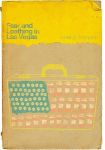 Subtitled A Savage Journey to the Heart of the American Dream, what strikes the reader (or at least this reader) about Fear and Loathing in Las Vegas is the savagery with which Thompson/ Duke treats primarily the female characters and really most of the book’s secondary characters. One way of looking at the nastiness of the interactions with the waitress in the chapter ‘Back Door Beauty & Finally a Bit of Serious Drag Racing on the Strip’ is that Thompson wants to implicate all of us in the nastiness that America became after the “Main Era” ended. The Main Era is what he names that time in the 60s when ‘You could strike sparks anywhere. There was a fantastic sense that whatever we were doing was right, that we were winning’ (p. 68). He continues, ‘We had all the momentum; we were riding the crest of a high and beautiful wave. So now, less than five years later, you can go up on a steep hill in Las Vegas and look West, and with the right kind of eyes you can almost see the high-water mark – that place where the wave finally broke and rolled back.’ (I love the idea of a ‘steep hill in Las Vegas,’ a place in the middle of a desert and nearly as flat as The Netherlands.)
So that moment of mind-altered optimism was undone, or undid itself through subverted protest, Nixon’s treachery, an unwinnable war, and the crackdown of the original war on drugs that Nixon instigated with the help of Elvis Presley. But in the retelling, Thompson says, yes, it all fell apart and to a one, even me, we became nasty and crass.
Thompson shares that, beyond the Strip, you find ‘the shoddy limbo of North Vegas…out there with the gunsels, the hustlers, the drug cripples and all the other losers,’ and here Duke and Gonzo drop into the North Star Coffee Lounge for late night eats. Their waitress, extensively described as, ‘large in every way, long sinewy arms, and a brawler’s jawbone…A burned out caricature of Jane Russell: big head of dark hair, face slashed with lipstick and a 48 Double-E chest that was probably spectacular about twenty years ago…but now she was strapped up in a giant pink elastic brassiere that showed like a bandage through the sweaty rayon of her uniform, (p. 158)’ finds herself on the receiving end of a pass from Gonzo, a napkin with ‘Back Door Beauty’ scrawled on it. On receipt, she lays into our heroes with vitriol. Duke just watches while Gonzo deflects the waitress’ accusations and cuts the receiver off the pay phone with a switchblade when she threatens to call the cops.
Duke understands that Gonzo has struck a nerve, ‘The glazed look in her eyes said her throat had been cut. She was still in the grip of paralysis when we left,’ but doesn’t comment or dissuade Gonzo from his behaviour. We as readers follow along, but Thompson not only lets his narrator off the hook, he relates the events that follow as being drawn verbatim from a tape recording transcribed by the editor. He doesn’t give Duke the opportunity to respond and lets himself off the hook at the same time.
From a wider perspective, Thompson’s after roping the reader into some kind of complicity. The more you enter the heads and the behaviours of the main characters the less you can say that you’re not part of the great destruction being wrought. Thompson attempts, through the excess of his protagonists, to separate the freaks – the ones who stepped out of the mainstream before that wave receded – from the normals who flock for whatever reason to Las Vegas’s casinos from the rest of the country. However, through that excess, he implicates all who see themselves on some version of the correct side of that divide. To what we now call coastal elites as well as those citizens of flyover states, Thompson seems to say: ‘You’re all in on this. We’re all in on this. Through silence or engagement. And I’m in on it as well.’
I’m not sure that this is what the man who famously asserted, ‘I wouldn’t advocate drugs, alcohol, violence, or insanity to anyone, but they’ve always worked for me’ meant to imply.
I wanted to add something about how Thompson’s anti-Nixon stance (against all hypocrisy propounded and promoted by the Nixon White House) had come back to taunt him when George W. Bush was selected for a second time, and might have contributed to his suicide a month into Shrub’s second term, but this doesn’t seem to be borne out by a suicide note which indicated that 67 was ‘17 years more than [he] needed or wanted.’ On the other hand, In October 2004, Thompson wrote: ‘Nixon was a professional politician, and I despised everything he stood for—but if he were running for president this year against the evil Bush–Cheney gang, I would happily vote for him.’ Six months after Thompson’s death, there was a hell of a memorial.
 However, this evinces the kind of whataboutism that makes political discussion today such a bloody fraught proposition. The gist is that occasionally white people are refreshed in the fears for themselves and their children that POCs live under all the expletivedeleted time. This is something that happened in Florida this month – nice suburban white high school terrorized by a young man with a gun irrationally marching through what should have been a safe space to learn and grow. Black Americans going about their daily business should expect and experience not being harassed or killed without probable cause, right? And I’m engaging in a variation of the same whataboutism, I suppose. A recent parallel is the Netflix dramatization of Margaret Atwood’s The Handmaid’s Tale. Again, not an original though on my part, but in Atwoods’ vision of the future, white women are treated the same way black women have been treated in America for centuries. I’m sure I’m not the only one to draw this comparison between Atwood’s fiction and the news treatment of our various tragedies. This situation is wrapped up in a lot of other American situations including the school to prison pipeline, Riker’s Island, and the stop-and-frisk policies all over the country.
 First off: I live in a country where the highest tax bracket is 52% and one reaches it pretty quickly. I’m an experienced technical writer by profession and could probably make USD 75-85,000/year if I returned to the US. I’ve worked in The Netherlands for over seven years and almost the entire time have had the benefit of what’s called the 30% ruling. Under this plan, the first 30% of the income of expats who qualify (based on age and earning capacity, primarily, though the tax authority here can be capricious) is untaxed. For the next 2 1/2 years, I will still benefit from this ruling. After that, half my income goes to the taxman.
 Joe Jots