Archives for category: Music

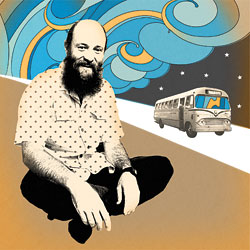
One of my favourite pieces of music is Terry Riley’s In C. While he’s considered one of the godfathers of so-called minimalist music, I’ve a feeling many critics feel Riley has a lot to answer for. I disagree.

On a certain level, it’s an astoundingly simple conceit: several dozen short phrases all in the same key. Any number of musicians can participate and the musicians play the phrases as many times as each one would like, until they all come together at the end. Historically, one musician keeps time by tapping middle C on a piano. In more recent versions, the pulse is often handled electronically, for reasons that aren’t hard to imagine.

RileyI’d heard of it when I was young, but never heard it until the 25th Anniversary concert version was released on CD in 1995. Some versions run as little as 20 minutes. This version, which features 128 musicians including all four members of Kronos Quartet, runs 76 minutes.

Here’s an interesting version that’s about 23 minutes, to give you an idea, though I like the versions that pull the piece in different directions. The recent Africa Express rendition is especially beautiful.

A couple of weeks ago, I thought of a version of In C I’d love to hear, or at least to know that it existed. Near my office is a building site on which there was a pile driver doing its work, gently echoing between nearby buildings. In my imaginary rendition, that pile driver is the pulse. 

Other instruments would include angle grinders, jack hammers, chainsaws, hydraulic routers, lathes, and so forth. As these tend to be one- or two-note instruments, my idea would is that they’d be sampled and run through some kind of digital music software to finally formulate a (pardon me) riveting industrial rendition. In the article Lamb Stew, Will Mackin writes about marking of hazards whilst setting up a camp in Iraq and includes in their number, ‘a two-story-tall barbed-wire tangle in the shape of a swan, which buzzed in the wind like a kazoo.’ That swan of barbed wire is another instrument in my imaginary version of In C

 A more realistic dream of another piece of music I would like to hear is an extended version of XTC’s Senses Working Overtime (1982). In its first three minutes, it builds a crescendo that crashes over the bridge and, were they not a fairly tight quartet, it could have descended into chaos in the last two. On the mix tape of my absolute favourite songs of my adolescence, this might top side A. My dream version builds up more like Ravel’s Bolero, with just one or two instruments – a small drum and a finger-picked mandolin perhaps, building up and adding instruments over ten or twelve verses and five or six choruses before the bridge, and descending back to silence over the two final choruses. I’m undecided as to whether it would have vocals, though I’m tempted by the idea of a sweet alto like Unwoman trading couplets with a growling Scott Walkeresque tenor.

In my last entry in this occasional history, I made the claim that the Yardbirds were the most important band of the 60s in term of their lasting influence through the 70s. Why? The main reason is that three of the four most influential guitarists (and possibly musicians) that came out of rock and roll passed through this band: Jimmy Page went on to form Led Zeppelin; Clapton formed Cream, Blind Faith, and Derek & the Dominoes before embarking on a prolific solo career; and Jeff Beck’s technique has been respected and imitated throughout rock music despite a less prolific/critically lauded output following his collaborations with Rod Stewart. Beck’s 70s power trio Beck, Bogart, and Appice possibly matched Cream for sheer brilliance.

Note: Most influential != greatest

The fourth would be Jimi Hendrix. We’ll get to him in a future post.

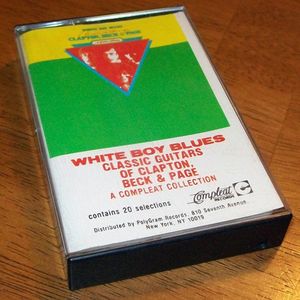
whiteboybluesI also discussed in the last post something of the love these bands had for the old blues artists. What I didn’t know is that many of them played with the blues greats when they toured England. I recently read Ian MacLagan’s autobiography. MacLagan was a keyboardist in a number of bands (including The Small Faces and The Faces (the latter of which featured Rod Stewart on vocals) with whom he’s most closely associated, the Rolling Stones, The New Barbarians, and in the last decade or so, Billy Bragg -Alas he passed away a couple of months ago. MacLagen got his start with an act called The Muleskinners. He discusses first a missed opportunity to back Howlin’ Wolf (the agent told them a date that was a week early and they had to hustle to get enough petrol to get back to London from Sheffield).

“We got another chance to play with The Wolf later though, when Marquee Artists brought him, Sonny Boy Williamson and Little Walter over from the States. As a rule, the Yardbirds backed Sonny Boy, and if they weren’t available, the Authentics got the job. This pecking order for backing blues legends ended when it eventually reached The Muleskinners. We didn’t mind. We were more than honoured to get the chance to meet and play with such fabulous players. Let’s face it, we had a lot to learn and who better to learn it from than the greats?” (All the Rage, Kindle edition, Location 793.) )

Clapton’s path is interesting: He ditched the Yardbirds claiming they were abandoning their blues roots. Fair enough. His tenure in John Mayall’s Bluesbreakers provides much evidence of his dedication to the form. The weird thing is, he took this side trip into psychedelia with Cream. Cream didn’t last long as a band (less than two years, IIRC), but they produced four or five classic albums. Cream’s bassist, Jack Bruce passed last year, though most thought drummer Ginger Baker would be the first to go. As with almost all the songs on Fresh Cream, Bruce supplied lead vocals. Blind Faith only released one, but it’s also six tracks of classics.

Read the rest of this entry »

Blues and early rock and roll records brought over to the UK in late 50s and early 60s inspired young Englishmen no longer required to participate in national service. [http://en.wikipedia.org/wiki/Conscription_in_the_United_Kingdom#After_1945] to form bands.

The Rolling Stones for example: http://www.noisemademedoit.com/wp-content/uploads/2012/07/mick-jagger.jpg

In 1957, Parliament ended mandatory conscription with those born in 1939. The oldest Beatles (Ringo and John) were born in 1940. Two members of the Rolling Stones, Ian Stewart and Bill Wyman (ne Bill Perks) were old
enough to do national service. Wikipedia indicates that Wyman actually did, and took his stage name from a national service colleague. No member of The Who or the Kinks was old enough to do national service.

American soldiers stationed in the UK and Germany brought over the sounds of the blues. But the appreciation of English lads for American blues music spawned a scene that included Page, Clapton, Beck, the Yardbirds, the Rolling Stones, The Who, and (to a lesser extent, oddly enough), the Beatles. Poppier bands, including Gerry and the Pacemakers and Herman’s Hermits piggybacked onto the successes of these English blues-based rock bands in the US.

The paragraphs that follow fall into that well-known category of writing known as Rock Critic Clap Trap. I argue one point here, but it’s all but guaranteed I’ll be arguing another way next time.

My argument is that none of the British Invasion bands had vital and influential careers much into the 70s, save one. The Beatles were over by ’69 and their continued influence was based on their work as the Beatles, not the solo work. The last Stones album worth its salt is ‘72’s Exile on Main Street. Every album that came after is held up to Exile and found wanting.  (Love Emotional Rescue and Some Girls though I do, they don’t hold a candle.) The Who’s vitality carried through to the mid-70s, but with Keith Moon’s death (Not to be removed) in ’78, they were pretty much over (the ’82 stadium tour with the Faces’ Kenney Jones on drums and the Clash opening notwithstanding).

That one would be the Yardbirds.

Like the Stones, they started out as a bunch of white guys doing covers of American blues. Their first three albums, recorded between 64 and 65 leaned heavily on Chess covers. The first album featured guitarist Eric Clapton, a self-professed blues purist. The second and third also had Jeff Beck.

Their first album, 1964’s Five Live Yardbirds consisted entirely of American rock and blues covers including three Bo Diddleys, a Chuck Berry, and a Howlin’ Wolf. A later expanded edition (20 tracks compared the 10 on the original release) had one Keith Relf original, but added more of the blues covers. They handle the covers admirably but what’s most apparent to me is that they’re enjoying making the music. Relf’s original, Honey in Your Hips, relies on that Bo Diddley beat, and I think owes a bit to Carl Perkins (vocally) and Larry Williams (for the choice of lyrical content, such as it is).

In ’65, For Your Love was an amalgamation of single and EP tracks cobbled together for the US market in advance of an American tour.  The title track was the first of three hits for the Yardbirds penned by Graham Gouldman (later of 10cc among other acts). Its poppier leanings led to Clapton decamping for John Mayall’s Bluesbreakers. This album is also the first to feature Jeff Beck.

The following release, 1965’s Having a Rave-Up with the Yardbirds, also cobbled together for the US market contained songs from singles and the earlier albums, and both Beck and Clapton tracks. Two more Gouldman songs, Evil-Hearted You and Heart Full of Soul kept this album on the charts for almost nine months.

But 66’s The Yardbirds (aka Over Under Sideways Down and aka Roger the Engineer) featured all original material by the band. It opens with Lost Woman, a blues –based track that would have been pretty comfortable on the earlier albums. We know we’re heading into new territory with the sitar opening of Over Under Sideways Down. The album combines pop, two blues instrumental from Beck (The Nazz Are Blue, Beck’s Boogie), psychedelia
(Hot House of Omargarashid). The closer, Ever Since the World Began offers something oddly psychedelic before moving into something like folk blues and concludes without resolution which is still weird in pop and not done often, much less on the last track on side 2.

Somewhere between Over Under and the follow-up, Little Games (the final Yardbirds album until a 2003 regrouping), session musician Jimmy Page joined. For a short while, both Beck and Page shared duties in the band. The obligatory club scene in Antonioni’s classic Blow Up features them onstage together performing Stroll On. However, shortly after this, Beck was sacked (according to W’pedia) “both for being a consistent no-show and difficulties caused by his perfectionism and explosive temper” – an odd combination of reasons to be sure.

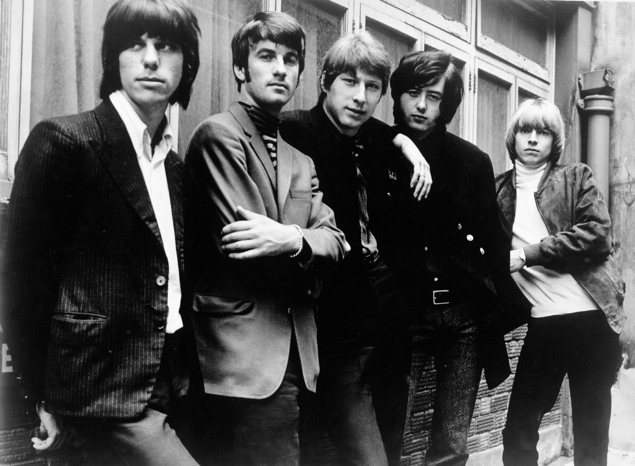
Rock Group "The Yardbirds"The Beck/Page band didn’t record very much else together, and Page, it seems, took a lot of control of the band. Seven of the ten tracks on Little Games bear Page writing or co-writing credits. The album leans towards harder electric blues than Over Under had done. Side one opens with two such hard blues before backing up a step into Page’s White Summer, a song that would be a live staple in Page’s next band. There were other switches in line-up as well – Bassist Paul Samwell Smith left to concentrate on music production and rhythm guitarist Chris Dreja took over the bass. (Among other things, Samwell-Smith was the music director for the movie Harold and Maude.)

There are detours into psychedelia and the pseudo-music hall of Stealing Stealing. Like White Summer, the guitar on Only the Black Rose presages the acoustic sounds Page would later pursue. By ‘68, the remaining original members of the band were keen to do other things. Clapton had gone on to form the psychedelic blues trio Cream with Jack Bruce and Ginger Baker and Relf and McCarty were more interested in folk music – they went on to form Renaissance with Relf’s wife Jane on vocals, though Keith Relf left that band after the first album.

Strangely, the last addition to the band, Page, was left with the contractual obligation to finish the ‘68 tour. Several vocalists were considered including Terry Reid, who had toured the US with Cream. Reid declined, but recommended an unknown named Robert Plant. Plant in turn recommended his friend John Bonham for the drum kit. The New Yardbirds were rounded out by a session bassist named John Paul Jones who had played bass on the Yardbirds single Happenings Ten Years Time Ago. This quartet finished the contractual tour of Scandinavia, but decided a new name was needed (for a variety of reasons) when they settled in to record an album in ’68. The phrase Lead Zeppelin was lifted from a comment Keith Moon had made regarding the group who recorded the song Beck’s Bolero (Beck/Jones/Hopkins/Moon/Page). A change of spelling set the stage for the band that would rule rock and roll for the next twelve years. (Sorry about that – more clap trap.)

A gent named Channing Kennedy recently wrote a piece called Face It, Live Music Kinda Sucks for Talking Points Memo in which he went to great lengths to discuss how the live music experience falls short of expectations. I shared it because my wife and I don’t see eye to eye about going to gigs. For her the hassle of getting to a gig even for a band she really loves and standing up for several hours is not generally outweighed by the joy of listening to musicians who really love what they’re doing do it well.

bumper-sticker_LMIBRatD
Kennedy puts forth his bona fides: ran a small record label, played in a few bands, and has been to a lot of gigs. On my part: I’ve bought a lot of music from small labels and I’ve been to a lot of gigs. From my first, Donna Summer at the Hollywood Bowl in (I think) 1980 to my most recent, Kraftwerk in Amsterdam two weeks ago.
He then asserts that “musicians you don’t know will bore you to death.” Could be. I saw Mr. Mister in 1984 (an opening slot for Adam Ant), just a couple years before their hits. I wished I’d known to watch the drummer. He has manned the sticks with King Crimson since the mid-90s and is mind-blowing. Was he in ’84 (or even in ’87 when you couldn’t escape Broken Wings and Kyrie)? Not sure. I’ve seen plenty of acts whose music I didn’t know, but whose work I happily purchased after the gig. A couple years ago I saw an EBM crew called Covenant because a friend played keyboards for the opening act. Bloody brilliant. A few years ago I saw  Sunn O))) for (what I hope is) the first time. I’d heard their shows were quite intense and decided not to listen to anything they’d done before the gig. Mindbending. Allow yourself the whole experience.
Consider the jazz made in the late 40s and early 50s. Even if you’d heard recordings by Miles or Dizzy before seeing them, what you heard on any given night bore little resemblance to those sides. The same is true of music with any improvisational aspect today.
What distinguishes your experience of musicians you know vs. musicians you don’t is your openness to what the person on stage is doing. Close yourself and it’s dull; open yourself and oh gracious, what a beautiful thing that guy just did with his voice.
Kennedy’s next point is that “the musicians you love will disappoint you.” Live performance is a risk. Musicians have off nights; audiences are capricious; venue policies can spoil even the most well-conceived evening. He describes one of his first gigs: They Might Be Giants, who were just two middle-aged guys playing clever music. The complaint: The show didn’t resemble Van Halen’s Jump video. Did he not notice David Lee Roth’s multiple costume changes in the course of one 3-minute pop song? TMBG disappointed because the writer wasn’t up for the experience of the evening. (Note also the writer’s admission that he attended with a girl he’d just broken up with. That’d put a wet blanket on any gig. I saw David Bowie and Nine Inch Nails with my wife (previous) and a guy she was having an affair with. It was a fantastic show, but I was not the ideal audience. Next time Bowie came to town, I went alone.) The artists you love offer you nothing more than the opportunity to see and hear them perform (depending on your place in the venue). Adjust your expectations accordingly and you won’t be disappointed. If you’re grown up enough to do so.
The writer’s comments about TMBG and Van Halen, however, come from  his  next supporting argument: Live music, as a medium, is structurally flawed. His assertion here is that the tension between an audience wanting to hear exactly what’s on the album goes head to head with their desire to hear something new in the music and the artist’s desire/lack thereof to actually perform. In the 80s, Bruce Springsteen released a slow, mournful arrangement of Born To Run which he used briefly in his live sets. Artistic freedom, yes, but I was also relieved that the version he played when I saw him the following year was closer to that on the album. Springsteen might be an exceptional  case because of his sheer showmanship. Few young artists can dredge up the experience Bruce’s thousands of road hours provide him. Again, there’s got to be a trust between performer and audience that the experience is not one way.
Kennedy then goes after the nature of the booking system. Acts get booked based on a lot of factors that aren’t talent or entertainment value. Fair enough, but that has little to do with live music as a whole being lousy. What it means is that, especially at the low-budget end of the live music spectrum, there will be surprises no matter the gig. And that’s part of the experience. To be fair, he talked about hustling for gigs and getting cut slack because his band were “two white males with college-town cultural fluency”. That doesn’t speak well for him or his band, but one clapping to him for acknowledging his privilege.
His concluding advice to bands, venues, and audiences is an effort to make live music kinda suck less and points up that he’s not so much against all  live music but against the aspects of it that have become unbearable. I’m with him on that.
And Neil Young’s Union Man, from which we get the line “Live Music Is Better Bumper Stickers Should Be Issued”.

I gotta say, I had forgotten how good Dramarama’s Cinema VeriteShe's so subliminal was. I bought it in ’86 or so after seeing them open for the Psychedelic Furs at the Warfield. They were the epitome of the absolute cool the 19 year old me could not hope to achieve. Bought the album, taped it, and played it loads. I know I got sick of how much Anything, Anything got overplayed, to the exclusion of so much other good stuff they produced both on this and on subsequent albums. Not having heard it in a few years (possibly only once or twice in the last 12 years – it doesn’t get airplay on NL on CZ radio, as far as I can tell), listening to it again tonight, I hear the brilliance in it. “I got wasted, she got mad, called me names and she called her dad,” captures the immaturity associated with love and desire and how it’s all wrapped up with possession and that desperate ned to hold on to someone captured in the refrain “I’ll give you candy, give you pills, anything you want, hundred dollar bills.”

They married some of the lowlife dinginess of the Velvet Underground’s third album to a sparkling 70s power pop aesthetic.And while Anything, Anything got the airplay, it’s not the only perfect pop song on the album. The pounding tom-toms that open Visiting the Zoo introduce a song of fuzztone guitar artistry that Cheap Trick would have been proud to own.

At a time when the VU were still in legend status – in the mid-80s Lou Reed was still growing up in public and hadn’t made the elder statement of New York – Dramarama closed side A with Femme Fatale, imbuing it with a combination of sadness and bemusement, perhaps at the gap between the warnings to a suburbanite dropped in mid-60s New York and the harder first-person experiences of the originals on the album. (Note that Cinema Verite‘s cover sports Edie Sedgwick, about whom Femme Fatale was written.)

The album’s other cover, David Bowie’s Candidate (an album cut from 1974’s Diamond Dogs) opens the more varied side B. It’s an odd choice, but helps the band lay claim to the glam sensibility that dominates the second half of the album. The piano introduction to Some Crazy Dame reflects that, though the song is squarely in the seedy downtown category, as its subject seems to be a porn starlet (“She’s on camera she’s an actress now / Such charisma on the mattress now”).

When I say the second side has a glam sensibility, I might mean that stylistically, the second side wanders somewhat. Etc’s cryptic lyrics (“30 biscuits on 30 plates / Different colors cause they were made on different dates”) supported by a lead bass line are followed by the almost folk of Transformation, the introduction for which wouldn’t have been out of place on a 70s era Styx or Andrew Gold album, ditto for its guitar solo. All I Want is nearly a proper punk song, whereas the solo acoustic closer Emerald City almost feels like a folk song. The drugged haze of lyrics such as “I’m lost in a sweet dream / I’m living on chocolate ice cream / I’m letting off my steam” indicates that all is still not well

Nearly thirty years later, I still give it four stars. While Cinema Verite, and follow-up, Box Office Bomb are available on iTunes, only the subsequent studio albums are available on Spotify.

You can enjoy all of CV on youtube, however: https://www.youtube.com/watch?v=x59-cFofXu8