Archives for posts with tag: pop music

Released: 1980
Produced by Mike Chapman

Side A:
Europa
Live It Up
Here’s Looking at You
The Tide Is High
Angels on the Balcony
Go Through It

Side B:
Do the Dark
Rapture
Faces
T-Birds
Walk Like Me
Follow Me

Autoamerican is probably my favourite Blondie album. I certainly played it the most, and I didn’t really keep up with them after. It’s my favourite despite the two inescapable singles. While The Tide is High and Rapture did boffo business (both hit #1 in the US), at least three other songs would have done well as singles (IMHO), T-Birds, Do the Dark, and Live It Up. (The previous two albums, Eat to the Beat and Parallel Lines had 10 singles released between them.) The crazy thing about Autoamerican is that it shouldn’t work, at all.

From the atmospherics of opener Europa, through some disco, some new wave, the reggae and hip hop of the two singles to Lerner and Lowe’s Follow Me (from Camelot), there’s nothing holding the damn thing together.

Live It Up is almost punk in its lyrics, but closer to disco in execution.
Here’s looking at you is closer to jazz. The Tide Is High started life as a reggae song. Angels on the Balcony is a ghost story with a pop interlude. And side one closes with Go Through It, which is almost country. Those rolling drum fills are gorgeous.

Do the Dark is sort of a disco rock thing. Rapture is the song we all know and love – first hip hop (ya don’t stop, go out to the parking lot) song played on MTV. Of course it was white folks doing it because it would be several more years before Yo! MTV Raps hit the scene.
Faces is a slow beautiful strangeness about the underclass on the Bowery (the neighborhood where CBGB was located), a tribute to the folks living on the street there.

T-Birds, about roller derby of all things, is still (45 years later) my favourite song on the album. It’s rock and roll (with an amusing spoken interlude) that simply works. Walk Like Me continues the rock and roll – its hard edge makes it possibly the one song on the album that wouldn’t have been out of place on Eat to the Beat (or Plastic Letters).

And then the whole thing drops into a little echo chamber with their take on the Lady of the Lake’s song, Follow Me, from Camelot. It closes the album out beautifully.

As I said, it shouldn’t work – but it manages with panache.
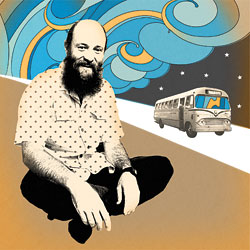
One of my favourite pieces of music is Terry Riley’s In C. While he’s considered one of the godfathers of so-called minimalist music, I’ve a feeling many critics feel Riley has a lot to answer for. I disagree.

On a certain level, it’s an astoundingly simple conceit: several dozen short phrases all in the same key. Any number of musicians can participate and the musicians play the phrases as many times as each one would like, until they all come together at the end. Historically, one musician keeps time by tapping middle C on a piano. In more recent versions, the pulse is often handled electronically, for reasons that aren’t hard to imagine.

RileyI’d heard of it when I was young, but never heard it until the 25th Anniversary concert version was released on CD in 1995. Some versions run as little as 20 minutes. This version, which features 128 musicians including all four members of Kronos Quartet, runs 76 minutes.

Here’s an interesting version that’s about 23 minutes, to give you an idea, though I like the versions that pull the piece in different directions. The recent Africa Express rendition is especially beautiful.

A couple of weeks ago, I thought of a version of In C I’d love to hear, or at least to know that it existed. Near my office is a building site on which there was a pile driver doing its work, gently echoing between nearby buildings. In my imaginary rendition, that pile driver is the pulse. 

Other instruments would include angle grinders, jack hammers, chainsaws, hydraulic routers, lathes, and so forth. As these tend to be one- or two-note instruments, my idea would is that they’d be sampled and run through some kind of digital music software to finally formulate a (pardon me) riveting industrial rendition. In the article Lamb Stew, Will Mackin writes about marking of hazards whilst setting up a camp in Iraq and includes in their number, ‘a two-story-tall barbed-wire tangle in the shape of a swan, which buzzed in the wind like a kazoo.’ That swan of barbed wire is another instrument in my imaginary version of In C

 A more realistic dream of another piece of music I would like to hear is an extended version of XTC’s Senses Working Overtime (1982). In its first three minutes, it builds a crescendo that crashes over the bridge and, were they not a fairly tight quartet, it could have descended into chaos in the last two. On the mix tape of my absolute favourite songs of my adolescence, this might top side A. My dream version builds up more like Ravel’s Bolero, with just one or two instruments – a small drum and a finger-picked mandolin perhaps, building up and adding instruments over ten or twelve verses and five or six choruses before the bridge, and descending back to silence over the two final choruses. I’m undecided as to whether it would have vocals, though I’m tempted by the idea of a sweet alto like Unwoman trading couplets with a growling Scott Walkeresque tenor.