Archives for category: Rock

Last night’s adventure was the first date on Italian progressives The Watch’s ambitious tour alternating performances of Genesis classics The Lamb Lies Down On Broadway and Foxtrot/Selling England by the Pound. And they pulled it off admirably, save for the occasional opening night glitch. The tour also celebrates the 50th anniversary of the release of The Lamb.

The Watch currently consists of Simone Rossetti (lead vocals, flute, keyboards, synthesisers), Valerio De Vittorio (keyboards, synthesisers, guitars, vocals), Mattia Rossetti (bass, guitars, vocals), Francesco Vaccarezza (drums, percussion, vocals) and Andrea Giustiniani (lead guitars). My friend Cheryl and I were stood right at the front of a mostly sold-out venue (Boerderij in Zoetermeer, a pretty friendly room that hosts a lot of prog/tribute acts) just to the right of Rossetti with Vittorio and Vaccarezza in clear sight.

Now, I listened to The Lamb a lot as a kid, though mostly the first two sides of this double-album set. I read the notes and lyrics assiduously, and the way Cheryl tells it, she listened a lot as well. It’s a daunting, musically ambitious album that had a lot of appeal to me for the crazy storyline (found in small print across the inside of the gatefold; if you only had the CD, it was impossible to read) and weird theatricality. For those unfamiliar with the plot, Rael, a small-time Brooklyn hood, finds himself trapped in a weird fantasy world, one step ahead of or behind his brother John. Each experience is told more than shown, but that’s fine, it’s prog rock. At certain points of the show, a voiceover gave the audience occasional snippets of that text.

The whole show was an admirable recreation of the album with no effects, save for lighting and a backdrop reminiscent of the album’s cover.

The sound mix from my perspective was good, but Giustiniani’s recreation of Steve Hackett’s intricate guitar work was too low. This may have had something to do with how close to the stage I was. Simone’s vocals took a little while to get up to the task – this might also have had to do with mixing, but he was also, I think a little nervous. After the third or fourth song, he was in full Peter Gabriel form. Extra shout-outs for backing vocals from Mattia and especially Francesco from behind the drum kit. Simone, as an Italian performing for a Dutch audience, didn’t do much of the between song banter that Genesis-era Peter Gabriel was known for. The exception was the introduction to Counting Out Time, a tale of teenage pre-sexual experience angst, solved with the help of a book on the the erogenous zones. This he read out from a sheet with admirable Dutch pronunciation. (This, however, was also an opening night glitch – he read it before Back in NYC, the song that precedes Counting Out Time. Whatever. He still gets points.)

The Lamb Lies Down On Broadway is an attempt at a rock opera (released not that long after Tommy and Quadrophenia), and makes attempts at theatricality in its bombast. The Watch held our attention from an otherwise bare stage for the duration. While the story might bog down a bit in the second half, the recreation was fantastic. And this music (prog, after all) is not easy. I spent much of the show watching Francesco’s drumming. There was a moment during The Waiting Room which brought me joy – he was concentrating on a pretty complex figure and when he completed it, his face had a huge smile. Whatever the phrase ‘nailed it’ is in Italian, he did.

After a fair amount of musical meandering, Rael emerges into daylight and the main show concludes with the pure 4/4 rock and roll joy of IT.

For the main set (broken by a short intermission), Mattia only played one instrument, a double neck bass/12-string (and several effects pedals). However, there were two more guitars on stage. What else are they going to play. After another short break, the band came back and Simone looked confused for a second, then tapped the tablet on his music stand before saying something like ‘ah, that’s the encore.’ Yes, he had a tablet and a couple of notes at his side, but barely looked at them through the whole show. Not that I blame any singer with a massive piece of music to sing the crutch of the occasional lyric sheet. The band kicked into The Musical Box, a multi-part epic from 1971’s Nursery Cryme (and possibly my favourite Genesis song, though there are other candidates) which they hit out of the park. (Here’s The Watch performing it at Boerderij two years ago.)

I left the venue with a massive grin on my face – Seeing this formative soundtrack of my adolescence performed in full by stunningly talented musicians who obviously also have a love for it was definitely one off the bucket list.
The other night I had the time to finally watch Marco Porsio’s 2019 Swans documentary Where Does a Body End. First off: Five stars. Well done. Rock docs follow a certain pattern that this didn’t really deviate from – interview the principals, interview their comrades present and past. In this case the principal is Michael Gira, who founded Swans in 1981 or so and has been the only consistent member across 40-plus years. He was generous with his time and his own assessments of his strengths and faults. I was excited early on that there was a clip of Einsturzende Neubauten’s Blixa Bargeld expressing some praise. Alas, he only gets the camera once more near the end. Other key interviewees included Lee Ranaldo and Thurston Moore of Sonic Youth (who toured with Swans at the beginnings of both bands’ histories), and Jarboe. Jarboe drove up to NYC from Atlanta in ‘85 or so having written a fan letter (shared in the doc) to the band after hearing an early recording on college radio. She joined as keyboardist and occasional vocalist appearing first on the 1986 releases Greed, Holy Money, and Time is Money (Bastard). We learn from the doc that she and Gira were partners from that period until Gira disbanded Swans in 1997. (He would reignite Swans in 2010 without Jarboe. An impetus for the film was Gira’s announcement that the newer incarnation of the group would halt after four albums and the accompanying 2017 tour. Last year, a new lineup released an album and are touring – I’ve seen them twice this time out.) Her participation in the documentary is generous and alone worth the price of admission if you’re interested in how bands work.

Thurston Moore’s memories of their bands’ tours together is poignant in the descriptions of just how difficult life on the road was/is for independent acts. In his thoughts on the re-invigorated version of Swans, he admits to a little jealous that Gira’s band was still going, ‘He’s got Swans. I don’t have Sonic Youth.’ (This is a little disingenuous – Moore and SY’s bassist Kim Gordon had been a couple/married for 27 years until Moore fathered a child with their nanny. That put paid to SY.)

One of the most interesting thing about how the film is constructed is the wealth of live footage of the band, both their earlier incarnations and the more recent tours. I was amused of a clip from their 2011 appearance at the All Tomorrow’s Parties festival in London because I was there. Not that I could have picked myself out in the audience. My favourite clip (which I hope to find online) was Jarboe joining the new lineup in 2016 or so to perform Blood On Yr Hands (a highlight of the ‘95/‘97 tours.)

And of course I can write paragraphs and paragraphs about the interviews and the clips and so forth, but as always, it’s a case of dancing about architecture. Swans have always been about the intensity of the musical experience and their music isn’t for the faint of heart. I think Screen Shot is representative.

I tell a story about my sister having two tickets for Talking Heads at the Pantages in Hollywood in December of 1983. She was already in college and her boyfriend begged off the show she’d bought tickets for. She asked me if I wanted to go. Of course I did, but those gigs were a Tuesday, Wednesday and Thursday and the hard fast rule for me was no gigs on school nights. Our parents were out of town, and there was no way they’d find out. But I went to Hollywood with my sister and watched her sell the tickets around the corner from the show. How many of you have regrets that have lasted for four decades?

Eight or nine months later, that series of gigs was immortalized on film as Stop Making Sense. I went to see it in the theatre three or four times in its initial run (once with friends who were flying on LSD – I didn’t partake of that either) and I’ve seen it at least three or four more times in the intervening decades. And I’ve listened to the album hundreds of times. I’ve had it on tape, CD, and download.

So ever since that teaser of David Byrne picking up his big suit from the dry cleaner came out, I’ve been keen to see it again on the big screen. And I finally did this week with my friend Cheryl (who hadn’t seen it since that initial run). From that beautiful moment when Byrne walks out on a bare stage with an acoustic guitar and a boom box and says “I have a tape I want to play for you” and we hear the backing of Psycho Killer, we know we’re in for something special.

With each of the next several songs, another band member comes on: Tina Weymouth to play bass on Heaven, Chris Franz to play drums (the drum riser rolled out by crew all in black) on Thank You For Sending Me An Angel, and then guitarist/keyboardist Jerry Harrison on Found A Job. Two backup singers, Lynn Mabry and Edna Holt, percussionist Steve Scales, and guitarist Alex Weir join the action for Slippery People. Finally keyboardist Bernie Worrell joins on Burning Down the House.

On seeing it in 1984, everything was very new to me in terms of how rock and roll was put on film. The first surprise, having been far more familiar with the music than the visuals, is that there are two capable singers on stage for the song Heaven, but Tina Weymouth doesn’t have a mic. Lynn Mabry sings harmony from offstage. (Later in the film, Byrne leaves the stage to Weymouth and Franz, aka Tom Tom Club, to perform their hit Genius of Love, on which Weymouth sings lead. It’s not as though she couldn’t have harmonized on Heaven, as she was already on stage.)

As the film moves forward, there’s wonder in how long the cameras linger on Byrne, and occasionally on the other musicians. There’s none of the jump-cut editing that so annoys me on Strictly Come Dancing (and, to be honest, most movies these days), which is nice. On the other hand, there are nine really capable musicians  on stage for most of the performance and the joy of a good performance film is being able to see them interact in the context of their art. The most egregious example of the hyper-focus on Byrne is the song Once In a Lifetime. The camera doesn’t move for five of the song’s 5 1/2 minutes, and when it does, we see Holt and Mabry out of focus doing interesting dance moves that Demme didn’t think we’d be interested in, somehow. (Then there’s this Siskel and Ebert review in which all they talk about is Byrne.)

There are other places in Stop Making Sense where we get wider camera angles and see the interplay of the performers, most notably in the gorgeous Naive Melody.

In ‘83, Talking Heads were touring their fifth album, the damn near flawless Speaking In Tongues, which provides six of the film’s 16 tracks. The sound on all of the songs (especially from the third song onward) is fuller and deeper than on the studio albums (and even the versions found on earlier live compilation The Name of this Band Is Talking Heads. When you can see the other members of the band, you can tell they’re firing on all cylinders, having performed as quartet for several years before expanding in ‘80 and ‘81 to a much larger touring act.

Even in ‘83 there was animosity between Byrne and the other Talking Heads, and they continued for three more very interesting albums (Little Creatures, True Stories, and Naked), but they never toured again. While the music on Stop Making Sense is obviously a collaboration of brilliant and capable musicians, one can only wish that the band and film makers had seen fit to share more of that collaboration with the audience.

Stop Making Sense on Spotify
Tom Tom Club: Genius of Love (YouTube)

A couple of weeks ago I was listening to a favourite album, and had the thought that it was a perfect enough album that it would be one I’d take to a desert island. And thinking on the very long-running (80 years!) BBC program Desert Island Discs, I considered what my other seven would be. And my thoughts took me further – most of my friends are music mavens and would have though on this concept as well. So in the new year, I’ll be interviewing my friends as to what music would see them through if they were the last person on Earth and there were only eight records to listen to.

I came to most of these albums in my 20s, that period after the teenage enthusiasms have been sloughed off. While I still love the music I cut my teeth on, the albums associated with that first period of coming into my own seem more timeless.

The website will be l8roe.blog as soon as the registration goes through.

So what was that perfect album? Premiers Symptômes by Air (1997), a compilation of songs from their first three singles. I first picked it up in 1998 or so, when everyone, it seemed, was going crazy for Air’s first full-length, Moon Safari. I preferred the slightly weirder, rawer earlier singles (though, to be fair, Moon Safari is a well-nigh perfect album as well). On these songs, the combination of Fender Rhodes, Moog, and euphonium bring me a strange feeling of nostalgia (for a period and place I never experienced) and are also perfectly of their own moment mid-90s moment.
Favourite track: J’ai dormi sous l’eau (YouTube link).

Duke Ellington and John Coltrane (1963) – When my friend Steve introduced me to this album in about 1996, I’d known of Ellington because of Stevie Wonder’s Sir Duke and had some idea of his importance in jazz, but I hadn’t yet delved. And I knew Coltrane’s A Love Supreme (an album that after more than 30 years of listening, I still can’t get inside of), but this was something else. This meeting of two giants whose paths hadn’t crossed in the recording studio. Only in the last decade or so have I heard the vast number of collaborations Ellington undertook in the early 60s, but this was the first. For me it’s the interplay of Coltrane’s mastery of ballad forms and Ellington’s understated piano work. There’s a different sweetness in each of the album’s seven tracks that runs from the ebullience of The Feeling of Jazz and Big Nick to the yearning trills of In A Sentimental Mood and My Little Brown Book.
Favourite track: Stevie (YouTube link)

I came to Sister Rosetta Tharp much later than most music in this selection, while I was researching the origins of rock and roll for a series of blogs I wrote several years back. I’d never heard of Tharp. She was one of the progenitors whom the historians reference, but doesn’t get the kudos she should, for her delivery, her style, and her guitar mastery (not in that order). There’s a wealth of compilations to choose from, but Volume 2, the Document Records collection of 1942-1944 recordings has both rock and roll and gospel and my favourites Trouble In Mind (YouTube link) and Strange Things Happening Every Day. (Other favourites, This Train and Didn’t It Rain came later – I might have to keep looking for the perfect album.)

Aviary by M-1 Alternative (1991) – This band should have been huge, something I’ve said for 30-plus years. I got into them on the release of La Llorona, the first of their three albums in 1988 or so. My flatmate Mikki introduced me to them and I saw them perform in clubs in San Francisco over the next couple of years. I love all three albums, but this one features Ghetto and Reclaim (YouTube link), two of my favourites songs of theirs. The line I am a ghetto / a maze of streets far from the landing field always spoke to me – my feeling that I was too complicated and not near enough emotionally or intellectually to any place those I was close to landed and met. Theirs was a sad story, to me. They signed to C’est La Mort records for Aviary, and released the followup, The Little Threshing Floor on CLM as well. Just after The Little Threshing Floor was released, CLM’s distributor, Rough Trade, went under. One of the two members moved to New York and out of sight. The other has recently been remastering their work, starting with their earlier demos, and releasing them to Bandcamp.

The Good Son by Nick Cave and the Bad Seeds (1990) – Dang, but choosing a Nick Cave album for this list was a task. Nearly every album has more high points than lows. I was leaning towards Push The Sky Away which is so beautiful. Other contenders were The Boatman’s Call (beautiful and perfect but closely associated with a difficult time in my life) and Let Love In (great, but I don’t really need to hear Red Right Hand again – it seem to show up everywhere!). When I got into this album, I was still mourning my father who died in 1986 when I was 19. The father/son dialogue of The Weeping Song (YouTube link) spoke volumes to me in its invitation to reconciliation. The son asks in turn why the women, men, and children are all weeping, and finally asks, ‘Father, why are you weeping? / I never thought I hurt you so much,’ with the word ‘hurt’ is stretched out to seven or eight syllables.

Lady In Satin by Billie Holiday (1958) – This is such a strange album – it’s late in Lady Day’s career – one of her last albums, released a year before her death at the age of 44. Her voice is much thinner than it was in her prime, but somehow more expressive. The orchestration is lush and befitting the songs she chose. Violets for Your Furs (YouTube link) and I Get Along Without You Very Well are particularly poignant. My mom or sister bought it when I was in high school and at 15 or so, I definitely didn’t get it. On someone’s recommendation I came back to Billie a few years later with a cassette of Lady Sings The Blues which was in heavy rotation on my walkman for many years. The sheer weight of Lady In Satin, with its lush orchestration started to mean something to me when I turned about 40. A few years ago, I found a 180-gram reissue and my heart just sings when I listen to it now.

Dømkirke by SUNN O))) (2008) – This is definitely the odd one out in my collection. It’s 60 minutes of drone metal and feedback, made melodic and holy. SUNN O))) (pronounced Sun) are known for shows of punishing volume, the use of deep feedback and strange guitar tunings, but that put the listener in an altered state if they come with open ears. While the shows I’ve seen have been in performance spaces, this set was constructed for a one-off show at the titular Dømkirke church in Bergen, Norway. (To be fair, Paradiso in Amsterdam was once a church, but it’s been a concert venue for several decades.) The band’s lineup for this show included vocalist Attila Csihar whose bass rumblings compliment the guitars of founders Stephen O’Malley and Greg Anderson. My favourite of the four tracks is probably Cannon, but telling the differences between any set of SUNN O))) songs is its own exercise. (Greg Anderson, AKA The Lord, recently released a collaboration with Petra Haden called Devotional (Bandcamp link), which may overtake Dømkirke if you ask me in a year. It’s glorious.)
Favourite track: Cannon (YouTube link)
Bandcamp link: Dømkirke

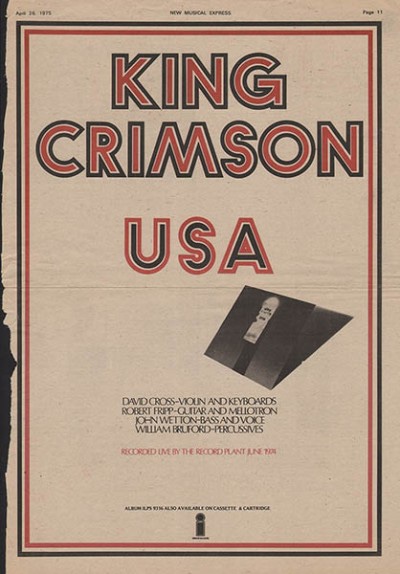
USA by King Crimson (1975) – I had a very hard time choosing a KC album. They’ve been one of my favourite bands for ages. I think my choice was between this live album and Larks’ Tongues In Aspic (represented here with three tracks – part two of the title instrumental, the ballad Exiles and Easy Money, but not Talking Drum). USA was recorded over two dates on the 1974 tour for Starless and Bible Black, but released as an obituary of sorts after its followup, Red. (USA was not a contractual obligations album the way the near-bootleg quality Earthling was a couple of years before.) This version of the band imploded during the recording of Red and there was no tour for it. Even though some of David Cross’ violin work was overdubbed after by Eddie Jobson, this era was intense and beautiful and never matched. I probably bought my first copy of USA sometime in the 90s. Previously I’d most liked the early 80s incarnation with Adrian Belew on vocals and Tony Levin on Bass (alongside founding guitarist Robert Fripp and drummer Bill Bruford), but I picked up Larks’ Tongues on the recommendation of my then partner’s violin teacher for the intensity of Cross’ work. I then delved into the ‘72-‘74 period (Fripp, Bruford, Cross, John Wetton on bass/vocal) with more interest. For me, the version of LTIA Part II here is one of the best I’ve heard. (It’s been in their set lists for all lineups from this period through the tours of the last 10 or 12 years.) And the version of USA that I’d want is the 2002 reissue that includes Fracture and Starless (the studio version of which is on Red. Fracture is an insane instrumental that was the result of Fripp wanting to write a piece that he himself would find too difficult to play. And it blows my mind whenever I hear it.

Standout improvisation: Asbury Park (YouTube link)

Island records advert for King Crimson’s USA. Band credits and a representation of the album cover are below the name of the band and album in large type.

Spotify playlist

After the minor MTV hit that was Mexican Radio, Stan Ridgway left Wall of Voodoo and a couple of years later released his first solo album, 1983’s The Big Heat on IRS Records, the same label that had released Wall of Voodoo’s first three releases. I’m sure I have wonderful things to say about that album. I wore out the grooves on my cassette of it, for certain. In 1989, Ridgway moved to Geffen Records for his second solo album, Mosquitos, a copy of which has found its way to me for the first time in about 20 years. And it holds up. His music always had the feel of the best noir fiction and musically he pulls on the same devices that make up the atmospheres of Dashiell Hammett novels and Bogart movies.

Thematically, Mosquitos works over the same characters, low-lifes with pessimistic outlooks (Can’t Complain) and guys who think the girl is in it for them (Peg and Pete and Me).

In general the whole album is of a piece. Some of it upbeat (Goin’ Southbound, the aforementioned Last Honest Man), some of it more atmospheric (bookends Heat Takes a Walk/Lonely Town and A Mission In Life). 1989 was a weird year, though, for this kind of album. Two years later, he made his last album for the majors, Partyball. Alas, Geffen put out the made-for-Doctor-Demento track I Wanna Be A Boss as the first single. And people who’d followed Ridgway for a few years said, What the hell?

He continues to make great music, but fell off the radar for me at that point. It might be a case of those being the albums I heard when I was that impressionable age. But I absolutely recommend all three of those first solo albums.

While Mosquitos isn’t available on Bandcamp, there’s a veritable scad of Ridgway goodies (including live recordings from the period) available his BC page.

Discogs links: The Big Heat / Mosquitos / Partyball