Archives for category: Rock

Island Records, 1973

Recorded over a year after Islands and with a completely new lineup, Larks’ Tongues In Aspic takes King Crimson in an entirely new direction. Not only had Robert Fripp dismissed Collins, Burrell, and Ian Wallace, he also parted company with lyricist Pete Sinfield who had provided the words for all four previous Crimson albums.

The new lineup, mad percussionist Jamie Muir, drummer Bill Bruford nicked from an unsatisfying stint in Yes (here he is with Yes in ‘71), violinist David Cross and bassist/vocalist John Wetton (longtime friend of Fripp’s who had declined an invitation to join KC in two years before). Violin? Those strings on Islands and their possibilities possibly sent the band in an interesting new direction with the choice of Cross. And taking over lyrics, poet Richard Palmer-James who would continue to provide words for the next two albums as well. The album consists of three instrumentals, the first part of the title track opens the album followed by three songs with words, Book of Saturdays, Exiles, and Easy Money and closes with Talking Drum and Larks’ Tongues In Aspic Part II. Palmer-James’ lyrics don’t seem to be thematically linked the way Sinfield’s were, especially on the first three albums. One should also note that there’s no embarrassment listening or quoting the words from this album. They’re penetrable or impenetrable as good poetry most of the time.

I got into this album in the 90s when it was recommended by my wife’s violin teacher. KC had a fiddler? Who knew? (At the time, I probably had Red, Court, Discipline, and Beat, but I wasn’t a collector.) Since then, it’s been my go-to perfect King Crimson album. It didn’t hurt that live recordings from the early Adrian Belew period also feature LTIA Part II, which along with Red and occasionally Talking Drum are the only Wetton-era songs that made it into the set lists when he fronted the band. One of the joys of the current line-up is that they’re not only playing LTIA Part II, but also Easy Money and LTIA Part I. (Not to mention several goodies from the first four albums which benefit from Mel Collins’ return to the fold.)

Larks’ Tongues In Aspic Part I announces that a new KC is in town. On the one hand, it’s a multi-part epic of uncompromising, unrelenting noise, but midway through, Cross steps up with no accompaniment at all to deliver an elegy in four strings to which Muir adds bells and some noise and then the song turns again into something else entirely before the opening theme reasserts itself. Fripp and company continue to play with jazz structures, but it’s not jazz that’s found anywhere else. (Yeah, I know, save for in the Crimson Jazz Trio.) There’s something spoken in the back of the song near the end, but for the life of me I can’t make it out.

Following the crashing conclusion of the opening track, Book of Saturdays pulls the mood into almost love song territory. The instrumentation starts with some mellotron which blend really nicely with the violin, and Wetton uses his voice to very good effect. The vocal harmonies at the end of the song are oddly the only musical accents that place this album in its time. The music for the first time in the KC journey is only KC and not folk or prog or jazz. It’s like few other albums in that regard. Wish You Were Here, maybe? Bitches Brew?

Exiles starts with what sound like notes played from underwater and the sound of a distant whale (to my ears). A low drone from Cross introduces the theme. Wetton’s voice is more distinct than those of previous KC vocalists, though I feel an outside producer, especially on this song, would have kept his singing more focused. (Of course an outside producer, in my opinion, would have ruined everything else that makes this such a brilliant album.) There are places that he almost hits the note, but doesn’t quite. It’s a little frustrating. The violin work is essential to the success of the song – one could probably argue that it’s essential to the success of the whole album. David Cross still has it as a centerpiece of his live shows. (The guy on the horns in this video is David Jackson from Van Der Graaf Generator. I was at this gig and absolutely baffled that there were only about 150 people in the audience. Two absolute legends and the Netherlands says ‘meh’.)

Side 2 opens with Easy Money – it’s got the heavy guitar lines we’ve come to expect from the rockier pieces on previous albums, but the song features greater dynamics. This is another track where the violin is key to the whole tune.

After Easy Money, The Talking Drum’s quiet introduction marks it as the odd song out on the album. It only really picks up about two minutes into the action. Along with the other instrumentals on the album, it really marks what become the King Crimson style – the odd time signatures, the intertwining repetitions. The thing is, there’s nowhere else to put it on the album because its conclusion leads right into the opening notes of Larks’ Tongues Part II. It’s one of the great song pairings in rock and roll.

There’s still no describing LTIA Part II – I’ve heard versions by multiple King Crimson lineups and several versions by Stick Men and Crimson ProjeKct as well.Yeah, I know, those other two are just variations on KC, but the song always has a surprise to offer. For me it perfectly rounds out an almost perfect album. 5 stars? Pretty much.

ETA: 23 March 2018 marks the 45th anniversary of the release of this album and there’s a great article on its creation over at dgmlive. Check it out.

Next? Starless and Bible Blackkclthttps://wasawasawa.deviantart.com/art/Lark-s-Tongues-in-Aspic-197213614

Island Records, 1971

Released almost a year after Lizard, Islands is a somewhat mixed bag of very interesting music. As you might have guessed from my previous reviews, I haven’t seen the inside of the Sailor’s Tales box set which gathers up (on 27 discs) almost all the extant studio and live work from the period from In the Wake of Poseidon through Islands. I’m sure has a lot of interesting background material on both those LPs and this one. (I’ve got the follow-up box sets of the ‘72-’74 lineup with their long informative booklets of, so I have some idea of the material included.) So this too is a review of the album as released at the time.

king-crimson-islands-cassetteThe album’s opener, Formentera Lady is introduced by Harry Miller’s double bass theme. Mel Collins’ flute and Keith Tippet’s piano weave around one another behind Boz Burrell’s vocals. (KC’s third vocalist in four albums, Burrell had previously worked with Fripp and other Crimson members in Keith Tippet’s Centipede project.)
This song’s almost stereotypically Asian flute work that introduces the third verse has always led me to confuse Formentera with Formosa (the former English name of Taiwan). Looking it up now, I learn that Formentera is near Ibiza and is part of Spain, and was a popular hippie destination in the late 60s. I obviously didn’t pay that much attention to the lyrics until recently, as its references to Odysseus and Circe in the fourth verse place it in a squarely Mediterranean setting. For a couple of minutes after the last verse, the song moves into a now familiar jazz improvisatory realm, anchored by Burrell’s bass lines, eventually coming back to square one for the final verse. I’m pretty sure the soprano vocals that overlay this section of the song are unique in the KC canon. It’s amusing to note that Joni Mitchell was living on Formentera in 1971 and working on her album Blue, leading one to wonder if she’s who Pete Sinfield is referencing in the title.

The soprano is faded out behind some sax before the mellotron introduces Sailor’s Tale, an almost Philip Glass-like workout for drums, horns, and keyboards. Well, it feels minimalist until some honks from tenor sax take the front of the song. As is becoming familiar in KC territory, the song takes a couple of turns in tempo and instrumentation, increasing in intensity before an oddly long fade. This seems an appropriate way to bring the listeners to the next track.

The Letters, a 16-line story of infidelity and death. closes side 1. The first letter from a husband’s lover to his wife informs her that she’s pregnant, the reply to which seems to indicate the wife has killed her husband (‘What’s mine was yours is dead’) and is about to take her own life (‘I take my leave of mortal flesh’). The opening verses are very quiet but lead to several turns with the sax taking the lead. The middle section of the song is all emotional turmoil until the wife takes up her pen. Collins comes back on flute and in the final lines the instruments leave all the work to Burrell’s bass.

The composition around which the song is arranged dates back to the Giles Giles and Fripp song Why Don’t You Just Drop In, performed on the early Crimson tours as simply Drop In. The lyrics to Drop In, however, are entirely different than those of The Letters.

Side 2 opens with possibly the oddest song for King Crimson to record. A couple of people responded to my assessment of Happy Family on Lizard to tell me it was actually about The Beatles. A case can be made for this, especially when listening to Ladies of the Road, a raunchy paean to groupies which sounds in places like either late model Beatles or early John Lennon solo work. To be honest, I was first turned off to Islands because of this song. It’s direct and explicit and almost glam in its presentation (not a problem for me in the grand scheme – one could hear it fitting in on the soundtracks to Almost Famous or Velvet Goldmine). The main issue I have with this song’s lyrics are not that they’re frank or sexually explicit, but more that the narrator is objectifying (‘[She] Said I’m a male resister / I smiled and just unzipped her’). The worse crime still, however, is that there’s no metaphorical content or lyric irony. This is uncommon both in Sinfield’s other lyric poetry for KC and in Crimson lyrics as a whole.

After the hardness of ‘Ladies’, Prelude: Song of the Gulls is oddly soothing. Its repetitive motif of flute against strings is almost baroque. And despite being a Fripp composition (recorded by Giles Giles and Fripp and also found on The Brondesbury Tapes), the recorded song doesn’t seem to feature him. I’m reminded of the credit given to Bill Bruford for the song Trio on which he doesn’t play (‘admirable restraint’).

Finally, the title track is a slowly built layering of instruments. Flute (or possibly alto sax), piano, and guitar are added to Burrell’s vocals. In the second half of the song, the vocals are faded and Collins switches over to tenor sax and Fripp adds a quiet harmonium as the song gathers in intensity. It’s one of their loveliest songs – up there for me with Matte Kudesai and Walking On Air.

The album works well as a whole, and taken on its own terms is mostly successful. Its production is more polished than that of the earlier albums. Combined with the the photograph on the cover, it’s a departure from how the band had earlier presented itself. I honestly can’t come up with a star rating for it – Islands simply needs to be experienced.

Next on the menu? Larks’ Tongues In Aspic!

Island/Atlantic/Vertigo Records, 1970
Produced by Robert Fripp and Pete Sinfield

The first of many massive personnel changes in the Crimson camp occurred when Greg Lake met Keith Emerson at a King Crimson/The Nice double bill at the Fillmore in San Francisco in December, 1969. After that show and Emerson and Lake decided to hook up and with Carl Palmer and they recorded their first album the following summer. Wikipedia is not helpful in explaining why Ian MacDonald and Michael Giles left the band after that American tour as well, but even with all of these changes, Poseidon remains an even more cohesive album (IMVHO) than Court. Part of the reason is that Pete Sinfield is still handling lyrics, Lake sings on all but one of the album’s vocal tracks, and McDonald cowrote two tracks, the single Cat Food and side 2’s epic instrumental The Devil’s Triangle.

The album is bookended with three parts of a song called Peace – A Beginning opens side 1; A Theme and An End open and close side 2. The second tracks on each side are the two straight up rockers, Pictures of a City and the single Cat Food, and the album is rounded out with a couple of more progressive propositions.

Pictures of a City evolved out of A Man, A City, performed on the Crimson King tour and found in multiple versions on the Epitaph collection of those 1969 concerts. Musically it’s roped in from the clatter of those early performances into something a bit tighter. In the earlier versions, there’s room for a sax solo, and some stretched out interplay between the musicians. On the studio album, it’s a distinctly less free (as in jazz, not beer) proposition.

Side 1 continues with the thinly arranged ballad Cadence and Cascade, sung on the album by Gordon Haskell, but for which there’s a Greg Lake vocal version included as a bonus track on later releases. The sparse arrangement keeps the instruments from tripping over/crashing into one another, but leaves room for the individuality of the guitar and a sweet flute solo from Mel Collins. On the other hand, Haskell’s voice really doesn’t do the song justice – he doesn’t hit the high notes or master the low notes the way Lake did.

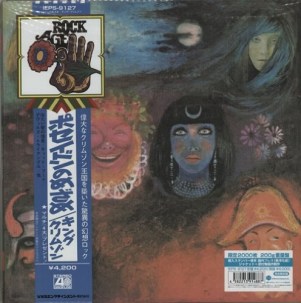
king-crimson-wake-jpThe title track closes out side 1. I think the band was going for something like Epitaph – musically, the song has the flow and drama of the earlier song with those smooth mellotron lines connecting the piece together. Lyrically however, it’s one of those songs that (and I paraphrase mellotron master Mike Dickson – I just can’t find the source – it’s in the notes for one of the songs on mellotronworks II) make prog rock fans say, ‘I don’t listen for the lyrics’. Sinfield seems to be after the grandeur of the drama between heroes and rulers and peasants in war, but each stanza has multiple subjects, whereas in Epitaph, we had only a tortured ‘I’ to give the song its emotional weight. The song is crushed under the weight of Bishop’s kings, Harvest hags, Heroes, Magi, and Harlequins.

After the resonant acoustic solo of Peace – A Theme, Cat Food roars in. More jazz than progressive, this was the song that grabbed me most when I first listened to this album in the 90s. My emotional response was to the weird, almost new wave instrumentation. The piano lines are reminiscent of the work Mike Garson was doing with David Bowie at the time with that right-hand madness. I’m not surprised the label used it for the single – it’s the tightest of the songs and the vocals are clear and mostly untreated. On the other hand, it’s the most unrepresentative song of the early work. (Listening now, I’m surprised it didn’t return to active service in the Adrian Belew years – it has some of his offbeat humour, both musically and lyrically.)

The Devil’s Triangle is a proper three-part instrumental epic which fades into some long mellotron chords, adds martial drums and some other stuff. The third part of the song (‘The Garden of Worm’) is very neatly separated from the previous section by a wind effect that fades to silence. The same martial drums are accompanied by whistles maybe and then a harpsichord shows up. Describing a song like this is very much in the ‘dancing about architecture’ category. Some bits are jazz, and some bits are just noise, and it’s mostly unlike anything else except when the occasional chord points out that this band evolved from Giles Giles and Fripp and another segment repeats a piece of the previous LP’s title track. Just for a moment, those Ah-ah-ahs show up, before Peace – An End. I hear the thematic reason for having the three parts of Peace show up evenly placed on the album, but the a cappella intro is almost as jarring to the ear as the opening chord of Pictures of a City after Peace – A Beginning. It might be done on purpose, but it doesn’t make for consistent listening, not that I’m asking for consistent listening from King Crimson. Honest!)

Overall, I give it a solid four stars. Next up? Lizard.

Island Records/Atlantic Records 1969 Produced by King Crimsonking-crimson-in-the-court-of-the-crimson-king-4-ab
The signal blast that opens this album’s opening track, 21st Century Schizoid Man, is the announcement that there may still be insanity in the Fripp camp, but it is not cheerful. The improvisational center of the song with its nearly uncontrolled horns lays it out, as do the sections in which the time signatures shift without seeming to hint at any plan before roping it all back in. Fripp and company (this time Michael Giles, Greg Lake, Ian MacDonald, and lyrics by Pete Sinfield) are engaging in what sounds like a proto-fusion jazz experiment.
And almost as soon as it starts, it’s over.
The new recording of I Talk to the Wind, more reliant on the flute than on the Judy Dyble / GGF version recorded the previous year, is more complex and more controlled. The interplay of the instruments hints at the band’s wider ambitions than the silliness found on Cheerful Insanity.
Following the proto-jazz metal of Schizoid Man, this song’s pastoral arrangement is unexpected, but it’s thematically of a piece with the opener. The alienation of Schizoid Man’s last verse ‘Blind man’s greed / Poets starving, children bleed / Nothing he’s got he really needs’ dovetails with ‘On the outside, looking inside, what do I see / Much confusion, disillusion, all around me’. Just because it’s sung clearly with pleasing music doesn’t mean it’s not the same character.
There’s an argument to be made that the opener is an id-driven, gut-level response to the times and to the madness of the world in general. It’s the only musically heavy track on the album and a strange thing to open an otherwise soft album with. But in the sense of the album, it’s perfect. The first listeners must have been struck by the contrast between Schizoid Man’s coda and the opening of I Talk to the Wind, but, again, the themes of the album are supported by its calm. The emotional response to the world’s insanity, when articulated to communicate woe, is lost on the world. ‘My words are all carried away…the wind cannot hear.’ The pun of having a wind instrument carry the song wouldn’t be worth the bother if the song didn’t hold together. (Question though: Can someone sing the lyrics to Pete Shelley’s Homosapien to the tune of this song? ‘Said the shy boy to the coy boy…’ This would amuse me greatly.)
Epitaph, which closes side 1, is the album’s fulcrum and thematic and musical heart. Our narrator looking at the world and seeing its fate ‘is in the hands of fools’ sounds eerily timely. Balancing the possibility of survival (‘If we make it, we can all sit back and laugh’) with an honest assessment of the possibility of destruction (‘Yes I fear tomorrow I’ll be crying’), we know from the title where the song things the scales will fall.
Side 2’s first track, Moonchild, opens with a folk song subtitled The Dream, which after a couple of minutes slips into several minutes of nothing much, for want of a a more articulate reaction. Subtitled ‘The Illusion’, this is the least interesting stretch of music, possibly in the entire KC canon. It’s almost a surprise to hear the opening notes of the album’s title track which follows. I find this a little sad, because the lyric portion of the song is so beautiful.
Finally, In the Court of the Crimson King. The album’s title track has a weird structure moves from folky to jazzy to full on progressive before we knew what that meant. The lyrics about fire witches and puppets might indicate that the schizoid man has finally gone from close to the edge to over it and possibly towards peace in his own head. Musically the band is still playing games with both rock and roll and free improvisational jazz, while taking what it needs from the folk and classical traditions that were the wellspring of the UK progressive sound. The Dance of the Puppets, which takes us through the last two minutes of the album presents a strange coda which only in the last moments pulls back into the song’s musical theme.

Next up: In the Wake of Poseidon.

So this month, I’ll be diving into the studio recordings of King Crimson. I’ve been a fan since the early 80s and have seen them perform four times. (I’ll see them again in July. Woot!) I considered reviewing the albums alphabetically rather than chronologically, but was dissuaded.

While Robert Fripp is the only constant in almost 50 years of KC, both Giles brothers appeared on either or both of the first two KC albums.

There are two ways to consider this album, neither of them very useful. One way is to look for aspects of it that point to what Michael Giles and Robert Fripp would do the following year with In the Court of the Crimson King. The fact is that very little of Cheerful Insanity resembles anything in the first few years of KC. The other way to look at is to consider where it falls in the music being made at the same time. This is more helpful, I suppose, because there are bits of the album that resemble early Moody Blues, early Pink Floyd, generic English folk rock and its proggy offspring (Genesis, Jethro Tull, Yes).

I first heard this album sometime in the mid-90s when I was collecting as best I could anything with Fripp’s name on it. I couldn’t hear anything in it (and still don’t) that resembles the weirdness of that late-70s/early 80s period when he’d been applying that arpeggiating guitar technique to everything he touched (including, for example, the stylings of the first and third Roches LPs. And much as I enjoyed that early prog, Cheerful Insanity just didn’t cut it.

Part of the issue I had was that a very young Fripp only wrote three of the songs. Little Children on side A suggests why Fripp left the lyrics to others after that. This song is notable for vocals provided by The Breakaways who famously backed Petula Clark and Cilla Black on several singles.

GGFSuite No. 1 and Erudite Eyes, which close side B have a more Frippish feel to them than the rest of the album. Suite No. 1, which clocks in at just under six minutes, starts with some Paganini-like runs that are joined by bass and keyboard, but after a minute and a half or so, the baroque gymnastics are replaced with a piano/strings/vocals arrangement that brings to mind the Chi-Lites’ Have You Seen Her. This segment is followed by a harpsichord-guitar duet which is followed by a reprise of the Paganini. A single track broken into three possibly unrelated forms, pulled together by a reprise of the theme? The application of jazz theory to folk motifs is one of the main threads of early progressive rock – it’s just weird to hear it applied so strangely.

Erudite Eyes is really the only song that points to the musical strangeness that was to come. It begins as a waltz, turns into a polka, returns to waltz-time and moves into improvised psychedelic strangeness before the second minute is up.

Lyrically, the whole affair is pretty strange. Newly-Weds suggests the discord of couples keeping up with the Joneses (He worries all day about wolves at his door…but on the other hand, she’s got a ring). One In A Million’s look at a man ‘content with the things at the moment, except the yellow line by the pavement’ echoes Revolver-era Beatles (Eleanor Rigby, Taxman).

The biggest issue I have with the whole album is the interspersed comedic numbers. Most of the songs on side A are bookend with episodes of The Saga of Rodney Toady, a ‘sad young man’ who girls run away from at school dances and whose parents are ‘fat and ugly’ and tell him that will ‘meet a fat and ugly girl just like Rodney’s mother and they would get married.’ These interludes don’t speak back to the music and actually detract from enjoying the album.

Side B’s songs are interspersed with repetitions of the sentence ‘I know a man and his name is George’ spoken in the correct order once and then in permutations (Know I George his name and a man, for example) and in increasingly annoying voices. One could argue that the rearrangements of the words reflect the possibilities inherent in the structured and random mutations of music that lie at the heart of King Crimson’s most intriguing work (for me, this includes tracks like Fracture, Level 5, and Starless).

After this album was released, Peter Giles left, and Ian MacDonald and Judy Dyble (late of Fairport Convention) joined and they made a collection of high quality home recordings released in 2001 as The Brondesbury Tapes. This collection is mainly notable for Dyble’s vocal on an early version of I Talk to the Wind. Soon after, Greg Lake joined and the Crimson King was born.