Archives for category: Rock

Okay, this is a weird one. VDG’s first outing as a trio following another departure of David Jackson. It might reward further listening, but I’m not certain.

vdgg-trisector_eclipsed0308_adThe opener, Hurlyburly, is an instrumental which seems to declare in major chords where the band is going this time. One of the melodies echoes the rinky-dink of Freddie Cannon’s Palisades Park.

Interference Patterns is almost a parody of a VDG song – weird rhythms, off-the-wall subject matter, and a howling vocalist, all grinding to a halt for a solo in a different time signature. Lyrically, however, it’s a word salad lifted from a book of popular pseudophysics. Or at least that’s what it sounds like.

The Final Reel is a fairly straightforward song about an elderly couple choosing mutual suicide over slow decline and sounds much like a jazzy 70s rock ballad. It’s strange to hear a story from Hammill so devoid of nuance. This isn’t a bad thing, just strange.

Drop Dead is another song short on the poetry we’d come to expect. In a sense some men are always caught in adolescence / trying to crack the mystery girl cocoon.

Over The Hill is a proper VDG epic – 12 minutes 30 and more lyrics and tempos than usual, and like The Final Reel, seems to be about facing mortality (‘and there’s no time for hesitation as the stations of our lives are passing by’)

(We Are) Not Here, which closes Trisector, is another song about mortality, but one that sounds more like classic VDG – Hammill howling over insane keyboard and guitar noise about, well, things like ‘Light streaming through us blindly / we are not here for long’.

Musically, Trisector is good stuff, but it’s just not as interesting as their other work. I put it down with Godbluff.

Indeed, what a difference 27 years makes. Another interesting album. Far more listenable than most of their efforts. This release was divided into two discs. The first consists of six finished tracks, one of which (Boleas Panic) is an instrumental. The second is made up of ten improvisations. This album has more of an overarching theme that has to do, I think, with bearing up or sinking under the burden of history.

One of thevdgg-p first things one notices about this album is David Jackson’s horns, missing (for the most part) from the last two 1970s releases. They’re really quite integral to the Van Der Graaf sound and it was odd on the previous release to have them replaced with strings.
The opening track, Every Bloody Emperor, is one of the only politically charged songs in the band’s catalogue. While it was bloody appropriate to 2005, the beginning of Bush II’s second term, it seems even more so now:

Truth’s been beaten to its knees; the lies embed ad infinitum
till their repetition becomes a dictum
we’re traitors to disbelieve.

Nutter Alert seems to be a flip side of MC 900 Ft. Jesus’ The Killer Inside Me, the narrator of which is an absolute nutter. (I have a feeling I’ve mentioned The Killer Inside Me with reference to an earlier song, but I’m not certain.) Nutter Alert has the narrator indicating that he’s stuck listening to someone who is no longer fully with the programme:

Oh, but here comes that special nonsense
all the words out in a spurt,
the unhinging of the trolley
as the mouth begins to blurt…

Abandon Ship! is lyrically a little weak, but I quite like the interplay of the horns and guitars.

In Babelsberg seems to describe a walk through late 20th century Berlin and compares it to, perhaps, a pre-reunification version of the same city.

The light is getting dimmer,
the walls of history close in.
In Babelsberg they’re hunting
for a different Stimmung (mood, according to google translate)
that predates the war.

The title of the disc 1’s closing track, On The Beach, would suggest Neville Chute’s novel of the same title, about life in a post-nuclear war Australia, but lyrically, not so much. ‘We could have thrown in our cards / when the going got hard / but evidently we went on interminably’ seems to indicate another of Hammill’s tales of love that’s gone awry in that human way.

The improvisations of disc 2 seem to be more focused than those that made up, for example, the various sections of A Plague of Lighthouse Keepers. While the band members are striking out for the edges of what a song can hold, they manage to pull each piece back into a song.

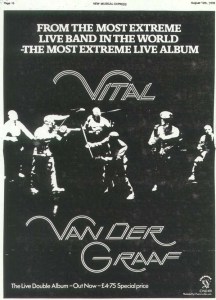
Vital is a weird one for me because it was the only Van Der Graaf I purchased as a kid. I honestly didn’t know what to make of it. I only knew about Van Der Graaf at all because of references to the 6 Bob Tour (Genesis/VDGG/Lindisfarne – all Charisma Records artists who toured together in ’71) in Armando Gallo’s Genesis: I Know What I Like, which I read cover-to-cover multiple times. So when I finally saw a Van Der Graaf album in the used bins (probably at Rhino on Westwood Blvd, but not sure), I grabbed it. I played it a couple of times but really had no idea. Listening to it now, nothing is familiar from listening to it then. I haven’t recognized any of the songs from delving into the catalog these last few weeks.

vdgg-vAll in all, it’s pretty good stuff. As with most of Van Der Graaf’s work, it’s pretty compelling and there’s no easy entry.

To give the uninitiated an idea of how truly contrary this band was, they opened (the album, if not the gig – one isn’t sure what the original set list was) with Ship of Fools, the b-side to a single (the previous year’s Cat’s Eye) that was only issued in France. Mirror Images would appear on a Hammill solo album the following year. The vocals are far forward in the mix and the arrangement is sparse, enabling better understanding than is often the case with VDGG’s music. On the other hand, it’s another seriously wordy Hammill lyric that requires a lot of parsing.

The album covers music from almost their entire history including a truncated Plague of Lighthouse Keepers (in a medley with Godbluff‘s The Sleepwalkers) and Pioneers over c. The violin and cello bring an interesting new dimension to the older work. Though David Jackson (sax/flute) had left the band during the recording of Quiet Zone/Pleasure Dome, he played this gig and the noise he brings to Pioneers contrasts nicely with the strings, especially in the song’s middle section. This performance opens side 3/disc 2 and received the greatest applause.

Sci-Finance (later released on a Hammill solo album) is a pretty hard track about big business. It’s mostly short on dynamics until the instrumental break which seems to be a competition between a violin, a horn, and a guitar.

Door, another non-album track (a demo version was later appended to Quiet Zone), has a spoken introduction in which Hammill tries to explain the song. It’s odd that it’s the only one on an album with more lyrically challenging pieces that would have been unfamiliar. This is another one with a great improvisational section comprising the second half of the piece. It’s followed by a song titled Urban/Killer/Urban, the middle of which is an instrumental version of the song that opens H To He Who Am The Only One. It’s an interesting way of including one of the band’s more recognizable songs.

And the whole adventure concludes with Nadir’s Big Chance, the punk-ish title track of a 1975 Hammill solo album. Lyrically it bears a disturbing resemblance toMirror Stars by The Fabulous Poodles (who, according to an image in Vital’s CD booklet, played the Marquee the same week Vital was recorded.

The sound is becoming tighter with this album – less prog, more new wave, as was not uncommon at the time – look at the direction Peter Gabriel took the same year. A change in sound is due in part, it seems, to the departures of organist Hugh Banton and saxophonist/flautist David Jackson, the return of bassist Nic Potter and the addition of violinist Graham Smith. A violin riff from Smith opens Lizard Play, the album’s first track. It’s a signal of new things, to be sure. Lizard Play is also notable for some nicely mixed harmonies.

vdgg-quietz2Running times are shorter, arrangements are less improvisational, but the vocals are still speaking/howling combinations we’ve come to know and love. Replacing horns with a violin produces a slightly more listener-friendly sound, which works well with the shorter songs.

I especially like the double-tracked violin in the second half of Cat’s Eye/Yellow Fever (Running). That’s a mouthful of a title – I think we’ve got the same glut of ideas that populate earlier VDGG work, but condensed somewhat. There’s a fine lip-sync video of this track (alas the sound is not cleaned up) that shows there was also a cellist in this lineup. You can hear the cello on the album, but the player isn’t credited on Wikipedia. The notes for the video name him as Chas Dickie.

The Sphinx In The Face (one of two songs on which Jackson plays) opens with a Dirty Water-style bassline which is kind of tasty. Stylistically it might have done well if pushed as a new wave track, but lyrically it relies heavily on the repetition of a refrain that Hammill usually avoids. (And I’m not sure if You’re so young, you’re so old / You’re so queer, you’re so strong / Such a drag to be told / You’re so here, you’re so gone ranks with his best writing. A 90-second reprise after Chemical World seems a little superfluous.)

Chemical World is sort of Suede meets Fairport Convention via Hamilton Beach.

It’s kind of an odd album to go out on. They toured it and released a live album (Vital, coming up next), and then went on hiatus for 28 years.

I like the cover which merges an outerspace blue marble photo of the earth (centered on the middle east, oddly, not Europe or the US) with an LP. Musically, it’s a lot of the same kind of stuff we’re used to and then suddenly not. It’s a very different beast than Still Life, which was released only six months before.

vdgg-wrOpening track When She Comes closes with an interesting Spanish castanet thing, but it’s a proper rocker. For the most part. The second verse almost had me feeling I’d tripped into a Leonard Cohen song: ‘And you think she’s really with you, / and you think that she’ll always stay, / always ready to forgive you, / always ready to grant you her mercy / but in her own way,’ but Hammill twists in his own vision of things, namechecking ‘The Belle Dame [is] without mercy’ from Arthurian mythology.

A Place To Survive also rocks out pretty mightily with Jackson’s horns positively screeching at times over Banton’s mellotron arpeggios. It closes with the the sound of the recording tape being pulled thin, garbled and distorted. Masks, which closes side 1 (just a note or two short of actually resolving musically), continues the musical intensity with another confused/complex Hammill character who confuses the face he shows the world with the face he shows himself. Or something. Lyrically, it reminded me a bit of MC 900 Ft Jesus’ The Killer Inside Me, though that might be a little twisted.

Side 2’s 21-minute epic, Meurglys III (The Songwriter’s Guild), has a long reggae section. The first 13 minutes are a normal proggy VDGG song with lyrics about not knowing the truth or thinking the truth is there but in the end it’s not. And then the bass takes over and there’s several minutes of that loping 70s reggae beat with some way-down-in-the-cutaway guitar work. It’s cool, but a little unexpected. (The 2015 live version on Merlin Atmos clocks in at 15:24 and keeps the reggae to a minimum.)

The initial release of the album closed with Wondering, which starts as a flute-based (or rather synth-flute-based) waltz and evolves into something musically anthemic, but lyrically ambivalent. In the first iteration of the last line, wondering if it’s all been true, the last word is spoken and intoned like a question. The line is repeated several times with the word true usually sunk below the instrumentation.

The reissue also includes rather fuzzy Peel session versions of When She Comes and Masks. (Noting again, that I’m listening on Spotify, so gauge the term ‘fuzzy’ as you will.)