It used to be that my daily listening included audio drama, music discussion, book discussions/audiobooks and a lot of politics. These days I’ve dropped to politics for the most part and have happily found more music discussions.
Discord & Rhyme has been running for seven years (164 episodes as of this writing) and is one of several music panel shows I listen to regularly. The format is usually three or four out of a group of seven regular panelists (plus occasional guests) discuss an album that one of them has chosen for the episode. The person who chose it tells the history of the artist up to that point and why they picked the album. They then talk individually about their histories with the album/artist (if any) and then dive in, talking about the album song by song. Finally, they suggest to listeners where to go next if they liked the album in question.
All of the panelists have a great love for a fairly wide variety of music, though most of the albums they’ve covered are in the pop realm to some degree (with a fair helping of prog – including seven (and counting) Moody Blues episodes). Once they get down to the tracks it’s primarily a matter of ‘I love/don’t love this track, and here’s why.’ And they really dive in – recent episodes run well over an hour. They took two for Nine Inch Nails’ The Downward Spiral and over three (divided into two episodes) for Prince’s Sign O’ The Times. The thing that makes this podcast even more interesting for me is the various digressions into the sources of songs, who played what on each track, where a track has been sampled, and so forth.
The discussion of Prince’s The Cross is a good example of the variety of opinion they bring to bear. One panelist commented that he didn’t like the song because there’s no musical development in it – it’s the same short piece of music over and over. Another (John McFerrin, I think) went into how it appeals to him because it accumulates, like Ravel’s Bolero. It starts with something very quiet and then the instruments just pile on one by one until there’s this grand explosion of sound. And I always joke that as a Jew, it’s weird that The Cross is my favourite song on that album. While I’d never thought about it that way, I’m quite fond of that kind of music as well, no matter the genre.
I’ve mostly listened to episodes on albums I know but I look forward to going back into albums I don’t. They clip generously so even a newcomer to an album can get what they’re talking about.
Another interesting thing that comes up in their discussions is what makes a perfect album opener, what makes for a great track two. The idea of a good album having a statement of purpose that sets up what’s to come. For many pop albums this is an ideal rather than something put into practice, but given the entire crew’s love for progressive rock (probably the genre that set the stage for this kind of musical analysis), this comes into their discussions pretty regularly. In considering my own efforts (some on this very blog) into album reviewing, this isn’t something that has come to my mind before. At least not in so many words.
I have a variety of responses to their analyses based on how well I know or love an album or an individual track, but that’s not surprising. The hosts are all about my same age (mid 50s) and part of what I enjoy is the common experiences we have with the albums that came out in the 80s and 90s. There’s something comforting in that. Or amusing when one of them might say, ‘My first experience with this album was when that week’s host chose it for this podcast.’ The fresh ears they sometimes bring helps to open my ears to things I may have forgotten.
A couple of weeks ago I was listening to a favourite album, and had the thought that it was a perfect enough album that it would be one I’d take to a desert island. And thinking on the very long-running (80 years!) BBC program Desert Island Discs, I considered what my other seven would be. And my thoughts took me further – most of my friends are music mavens and would have though on this concept as well. So in the new year, I’ll be interviewing my friends as to what music would see them through if they were the last person on Earth and there were only eight records to listen to.
I came to most of these albums in my 20s, that period after the teenage enthusiasms have been sloughed off. While I still love the music I cut my teeth on, the albums associated with that first period of coming into my own seem more timeless.
The website will be l8roe.blog as soon as the registration goes through.
So what was that perfect album? Premiers Symptômes by Air (1997), a compilation of songs from their first three singles. I first picked it up in 1998 or so, when everyone, it seemed, was going crazy for Air’s first full-length, Moon Safari. I preferred the slightly weirder, rawer earlier singles (though, to be fair, Moon Safari is a well-nigh perfect album as well). On these songs, the combination of Fender Rhodes, Moog, and euphonium bring me a strange feeling of nostalgia (for a period and place I never experienced) and are also perfectly of their own moment mid-90s moment. Favourite track: J’ai dormi sous l’eau (YouTube link).
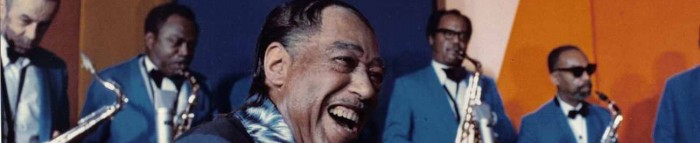
Duke Ellington and John Coltrane (1963) – When my friend Steve introduced me to this album in about 1996, I’d known of Ellington because of Stevie Wonder’s Sir Duke and had some idea of his importance in jazz, but I hadn’t yet delved. And I knew Coltrane’s A Love Supreme (an album that after more than 30 years of listening, I still can’t get inside of), but this was something else. This meeting of two giants whose paths hadn’t crossed in the recording studio. Only in the last decade or so have I heard the vast number of collaborations Ellington undertook in the early 60s, but this was the first. For me it’s the interplay of Coltrane’s mastery of ballad forms and Ellington’s understated piano work. There’s a different sweetness in each of the album’s seven tracks that runs from the ebullience of The Feeling of Jazz and Big Nick to the yearning trills of In A Sentimental Mood and My Little Brown Book. Favourite track: Stevie (YouTube link)
I came to Sister Rosetta Tharp much later than most music in this selection, while I was researching the origins of rock and roll for a series of blogs I wrote several years back. I’d never heard of Tharp. She was one of the progenitors whom the historians reference, but doesn’t get the kudos she should, for her delivery, her style, and her guitar mastery (not in that order). There’s a wealth of compilations to choose from, but Volume 2, the Document Records collection of 1942-1944 recordings has both rock and roll and gospel and my favourites Trouble In Mind (YouTube link) and Strange Things Happening Every Day. (Other favourites, This Train and Didn’t It Rain came later – I might have to keep looking for the perfect album.)
Aviary by M-1 Alternative (1991) – This band should have been huge, something I’ve said for 30-plus years. I got into them on the release of La Llorona, the first of their three albums in 1988 or so. My flatmate Mikki introduced me to them and I saw them perform in clubs in San Francisco over the next couple of years. I love all three albums, but this one features Ghetto and Reclaim (YouTube link), two of my favourites songs of theirs. The line I am a ghetto / a maze of streets far from the landing field always spoke to me – my feeling that I was too complicated and not near enough emotionally or intellectually to any place those I was close to landed and met. Theirs was a sad story, to me. They signed to C’est La Mort records for Aviary, and released the followup, The Little Threshing Floor on CLM as well. Just after The Little Threshing Floor was released, CLM’s distributor, Rough Trade, went under. One of the two members moved to New York and out of sight. The other has recently been remastering their work, starting with their earlier demos, and releasing them to Bandcamp.
The Good Son by Nick Cave and the Bad Seeds (1990) – Dang, but choosing a Nick Cave album for this list was a task. Nearly every album has more high points than lows. I was leaning towards Push The Sky Away which is so beautiful. Other contenders were The Boatman’s Call (beautiful and perfect but closely associated with a difficult time in my life) and Let Love In (great, but I don’t really need to hear Red Right Hand again – it seem to show up everywhere!). When I got into this album, I was still mourning my father who died in 1986 when I was 19. The father/son dialogue of The Weeping Song (YouTube link) spoke volumes to me in its invitation to reconciliation. The son asks in turn why the women, men, and children are all weeping, and finally asks, ‘Father, why are you weeping? / I never thought I hurt you so much,’ with the word ‘hurt’ is stretched out to seven or eight syllables.
Lady In Satin by Billie Holiday (1958) – This is such a strange album – it’s late in Lady Day’s career – one of her last albums, released a year before her death at the age of 44. Her voice is much thinner than it was in her prime, but somehow more expressive. The orchestration is lush and befitting the songs she chose. Violets for Your Furs (YouTube link) and I Get Along Without You Very Well are particularly poignant. My mom or sister bought it when I was in high school and at 15 or so, I definitely didn’t get it. On someone’s recommendation I came back to Billie a few years later with a cassette of Lady Sings The Blues which was in heavy rotation on my walkman for many years. The sheer weight of Lady In Satin, with its lush orchestration started to mean something to me when I turned about 40. A few years ago, I found a 180-gram reissue and my heart just sings when I listen to it now.
Dømkirke by SUNN O))) (2008) – This is definitely the odd one out in my collection. It’s 60 minutes of drone metal and feedback, made melodic and holy. SUNN O))) (pronounced Sun) are known for shows of punishing volume, the use of deep feedback and strange guitar tunings, but that put the listener in an altered state if they come with open ears. While the shows I’ve seen have been in performance spaces, this set was constructed for a one-off show at the titular Dømkirke church in Bergen, Norway. (To be fair, Paradiso in Amsterdam was once a church, but it’s been a concert venue for several decades.) The band’s lineup for this show included vocalist Attila Csihar whose bass rumblings compliment the guitars of founders Stephen O’Malley and Greg Anderson. My favourite of the four tracks is probably Cannon, but telling the differences between any set of SUNN O))) songs is its own exercise. (Greg Anderson, AKA The Lord, recently released a collaboration with Petra Haden called Devotional (Bandcamp link), which may overtake Dømkirke if you ask me in a year. It’s glorious.) Favourite track: Cannon (YouTube link) Bandcamp link: Dømkirke
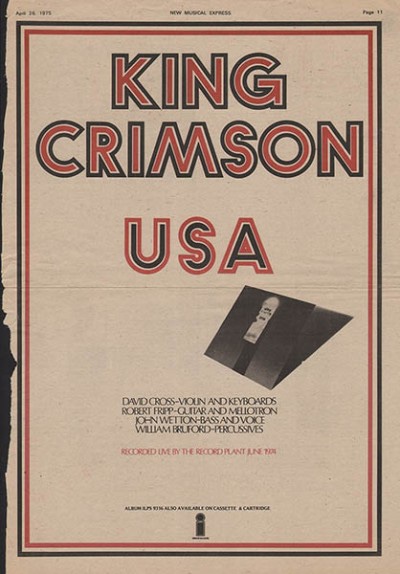
USA by King Crimson (1975) – I had a very hard time choosing a KC album. They’ve been one of my favourite bands for ages. I think my choice was between this live album and Larks’ Tongues In Aspic (represented here with three tracks – part two of the title instrumental, the ballad Exiles and Easy Money, but not Talking Drum). USA was recorded over two dates on the 1974 tour for Starless and Bible Black, but released as an obituary of sorts after its followup, Red. (USA was not a contractual obligations album the way the near-bootleg quality Earthling was a couple of years before.) This version of the band imploded during the recording of Red and there was no tour for it. Even though some of David Cross’ violin work was overdubbed after by Eddie Jobson, this era was intense and beautiful and never matched. I probably bought my first copy of USA sometime in the 90s. Previously I’d most liked the early 80s incarnation with Adrian Belew on vocals and Tony Levin on Bass (alongside founding guitarist Robert Fripp and drummer Bill Bruford), but I picked up Larks’ Tongues on the recommendation of my then partner’s violin teacher for the intensity of Cross’ work. I then delved into the ‘72-‘74 period (Fripp, Bruford, Cross, John Wetton on bass/vocal) with more interest. For me, the version of LTIA Part II here is one of the best I’ve heard. (It’s been in their set lists for all lineups from this period through the tours of the last 10 or 12 years.) And the version of USA that I’d want is the 2002 reissue that includes Fracture and Starless (the studio version of which is on Red. Fracture is an insane instrumental that was the result of Fripp wanting to write a piece that he himself would find too difficult to play. And it blows my mind whenever I hear it.
Standout improvisation: Asbury Park (YouTube link)
Mason Alexander Park and Mike Garson and band at The Sun Rose in West Hollywood, 22 October 2022.
I’m not sure how I heard about this show – something shared on Twitter, it must have been. Park plays Desire on the Netflix series The Sandman and Garson played piano for David Bowie for years. (‘72-‘74 – Aladdin Sane, Pin-Ups, Diamond Dogs, and David Live, and was a constant member from 1995’s Outside through 2013’s The Next Day.) Park has other credits to their name, but nothing I’d seen. I just know that people thought it pretty cool they’d found a trans actor to play Desire. The theme to the show was songs associated with desire and dreaming, but in general it was a cabaret with a heavy Bowie emphasis. (Park mentioned that the two of them had done whole sets of Bowie covers together – that must have been a treat.)
Most of the songs in the set were pretty well known, but opening with a deep cut from a late Bowie album (Bring Me the Disco King from 2002’s Reality) was an odd choice. But the audience seemed ready for anything. Moving from that to Space Oddity (the second time on this trip to the US I’d seen that performed – Megan Slankard covered it in her set opening for John Doe) and Oh! You Pretty Things got everyone focused.
They then moved on to other artists for a while – two songs called Desire that I’d never heard – by Meg Myers and Bob Trask, a nice version of Mr Sandman incorporating first a torch song arrangement, and concluding with a couple of verses in the style of the Chordettes’ version.
Michael Thomas Grant of the show Zoe’s Extraordinary Playlist (yes, I had to look that up – I had no idea who he was, but he has a tremendous voice) joined in a cover of the Cranberries’ Zombie. (The guitarist tuned in to some amazing energy on that song – gracious but it’s good to be near good musicians when they’re in the zone.)
Keeping with the theme, the set also included pop standard Dream a Little Dream of Me, Jacques Brel’s My Death (covered by Bowie on the Ziggy Stardust tour and later on the Outside tour, when Garson was back in the fold) which Park introduced as being ‘about my sister,’ a nice little Sandman joke.
They continued with a quartet of songs from the Rocky Horror Show (which explained the young lady in the front dressed as Columbia). Garson introduced this with a story of getting a call from Richard O’Brien in ‘74, after he’d finished a Bowie tour, to play in this new production. The first night, he played the score straight, the second added some of his own flourishes, and the third had turned it into a Mike Garson score, at which point he was fired. They started with Sweet Transvestite (with Grant returning to do Brad’s lines – ‘We’ll say where we are and then go back to the car’) and moved into the show’s closing medley of Don’t Dream It – Be It, Rose Tint My World, and I’m Going Home.
The main set closed with a sweet rendition of the Kinks’ Celluloid Heroes. It was strange to be in Hollywood listening to a performance of a song about Hollywood. Even though I grew up in Los Angeles, I’m rarely here now and I felt an odd doubling of my emotional response to the tune – a combination of nostalgia and longing and infinite presence all at once.
The audience clamored for more – a slightly ramshackle version of T. Rex’s Cosmic Dancer, which the bassist didn’t know, but the guitarist showed him the tabs and he picked it right up. Jazz musicians don’t mess around. I had to go after that having not paid enough for parking to stay longer, but I think they kept going – somewhere in the set there was a song from Hedwig and the Angry Inch and I think they were considering doing another, but I was well satisfied with almost two hours of excellent music. I recommend this bunch highly.
I spent the second half of 1989 traveling in Europe after finishing up (most of) my BA. I was 22 and after four years in San Francisco, had stowed all my stuff (including a couple hundred CDs, LPs, and tapes) back at my parents’ house in LA before boarding a flight with no music playback device at all. I traveled for six weeks with a friend and after he came back to the US for a job, I really needed some music. I bought a cassette walkman and some tapes. Maybe this blog entry will look back at the dozen or so albums that soundtracked that summer and autumn for me. But, because Cherry Red has graced the world with a 2-CD/1-DVD repackaging of The Stars We Are, I’m going to start there.
The first single, Tears Run Rings, had already been on Live 105’s rotation before I left the states, but I don’t think I’d heard the rest of it. I may have, though, because the interwebs tell me the album came out in 1988. I’m pretty sure I bought my tape of it at a market in Istanbul, but that might be because the song She Took My Soul In Istanbul is so tied up with the week I spent there.
The rockers like the title track, Tears Run Rings, and Bittersweet pull the listener in, but that’s only a part of the skill set Almond brings to the table. We also get some almost cabaret-style pieces (Only the Moment, Your Kisses Burn). To borrow a line from Nina Simone, there are even show tunes for shows that still haven’t been written (Kept Boy, Istanbul).
Aside from Tears Run Rings, what roped me into the album was the macabre knowledge that it contained the result of Nico’s last recording session. I was turned on to the Velvet Underground a few years before and had collected all their albums to that point and started delving into the solo work. Nico’s voice, even when ravaged on late live albums, insinuates itself the way few voices do. And there’s really nothing like the way she slips this between your ears:
I’ll make a fire there in your heart / Made not of love, but only hate And for the fuel will be your soul / An inferno to consume you whole.
Shudder.
Almond’s cover of Gene Pitney’s hit Something’s Gotten Hold Of My Heart let the world know that he had the chops. It’s a tossup whether his solo vocal, or the duet with Pitney himself is the better. Initial pressings of the album had the solo version, but it was replaced by the duet which was itself a hit. This deluxe edition relegates the solo version to the CD of remixes.
Almond and Gene Pitney, 1989
Because my first experience of the album was the cassette, I never considered the LP’s closing song She Took My Soul in Istanbul to be the end of the album. Istanbul slides neatly into The Frost Comes Tomorrow (originally the b-side of Something’s Gotten Hold of My Heart) and closer Kept Boy.
Kept Boy is something like a demented outtake from Sunset Boulevard in which the male voice admits to being after the riches of the older woman keeping him, until he realizes she’s poisoned him. While not as rich a song as others on the album, it features Agnes Bernelle as the other voice. Bernelle, whose family left Germany in the 30s and settled in London, earned renown during WWII for broadcasts to Germany and to the resistance. After the war, she acted and recorded cabaret songs.
The first CD in the set concludes with three B-sides, Everything I Wanted Love To Be, King of the Fools, and Real Evil. Disc 2 collects the various remixes including three versions of Tears Run Rings and two of Bitter-Sweet. There’s nothing that wasn’t available at the time of release – nothing live or pulled out of the archives or recovered from the cutting room floor. Gorgeous stuff, all of it, but the liner notes mention shows from ‘87 that featured about half of the album’s songs, and a show in ‘86 that featured an entirely different version of the title track. Some of those goodies would definitely have made my heart skip a beat.
After the minor MTV hit that was Mexican Radio, Stan Ridgway left Wall of Voodoo and a couple of years later released his first solo album, 1983’s The Big Heat on IRS Records, the same label that had released Wall of Voodoo’s first three releases. I’m sure I have wonderful things to say about that album. I wore out the grooves on my cassette of it, for certain. In 1989, Ridgway moved to Geffen Records for his second solo album, Mosquitos, a copy of which has found its way to me for the first time in about 20 years. And it holds up. His music always had the feel of the best noir fiction and musically he pulls on the same devices that make up the atmospheres of Dashiell Hammett novels and Bogart movies.
Thematically, Mosquitos works over the same characters, low-lifes with pessimistic outlooks (Can’t Complain) and guys who think the girl is in it for them (Peg and Pete and Me).
In general the whole album is of a piece. Some of it upbeat (Goin’ Southbound, the aforementioned Last Honest Man), some of it more atmospheric (bookends Heat Takes a Walk/Lonely Town and A Mission In Life). 1989 was a weird year, though, for this kind of album. Two years later, he made his last album for the majors, Partyball. Alas, Geffen put out the made-for-Doctor-Demento track I Wanna Be A Boss as the first single. And people who’d followed Ridgway for a few years said, What the hell?
He continues to make great music, but fell off the radar for me at that point. It might be a case of those being the albums I heard when I was that impressionable age. But I absolutely recommend all three of those first solo albums.
While Mosquitos isn’t available on Bandcamp, there’s a veritable scad of Ridgway goodies (including live recordings from the period) available his BC page.


 Joe Jots