Archives for category: rock and roll

And Nothing Hurt – 2018
Oh, man. Have you heard the new Spiritualized album? Dang.

My opinion is that it’s the best work Jason Pierce has done since about 2003’s Amazing Grace. Mind you, the peak is still 1997’s Ladies and Gentlemen We Are Floating in Space. If our scale is 1-10, then Ladies and Gentlemen is a sold flawless 10 (a 14 or 15 in comparison to even the best albums out there, just not in terms of this band). That’s the gauge. Let it Come Down from 2001 and Amazing Grace come in at 8 or 9. The goal with the latter was to pull away from the excesses of the previous two. (Let It Come Down, for example, took four years and 115 musicians to record.)

2008’s Songs in A&E was recorded in the aftermath of Pierce’s near-death experience with pneumonia and respiratory failure, though mostly written before that. 2012’s Sweet Heart Sweet Light was mostly written on medication for liver disease and suffers, oddly, from both lyrical and arrangement-related excesses. Even still, these are both solid 7s on my Spiritualized scale.

But both are, in my opinion, fairly tame. The new album, however, nails all the best things about Spiritualized in one gorgeous package.

Spiritualized-And-Nothing-Hurt-1528723857-640x640Now, this is the thing about Spiritualized – They (Pierce and whoever he ropes in when he’s ready to work) do a crazy amalgamation of soft balladry, krautrock-inspired drone, psychedelic space rock, and straight-up rock and roll. Sometimes in one song, but usually over the course of an album. And they’re not the only band that takes this kitchen sink approach – but they may be the only one these days to do it so successfully. They’re sort of like the Grateful Dead – the only band to put all these disparate pieces of rock and roll history together and make it work. Anyway, And Nothing Hurt is the return to form I’ve been waiting for. From the ambivalent sweetness of A Perfect Miracle through the nearly eight-minute rampage of The Morning After, to the gospel closing of Sail On Through. Thematically, there’s love, lust, abandonment, road tripping, and suicide, but what’s most touching is the combination of themes in single songs. A Perfect Miracle and I’m Your Man both combine the desire to love and be the best partner with admissions of both past and future failure threaded through. ‘I could be faithful, honest and true…but if you want wasted loaded, permanently folded…I’m your man.’

Here It Comes (The Road) Let’s Go sounds from the title and the opening twist of an AM radio knob like it should be a tale of an actual road trip, but it’s simply directions to a partner to drive ‘a couple of hours’ to visit where ‘we’ll get stoned all through the night’. Looking about on YouTube, it seems this song dates from the Sweet Heart Sweet Light tour on which it was performed in pretty much the same arrangement. Musically, it’s probably my favourite song on the album.

Let’s Dance builds from a slow piano figure as the narrator tries to convince a girl to dance as the bar they’re in is closing up, ‘The hour is getting late / They’re putting all the chairs away’, but ‘if they’ve got Big Star on the radio, they’ll let us stay’. Gotta love a Big Star reference. And this is another one that’s been gestating for a while. There’s a little viewed live video from 2013 with somewhat different lyrics.

And with On the Sunshine, the album kicks into a higher gear. Yeah, it’s another drug song (‘you can always fix tomorrow what you can’t pull off today’) but powered by organs and horns and without much of a bridge, it just barrels into your ears as sweet as can be.

And then Pierce pulls it all back with the lullaby Damaged. Lyrically, it’s Pierce’s narrator (again – this is a theme across many Spiritualized albums) laying the blame for his unhappiness on a lover who’s left, ‘Darlin’ I’m lost and I’m damaged / Over you,’ but the combination of piano, strings, and fuzzed guitar behind Pierce’s sadness bring all his pain to the fore.

But, then there’s the rocker, The Morning After. Of course, the rock and roll is subverted by the lyrical subject, another Jane (see Sweet Heart Sweet Light’s Hey Jane, for example) who decides her parents are the problem and decides to ‘hang herself up by the bathing pool’. Musically, it kicks right in with a Velvet Underground riff, to which a horn section is added and by the song’s midpoint, it’s moving into free jazz territory.

The album closes with two more slow pieces, The Prize and Sail on Through. The first of these is a lovely waltz in which our hero addresses his love over and over saying I don’t know if I should stay or go or if it’s too late to say goodbye. As is often the case, the objective listener is pretty sure the narrator isn’t himself a prize catch, but the intonation is so beautiful that it may not matter for a while. And in the end, Pierce brings it back to the opening with a direct admission that he doesn’t need the object he addresses:

I tell no lie, I tell the truth
You know I just don’t need to be with you
If I could hold it down
I would sail on through for you
If I weren’t loaded down
I would sail on through for you

There’s no more ambivalence, just resignation. Over the closing, notes, we hear the Morse code found on the cover for the album’s title. Having let go, nothing hurts anymore.

On the original issue of Ladies and Gentlemen We Are Floating In Space, the title track quoted Elvis Presley’s Can’t Help Falling In Love both lyrically and musically. The Presley estate objected and later pressings used a remix of the song without those references, though they’re restored on later pressings still. I mention this because the two-note phrase that opens A Perfect Miracle is also lifted from that song, a little gift for music geeks like yours truly who obviously live for that sort of thing.
Of all David Bowie’s albums, Let’s Dance is one that’s had very little airplay in my headphones. Which might be a shame. I’ve been listening to it lately and trying to place myself in the shoes of someone giving it an honest listen in 1983. Fans had waited three years for a follow-up to Scary Monsters and Super Creeps, his last album for RCA which had spawned minor US hits in Fashion and Ashes to Ashes. In the meantime, MTV had launched and given some airtime to videos from his previous albums. I recall seeing the videos for those two songs and DJ from 1979’s Lodger. That said, the title track from Let’s Dance landed like a bomb on MTV, followed by Modern Love and China Girl. Those three songs and a reworked version of Cat People (Putting Out Fire), originally recorded for the closing credits of Paul Schrader’s film of the same name and released in March 1982, comprise half of the album’s eight tracks. A fourth single from the album, Without You, didn’t get much airplay and didn’t chart.

db-ldThe problem, for me, is that by the time I listened the album in its entirety a few years after its release, those first three tracks had turned into background noise. Modern Love barely sounds like a Bowie song at all – the piano and horns driving the sound instead of the guitar, and lyrics that don’t seem to be about anything at all. The live video didn’t give a story to it. Mind you, that’s what was expected of 80s videos and even 35 years later, when I listen to the songs that did have story videos – China Girl and the title track – I still see the videos in my head. And by the time Modern Love was released as the third single in September, we’d spent the summer being bombarded with tracks two and three.
China Girl is a reworking of a song Bowie had written and produced with Iggy Pop seven years earlier and released on Pop’s The Idiot.

And then there’s the title track. I’ve heard those opening snares and Ah Ah Ahs hundreds of times and tried to feel that moaning ‘tremble like a floooow-ah’. But the album version is a different beast. Clocking in at seven and a half minutes (as opposed to the single/video at just over four), it takes the listener on a different journey. Dub elements which at the time were used to create club mixes sit right in the middle of the album mix and pull it into the fade out.

Without You relies on Bowie’s falsetto, and what sounds like plinking keyboards but is either Stevie Ray Vaughan or producer Nile Rodgers who shared guitar duties throughout. It doesn’t have the drive of the other songs on side A, but as a simple declaration of love it’s not without its merits.

Whereas side one has one song that’s not so well known to me, side two’s Ricochet, Criminal World, and Shake It are all tracks I’ve never listened to much.

Ricochet is proper weird Bowie. Sometimes, its underlying sax lines sound lifted from Low; elsewhere the song is much funkier. Lyrically, it seems to be addressing industrialization and fascism, some of those big themes that he’d explore in songs like Loving the Alien and Time Will Crawl later in the 80s. Moving on, Criminal World is a cover of a 1977 song by Peter Godwin’s band Metro – musically it fits with the rest of the album because Rodgers has arranged it (and the whole album, for that matter) to flow.

And then the album concludes with a throwaway piece of disco/funk called Shake It. Lyrically it doesn’t have much to say – the most interesting lines are ‘We’re the kind of people who can shake it if we’re feeling blue / When I’m feeling disconnected well I sure know what to do.’ In his catalogue, it seems most connected to the discofied John I’m Only Dancing (Again) released around the time of Young Americans. That’s not to say that it’s bad, just that it’s not worthwhile as a Bowie song.

My overall assessment is that it holds together or hold up not as a David Bowie album, but as a Nile Rogers or Chic album that just happens to have Bowie doing the singing and most of the words. Lyrically the album is half-baked and musically, it’s mostly disposable. According to interviews in a recent issue of Mojo, this is, on a certain level, what Bowie was after. At the height of New Romanticism, Bowie heard his own influence on new music and felt the current crop had drained the life from pop. Having not had a serious hit stateside in almost eight years (Fame), he made the leap, and spent the next six years barely involved, by his own admission, in his own music making at all.

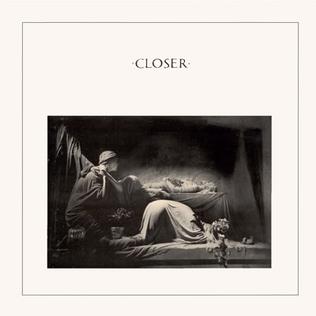
This past weekend included a listen to Joy Division’s Substance (1988) and continued reading of bassist Peter Hook’s Joy Division memoir Unknown Pleasures. I first heard Joy Division in 1987 when I went out record shopping with my friend Natalie. She and I had a lot of overlapping tastes, but she was a proper goth and I was just into the music. I knew a lot of Joy Division-adjacent stuff, but hadn’t heard anything by them. She recommended their second album, Closer. I was 20, living in San Francisco, and (as I would for several years) spent a lot of my time not processing my father’s death the previous year. I was hard to reach and generally hard to communicate with. The thing Joy_Division_Closerabout Closer, and JD in general for me at the time – I knew a little of the history – I’d even seen New Order (the band formed out of the remains of Joy Division) perform. That would have been in 1985 at the Santa Monica Civic – hadn’t heard any of their music prior and the show was boring – listening to live recordings from that period now – yeah, they were a dull live act). I recall playing this album a lot that year, and feeling all kinds of despair associated with it, primarily because I knew of the untimely death of lead singer Ian Curtis. One of my flatmates at the time told me it was familiar and asked if he would have heard something else by the band. It’s possible, I probably told him, but this tastes and mine were quite different. Yeah, I listened intently to Closer, but I didn’t know (yet) their biggest hit, Love Will Tear Us Apart, which was a little weird. But this was before someone could send you an email saying ‘you’ll like this song’ and before you even read the next sentence, you could be listening to the song.

So, yeah, Lawrence probably had heard Joy Division before me, though hipster that I was, I was loath to admit it.

Anyway, Closer threw me into a funk that was hard to escape but I was compelled to listen to it more and more. I bought Substance the following year and found that I especially liked the post-punk stuff (Atmosphere, Love, Dead Souls, These Days), but really didn’t know what to make of the earlier, punkier tracks. Later I’d buy the Short Circuit compilation (which includes At a Later Date recorded when they were still a punk band called Warsaw) on the same day I purchased Iggy and the Stooges’ Metallic KO. The following week, a friend told me the apocryphal tale of Ian Curtis committing suicide on the eve of Joy Division’s first American tour because he believed they’d never make a record as good as Metallic KO. A cursory search indicates that Curtis played Iggy Pop’s The Idiot and watched a Herzog film before taking his own life at the age of 23. His epilepsy wasn’t a secret to those nearest him, though in the late 70s, people didn’t know so well how to be supportive of an epileptic friend.

Hook notes that everything Joy Division recorded was classic – something he credits to band chemistry, youth, and Curtis’ lyrical brilliance. With this in mind, I can probably say that everything JD recorded , especially after An Ideal For Living, supersedes everything on Metallic KO (much as that document of two late shows from the original incarnation of the Stooges, including their last show in 1974, is brilliant in its own twisted way). Whether JD’s work supersedes The Idiot, well that’s a bit subjective.

Later I would have a huge poster of the cover of Closer on my wall, next to a huge poster of the cover of Aladdin Sane. As usual, there’s no real conclusion to this story. Even the fact that I’m reading Hook’s memoir right now is a little random. I purchased it for the kindle months ago when it was probably on offer for 99p, about what it cost to see Joy Division open for the Buzzcocks in 1979. It simply came up when I was scrolling through to find what next to read.

In this review, I look at the 40th Anniversary editions of two King Crimson live albums. I’ve been a fan of the USA album since before I knew where it stood in the KC canon. Earthbound, however, was never high on my listening list. Having launched into this adventure of rambling through the King Crimson discography, however, I was inclined to give it another go, especially as the notoriously lo-fi recordings are accompanied by an (expectedly cleaner) radio session, Live at Summit Studios, in this release. More on Summit later.

My favourite thing about Earthbound, recorded on the Islands tour in early 1972, is Boz Burrell’s voice. Being a fan of the classic mid-70s lineup that produced USA, Red, Starless and Bible Black, and Larks’ Tongues in Aspic, the limitations of Wetton’s voice always grated on me. With this in mind, however, these recordings also reveal in stark relief why leader Robert Fripp gave the Islands lineup the boot. Fripp himself had already moved on before they went on the road to meet contractual obligations. The other three members, Mel Collins on flutes and saxophones, Burrell on bass/vocals, and Ian Wallace on drums, are very loose in their playing and seem to want to be more of a boogie band than a progressive rock outfit. The original release consisted of 21st Century Schizoid Man, two improvs, a particularly sloppy Sailor’s Tale, and an extended jam on Groon, the instrumental b-side of the very jazzy Cat Food from 1970. The initial release of Groon was only about four minutes (four different takes can be found on the 40th Anniversary Edition of In the Wake of Poseidon), but on this tour, it was regularly extended past fifteen.

The CD portion of this release extends the initial album with Pictures of a City, Formentera Lady, and Cirkus. The DVD portion extends it further with Ladies of the Road, The Letters, and full versions of The Sailor’s Tale and Groon.

kc-eb-usa-back-smThe opening Schizoid man pushes the needle to the red in terms of both saturation and energy. While the structure remains the same, the improvisations in the middle exceed what is expected. Mel Collins’ sax work is intense, and marred somewhat by drumming that seems to be, possibly, part of a different song. Fripp ropes everyone back in with some searing runs. Boz’s treated vocals are more menacing that we hear in later versions, which is somehow appropriate.
Peoria lets us in with some bass/horn/drum interplay, but if Fripp’s guitar is in there, it’s very low in the mix. Sailor’s Tale fades in and closes out side 1. It’s the only song on Earthbound’s original release that also appears on the album they were touring, Islands. It’s a bit sloppy – and perhaps it’s this tendency to sloppiness that frustrated Fripp, but on its own terms it works.

Read the rest of this entry »

I’d heard of Performance from a couple of different angles. I knew Jagger’s Memo From Turner came out of this movie, and I knew a couple of samples nicked by Big Audio Dynamite for the song E=MC2, which is itself an odd musical tribute to Roeg’s work.
The film is both a continuation of the gangster dramas that had been coming out since the 30s and an influence on movies that came later including In Brugges and Lock, Stock, and Two Smoking Barrels.
The plot has a fairly straightlaced gangster, Chas, going to ground after he kills his boss’ new protégé without authorisation. There’s an interesting subtext going on that his boss and those higher up in the organisation are middle-aged queens while Chas is not only straightlaced, but decidedly straight. Through a turn of luck, Chas overhears of a room in Notting Hill Gate from a musician going on tour who has left his gear and some unpaid rent. Chas shows up at the address and pays off the debt in return for the room. Visiting Notting Hill in the late 60s is quite odd, because the lower-class neighbourhood of that era is full of million quid houses now. Those self same houses.
Mick Jagger plays the house’s owner, retired rock star Turner. In the course of Chas’ stay in the house with Turner and his two lovers, Pherber, played by Keith Richards’ girfriend at the time, Anita Pallenberg (RIP), and Lucy, he discovers a situation that is decidedly Bohemian and sexually open. In order to get into his head, Pherber and Turner dose Chas with mushrooms and from there the movie takes a distinctly psychedelic turn.
Another place I heard of this movie was in conversation with Coil’s Jhonn Balance. I was lucky enough to chat with him after Coil played in Prague in 2002. My friend Chris asked him what the source of the sample ‘We must go further back. Further back and faster’ was from. (The track Further Back and Faster is on the 1991 album Love’s Secret Domain.) Balance referenced this movie and talked about Roeg for a little bit before we moved on to talking about Derek Jarman movies. So this film has been at the back of my mind for over 15 years. Queerness and queer identity were very much at the heart of Coil’s musical identity and the queerness of those who have authority over Chas is not a lost plot point. Chas holds enough fascination for Turner that he feels the need to defend himself from what are fairly subliminal advances on Turner’s part.
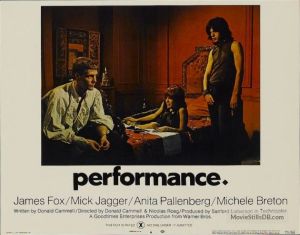
performance-lobby-card The fascination for Balance in this movie possibly included what was essentially a music video inserted in the midst of Chas’s mushroom trip. When Jagger lip syncs Memo From Turner in the offices of the gangsters Chas reports to, it’s not clear who’s experiencing what, but it’s interesting that when the movie was made, the queerness of both the song and the action in this sequence is quite matter of fact. That Chas rejects unspoken advances, as well, is (I think) meant to be interpreted as a shortcoming on his part.
This was not without controversy at the time. The studio refused to release the movie for two years due to graphic sex and violence. My first thought on reading about that was that I’d love to know what the Memo from Warners actually pointed to as problematic. By more recent standards, a few killings and a little sex are considered PG-13 fare by the MPAA, but there are two graphic scenes of gangland violence that were probably more shocking then than they’d be considered now. And unfraught sexuality between two women was also quite shocking. Imagine my surprise to find the image accompanying this review. Initially it was either given the X rating or the studio simply assigned the film an X rating. (Note: All of the other MPAA ratings are trademarked. Only the X rating can be used without MPAA authorisation. I think the idea was that the MPAA didn’t actually want to assign ratings to porno. Porn studios could take the rating and the limited release associated with it. On the other hand, in the early days of the ratings system, movies like Midnight Cowboy and Bilitis which had non-pornographic inclinations could take the rating and the artistic freedom that came with it.)
Regular readers might take my opinion of Chas’ response to Turner’s interest as hypocritical. Didn’t I just recently write that the correct response to the possibility of homosexuality in an interaction should be ‘not a problem’? What’s the difference here? The storytellers of Ready Player One were positing that the homosexual angle was to be avoided where presented. In Performance, however, the storytellers suggest that Chas’ rejection of the possibility is part and parcel of Chas’ rejection of life as a whole.
The ending of the film confused me and the friends with whom I saw the movie. It wraps up rather quickly with the viewer being not quite sure who lives and who dies (despite the writers at Wikipedia seeming very certain of themselves). That said, the movie’s seedy opulence, spot on performances from all concerned, and excellent soundtrack earn this goody four stars.