Archives for category: rock and roll

In this review, I look at the 40th Anniversary editions of two King Crimson live albums. I’ve been a fan of the USA album since before I knew where it stood in the KC canon. Earthbound, however, was never high on my listening list. Having launched into this adventure of rambling through the King Crimson discography, however, I was inclined to give it another go, especially as the notoriously lo-fi recordings are accompanied by an (expectedly cleaner) radio session, Live at Summit Studios, in this release. More on Summit later.

My favourite thing about Earthbound, recorded on the Islands tour in early 1972, is Boz Burrell’s voice. Being a fan of the classic mid-70s lineup that produced USA, Red, Starless and Bible Black, and Larks’ Tongues in Aspic, the limitations of Wetton’s voice always grated on me. With this in mind, however, these recordings also reveal in stark relief why leader Robert Fripp gave the Islands lineup the boot. Fripp himself had already moved on before they went on the road to meet contractual obligations. The other three members, Mel Collins on flutes and saxophones, Burrell on bass/vocals, and Ian Wallace on drums, are very loose in their playing and seem to want to be more of a boogie band than a progressive rock outfit. The original release consisted of 21st Century Schizoid Man, two improvs, a particularly sloppy Sailor’s Tale, and an extended jam on Groon, the instrumental b-side of the very jazzy Cat Food from 1970. The initial release of Groon was only about four minutes (four different takes can be found on the 40th Anniversary Edition of In the Wake of Poseidon), but on this tour, it was regularly extended past fifteen.

The CD portion of this release extends the initial album with Pictures of a City, Formentera Lady, and Cirkus. The DVD portion extends it further with Ladies of the Road, The Letters, and full versions of The Sailor’s Tale and Groon.

kc-eb-usa-back-smThe opening Schizoid man pushes the needle to the red in terms of both saturation and energy. While the structure remains the same, the improvisations in the middle exceed what is expected. Mel Collins’ sax work is intense, and marred somewhat by drumming that seems to be, possibly, part of a different song. Fripp ropes everyone back in with some searing runs. Boz’s treated vocals are more menacing that we hear in later versions, which is somehow appropriate.

Peoria lets us in with some bass/horn/drum interplay, but if Fripp’s guitar is in there, it’s very low in the mix. Sailor’s Tale fades in and closes out side 1. It’s the only song on Earthbound’s original release that also appears on the album they were touring, Islands. It’s a bit sloppy – and perhaps it’s this tendency to sloppiness that frustrated Fripp, but on its own terms it works.
Read the rest of this entry »

I’d heard of Performance from a couple of different angles. I knew Jagger’s Memo From Turner came out of this movie, and I knew a couple of samples nicked by Big Audio Dynamite for the song E=MC2, which is itself an odd musical tribute to Roeg’s work.
The film is both a continuation of the gangster dramas that had been coming out since the 30s and an influence on movies that came later including In Brugges and Lock, Stock, and Two Smoking Barrels.
The plot has a fairly straightlaced gangster, Chas, going to ground after he kills his boss’ new protégé without authorisation. There’s an interesting subtext going on that his boss and those higher up in the organisation are middle-aged queens while Chas is not only straightlaced, but decidedly straight. Through a turn of luck, Chas overhears of a room in Notting Hill Gate from a musician going on tour who has left his gear and some unpaid rent. Chas shows up at the address and pays off the debt in return for the room. Visiting Notting Hill in the late 60s is quite odd, because the lower-class neighbourhood of that era is full of million quid houses now. Those self same houses.
Mick Jagger plays the house’s owner, retired rock star Turner. In the course of Chas’ stay in the house with Turner and his two lovers, Pherber, played by Keith Richards’ girfriend at the time, Anita Pallenberg (RIP), and Lucy, he discovers a situation that is decidedly Bohemian and sexually open. In order to get into his head, Pherber and Turner dose Chas with mushrooms and from there the movie takes a distinctly psychedelic turn.
Another place I heard of this movie was in conversation with Coil’s Jhonn Balance. I was lucky enough to chat with him after Coil played in Prague in 2002. My friend Chris asked him what the source of the sample ‘We must go further back. Further back and faster’ was from. (The track Further Back and Faster is on the 1991 album Love’s Secret Domain.) Balance referenced this movie and talked about Roeg for a little bit before we moved on to talking about Derek Jarman movies. So this film has been at the back of my mind for over 15 years. Queerness and queer identity were very much at the heart of Coil’s musical identity and the queerness of those who have authority over Chas is not a lost plot point. Chas holds enough fascination for Turner that he feels the need to defend himself from what are fairly subliminal advances on Turner’s part.
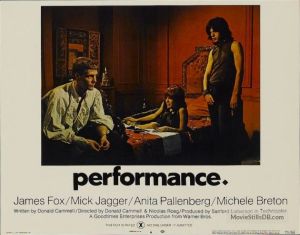
performance-lobby-card The fascination for Balance in this movie possibly included what was essentially a music video inserted in the midst of Chas’s mushroom trip. When Jagger lip syncs Memo From Turner in the offices of the gangsters Chas reports to, it’s not clear who’s experiencing what, but it’s interesting that when the movie was made, the queerness of both the song and the action in this sequence is quite matter of fact. That Chas rejects unspoken advances, as well, is (I think) meant to be interpreted as a shortcoming on his part.
This was not without controversy at the time. The studio refused to release the movie for two years due to graphic sex and violence. My first thought on reading about that was that I’d love to know what the Memo from Warners actually pointed to as problematic. By more recent standards, a few killings and a little sex are considered PG-13 fare by the MPAA, but there are two graphic scenes of gangland violence that were probably more shocking then than they’d be considered now. And unfraught sexuality between two women was also quite shocking. Imagine my surprise to find the image accompanying this review. Initially it was either given the X rating or the studio simply assigned the film an X rating. (Note: All of the other MPAA ratings are trademarked. Only the X rating can be used without MPAA authorisation. I think the idea was that the MPAA didn’t actually want to assign ratings to porno. Porn studios could take the rating and the limited release associated with it. On the other hand, in the early days of the ratings system, movies like Midnight Cowboy and Bilitis which had non-pornographic inclinations could take the rating and the artistic freedom that came with it.)
Regular readers might take my opinion of Chas’ response to Turner’s interest as hypocritical. Didn’t I just recently write that the correct response to the possibility of homosexuality in an interaction should be ‘not a problem’? What’s the difference here? The storytellers of Ready Player One were positing that the homosexual angle was to be avoided where presented. In Performance, however, the storytellers suggest that Chas’ rejection of the possibility is part and parcel of Chas’ rejection of life as a whole.
The ending of the film confused me and the friends with whom I saw the movie. It wraps up rather quickly with the viewer being not quite sure who lives and who dies (despite the writers at Wikipedia seeming very certain of themselves). That said, the movie’s seedy opulence, spot on performances from all concerned, and excellent soundtrack earn this goody four stars.

E’G/Warner Bros., 1984

One could argue that the three albums by the Fripp/Bruford/Levin/Belew lineup, and especially the last two, have the flavour of Belew’s solo albums of the time, just featuring legendary supporting players, but that’s really not fair. For all of the bits of it that are very much of their moment, there’s also a lot of that transcendent KC magic here. The more I listen to it, the more falls together and achieves a kind of unity that Discipline has, but that I feel Beat lacks.

Addressing the album song by song doesn’t do it justice. As a work, the pieces fall together quite effectively.

The Left Side

king-crimson-3-of-a-perfect-pairOpening with four vocal tracks, none of which (on the face of it) is that demanding on the listener. Title track/opener, Three of a Perfect Pair is an interesting one because it stayed in King Crimson/Crimson ProjeKct set lists well into the 21st century, and as a fan, it’s easy to find that it’s just a little overplayed. Belew is right to be impressed with his ability to play the guitar in one time signature and sing in another, but it’s only because he’s the vocalist that this makes him unique in the band. The song itself being about the breakdown of a relationship seems an apt one as this incarnation of KC was on the verge of collapse at the end of the Beat sessions (and after the tour for this album, these four would not reconvene for 10 years).

Model Man, oddly, presents us with another relationship song in which the narrator begs for understanding (‘imperfect in a word…but I give you everything I have’) from the one who always has him on edge (‘look[ing] for the sights…the symptoms…the slight calm before the storm).

Sleepless, the single that should have been a hit. Warners even ponied up for a video in which everyone seems a little uncomfortable. The song is the most distinctly new wave of the album (especially the Clearmountain remix which was used instead of the original on the first pressings of the album). The interplay of the rhythm section is what I find most interesting about this song.

Man with an Open Heart should have been both a single and a hit. Of the four lyric tracks on the album, three address relationship issues and this one seems especially personal. Its changing time signatures anchor it in the KC universe as well.

The most surprising aspect of this album (and Beat for that matter) is how far in the shadows Robert Fripp seems to be. His guitar work through Discipline is always the most distinctive aspect of a KC recording. However, with Nuages (That Which Passes, Passes like Clouds), the instrumental that closes the Left Side, Fripp’s voice comes to the fore. It feels like one of his soundscapes as it flows through the ears, but has a rather non-cloudlike feel for a song with its title. It’s anchored by an almost underwater-feeling percussion.

The Right Side consists of three interesting instrumentals and a decidedly different vocal.

Industry is almost an extended meditation that relies heavily on the interplay between Fripp and Levin. It works on one level, as a continuation of Nuages, not the opening of a different suite of songs. It’s structured more as a bolero – each instrument building in intensity and than slipping away again.

Dig Me, welcomes Belew’s voice back into the fray with an oddly sad follow-up to the previous album’s opener, Neal and Jack and Me. In this episode, what was once a proud automobile stretching out on the open highway is now rusting, unhinged, and what ‘was deluxe becomes debris’. On a certain level, it’s of a piece with the relationship songs on the Left Side, but is also markedly different.

No Warning feels like a more pure KC improv, but kept short and to the point. It has the energy of one of those moments where the band just locks together.

And then there’s the album’s closer, Larks’ Tongues in Aspic Part III. It’s an oddly titled jam that doesn’t seem of a piece with the other two songs that are its namesake. After more than twenty years of listening to this album (as with all the other entries in this series of reviews), never so diligently and with such interest as I have in the last week, I’ve never quite gotten what it was about this composition that invited adding it to the other two. And I’m still not, but I’ve got a feeling there’s something in the musical structure that lends itself or was consciously taken for that reason.

Sleepless has long been my favourite track on the album for purposes of sheer grooving. Of the vocals I’m now more drawn to Man With An Open Heart than I ever was before. I’m not sure I have a favourite of the instrumentals – they all feel of a single piece.

Next up: Vrooom and Thrak, but I’m going to take a KC break first.

Island Records, 1973

Recorded over a year after Islands and with a completely new lineup, Larks’ Tongues In Aspic takes King Crimson in an entirely new direction. Not only had Robert Fripp dismissed Collins, Burrell, and Ian Wallace, he also parted company with lyricist Pete Sinfield who had provided the words for all four previous Crimson albums.

The new lineup, mad percussionist Jamie Muir, drummer Bill Bruford nicked from an unsatisfying stint in Yes (here he is with Yes in ‘71), violinist David Cross and bassist/vocalist John Wetton (longtime friend of Fripp’s who had declined an invitation to join KC in two years before). Violin? Those strings on Islands and their possibilities possibly sent the band in an interesting new direction with the choice of Cross. And taking over lyrics, poet Richard Palmer-James who would continue to provide words for the next two albums as well. The album consists of three instrumentals, the first part of the title track opens the album followed by three songs with words, Book of Saturdays, Exiles, and Easy Money and closes with Talking Drum and Larks’ Tongues In Aspic Part II. Palmer-James’ lyrics don’t seem to be thematically linked the way Sinfield’s were, especially on the first three albums. One should also note that there’s no embarrassment listening or quoting the words from this album. They’re penetrable or impenetrable as good poetry most of the time.

I got into this album in the 90s when it was recommended by my wife’s violin teacher. KC had a fiddler? Who knew? (At the time, I probably had Red, Court, Discipline, and Beat, but I wasn’t a collector.) Since then, it’s been my go-to perfect King Crimson album. It didn’t hurt that live recordings from the early Adrian Belew period also feature LTIA Part II, which along with Red and occasionally Talking Drum are the only Wetton-era songs that made it into the set lists when he fronted the band. One of the joys of the current line-up is that they’re not only playing LTIA Part II, but also Easy Money and LTIA Part I. (Not to mention several goodies from the first four albums which benefit from Mel Collins’ return to the fold.)

Larks’ Tongues In Aspic Part I announces that a new KC is in town. On the one hand, it’s a multi-part epic of uncompromising, unrelenting noise, but midway through, Cross steps up with no accompaniment at all to deliver an elegy in four strings to which Muir adds bells and some noise and then the song turns again into something else entirely before the opening theme reasserts itself. Fripp and company continue to play with jazz structures, but it’s not jazz that’s found anywhere else. (Yeah, I know, save for in the Crimson Jazz Trio.) There’s something spoken in the back of the song near the end, but for the life of me I can’t make it out.

Following the crashing conclusion of the opening track, Book of Saturdays pulls the mood into almost love song territory. The instrumentation starts with some mellotron which blend really nicely with the violin, and Wetton uses his voice to very good effect. The vocal harmonies at the end of the song are oddly the only musical accents that place this album in its time. The music for the first time in the KC journey is only KC and not folk or prog or jazz. It’s like few other albums in that regard. Wish You Were Here, maybe? Bitches Brew?

Exiles starts with what sound like notes played from underwater and the sound of a distant whale (to my ears). A low drone from Cross introduces the theme. Wetton’s voice is more distinct than those of previous KC vocalists, though I feel an outside producer, especially on this song, would have kept his singing more focused. (Of course an outside producer, in my opinion, would have ruined everything else that makes this such a brilliant album.) There are places that he almost hits the note, but doesn’t quite. It’s a little frustrating. The violin work is essential to the success of the song – one could probably argue that it’s essential to the success of the whole album. David Cross still has it as a centerpiece of his live shows. (The guy on the horns in this video is David Jackson from Van Der Graaf Generator. I was at this gig and absolutely baffled that there were only about 150 people in the audience. Two absolute legends and the Netherlands says ‘meh’.)

Side 2 opens with Easy Money – it’s got the heavy guitar lines we’ve come to expect from the rockier pieces on previous albums, but the song features greater dynamics. This is another track where the violin is key to the whole tune.

After Easy Money, The Talking Drum’s quiet introduction marks it as the odd song out on the album. It only really picks up about two minutes into the action. Along with the other instrumentals on the album, it really marks what become the King Crimson style – the odd time signatures, the intertwining repetitions. The thing is, there’s nowhere else to put it on the album because its conclusion leads right into the opening notes of Larks’ Tongues Part II. It’s one of the great song pairings in rock and roll.

There’s still no describing LTIA Part II – I’ve heard versions by multiple King Crimson lineups and several versions by Stick Men and Crimson ProjeKct as well.Yeah, I know, those other two are just variations on KC, but the song always has a surprise to offer. For me it perfectly rounds out an almost perfect album. 5 stars? Pretty much.

ETA: 23 March 2018 marks the 45th anniversary of the release of this album and there’s a great article on its creation over at dgmlive. Check it out.

Next? Starless and Bible Blackkclthttps://wasawasawa.deviantart.com/art/Lark-s-Tongues-in-Aspic-197213614

Island Records, 1971

Released almost a year after Lizard, Islands is a somewhat mixed bag of very interesting music. As you might have guessed from my previous reviews, I haven’t seen the inside of the Sailor’s Tales box set which gathers up (on 27 discs) almost all the extant studio and live work from the period from In the Wake of Poseidon through Islands. I’m sure has a lot of interesting background material on both those LPs and this one. (I’ve got the follow-up box sets of the ‘72-’74 lineup with their long informative booklets of, so I have some idea of the material included.) So this too is a review of the album as released at the time.

king-crimson-islands-cassetteThe album’s opener, Formentera Lady is introduced by Harry Miller’s double bass theme. Mel Collins’ flute and Keith Tippet’s piano weave around one another behind Boz Burrell’s vocals. (KC’s third vocalist in four albums, Burrell had previously worked with Fripp and other Crimson members in Keith Tippet’s Centipede project.)

This song’s almost stereotypically Asian flute work that introduces the third verse has always led me to confuse Formentera with Formosa (the former English name of Taiwan). Looking it up now, I learn that Formentera is near Ibiza and is part of Spain, and was a popular hippie destination in the late 60s. I obviously didn’t pay that much attention to the lyrics until recently, as its references to Odysseus and Circe in the fourth verse place it in a squarely Mediterranean setting. For a couple of minutes after the last verse, the song moves into a now familiar jazz improvisatory realm, anchored by Burrell’s bass lines, eventually coming back to square one for the final verse. I’m pretty sure the soprano vocals that overlay this section of the song are unique in the KC canon. It’s amusing to note that Joni Mitchell was living on Formentera in 1971 and working on her album Blue, leading one to wonder if she’s who Pete Sinfield is referencing in the title.

The soprano is faded out behind some sax before the mellotron introduces Sailor’s Tale, an almost Philip Glass-like workout for drums, horns, and keyboards. Well, it feels minimalist until some honks from tenor sax take the front of the song. As is becoming familiar in KC territory, the song takes a couple of turns in tempo and instrumentation, increasing in intensity before an oddly long fade. This seems an appropriate way to bring the listeners to the next track.

The Letters, a 16-line story of infidelity and death. closes side 1. The first letter from a husband’s lover to his wife informs her that she’s pregnant, the reply to which seems to indicate the wife has killed her husband (‘What’s mine was yours is dead’) and is about to take her own life (‘I take my leave of mortal flesh’). The opening verses are very quiet but lead to several turns with the sax taking the lead. The middle section of the song is all emotional turmoil until the wife takes up her pen. Collins comes back on flute and in the final lines the instruments leave all the work to Burrell’s bass.

The composition around which the song is arranged dates back to the Giles Giles and Fripp song Why Don’t You Just Drop In, performed on the early Crimson tours as simply Drop In. The lyrics to Drop In, however, are entirely different than those of The Letters.

Side 2 opens with possibly the oddest song for King Crimson to record. A couple of people responded to my assessment of Happy Family on Lizard to tell me it was actually about The Beatles. A case can be made for this, especially when listening to Ladies of the Road, a raunchy paean to groupies which sounds in places like either late model Beatles or early John Lennon solo work. To be honest, I was first turned off to Islands because of this song. It’s direct and explicit and almost glam in its presentation (not a problem for me in the grand scheme – one could hear it fitting in on the soundtracks to Almost Famous or Velvet Goldmine). The main issue I have with this song’s lyrics are not that they’re frank or sexually explicit, but more that the narrator is objectifying (‘[She] Said I’m a male resister / I smiled and just unzipped her’). The worse crime still, however, is that there’s no metaphorical content or lyric irony. This is uncommon both in Sinfield’s other lyric poetry for KC and in Crimson lyrics as a whole.

After the hardness of ‘Ladies’, Prelude: Song of the Gulls is oddly soothing. Its repetitive motif of flute against strings is almost baroque. And despite being a Fripp composition (recorded by Giles Giles and Fripp and also found on The Brondesbury Tapes), the recorded song doesn’t seem to feature him. I’m reminded of the credit given to Bill Bruford for the song Trio on which he doesn’t play (‘admirable restraint’).

Finally, the title track is a slowly built layering of instruments. Flute (or possibly alto sax), piano, and guitar are added to Burrell’s vocals. In the second half of the song, the vocals are faded and Collins switches over to tenor sax and Fripp adds a quiet harmonium as the song gathers in intensity. It’s one of their loveliest songs – up there for me with Matte Kudesai and Walking On Air.

The album works well as a whole, and taken on its own terms is mostly successful. Its production is more polished than that of the earlier albums. Combined with the the photograph on the cover, it’s a departure from how the band had earlier presented itself. I honestly can’t come up with a star rating for it – Islands simply needs to be experienced.

Next on the menu? Larks’ Tongues In Aspic!