
Island Records, 1970
Released only six months after In the Wake of Poseidon (and only 14 months after their debut), Lizard is a definite continuation of the improvisational jazz/rock found on the first two LPs. Almost all of the vocal work has been taken on by Gordon Haskell (whose voice graced the released version of Cadence and Cascade on Poseidon). One of the main changes in sound is the full-time presence of Mel Collins on flute and sax. Lyric duties are still being handled by Pete Sinfield.
In rough structure, we get three uptempo songs on side 1 followed by a ballad. Side 2 consists of the multi-part Lizard Suite. The first thing to catch is that the more rocking of the songs don’t really resemble much from the previous albums, except for the maybe the jazz inflections of Cat Food.
At a finer level, there seems to be both a lyrical and a musical plan to the whole thing. Almost, but not quite, a concept album in much the same way that Court seemed to follow an interlocking plan, but wasn’t a single story carried through.
Cirkus musically feels on the one hand like four verses in search of a chorus, until the crashing cadences of the first three verses cross-fade into a soprano sax and Mellotron-led bridge that feel more a part of some AM radio soft rock hit. This doesn’t last. The fourth verse collapses into a crash of noise which evolves through several phases and concludes with what sounds perhaps like the ‘megaphonium fanfare’ referenced in the second verse.
Indoor Games feels much the same as Cirkus, both musically and in terms of wild lyrics that come from all over the place and might reflect how a writer who has never taken psychedelics might script a trip: ‘One string puppet shows amuse / Your sycophantic friends…Whilst you loaf on your sofa / Sporting falsies and a toga-Playing Indoor Games’.
Happy Family features Haskell’s voice run through a vocoder most of the time (in the second and third verses sounding almost like a dalek), arrayed against some flute and organ. Some of the instrumentation again brings the midway to mind. The bridge is again a controlled madness of improvisation, anchored primarily by Collins’ flute work.
Lyrically, we hear of four men, Uncle Rufus, Brother Judas, Cousin Silas, Nasty Jonah, who grow rich (whipped the world and beat the clock / wound up with their share of stock), perform (Uncle Rufus grew his nose / threw away his circus clothes), and presumably go to war. Four times the lyrics repeat ‘four went on (or ‘by’ in the first verse) and none came back’. Thematically, this points backwards to the opening track and forward to the Battle of Glass Tears, again suggesting that perhaps there’s a plan in all this madness.
Side 1 closes with Lady of the Dancing Water which at less than three minutes and only ten lines, is the shortest of of the tracks on Lizard. It also seems the most like the easy folk Haskell would do a couple of years later. Lovely as it is, Lady doesn’t seem to fit with anything else on the album. On the other hand, it’s not as though a little respite doesn’t add poignancy to the proceedings.
 Right then. On to side 2, the Lizard Suite.
The first section, Prince Rupert Awakes, features an unadorned and untreated vocal from Jon Anderson of Yes, which also sounds like he’s handling his own harmonies. Before getting into the lyrics and the structure of the piece, I’ve got to say that this must have been particularly galling to Haskell, who cited his treated vocals as one of the reasons he left KC following this album. Haskell at the time had a strong voice, though not one with much expressed range. (His 1974 album It Is and It Isn’t features some lovely work, such as this piece.)
Lyrically, it’s more Pete Sinfield mush, but there’s a wonderful contrast between the verses in which the vocals play against dissonant instrumentation – piano in one channel and bells and synth flourishes in the other, while the choruses feature almost Spanish-style guitar runs and Mellotron.
The suite continues with Bolero – The Peacock’s Tale, which is a nice little pun that references the last verse of the opening, ‘Now tales Prince Rupert’s peacock brings / Of walls and trumpets thousand fold’. It’s an interesting instrumental that I suppose is mostly a jazz battle between pianist Keith Tippet and Collins. The bolero sounds like it’s closing about a minute before it should, and the the flute rises in a crescendo joined by a quieter piano accompaniment and finally kettle drums. The Battle of Glass Tears, the third part of the suite, is itself divided into three parts. The name of this section again draws from Prince Rupert Awakes, in which ‘Prince Rupert’s tears of glass / Make saffron sabbath eyelids bleed’. Dawn Song, a vocal, describes armies preparing themselves for battle, ‘Three hills apart great armies stir / Spit oath and curse as day breaks. / Forming lines of horse and steel / By even yards march forward.
It’s interesting to note that with Mel Collins’ 2015 return to active service in King Crimson, Cirkus and The Battle of Glass Tears (along with Pictures of a City from the last album, and The Letters from the next one) have become regular features of the band’s live sets.
With the lyrics to hand, the plan behind the whole thing seems obvious. The first verse of Cirkus concludes ‘Bid me face the east closed me in questions / Built the sky for my dawn’, suggesting that perhaps the battle is just another aspect of a cosmic ringmaster’s production.
Fairly straightforward, the aptly titled Last Skirmish finds the band at its most dissonant. Prince Rupert’s Lament builds a high wail from the guitar balanced against metronomic notes from Haskell’s bass.
In true King Crimson style, the album doesn’t end on this note of despair. Big Top, which sounds like a demented fun fair carousel committed to tape, slowed and sped up, fades out in just over a minute. When the album is played on repeat, it feels as though it really is a circular experience as Cirkus starts up again.
It’s possible I had this album during my 90s period of KC fascination, but there was nothing for me to grab on to – it was far too late for my prog-bound adolescence on the one hand and the jazz and improvisation didn’t seem of a piece with anything else I knew in the rest of the work. That said, having listened to it at least once a day for the last week, it’s a strong offering and well worth checking out. (And because there don’t seem to be any live versions of songs from this album on YouTube, here’s an 8-bit rendition of Happy Family.)
Next up: Islands.

 Suite No. 1 and Erudite Eyes, which close side B have a more Frippish feel to them than the rest of the album. Suite No. 1, which clocks in at just under six minutes, starts with some Paganini-like runs that are joined by bass and keyboard, but after a minute and a half or so, the baroque gymnastics are replaced with a piano/strings/vocals arrangement that brings to mind the Chi-Lites’ Have You Seen Her. This segment is followed by a harpsichord-guitar duet which is followed by a reprise of the Paganini. A single track broken into three possibly unrelated forms, pulled together by a reprise of the theme? The application of jazz theory to folk motifs is one of the main threads of early progressive rock – it’s just weird to hear it applied so strangely.
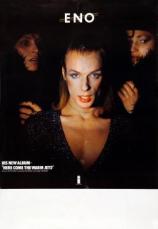 And there’s a reason Haynes used it: That opening rush of instrumentation (which accompanies a rush of glam-rocking teenagers chasing a pop star) pulls the listener right in. The intrigue doesn’t let up through the album’s 42 minutes. Lyrically, it’s almost all (in the words of Blank Frank) incomprehensible proverbs, but musically it’s a gorgeous grab-bag of styles, the way the best glam albums were back in ’73. This new remastering does a wonderful job of separating the musical components so that you can hear the strange fuzzed out guitar on the title track as something separate from the drums, keyboards, and the vocals (which are still too indistinct to figure out).

