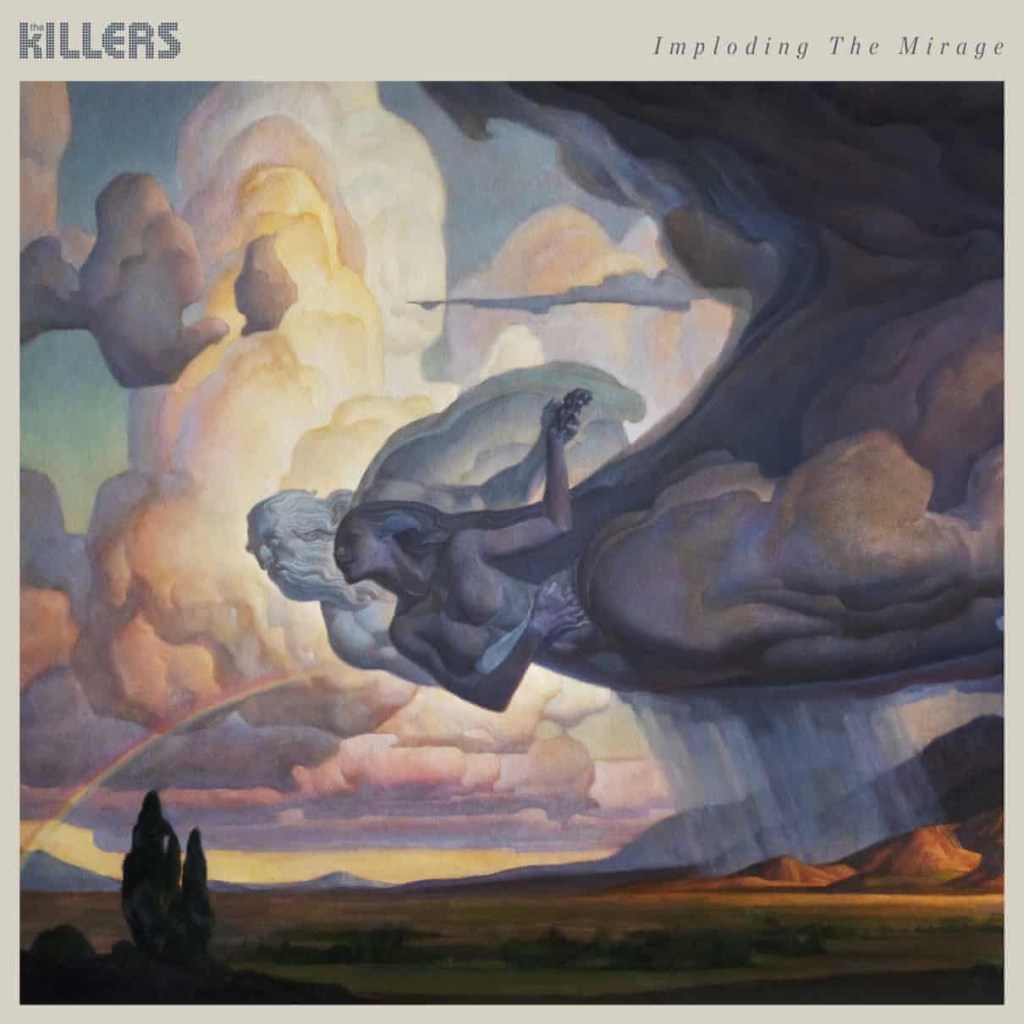
A look at the new albums by The Killers and Chuck Prophet.

These two albums have little in common except that they were released within a couple of weeks of each other.

First up: The Killers’ Imploding the Mirage. Before I heard this album, I’d read Alexis Petridis’ review of it in the Guardian. His main complaint was that the album had the same musical intensity – straight-up intense – all the way through. This feels like a correct assessment, but that’s not really a problem for me. I’ll happily listen to a death metal or stoner rock album straight through and not have a complaint that the thing doesn’t let up. Noting that the album’s title refers to the demolition of a Las Vegas hotel, it’s not as though we weren’t warned about its intentions.

Opening with My Own Soul’s Warning, a piece of pseudo Bruce Springsteeniana that should rope the listener in, we’re left wanting. When Flowers sings ‘something just didn’t feel right,’ I just ask ‘What? What is it? I’m giving you the space to explain yourself and all you can say is “something”?’ I shouldn’t judge my pop singers so harshly, but if you’re going to channel the poetic muse, you have to give it some words to work with.

Blowback uses the term ‘white trash’ to describe its subject, and it’s not the only time Flowers and company do that on this album. It points out how lazy the band (is Flowers the only lyricist?) is at putting words together. Again, I want to like the album, but leaning on clichés like that rather than working out what you mean gets on my nerves. Caution is the other one. It’s the first track I heard off this album when BBC Radio 2 started playing it a couple of months ago. Musically it’s quite inviting, and catchy as hell, but that phrase doesn’t endear me to it. In addition, the chorus refers to both throwing caution to the wind and the winds of change. Come on, already.

Lightning Fields has the benefit of k.d. lang on vocals on a verse and feels like an 80s-era Daniel Lanois production. This isn’t a bad thing at all. It’s followed by Fire In Bone which feels lifted from a mid-80s Bill Nelson album. The band has never shied away from what they owe to the 80s, but it seems rather serious on this track. Also in its favor is not being lyrically embarrassing.

Running Towards A Place is another track that’s musically earnest, by lyrically lazy. The very serious reading of the lines in the chorus make me feel as though Flowers has never read any actual poetry.

Because we’re running towards a place
Where we’ll walk as one
And the sadness of this life
Will be overcome

But someone has shared a bit of poetry with him because he asks in the bridge about worlds in a grain of sand. Of course, that phrase is cliché now as well.

My God is another really intense one. Knowing in advance that Flowers is a Mormon, and that when he addresses God, it’s a rather more personal relationship than what often happens when God shows up in pop music. That said, he’s also lifting, musically, from 80s era Laurie Anderson, an artist who is rarely amorphous when addressing the forces of the universe.

And the album concludes with the title track, which wants to be a declaration of some kind of superiority. While you were doing X and Y, I was doing the serious work of imploding the mirage. But we don’t get the joy of what this means from the voice of someone who can actually describe what makes this important. Instead we get the same dead metaphors and platitudes that this band always relies on, for example,
Sometimes it takes a little bit of courage and doubt
To push your boundaries out beyond your imagining.

Especially in this song which should bring the album to its apex, I feel let down that they couldn’t do better.

It’s a well-produced affair, and well played. Some years back there was a report that Flowers had said in a tweet that he couldn’t sing. I laughed, because I had never given him much credit in the vocals department. Alas, he wasn’t admitting to an overarching personal failing, just explaining a cancelled gig due to laryngitis. One of the nice things about this album is that Flowers does have a voice that he uses well, and that’s instantly identifiable as his. I just wish his poetry was more polished. I don’t even mind how much the band’s (or the producer’s) influences infuse the workings of the thing. I’ve been listening to pop since the 80s, and I pick up on these weird things that might seem minor. On the other hand, the members of Can and Neu! Get writing credits on Dying Breed and for the life of me there’s not much more than a motorik beat to harken back to those 70s krautrock acts. Wikipedia lets us know that there are samples of Neu!’s Hallogallo and Can’s Moonshake in there somewhere. Could be.

And then there’s Chuck Prophet’s The Land That Time Forget.

This isn’t a flawless album, either. But musically, I think Prophet and his band The Mission Express are more interesting. I fully admit to simply liking the kind of music Prophet does more than the polished pop of the Killers. This album is, like a lot of his work, varied in expression, tempo, and subject matter, but holding on to an overarching theme. In this case, the theme has to do with what modern American life inherits from things as disparate as the dance marathons of the 30s and Richard Nixon’s presidency,

High As Johnny Thunders, the first song released from the album, asks what the world would be like if certain things were true, like Johnny Thunders’ first band, the New York Dolls still being together and Romeo and Juliet having kids (‘Shakespeare would be on the dole’). Interesting to think of things like Johnny Thunders still being alive the week that Walter Lure, the last original member of Thunders’ band the Heartbreakers passed away.

Marathon refers to the dance marathons of the 1930s and features the sweet backing vocals and keyboards of Chuck’s wife Stephanie Finch. It’s danceable the way rock and roll was in the 70s. One of the things Prophet’s doing (the hint’s in the title) is playing with how we deal with nostalgia and how our various shared histories play out in the modern echoes. For a day or so people danced until they dropped because it was a way to maybe win an extra prize to live a little like the world wasn’t in the throes of the Depression.

Paying My Respects to the Train slows the action down with some gorgeous lap steel work. Is there a difference between CP singing “I’ve got my heart in my throat and my ears to the track” and some of the overused metaphors found in Killers lyrics? It might be the juxtaposition with the rhyming line “Somehow I know that you’re not coming back” has the recognition that life isn’t moving forward with everyone hand in hand. It’s also an expression of a personal land that time has forgotten.

Willi and Nilli posits a pair living in a ‘Polk Street SRO’ cranking up the stereo and singing ‘Love me like I want to be loved’ till the neighbors call the cops who usually never come. Though come the last verse, the cops all sing along. One thing I love about this song is the fact that only the fact that they live on Polk Street and Willie claims he ‘could make a man bark all night’ indicate that they’re gay as they remember who they were in a different time. Today it’s my favourite song on the album.

Fast Kid tells of a girl who could have come out of one of the songs on Imploding The Mirage.

She’s a fast kid growing up all wrong
Shaking like a leaf in the golden dawn
Gone with the wind, gone with the moon
Gone like the tar in my silver spoon

Is there a difference in his use of
cliché? Not sure, but ‘Tar in my silver spoon’, with its heroin reference, brings the song down to the ground and into the alleys where Killers characters never seem to go.

Nixonland posits a trip back in time to San Clemente, the home of Richard Nixon’s California retreat. Prophet uses an electric blues arrangement to discuss what Nixon’s presidency and fall were like. Nixon’s life, and presidency, however aren’t that far from where we are now. He doesn’t draw a direct parallel, but crowds calling Jail to the Chief could have been calling that outside of the White House this year or last or the one just before.

Womankind offers the idea that man does all sorts of things but doesn’t do the things a woman does (‘while they short you every hour for the time that you put in’), and says straight up, ‘They think you’re weak Because you’re soft / I know who’s stronger than me’. Yeah, it’s kind of woke, but it’s the kind of heartfelt admission that woman is more than one archetype or another. It’s possible that Prophet is also putting his female characters on various pedestals – they’re just different than the ones Brandon Flowers uses.

Get Off The Stage, a direct attack on the current president repeats the sincere request that he just leave. Prophet compares his own life with a band (‘in an Econoline van’) with Trump’s (‘You have your crew’). On the world stage, though, Trump is just an embarrassment.

‘You’re an obstruction in democracy’s bowel, and the patient is dying.’ But he suggests, ‘come down and we’ll play some John Prine.’ I love the idea that if he just lets go, we can listen to good music and get on with things, in joy.

It’s not loud or otherwise profane. And it pulls all the history he’s plied on the album into the present day. Is it a suggestion that this too will be a land to be forgotten? None of the stories he tells on the album are of things that are completely forgotten, but that if we’d remember a little harder, we might get over the current obstructions as well. This song contains the album’s only moment of what I consider sloppy songwriting – he suggests Trump is going to prison, ‘but don’t worry, the first time is the hardest.’ The oft repeated suggestion that prison is always accompanied by forced sex doesn’t do anyone any favors, even as Prophet has shown he can write about gay characters without judgement.

Virginia Woolf (1882-1941) was a prolific writer primarily known for her novels To the Lighthouse, Mrs. Dalloway, and Orlando, and the feminist essay A Room of One’s Own. I was introduced to these novels in college and returned to them after certain cinematic excursions into the material. Dalloway and Woolf were central the novel and film The Hours. Sally Potter made a film of Orlando in the 1990s starring Tilda Swinton and featuring Quentin Crisp in the roll of Queen Elizabeth I.

Orlando (1928) is an outlier in that it’s in many ways a love letter to Woolf’s erstwhile lover, Vita Sackville-West. It’s comic, and light-hearted, which aren’t generally words associated with Woolf’s work. I picked it up again last night after a long time away from it. I try to find emotionally light reading for that half an hour at 2AM when I’m generally awake these days and don’t want anything too involving. Wodehouse often fits the bill, for example. However, I’d forgotten the opening paragraphs and was rather shocked by the sheer racism of those passages.

He…was in the act of slicing at the head of a Moor which swung from the rafters. It was the colour of an old football, and more or less the shape of one, save for the sunken cheeks and a strand or two of coarse, dry hair, like the hair on a cocoanut. Orlando’s father, or perhaps his grandfather, had struck it from the shoulders of a vast Pagan who had started up under the moon in the barbarian fields of Africa; and now it swung, gently, perpetually, in the breeze which never ceased blowing through the attic rooms of the gigantic house of the lord who had slain him.

Of course I have no idea why this passage never previously struck me, but it’s the nature of these times to question our assumptions, or lack thereof. The terms Moor, pagan, and barbarian to describe a single person, dead long before the action of the book begins, but obviously a source of the titular character’s emotional (and probably financial) inheritance. Woolf follows this statement with fairly glowing terms about the Orlando’s beauty, poetry, and outlook. But I return to those opening sentences and wonder at that casual approach Woolf takes.

1928 or no, it surprises me, and raises again the question of how one interacts with historical texts – do I say this person whose insights into the human condition are some of the most incisive in literature is no longer someone I’ll read, for the political reasons that we use to take other artists out of our personal spheres of influence?

It’s a casual racism in which shorthand is used to make up for characterization. Similar to the Jews in J.B. Priestley’s The Good Companions, and possibly all of the non-Europeans in Joseph Conrad’s “Heart of Darkness”.

In The Trouble with “Heart of Darkness”, David Denby offers this opinion submitted by Edward Said: ‘Most imaginative writers of the nineteenth century…failed to connect their work, their own spiritual practice, to the squalid operations of colonialism. Such writers as Austen, Carlyle, Thackeray, Dickens, Tennyson, and Flaubert were heroes of culture who either harbored racist views of the subject people then dominated by the English and the French or merely acquiesced in the material advantages of empire. They took empire for granted as a space in which their characters might roam and prosper; they colluded in evil. Here and there, one could see in their work shameless traces of the subordinated world…’

Woolf, though writing 30 years after “Heart of Darkness”, seems to fall squarely within the canon Denby and Said are citing. Her hero is an heir to the fortunes of Elizabethan colonialism just as much as the characters in Austen and Dickens.

Denby’s essay is a counterpoint of sorts to Achebe’s An Image of Africa: Racism in Heart of Darkness. ‘Heart of Darkness projects the image of Africa as “the other world,” the antithesis of Europe and therefore of civilization, a place where man’s vaunted intelligence and refinement are finally mocked by triumphant beastiality..’

I’m pretty sure a reread of “Heart of Darkness” is in order right now. One of the thrusts of Achebe’s argument against Conrad is that he reduces the natives of the Congo to caricatures with neither language nor art. The excuses made for Conrad include an argument that this wasn’t the story he was writing. Denby addresses this – that arguments against HoD are often that he should show the same modern sensibilities towards the non-European elements of his story as he does to the European. This isn’t Conrad’s job, but the shorthand he uses to compare the savage internal world of Europeans with a non-existent savage external world of Africa is similar to the shorthand with which Woolf opens Orlando. And there is most definitely a conscious or unconscious racial/racist aspect to this shorthand.

Denby suggests that Achebe, as a novelist and not an academic, doesn’t bring the necessary rigor to this discussion. And it’s easy to write off some of what he says as unsupported assertions about Conrad’s racism in general (actually well sourced by Achebe) and the racism in “Heart of Darkness” in particular. I think I’ll run with my initial take on the matter which is that the racist tropes that both Conrad and Woolf employ are in service to easy analogies. The stories of the Africans, pagans, or Moors aren’t the stories either are telling. On the other hand, Conrad’s ‘dog in breeches’ comparison (cited by Achebe) is simply sloppy writing – Woolf using the terms Moor, pagan, and barbarian interchangeably to describe the same severed head is also sloppy writing.

Neither Conrad nor Woolf (who, in Orlando’s introduction, thanks no fewer than 20 fairly illustrious literary contemporaries for their feedback) are careless writers. But I think both writers are relying on a European readership to recognize the tropes and to play along with how these tropes define and refine the portrayals of their main characters.

In this way it’s easy to contrast light with dark using these tropes, in the same way that Kurtz’ fall has to do with his adoption of the local nature and culture and his submersion in the native, dark part of the world, and his collusion in the enslavement and killing of the natives. The Grove of Death sequence cited by Achebe is essential to the story of Kurtz’ fall because it shows how the colonials used the natives to death in their trade. Orlando, like Woolf and Sackville-West herself, is a product of these activities – the wealth of the west is based on this kind of exploitation top to bottom and so is the exploitation pointed out in that opening paragraph.

I don’t know what to make of the fact that Woolf’s father was a prolific writer on ethics, science, and humanism and that her paternal grandfather and great-grandfather were prominent abolitionists.

Given how much input Woolf accepted regarding the history covered in Orlando, and how much she left in place, it’s hard to deny that the views expressed in the novel are her own, or those shared with Sackville-West, or those of the first readers. How else to explain the shorthand?

Later, the character Orlando compares the exploits of his ancestors (who killed individuals of different nationalities) with those of one particular poet. The poet, not the murderous ancestors, is immortal, and Orlando, too, ‘[perceives], however, that the battles which Sir Miles and the rest had waged against armed knights to win a kingdom, were not half so arduous as this which he now undertook to win immortality against the English language.’

Is Woolf saying that as Orlando grows, he grows from the limited mortality of his murderous ancestors into the immortal poet? It’s possible, but doesn’t reduce the shock of those opening lines. As the book progresses and Orlando (who remains about 30 years old from 1600 through to 1928) evolves away from that racism of that opening paragraph and the reader might be forgiven for thinking the attitude expressed there is that of the author and not the character himself. An argument might be made that because Orlando’s sex changes from male to female (in chapter 3), that this attitude belongs to the barbarity of maleness. And, in fact, the language of the story becomes more genteel for much of the story’s remainder.

As the book nears its conclusion, the narrator considers several of the lives Orlando has lived, ‘…a biography is consider complete if it merely accounts for six or seven selves, whereas a person may well have as many thousand. Choosing then, only those selves we have found room for, Orlando may now have called on the boy who cut the n*****’s head down; the boy who strung it up again,’ and two dozen more that we’ve met in the course of the novel. Again there’s the shock of her racist language when we thought we were or she was done with it.

There’s probably an answer to the question of Woolf’s racism if one delves into the letters and the diaries, and reads far more than I have. Or we can accept that she’s the product of her time and her place and her class. Oddly, she wrote of Ulysses that it was ‘egotistic, insistent, raw, striking, & ultimately nauseating…When one can have cooked flesh, why have the raw?’ One question of Orlando is, why when Woolf could have prepared the meal to perfection, did she garnish it so crudely?

Before I get into this, I’m aware that what I’m about to say may fall into the categories of both virtue signalling and performative anti-racism.

Black-Lives-Matter-Black-Sabbath-sm

A Facebook friend with whom I have little in common politically responded to this user pic with the rather reductive question ‘Slogan or movement?’ I’m not sure what my answer is. (And I’ll be honest – I saw a picture of a rock star wearing a shirt with this design. It’s in the style of the cover a Black Sabbath album. Part of my choice of image is sheer amusement at the conflation.) Starting with the slogan, though, there’s a meme going around which posits a person telling their partner about the pain they’re experiencing. The partner responds with something like, ‘Many people feel pain.’ True, but hurtful. This reflects how I feel about the common responses to the phrase ‘Black Lives Matter’ – Yes, all lives, but it’s black people being killed by white cops on the street, in their own homes by cops with no-knock warrants to arrest someone already in custody, while playing in the local park with a toy, while walking home with a bag of skittles. So for those folks and so many more like them, I say Black Lives Matter.

In our societies, this is how the phrase has been used since Trayvon Martin was brutally killed and his killer, who stalked the boy even when told to stand down, acquitted.
Systemic racism has been a boot on the neck of people of color since well before Reconstruction. And I know there are far better essays by people much better read and more experienced than I am on the subject. Repeating the phrase is a way of showing that I no longer want to operate in society in a way that doesn’t move us from racism to anti-racism. I want to be on the side of making this better, not on the side of complacency.
Is professing the phrase a precondition for action? I don’t know, but we don’t get to the next level of this society on word or faith alone. By standing up, I’m trying in a small way to say and be on the side of the repressed. It’s in that middle ground between speaking the platitude and doing the work. I know that I’m blessed as a cis-presenting white male, I’ve been the subject of very little discrimination. It’s well past the point that those who step or live outside of that is subject to repression and discrimination, and worse. I can, at this point, only imagine what it is like in these times to be Black and Trans, for example.
When I say that Black Lives Matter, I speak out that the rights to life and to simple self determination do matter and that the right to be treated equally under the law matters, and that the right to be judged as a person and not a representative of a group of people with the same skin color matters, and that the right to the same education as white peers matters, and that there is a right not to be mocked by society for two weeks every year matters, and that  the claim of tradition is no basis for being hateful.


Released: November, 1982
Lineup: Sioux, Steve Severin (bass), John McGeoch (guitar), Budgie (drums)

Tracklist:
Side 1:
Cascade
Green Fingers
Obsession
She’s a Carnival
Circle

Side 2:
Melt!
Painted Bird
Cocoon
Slowdive

This album has a really strange provenance. In many ways, it’s distinctly not goth at all, and in fact Wikipedia cites its genre as neo-psychedelic, though it has no connection to the west coast neo-psychedelia of the Paisley Underground, for example. There was a lot of tension between the band members themselves as well as their recently fired manager, Nils Stevenson (who the song Obsession might be about). There’s a great interview with Siouxsie that appeared in Uncut about the making of this album.

Lots of drugs, including LSD, but also an insistence that the sound be something new. Roping in real strings and bells to augment the sound rather than using synthesizers. The results are heady and beautiful and unlike anything else in their catalogue.

Lyrically, the songs lean on the emotions of new love, which is not surprising given the newness of Siouxsie’s and Budgie’s relationship. Oh love like liquid falling/Falling in cascades.

Green Fingers seems to be all about someone who can ‘make anything grow / magic in her hands’, but concludes with a repetition of ‘With this ring, I thee wed’. Musically it’s lush and growing and almost slithering out of the speakers.

Obsession, a slow waltz with instrumentation very low in the mix, is indeed about someone’s obsessive behavior, but told almost sympathetically from the point of view of the obsessive, not the object. It bears a strange resemblance to Throbbing Gristle’s Persuasion.

The album picks up speed with She’s A Carnival, which might be my favourite song on the album, except that its swirling mood stops quite suddenly to be replaced in the last minute with a circus organ sort of thing. Those first two and a half minutes are so sweet, though.

Circle is the only song that harkens back to an earlier sound. The minimal repetitive instrumentation with monotonous trap drum as the only percussion backs a song that starts off being about a girl of 16 who gets pregnant and has a baby like her own mother, but as the song progresses, it’s about the repetitions of life and poverty and discipline reflected in the musical repetitions and with references in the middle to the various lines of the London Underground, “Any line you can think of but for the Yellow” (which I’m pretty sure would be the Circle line.

Side two opens with the first of the album’s two singles, Melt!, which had always seemed to be about sex, but the song is also run through with references to death and funerals. But the intertwining of the two is not a new thing.

Painted Bird is another wildly festive song in arrangement, but seems to be about birds who attack their own when they perceive it to be somehow alien. It’s not an obvious point in the song, but the metaphor of society attacking those seen to be different or accused of difference is not hard to miss.

Cocoon is a weird piece of chamber jazz in which the subject wrapped in blankets on a cot imagines herself transforming but isn’t. The arrangement circles around a stand-up bass line and doesn’t (like most of this album) resemble anything they’d previously done. But the evolution it indicates will turn up on Tinderbox and Through The Looking Glass a couple of years later.

And the album concludes with the second single, Slowdive, which should have been a bigger hit given how obviously it is about sex. The slinky violin and viola arrangement draws the listener down into the music.

Sadly, John McGeoch’s excesses where just that much more excessive than those of the rest of the band that he was booted upon the album’s release. Robert Smith joined the band for the following tour and the next Banshees album, Hyaena.

That said, A Kiss in the Dreamhouse is absolutely a five-star album and one I’ve reveled in having on repeat the last couple of weeks.

Next: The Creatures’ Feast.


I thought I would discuss this Atlantic article in the context of political love languages, but there are so many other problems with Conor Friedersdorf’s Take the Shutdown Skeptics Seriously that I’m just going to get into it as a political discussion.

Friedersdorf argues several points:

  • That the discussion isn’t as clear-cut as pro-human and pro-economy. However, he goes on to argue the pro-economy stance much of the way through.
  • That because we don’t know how long a solution will take, or if we will reach a solution, “Americans should carefully consider the potential costs of prolonged shutdowns lest they cause more deaths or harm to the vulnerable than they spare.”
  • That supply chain interruptions and a prolonged depression are equally great risks to life and not to be discounted.
  • That crashed healthcare and education systems are also hard to recover.

He cites Michael Klare’s warning in The Nation that “Even where supply chains remain intact, many poor countries lack the funds to pay for imported food,” he explained. “This has long been a problem for the least-developed countries, which often depend on international food aid” This is not new. Starvation and poor access  to food has always been a hazard because of (among other things) how international trade and exploitation are arranged now and have been since the admitted colonial times. (These places are still colonies – of multinationals now, not other countries, but still.) When we talk about developing/developed countries, there’s often the assumption of dependence on foreign assistance. The problem here is that there are so many internal and external forces at play that keep such countries in the ’not developed’ column. Using this as an excuse not to work on those issues is just a continuance of the problem.

And note the absence of discussion of the plague of locusts in Africa – no global locust watch dashboards but the problem still exists, and people will starve because of it.

Note, too, that there’s currently enough food gin the US supply chain if we’re processing it carefully and not sending it to China. The web of trade can’t be brought back but government stimulus – paying a fair wage for fair work harvesting the food that’s rotting on the vine right now and planting for the next season will feed more people. But again, it seems to be a matter in American politics and the US media that dividing people works in some folks’ favour, and bringing people together to support the effort and each other runs counter to that. This might be a dream that free people will do manual labor in the absence of other labor to do, or in the interest of the country not going underfed in a land of plenty.

The part of the article that really got my blood boiling is the assertion that this crashing economy won’t leave the healthcare systems standing, sourced to Esther O’Reilly’s Arc Digital article Economic Costs Are Human Costs. In the West, this is mostly a problem in the US where a large portion of the economy rests on a fragile but very lucrative system of people paying large sums of money to insurance companies on the slim chance those companies will take care of them in the event of catastrophe. Those companies have a bottom line dependent on not covering care in the event of catastrophe. This is the big hole in how the US economy works that Obama and many before him were trying to fix and now we’re seeing how that affects the rest of society. In the context of the pandemic, we find that we had an opportunity to meet the disaster head on by working with manufacturers to build up the stockpiles of ventilators and PPE that were going to be necessary. See above about the ease of dividing people rather than bringing together to meet the challenge.

Healthcare systems running out of cash on hand is one of the symptoms of poorly run healthcare (and a poorly run country, in my opinion) – or healthcare run on a for-profit basis. We can fight the virus and put the economy on hold if the money we’re borrowing to shore up the economy goes into fighting the disaster and to the people it needs to help. It’s the same with giving tax breaks at the top rather than minimum wage increases at the bottom. That wage increase gets plugged right back into the economy. But a few more people are fed first.

Stimulus works a lot better when it’s effectively directed as well. Hospitals (nursing homes, prisons, food processing plants), three months into this disaster, should have all the PPE they need. There were hundreds of ways to reconfigure our manufacturing base temporarily to address the situation in testing as well as equipment. We (the executive branch of the US government) simply didn’t and made excuses for not doing so. And continues to. Gracious, DJT. You can’t blame the system for that – you can, but we saw disaster on the horizon and decided not to prepare and identified who we’d sacrifice and which corporations would reap the benefit of stimulus packages that should have supported humans in need.

A final point in the article that made me scratch my head was this: ‘The shuttering of auto manufacturing plants led to an 85 percent increase in opioid overdose deaths in the surrounding counties over seven years, according to a recent study.’ (The referenced article by Heather Mac Donald in The Spectator – https://spectator.us/consider-costs-coronavirus/ doesn’t cite a source for this statistic.) Friedersdorf is trying to argue about the social costs of a depression should this shutdown last too long. There’s a leap of logic here that I can’t fathom. Opioid deaths are also associated with the companies pushing the opioids, other healthcare issues associated with manufacturing and the holes in our healthcare system and the generally accepted disposability of workers in general in the US. Topic for another blog

And finally, I found this related sentiment on Facebook, but am having a time sourcing the original tweet:

medically-informed

We absolutely can do much better.