
2000 Virgin Records
After several years of noodling, with different combinations of players in the six-person lineup performing and releasing under the collective name of ProjeKcts, a new quartet recorded the next King Crimson album in 2000. Losing long-time members drummer Bill Bruford and Tony Levin to other responsibilities, Fripp, Belew, Mastelotto, and Gunn released The ConstruKction of Light in 2000. TCOL retains the intense heaviness of songs like Red, Sleepless, and Thrak in the new songs, but in the main, the light touch that balanced those songs in context is lost. Musically, don’t get me wrong, they’re at the top of their game. The arrangements of the title track and FraKctured are especially tasty. Lyrically, I’ll be blunt, Belew’s taken them off the deep end.
There’s a reason that the current lineup performs the title track as an instrumental. ‘What am I? A speck of dust on the penis of an alien?’ I dunno, Adrian, are you?
Another issue that plagues this album, and to a lesser extend its follow-up, The Power to Believe, is the reliance on older KC tropes. FraKctured reworks the complexity of Fractured from 1973’s Starless and Bible Black, while Larks’ Tongues In Aspic Part IV continues the saga begun on 1974’s LTIA and continued on 1984’s Three of a Perfect Pair.
The fact that it is so musically self-referential doesn’t need to be a detractor from its musical brilliance, but I still find it annoying. The opener, ProzaKc Blues, even contains the line ‘Son, you’ve been reading too much Elephant Talk.’ With that said, I’m still rather amused at the idea of Crimson performing a blues (something they hadn’t done since the days of Islands, when Boz Burrell wailed on Pharaoh Sanders’ The Creator Has a Master Plan). With its treated vocals (deepening Belew’s voice into a growl, much like we hear on the original 21st Century Schizoid Man – another throwback) and the musical interplay are interesting, but the lyrics… It’s a weird one, because they’re also playing with blues tropes and structures, from the opening line ‘Woke up this morning in cloud of despair’ to the way it thumps along, you could almost replace the lyrics with lyrics by Willie Dixon or Blind Lemon Jefferson. ‘You have to see the world for what it is / A circus full of freaks and clowns’, however, feels as though the writer hasn’t thought things through. And the doctor’s advice, ‘I recommend a fifth of Jack and a bottle of Prozac’ doesn’t help the listener any either. My feeling is that it might have been funny at the time, but as I’ve aged, I find it less so.
Into the Frying Pan is another song that’s musically gripping, but lyrically lazy.
And how life unwinds
Around and around and up and down
You think you’re fine but then
You’re back in the frying pan
Into the frying pan
And The World’s My Oyster Soup Kitchen Floor Wax Museum, while amusing for its word play, gets old. It might be that Adrian specializes in that sort of thing and always has. (Early in his career, Belew played with Frank Zappa, another gent who was musically brilliant, but used humor to relieve the complexity of his compositions. He even titled one album Does Humor Belong In Music?)
In King Crimson, the complexity has often been the point. Or perhaps just Robert Fripp’s point. So, I find the silliness the lyrics bring to the songs on this album off-putting. Is there a difference between Belew uttering the phrase ‘Get jiggy with it’ in the context of 2000-era King Crimson and John Wetton singing ‘Got no truck with the la-di-da / Keep my bread in an old fruit jar’ in 1973? Still not sure.
With this in mind, however, I’ve been hearing more in Belew’s vocalese – the arrangements place the words in counterpoint to the instrumentation in such a way that the vocals are almost a fifth instrument in a way they never were in earlier incarnations of the band.
While I may find the lyrics lazy or silly, and the references don’t indicate to the listener that the band is moving towards anything new, but musically, they are moving out and around both the classic sound and what was influencing them in those years after Thrak.
Another issue I have with TCOL as an album is that there are almost no let up – the album is just kind of loud. Into The Frying Pan, FraKctured, and Heaven and Earth play a little bit with the the fluid dynamics that make the best KC albums intriguing, it’s mostly about loud complexity. (Recently I started listening to Tool with whom KC toured around this time – I didn’t get at the time why they made up a double bill, but Tool is all about examining the complexity to be found in loud, which one definitely hears here.)
 While half the album’s running time is spent exploring themes they addressed in the mid-1970s – FraKctured and LTIA IV, this makes an odd kind of sense. Fripp and company are holding on and expanding the original genius KC brought to the musical landscape. Those things that are in a sense at the heart of KC from the start. Listening more closely to FraKctured, it has in its arpeggios some almost Mike Rutherford-like passages before delving back into the noise. It’s a very curious mix of things.
And while the melodic flow and patterns of those two tracks harken back, they are also musically timeless in a way. Play LTIA II or IV for someone who is totally unfamiliar – they won’t be able to identify a time period. (The same is not necessarily true for LTIA III – those early 80s albums are much more of their time period, I think, in terms of sound and production values.)
The original CD release of TCOL divided the title track into two parts, an instrumental and the shorter nonsensical vocal. I very much appreciate that the recent Spotify mix of the album pulls these into single tracks. The improv and the live version of the title track tacked on at the end of the Spotify version are nice, but neither are essential.
Note: I’ve got the reissue, The ReconstruKction of Light with reworked drum tracks and all sorts of extra goodies, on my wish list. I may revisit this review in light of enjoying that one.
Next up: The final studio release, The Power To Believe.
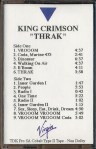 The instrumental B’Boom follows. After a short introduction, percussionists Bruford and Mastelotto go head to head. This is the first time KC had had two percussionists since that brief period around the recording of Larks’ Tongues In Aspic and this kind of interplay in Crimson got lost again after this album until Fripp regrouped with three drummers in the front line. The song, at least in its title, brings us back to a long improv performed on the LTIA Tour at the Zoom Club called Z’Zoom. (Note that the Zoom Club gig also included two more improvisations: Zoom and Zoom Zoom which together run for over an hour. The band might be referring back to them in the tracks Vrooom and Vrooom Vrooom. I might have to delve back into that recording.)
 My family had all left Synanon by the close of 1977 and the snake incident didn’t occur until about a year later. (I should verify, but in my memory the Morantz attack, the People’s Temple mass suicide and the murders of Harvey Milk and George Moscone all ran together in the news. So perhaps by this definition, Synanon counts as a cult, or at least it did by that point. I have vague memories of an increased focus on self defense while I was still there, but that might be an amalgam of readings and memories and discussions that happened later.
