In this review, I look at the 40th Anniversary editions of two King Crimson live albums. I’ve been a fan of the USA album since before I knew where it stood in the KC canon. Earthbound, however, was never high on my listening list. Having launched into this adventure of rambling through the King Crimson discography, however, I was inclined to give it another go, especially as the notoriously lo-fi recordings are accompanied by an (expectedly cleaner) radio session, Live at Summit Studios, in this release. More on Summit later.

My favourite thing about Earthbound, recorded on the Islands tour in early 1972, is Boz Burrell’s voice. Being a fan of the classic mid-70s lineup that produced USA, Red, Starless and Bible Black, and Larks’ Tongues in Aspic, the limitations of Wetton’s voice always grated on me. With this in mind, however, these recordings also reveal in stark relief why leader Robert Fripp gave the Islands lineup the boot. Fripp himself had already moved on before they went on the road to meet contractual obligations. The other three members, Mel Collins on flutes and saxophones, Burrell on bass/vocals, and Ian Wallace on drums, are very loose in their playing and seem to want to be more of a boogie band than a progressive rock outfit. The original release consisted of 21st Century Schizoid Man, two improvs, a particularly sloppy Sailor’s Tale, and an extended jam on Groon, the instrumental b-side of the very jazzy Cat Food from 1970. The initial release of Groon was only about four minutes (four different takes can be found on the 40th Anniversary Edition of In the Wake of Poseidon), but on this tour, it was regularly extended past fifteen.

The CD portion of this release extends the initial album with Pictures of a City, Formentera Lady, and Cirkus. The DVD portion extends it further with Ladies of the Road, The Letters, and full versions of The Sailor’s Tale and Groon.

kc-eb-usa-back-smThe opening Schizoid man pushes the needle to the red in terms of both saturation and energy. While the structure remains the same, the improvisations in the middle exceed what is expected. Mel Collins’ sax work is intense, and marred somewhat by drumming that seems to be, possibly, part of a different song. Fripp ropes everyone back in with some searing runs. Boz’s treated vocals are more menacing that we hear in later versions, which is somehow appropriate.
Peoria lets us in with some bass/horn/drum interplay, but if Fripp’s guitar is in there, it’s very low in the mix. Sailor’s Tale fades in and closes out side 1. It’s the only song on Earthbound’s original release that also appears on the album they were touring, Islands. It’s a bit sloppy – and perhaps it’s this tendency to sloppiness that frustrated Fripp, but on its own terms it works.

Read the rest of this entry »

I’d heard of Performance from a couple of different angles. I knew Jagger’s Memo From Turner came out of this movie, and I knew a couple of samples nicked by Big Audio Dynamite for the song E=MC2, which is itself an odd musical tribute to Roeg’s work.
The film is both a continuation of the gangster dramas that had been coming out since the 30s and an influence on movies that came later including In Brugges and Lock, Stock, and Two Smoking Barrels.
The plot has a fairly straightlaced gangster, Chas, going to ground after he kills his boss’ new protégé without authorisation. There’s an interesting subtext going on that his boss and those higher up in the organisation are middle-aged queens while Chas is not only straightlaced, but decidedly straight. Through a turn of luck, Chas overhears of a room in Notting Hill Gate from a musician going on tour who has left his gear and some unpaid rent. Chas shows up at the address and pays off the debt in return for the room. Visiting Notting Hill in the late 60s is quite odd, because the lower-class neighbourhood of that era is full of million quid houses now. Those self same houses.
Mick Jagger plays the house’s owner, retired rock star Turner. In the course of Chas’ stay in the house with Turner and his two lovers, Pherber, played by Keith Richards’ girfriend at the time, Anita Pallenberg (RIP), and Lucy, he discovers a situation that is decidedly Bohemian and sexually open. In order to get into his head, Pherber and Turner dose Chas with mushrooms and from there the movie takes a distinctly psychedelic turn.
Another place I heard of this movie was in conversation with Coil’s Jhonn Balance. I was lucky enough to chat with him after Coil played in Prague in 2002. My friend Chris asked him what the source of the sample ‘We must go further back. Further back and faster’ was from. (The track Further Back and Faster is on the 1991 album Love’s Secret Domain.) Balance referenced this movie and talked about Roeg for a little bit before we moved on to talking about Derek Jarman movies. So this film has been at the back of my mind for over 15 years. Queerness and queer identity were very much at the heart of Coil’s musical identity and the queerness of those who have authority over Chas is not a lost plot point. Chas holds enough fascination for Turner that he feels the need to defend himself from what are fairly subliminal advances on Turner’s part.
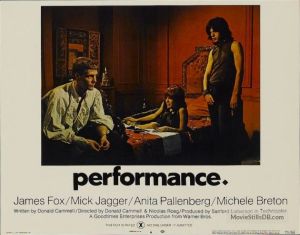
performance-lobby-card The fascination for Balance in this movie possibly included what was essentially a music video inserted in the midst of Chas’s mushroom trip. When Jagger lip syncs Memo From Turner in the offices of the gangsters Chas reports to, it’s not clear who’s experiencing what, but it’s interesting that when the movie was made, the queerness of both the song and the action in this sequence is quite matter of fact. That Chas rejects unspoken advances, as well, is (I think) meant to be interpreted as a shortcoming on his part.
This was not without controversy at the time. The studio refused to release the movie for two years due to graphic sex and violence. My first thought on reading about that was that I’d love to know what the Memo from Warners actually pointed to as problematic. By more recent standards, a few killings and a little sex are considered PG-13 fare by the MPAA, but there are two graphic scenes of gangland violence that were probably more shocking then than they’d be considered now. And unfraught sexuality between two women was also quite shocking. Imagine my surprise to find the image accompanying this review. Initially it was either given the X rating or the studio simply assigned the film an X rating. (Note: All of the other MPAA ratings are trademarked. Only the X rating can be used without MPAA authorisation. I think the idea was that the MPAA didn’t actually want to assign ratings to porno. Porn studios could take the rating and the limited release associated with it. On the other hand, in the early days of the ratings system, movies like Midnight Cowboy and Bilitis which had non-pornographic inclinations could take the rating and the artistic freedom that came with it.)
Regular readers might take my opinion of Chas’ response to Turner’s interest as hypocritical. Didn’t I just recently write that the correct response to the possibility of homosexuality in an interaction should be ‘not a problem’? What’s the difference here? The storytellers of Ready Player One were positing that the homosexual angle was to be avoided where presented. In Performance, however, the storytellers suggest that Chas’ rejection of the possibility is part and parcel of Chas’ rejection of life as a whole.
The ending of the film confused me and the friends with whom I saw the movie. It wraps up rather quickly with the viewer being not quite sure who lives and who dies (despite the writers at Wikipedia seeming very certain of themselves). That said, the movie’s seedy opulence, spot on performances from all concerned, and excellent soundtrack earn this goody four stars.

Ready Player One seen last weekend in 3-D, but not IMAX is fine on a popcorn level, to be sure, and I walked out well entertained, but there was a lot wrong with it. The quest token format is tried and true, but (in the movie’s favour) it wasn’t too obvious. Given that the plot is about finding things in an immersive video game, the format might actually be essential. The setup, given in a voiceover from the protagonist, was such that the first ten minutes were obvious to anyone living in the time line in which the story is told. It all could have been handled within the action rather than as exposition. In 2047, this is what life is like – people live in hovels and spend most of their time in Oasis, a VR environment where everything is peachy. Sort of. My point is, if you live in the period of the story, you don’t need to hear the setup, and as we don’t live on that time line, the experienced storyteller should get us where we need to be without the it. This alone would have made the movie more satisfying.

Side note: I’ve not seen the miniseries version of The City and the City, but have just finished the novel. The writer uses a bunch of terms in unfamiliar ways in the first chapters – some of them aren’t clarified until well into the book, but author China Miéville trusts his readers to follow him and we trust the writer that eventually all will be clear. Spielberg has never trusted his audience this way, and doesn’t surprise us this time either.

The hero, who uses the handle Parzival in Oasis, and Art3mis, the one who becomes one of his partners/love interest, are both good-looking white people. There’s very much a manic pixie dream girl aspect to Art3mis that could have been played with. Instead, the movie plays out the trope in the same way it’s been played out several thousand times before. And while her self-perceived flaw, a large birthmark, is an issue to her, it could absolutely have been a non-issue. The storytellers could have taken the opportunity to work with a more serious character-building trait (not to play the issue down, but it seemed superficial to me).

Ready-Player-One-Fan-Art-03192015

Ready Player One fan art by Carlos Lerma

The next thing that got on my tits was another missed opportunity. When Aech, a friend Parzival has within Oasis but hasn’t met in the real world, tells Parzival not to trust anyone in Oasis to be anything like they are in real life, ‘She could be a 300-pound dude named Chuck living in his parents’ basement,’ our hero responds with something like ‘Trust me, she’s not.’ The correct answer is ‘Not a problem.’ The director and writers could trust that the generation born essentially now might leap that hurdle. Might. And can. A little support from blockbuster filmmakers goes a long way.

Also, can we trust the audience to get that Parzival is supposed to be a knight in shining armor without it being spelled out by the pixie dream girl in the moments after they meet? Truly, they could have just let the names be the names and let characterization do the rest of the work. That’s what it’s there for. There was so much promise just in the characters’ names and they just threw it away.

All of that said, the movie has some truly meritorious bits. The whole sequence lifted out of Stanley Kubrick’s The Shining was fantastically well done. (Amused to read that the sequence in question uses Blade Runner in the book, but because Blade Runner 2049 was being made at the same time, it was off limits.) Working the new characters into Kubrick’s original film, the touches that were changed (the photo on the wall with the game designer instead of Jack Torrance, for example), the name of the movie theater – all very nicely done. And the viewer could get these little Easter eggs or not, and it didn’t matter because the sequence was created in service to the story. (My darling dearest, like Aech, ‘doesn’t do scary movies,’ and found what was going on easy enough to follow.)

The concept of IOI loyalty cells, where Art3mis briefly finds herself, is very cool, from a storytelling perspective. The bad guys buy up the in-game debt of players and then consign them to play games shackled in isolation, VR helmets locked to their heads, and earn in-game money until they pay off the debt – which they are never able to do. While the concept wasn’t overdone story-wise, there was yet another missed opportunity. Art3mis’ real-world player is in real danger, and real trouble, and there was a chance for the film makers to elicit real pity and fear for the character. The setup was there. The fact that the character’s parents had died in those cells gave an opening for the audience to really feel for the character. Yes, there’s a Saturday matinée aspect to this movie which is absolutely appropriate for the genre. In the old serials, the audience knew too that the hero would save the girl. But in 90-plus years of action adventure entertainment, there’s got to be room to grow that aspect of the story. And Spielberg could have been the one to do it. He knows how this is supposed to work. Remember Marian in Raiders of the Lost Ark? She was able to show off what it was like to be in mortal danger. Spielberg let her act. Her character didn’t necessarily grow from when we meet her, and we don’t get that much background on her, but when she was in trouble, we felt for her being in trouble. This is what’s missing in Ready Player One.

In the eight-minute video Kaizo Trap (which I absolutely recommend), a young woman gives her boyfriend a video game console and he starts playing while she does other things. Some hours later she comes back to find him gone. The TV then sucks her in and she finds herself (after reading the phrase ‘No Signal’ from the other side of the screen) in a Mario Brothers sort of game. She has to master the game and with every death she suffers, she regenerates. Life after life, she gets further into the game and finally finds her boyfriend. Despite the length of the video, we somehow understand that this journey takes the character years as she has to master more and more to get to the end. (And for those who have seen Ready Player One, the goal in Kaizo Trap is to win, not just to play.)

The whole thing is very dark and has no dialogue (in that regard similar to the first 20 minutes of Pixar’s Up, another superior piece of storytelling). When they do get back to their apartment, it has fallen into total disrepair, reinforcing how long the game has taken. I bring this up to suggest that the video game genre of movie-making has large spaces for pathos and the kind of storytelling that elicits pity and fear in the audience and can provide a certain catharsis.

There should be a version of this world that Ernest Cline (the author of the novel on which the movie was based and co-writer of the screenplay) and Spielberg’s team created in which the audience is trusted a little more. When Stanley Kubrick was dying, he thought highly enough of Spielberg to hand him the keys to the movie A.I. Kubrick had wanted to tell that story for decades on film, but the effects technology was never up to the task. By the late 1990s, the technology was there, but the ever-meticulous Kubrick’s time had run out. When Spielberg made the movie, he took all the subtlety out of the story. The whole thing was very heavy-handed. The characters were cutouts and the effects (again!) overwhelmed the story.

Listen. I loved the movie, I felt for the characters, the action was first rate. All of the references I did get? Fantastic. All the ones I missed? Didn’t matter. As I say above, I was well entertained. But Spielberg had such rich source material and characters that could have been far more interesting and interestingly developed, and an not insubstantial 175 million-dollar budget, but he just missed the mark. Again.

(Note: I wrote this in 2001, within a few weeks of A.I.‘s original release. I’m posting it now to accompany a writeup of Spielberg’s latest, Ready Player One.)

I think I will be parsing out the Spielberg/Kubrick production A.I. for a long time. It is a beautiful fabulous disaster of a movie. Which might also describe this review. I don’t think I give anything away in this review, but if you are inclined to see it, do so and then read. Some of the scenes are expansive and worth seeing on a big screen. The music is ghastly. You won’t miss too much by seeing it in a theater without THX.

ai-hjo-jlDavid (a very capable Haley Joel Osment), our protagonist, is a robot boy programmed to love. His adoptive parents kick him out to fend for himself when the family’s “real” son recovers from a terminal illness. The two boys are not, um, compatible. David spends the rest of the movie in search of the Blue Fairy (of Pinocchio fame) who will make him a “real boy.”

Because it’s a Spielberg film, A.I. is far more heavy handed than it needs to be. The voiceover that sets up the last segment is truly unnecessary. Stanley Kubrick (who spent 15 years trying to make this film, while the effects he wanted were being developed) would have let the images, the dialogue, and the action speak for themselves.

Kubrick, however, is all over the movie. The sterility of the opening segment, the lack of opening credits, and the sequence in which David finds several dozen Davids in boxes ready for sale all embrace his style.

On the other hand, John Williams’ music was sappy, unoriginal, overused, distracting and manipulative. (So what else is new?) My bias is that I’m a big fan of letting scenes speak for themselves and raising the tension of a scene by working with the sounds inherent to it. Music, when it’s used to make the audience less comfortable, like the Ligeti pieces in Eyes Wide Shut, enhances a movie far more than Williams’ trite chord progressions. Willams’ score is filled with unmemorable bits that suggest music that may have evoked emotion in 19th Century melodramas. In A.I., this music is used to raise emotional responses that the text of the film can’t or won’t.

Several scenes are used to demonstrate David’s lack of place in his family and the supposed threat he is to it. The “natural” son convinces him to cut off a lock of mommy’s hair while she sleeps, so that she will love them more. The music that backs the moment he has open scissors over her restless sleeping body is that of cheap thrillers. The crescendo of the strings builds and stops short with the gasp of the mother waking with scissor points inches from her eyes. Indeed, my heart beat faster as I watched that scene, and I felt tricked and manipulated throughout.

Spielberg embellishes pieces of the story way too much. His overuse of Yeat’s poem, The Stolen Child, threatens to rob the poem of it’s contextual poignance in a manner not seen since Luhrman’s use of Elton John’s Your Song in Moulin Rouge. Okay, it’s not that bad, but it could have been more subtle. On the other hand, a key component of the movie is the framing of robot Gigolo Joe (Jude Law) for murder. Spielberg clarifies the situation in just a couple of minutes. Would that he had the faith in his audience to maintain that economy.

There’s another masterfully handled sequence on the balcony of a half-submerged Manhattan skyscraper. David walks into the offices of Professor Hobby (William Hurt) the man who created him and converses with another David robot. No longer is David unique. He tells Hobby, “I thought I was one of a kind,” to which Hobby replies with failed encouragement, “Well, you were first of a kind.” David’s grief expands as he wanders into the room filled with boxed Davids. Continuing to the balcony, the grief becomes palpable and does not feel manipulative or forced.

As humans, we feel existential dread at being metaphorical cogs in a mechanical world, abandoned by a creator whose “long withdrawing roar” (thank you, Matthew Arnold) merely haunts us. We feel no comfort in the belief that we are unique to our creator. David, having learned about himself, is un-comfort-able. The one connection he needs isn’t just momentarily out of reach, it evaporates before his eyes.

Another problem with Spielberg films in general, and this one in particular, is that everything is laid out sequentially. At no point to the characters know more than we do or we all that much more than the characters. As I noted earlier, the last segment could have done without the voiceover. The facts that David prays until his batteries give out and that 2000 years pass before he is brought back are unnecessarily spelled out by a kindly-sounding male narrator. Ridley Scott managed to recover Blade Runner from the crime of its studio-imposed voiceover. Spielberg put his in on purpose. Perhaps Spielberg figured he was doing us the same favor Kubrick did us in Barry Lyndon. The difference is that the explanations in Lyndon spoke back to the original novel and provided an ironic distance between the viewer and the movie. And Kubrick knew what he was doing.

The dialog or scenery could have explained the passing of time. The number of years is irrelevant as we already know David’s relationship to time from an earlier scene. At the very end, we already know David’s relationship to sleep and to iterate a feeling over it is also unnecessary. The pathos of the scene was sufficient and survived the voiceover, but barely.

At the end of Eyes Wide Shut, the audience stopped breathing for a moment as the movie sunk in and started to resolve itself. It seemed that the close of A.I. evoked little more than a collective shrug.


©2001 Silber Lining Productions

Bloomberg News posted a rather disingenuous editorial comparing Bill Clinton to Donald Trump, the idea being that Trump is simply presenting a grotesque version of the Clinton presidency.

The upshot is that the sex scandals entrapping Trump are as unforgivable as those that Bill Clinton subjected us to back in the 90s, and that somehow because Dems gave Clinton a pass, we should do the same for Trump. I call bullshit. Loud and Clear. I won’t give Trump a pass for ostensibly the same issue (infidelity) for a great number of reasons. One is that Trump’s payouts push us into obstruction of justice territory that Clinton’s simply didn’t.

But let me back up. There’s some merit to this argument that it’s the same thing. For all his impropriety, if the allegations even of rape against Bill Clinton are true (and that’s a hard thing to write, given how loudly we howled in his defense back in the 90s), in general he had the interests of the country and its underclasses at heart. At least some of the time. The health care battle, in the history of those times goes head to head with welfare ‘reform’ and his Supreme Court choices get in the ring with the death warrant he signed during the ‘92 campaign. Yeah, he did dozens of things wrong from my liberal pacifist armchair perspective.

However, what devolved from the Clinton presidency onward was an intractable right wing that had only the interest of the the wealthy and the evangelical in mind and the continuation of their own power. Part of the issue is that the Democrats (as an organization, not an affiliation) have the same faults and predilections as the right, but never had what it took to separate the workers’ interests from the worker’s evangelical leaning in the public imagination. I’m not sure how it evolved that the best interests of the worker no longer lay with that of other workers. (Howard Zinn, if I recall rightly, explains that historically it dates back to slavery/reconstruction when whites in power peddled the line to the landless/luckless whites that ‘you may be trash, but at least you’re not black.’)

Fostering that seemed to hold things together. Oddly this was the Dems’ position, not the Republicans’. It wasn’t until Nixon that the Republicans took hold of Dixie. While it was a Republican that presided over the Union in the Civil War – the Dixiecrats held the south until a Southern white democrat signed the Civil Rights Act. It took the Dems 100 years to lose the South and Republicans have only tighetned their stranglehold in the last 50.

But it’s not unremarked upon that no matter what, both Republicans in legislatures and Democrats vote against the interests of the poor. Nine times out of ten, if not more. I’m not sure that’s just a recent New Democrat (the American equivalent of the UK’s New Labour) or if it dates further back than Clinton’s election. My suspicion is that recent statistics on the matter would be borne out if we applied them in every decade to the founding of the union.

I’ve said before that Clinton was a bastard (our bastard, sure), but we knew when he signed off on Rudy Ray Rector’s death penalty at the start of the ‘92 campaign, that he could be either disgustingly calculating or outright heartless. I think the left trusted it to be the former, because it’s somehow well-known that someone against the death penalty could never be president. I pulled the lever for him twice, because 12 years of Reagan/Bush were enough. And because in ‘96, Dole got the nomination because it was his turn, not because he was the best Republican for the job. Not saying he wasn’t the better man, but I wasn’t ready to question my own liberal ideology. (I’ve been ready enough in recent years, but 21st century American conservatism turns my stomach. So I’ll keep my lunch, thanks. And American Liberalism is firmly in Reagan territory at this point anyway.)

So all that noise above about Bill Clinton is simply to say that I, and possibly my fellow liberals, are not blind to his faults, and that we knew what we were getting into. He was as opportunistic a politician as any other, but no matter what bullshit was thrown at him with regards the so-called scandals of the time, he wasn’t found to be absolutely crooked. This is the key distinction between Clinton (and the Lewinsky affair which finally brought him to impeachment) and Trump (and his various scandals): we know that Trump is crooked. We know because he doesn’t release his tax returns; we know because the one lawyer he keeps close makes payoffs to keep stories from the newspapers; we know because several who did work for him came forward during the campaign to say he reneged on contracts; we know by the skeezy way he talks about his daughter.

I’m going to move from the differences between Trump and Clinton to the greater issue of how our recent presidents differ in similar ways.

Valerie Plame penned an interesting editorial on the pardon of Scooter Libby this week. Libby was the only person charged (and convicted) in the outing of Agent Plame as a covert agent in 2003. His situation plays into the essential what-aboutism of the Bloomberg editorial – Under Bush II and Trump, the worst elements of the party have twisted the agenda of the president. While we may have disagreed quite strenuously with Clinton’s policies, behaviour, and agenda, we didn’t doubt his grasp of policy and his understanding of how his actions would resonate in the geopolitical arena.

For example, when he joined in the bombing of the former Yugoslavia, he knew what the effects might be and he was aware of the historical context in which the war was taking place. (More on this in a moment.) When Rumsfeld and Cheney dragged us into Iraq, President Bush knew that we in the public knew that he was well out of his depth and had no idea what the fuck he was doing. (My apologies: Take a moment to diagram that sentence if you need to.) He told us as much during the campaign, that he was taking on the greatest minds of his daddy’s administration to guide him. The problem was then, as now, the massive conflicts of interest. Has anyone measured how much Dick Cheney’s fortune increased due to Halliburton’s Iraq/Afghanistan war contracts? Just for a start?

Cheney knew the effects of what was going to happen and apparently didn’t give a good goddamn.

Did anyone who mattered in the Shrub White House grasp the history of the region well enough to know the can of worms we were opening? In the public arena, they showed that they didn’t care. The impression they delivered was that eventually the oil would flow and its profits would flow back to the US, that they didn’t care about the war’s time line – the past history didn’t matter – the future would justify it, that they didn’t understand the distinctions between Shias and Sunnis and Kurds (the Yazidi didn’t even figure into the public equation at the time), that somehow all the ethnic hatreds that were held in check by Saddam Hussein would evaporate once we, um, liberated the place.

Clinton at least gave the impression that he cared about what was going to happen. With Bush and Trump, we don’t see that they understand the effects or that they care.

The Bloomberg editorial points out that one of the several parallels between Trump and Clinton is that when Clinton was in the hot seat regarding the Lewinsky scandal, he tried to divert attention by ordering a bombing raid, in Bosnia if I recall rightly. Trump, under slightly more pressure this week after a massive three-venue no-knock raid on that attorney I mentioned, and Trump pulled the same maneuver (possibly at the behest of Fox News), and sent soldiers to bomb Syria. The fact remains that there was feck-all for the independent counsel to nail Clinton on, despite the Republicans’ insistence there was (echoed later with all of the Benghazi bullshit flung at an unflappable Hillary Clinton when she was Secretary of State). The investigation finally got him for a blowjob, making the US the laughingstock of the western world. Bloomberg’s editorial suggests that the odd possibility that Trump might be brought down by a sex scandal somehow makes Trump’s presidency equal to Clinton’s. Of course I call bullshit.

Preet Bharara, in a recent interview with former Homeland Security secretary Jeh Johnson discussed Johnson’s efforts with President Obama to close the prison at Guantanamo Bay. Regarding Republican arguments against closing the prison, Preet asked ‘Do you think the Republicans were acting in good faith?’ This is the question I’m trying to parse with regards Bush’s actions, Clinton’s, and Trump’s. Did they then and do they now act in good faith?

And what do I mean when I use that phrase? I mean that what a politician says in public aligns with what they say in private, with what they promised to the public constituency on the campaign trail, and with a professed belief system. That’s a good start.

And I think that in general, the Dems have acted in better if not good faith to the extent they could, with the proviso that as politicians, they’re performing ethical balancing acts all of the time.

Trump, from my perspective, does not act in good faith, even in faith to what he’s said himself even a week before (viz his tweets about Syria within the month of April, 2018). Bush might have been an actor in good faith, but his advisors were not, and they not he were the government at the time. The fact remains that for the eight years of his residency at 1600 Pennsylvania Ave., he was a figurehead, and most folks knew that.

An example of the good faith/bad faith discussion is the health care debate of the first two years of Obama’s first term. Obama and the Democrats acted in as good faith as they could, to the point of compromise on the most basic of principles, finding middle ground for every one of the Republicans’ arguments, and still we were shafted. One could argue that the Republicans in congress were acting in good faith, but their faith was to the insurance companies, hospital conglomerates, and drug manufacturers. By my definition above, this isn’t good faith. And in the end, not a single red tie voted for the bill. And then they proceeded to sabotage it in the courts.

There wasn’t a credible Republican atop the 2008 ballot, John McCain having chosen the most unqualified VP since, um, Dan Quayle in 1988. Eight years of Bush/Cheney had worn us out on wars and lies and there was readiness for change, to be sure, but Sarah Palin was another example of the Republican party acting in bad faith. Palin was barely qualified for the job she had, like Bush (and Trump), didn’t read much, and could barely answer very simple questions. McCain and the Republican party played us for fools when they thought (and rightly so, obviously, given that Obama’s victory wasn’t precisely a landslide – solid, but it was no 1984 Reagan over Mondale trouncing) we would buy her pretty face over Obama’s obvious experience. Acting in good faith in the political realm requires some modicum of honesty – the whole ‘Democrats are coming for your guns’ canard comes into play here. Palin, in the midst of the Republican sabotage of Obama’s relatively modest agenda had the gall to utter the phrase ‘How’s that hopey-changey thing working out for you?’ as if she wasn’t spending all of her (at the time excessive) on-camera Fox News time subverting rather than adding something constructive to the debate. Had McCain chosen someone credible to join him on the ticket, things might have been different. But we got the grifter instead.

McCain, Mitt Romney, Bob Dole, and Hillary Clinton all have in common that their candidacies came about because it was their turn. They’d risen high enough in the party to be considered the de facto candidates. And they lost because they worked on the assumption that they didn’t have to fight. History might suggest (from more objective distance than we have yet) that Dole and Romney would have made for better history. Would the tea party have dragged Romney through it the way they did John Boehner? I suggest it’s possible, but counterfactual. Hillary Clinton might have lost the selection anyway given Jim Comey’s October Surprise, and the astounding amount of Russia-orchestrated fight against her, but the fight within the party to subvert Mr. Sanders didn’t help matters. She herself was also acting in bad faith.

And there is, of course, the bad faith of the media: Every venue that put Trump on camera acted in bad faith. He’d spent much of the previous decade proving himself an actor (on his TV show), and a political player of astoundingly bad faith. His insistence on the illegitimacy of Obama’s presidency did as much as anything else to sabotage that presidency in the eyes of the electorate. Even with that in mind, the news stations put him literally center stage to spew his schoolyard BS over people of actual political experience. Note: No love lost between me and any of the people running for the Republican nomination in 2016, but giving Trump center stage over and over again legitimized his brand of campaigning.

And we bought it. To try to circle this back to my original thought, it’s not that Trump’s presidency is simply Clinton’s repeated as farce. No, Trump in his personal, political, public, and private dealings is the apotheosis of fifty years of bad faith governance from the Republican party, epitomized by the savaging of the American working class.