E’G/Warner Bros., 1981

Released in 1981, Discipline was the first album by the reformed King Crimson after a seven-year hiatus. Prefigured by Robert Fripp’s 1980 LP League of Gentlemen, in the dead wax of which was inscribed The Next Step Is Discipline. The League of Gentlemen was an interesting exercise in angular new/no wave and featured Barry Andrews (at the time between XTC and Shriekback) and Sara Lee (who would go on to Gang of Four, the B-52s and a few other acts).

Fripp himself had spent the previous couple of years producing projects with Peter Gabriel (Scratch), Daryl Hall (Sacred Songs), and the Roches’ first album (and later their third) amongst others. Not to mention his own solo release, Exposure which included guest spots from those three and several others, including Peter Hammill.

The act Fripp was putting together after League was to be called Discipline, but at some point, he changed his mind and decided it would be the next incarnation of KC. As was the case with almost all previous releases, this album featured a new line-up. Bill Bruford returned from the mid-70s crew and was joined by Adrian Belew and Tony Levin.

Levin and Fripp had already worked together on Peter Gabriel’s first two solo albums. Belew and Fripp crossed paths on David Bowie’s Heroes – Fripp played guitar on the album, and Belew on the tour and Bowie’s next album, Lodger. Despite his work on the edges of rock and roll as a member of Frank Zappa’s band, Belew brought a distinctly pop sensibility to the proceedings. (On his 1983 solo album, there’s a cover of the Beatles’ I’m Down – he knows his power pop.)
devito_disciplineDiscipline runs the gamut from essentially downtown New York new wave to strangely beautiful downtempo work. Some pieces harken tot the noise mastered by the mid-70s line-up. What’s most interesting about this album (and its two successors) is that Fripp for the first time had a guitar foil in the band who was an equally forceful player. Belew also acted as frontman in a way the earlier singers (including Wetton and Lake) hadn’t. Belew never subsumed his vocal quirkiness to any greater KC ethos. This is also the first album with a co-producer from outside the band. Rhett Davies had recent credits with the second Talking Heads album, Dire Straits’ debut, and multiple Roxy Music and Bryan Ferry albums. It’s possible that he enforced on the band a certain rigid approach, despite what I’m about to say next.

KC to this point hadn’t done an album with a unified mood, and this album is no different. Down tempo pieces such as The Sheltering Sky share sides with rockers like Thela Hun Ginjeet, whilst the meditative Matte Kudesai sits between the bass-driven funk of Elephant Talk and Indiscipline.

It’s possible that the opening track, Elephant Talk, was the first King Crimson song I ever heard. KROQ (Los Angeles’ new wave station which started using the tag line ‘Rock of the 80s’ in about 1978) had it in rotation when it came out even though historically the band weren’t exactly new wave. (Around the same time, they were happy to have Jon and Vangelis’ Friends of Mr. Cairo in rotation as well, even though neither name over the title had new wave cred either.) It’s a strange bit of Belew weirdness in which he rattles off words beginning with the first few letters of the alphabet over a pretty funky bass line.

Frame By Frame might not be the first KC piece with backing vocals, but it’s one of very few, I think. Fripp makes himself known with some of his trademark arpeggios.

Matte Kudesai features a plaintive Belew vocal over a Frippertronics loop. Recently I saw a live video of k.d. lang crooning this, which seemed a really incongruous pairing of singer and song. But in her introduction, she said that it had been an influence on her album Ingenue. Curious, but if you listen to the lang album with this in mind, it’s kind of obvious.

Side 2 opens with Thela Hun Gingeet, a real group effort. Guitars, bass, and drums all play off one another in service of another piece informed by the NY funk scene. The vocal is a tape of Ade talking about meeting some very paranoid folks on the street who think he’s a narc. There are recordings from the time on which he speaks the text found on the tape (like this bootleg from 1981), but in others (including recent Crimson ProjeKct gigs) the original tape (or a digitisation thereof) is used.

The Sheltering Sky, the album’s longest track at over 8 minutes features the interplay of Fripp and Bruford which becomes more complex as the piece evolves. Bruford’s toms are relatively simple and metronomic and might themselves be looped. On the one hand, it harkens to the extended instrumental strangeness of Red and Larks’ Tongues Part II, but it’s really its own beast. Thematically, The Sheltering Sky presages the follow-up’s focus on, well, the Beats, informed by Paul Bowles’ novel of the same name.

Levin and Belew return for the title track which closes the album. Figures from other tracks on the album weave in and out as the musicians take on its complex and ever-changing rhythms.

While Discipline (along with the next two albums) sits uneasily with their previous work, a case can probably be made that the ‘73-’74 albums are also of a piece that doesn’t sit with their other work either.

I give this disc four stars.

Next up: Beat.

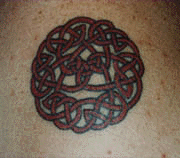
(Image credit: Chris DeVito’s tattoo of the knot on the cover of Discipline.)

I’m just going to riff on this for a bit and see if I reach any conclusions. Let’s start, as my friend Brian suggests, with more than one legally owned firearm for every man woman and child in the US. In other words, we can’t make something immediately illegal tomorrow that was legal yesterday.

The big news this week is that kids are now leading the fight for common-sense gun laws and (as heard on the BBC yesterday) companies are now starting to dissociate themselves from the National Rifle Association. Firms that formerly gave discounts to NRA members are no longer doing so. That’s a huge step in the right direction – the NRA brand has never been this toxic. For decades, Wayne LaPierre and his cold-dead-hands predecessors have fought for money to buy off legislators so that it’s always easy to get guns, no matter what your criminal background. Of course, state by state, your mileage may vary. And once you commit a crime with a gun, in many states including Florida, these stand-your-ground laws have made it more possible to get off if you happen to be white or white-ish. I’m looking at you, George Zimmerman. (NRA-written statutes enacted in Florida in 2005 and in two dozen other states made it impossible to arrest Zimmerman because he claimed self-defense. In addition, jury instructions made it impossible for them to convict even though Zimmerman stalked Martin and was told by the cops to back down and not confront the teenager.)

Martin had just turned 17 at the time and was killed six years ago this week (26 February, 2012).

Of course, there are racist aspects to how the various laws regarding gun ownership and use are treated. Note the cold-blooded murder of Philando Castile, a black Minneapolis school employee who noted to the officer at a traffic stop that he had a concealed carry permit. Within twenty seconds of reaching for his ID had five bullets fired into him. The officer in question was acquitted of all charges, despite dashcam footage from the cop car and Castile’s death livestreamed by his girlfriend just after the shots were fired. Arming school employees is all well and good, I suppose, but I can’t (as others who have pointed to the Castile case in the wake of the Florida massacre two weeks ago) see such things working out equally for all concerned. I tried to read the Wikipedia article on Castile’s murder and couldn’t stomach the heartlessness of the cop, of the jury, of the system.

And lets not lose sight of the domestic terror aspect of this latest case. Who trained N.C. (let’s stop naming the animals who do this stuff, please) to carry out his massacre? Had it been a Black or Muslim organization, they would have been hounded out of the woodwork so quickly heads would be spinning. As it stands, he was raised by a member of Republic of Florida, a white supremacist group. The ROF leader who claimed Cruz trained with them has since walked that back.

There’s also the speech by Florida AG Pam Bondi in the direct aftermath of the shooting. I recognize that there was a certain pressure to say something, but for crying out loud, couldn’t she have talked about something other than what the state of Florida was going to pay for? When someone carelessly breaks something precious and irreplaceable, the last thing you want to hear is that person saying they’ll pay for it. (Are Florida Governor Rick Scott and Bondi shills for the NRA in the same way Florida Senator Ted Cruz is ($77,000 in the 2012 election cycle alone)? I’m not sure. Yes, linking to a tangentially related article like that is shitty and shoddy journalism.) But what we’re not hearing from any of these people in so-called leadership positions is how to prevent these things.

The same Brian I quote at the top shared the following response to calls the current arguments:

Things a Constitutional amendment banning firearms will not fix:

An absence of compassion for fellow citizens.
An absence of value of lives of fellow citizens.
An absence of value in the success of others.
An absence of value in the health of others.
An absence of value in the welfare of others.
An absence of value in the education of others.
The patriarchy.
Toxic masculinity.
Radical conservationism.
Selfishness.
Dangerous nationalism.
Xenophobia.
Homophobia (not a phobia, you’re just an asshole).
Institutionalized racism.
General racism.
Intentional incarceration of minorities to deny their communities of viable male role models, at a critical mass, to actively prevent the establishment of viable successful family models.
Redlining.
Predatory lending.
Criminalization of poverty.
Criminalization of homelessness.
Criminalization of addiction.

And and infinite list of other things.

Our culture is diseased, broken, and rotting, but by all means, keep overlooking that, and keep focusing on the end-result.

There are a lot of one-liners out there in response to these latest deaths – If teachers should be armed, presidents should be required to read is one. Another compares the gun rights supporter (and presumed Republican) suggesting that those who don’t know the difference between certain kinds of firearms shouldn’t legislate from a position of ignorance, to which the gun rights opponent (and presumed liberal) responds: Please draw and explain the female reproductive system.

Image credit: http://military.wikia.com/wiki/FlintlockHowever, this evinces the kind of whataboutism that makes political discussion today such a bloody fraught proposition. The gist is that occasionally white people are refreshed in the fears for themselves and their children that POCs live under all the expletivedeleted time. This is something that happened in Florida this month – nice suburban white high school terrorized by a young man with a gun irrationally marching through what should have been a safe space to learn and grow. Black Americans going about their daily business should expect and experience not being harassed or killed without probable cause, right? And I’m engaging in a variation of the same whataboutism, I suppose. A recent parallel is the Netflix dramatization of Margaret Atwood’s The Handmaid’s Tale. Again, not an original though on my part, but in Atwoods’ vision of the future, white women are treated the same way black women have been treated in America for centuries. I’m sure I’m not the only one to draw this comparison between Atwood’s fiction and the news treatment of our various tragedies. This situation is wrapped up in a lot of other American situations including the school to prison pipeline, Riker’s Island, and the stop-and-frisk policies all over the country.

As noted, I’m riffing. There are no conclusions here, just frustration.

Island / Atlantic Records, 1974

Released just six months after Starless and Bible Black and right on the heels of Fripp dissolving the group (again), Red has been identified as King Crimson’s apotheosis. It is indeed damn fine stuff. Violinist David Cross was expelled from the band during sessions for basically not being able to keep up with the hardness of the sound they were creating, and indeed he’s only evident on two tracks. Former members Ian MacDonald and Mel Collins were brought in to round things out.

Side 1 consists of the instrumental title track; the album’s ballad, Fallen Angel; and the aptly named proto-metal One More Red Nightmare. Side 2 consists of the the improvisation Providence, recorded on the previous tour, and the album’s closing epic, Starless.

Red is, interestingly, the only song from this album that later incarnations of band continued to play into the 80s and 90s (and still). This is possibly because the album as a whole relies on a lot of overdubbing. With its multiple time signatures and sections, and its relative brevity, this one track sums up everything the band had been working on up to that point.

Fallen Angel, which recounts the death of the narrator’s brother in a knife fight, is strangely beautiful. I love how John Wetton holds the vocals together, never letting his range falter. The cornet and oboe (contributed by session musicians, not Collins and MacDonald who both contribute to Starless and MacDonald to One More Red Nightmare) give the track a special poignancy. (In terms of theme, location, and arrangement, it wouldn’t have been out of place somewhere on Genesis’ The Lamb Lies Down On Broadway, released the same year.)

The beauty of Fallen Angel leads to the the oddness of One More Red Nightmare in which the narrator recounts the horror of being aboard a falling airplane (Pan American nightmare / Ten thousand feet funfair) only in the last lines to awaken ‘safe and sound / Asleep on the Greyhound’. Last weekend my wife and I visited New York and from the Empire State Building’s observation deck could see the Met Life building which was still the Pan Am building the last time I was on that deck in about 1984.

Side two mirrors the second side of Starless and Bible Black, consisting of an instrumental improvisation and an epic. Providence (named for the city in which it was recorded, much like Asbury Park on USA) is a weird interweaving of noises that I’m mostly unsure what to make of. At times it doesn’t sound as though the band were playing in the same room, but then it pulls together before breaking apart again. I’m sure in these write-ups I’ve used variations of that same sentence. That sort of thing is very much in the nature of KCs improvisational experience. I find it more intriguing than many of the band’s other live improvs and it seems to make sense in context.

Finally, there’s the album’s longest track, Starless. What started as a Wetton composition rejected for the previous album ended up as this stupendous beast with parts written by each member (including Cross), contributions from Collins and MacDonald and words composed by Palmer-James. Like some of the best pieces of the Pete Sinfield era, this track combines relatively depressing lyrics (Cruel twisted smile / And the smile signals emptiness for me) with music that is by turns mad and manic.

Robert Fripp, commenting on both the size of the current KC lineup and amount of studio complexity that went into Red suggested that the band could now play all of this album without extra trickery. I don’t have the quote to hand, but KC Mark VIII have indeed performed all of the tracks save for Providence on recent tours. For many of the dates the last couple of years, the dgmlive website offers one track for free (with registration, natch). So:

  1. Red – https://www.dgmlive.com/tour-dates/2020
  2. Fallen Angel – https://www.dgmlive.com/tour-dates/2065
  3. One More Red Nightmare – https://www.dgmlive.com/tour-dates/1907
  4. Starless – https://www.dgmlive.com/tour-dates/2038

THE NEXT STEP IS DISCIPLINE.


Island Records/Atlantic Records 1974
This is a really strange offering in the KC canon – much of it was recorded live or derived from live recordings made on the Larks’ Tongues In Aspic tour, and some aspects feel too fast. This is especially true of some of the vocals on side 1. It’s not as though everything is too fast, just that speed sometimes overtakes dynamics.
Richard Palmer-James is back for another go in the writer’s seat. As with LTIA, there’s no overarching theme that ropes the lyrics together. (An argument can be made that the only other Crimson album that has some kind of thematic bonding is 1982’s Beat.) The album is divided equally between four instrumentals and four tracks with words, though side 2 only has two long instrumentals, so the division is not quite equal.
The Great Deceiver starts the album off with a bang, though it’s opening line (‘Health food faggot with a bartered bride’) rubs this listener the wrong way. It’s not common to hear something so derogatory in KC lyrics, though it’s not out of place in a song about the Devil. (ETA: The Elephant Talk FAQ notes that Palmer-James had in mind a meatball, not a derogatory gay reference.) There’s a nice slow bit in the middle of this track that helps it work as not just a rush from point A to point Z. The opening of Lament helps slow the proceedings down a bit. Lyrically it’s odd to hear a first-person, rather mundane song about being in a rock band from Crimson (though one could argue, Easy Money is also about being in a rock band, but from a different perspective). It has some of those nice changes that we’ve come to expect from KC and dives from the languorous opening into something more in keeping with the subject matter.
Next up is a strange little improv called We’ll Let You Know. As he did in Lament as well, Bill Bruford steps a bit into the odd percussive territory that Jamie Muir held on LTIA. It features a really nice interplay with Fripp and Wetton. I’m not sure Cross participates, though he might be on keyboards here. I’m pretty sure it was edited from a longer improv and messed with in the studio – it makes the piece a little less interesting as a base, I’m guessing, to build into a live staple.
The Night Watch (along with side 2’s tour de force Fracture), is one of my favourite songs on the album. The combination of instrumentation, subject matter, and setting is beautifully executed. The verses, telling the story of Rembrandt’s painting of the same name, fit as if joints in a picture frame. It was recorded at the Concertgebouw in Amsterdam, which is about half a mile from the Rijksmuseum where the painting is housed. The painting takes up a large dedicated wall – visitors make their way past hundreds of other pieces to find and then stare at it – if they can get close enough. Unlike the Mona Lisa, which plays a similar role at the Louvre, has one subject, and is about the size of a piece of notebook paper, The Night Watch is about twelve feet by fourteen and features almost two dozen characters and might be the museum’s star attraction.
The song is lyrically straightforward in its telling of the lives of Dutch burgers in the age after the Spanish occupation. There’s a line about the painting being dark (The city fathers frozen there/On the canvas dark with age). It had been displayed over its owners fireplace for several decades and in the 80s or 90s underwent repair and is much brighter now. (I am exceedingly lucky to have very good seats for the Crims’ return to this venue in July and I have hopes that they’ll add this to the set list. When they last played the Netherlands, they came to Utrecht which is very nice, but nearly so close to the subject of one of their songs.)
Trio, another instrumental, famously credits all four band members. Bruford’s credit, if I recall rightly, is ‘Admirable restraint’ as he never identified a place to come in so sat still with drumsticks in hand. Cross’ plaintive violin plays with (or against) Fripp’s Mellotron and guitar weaving in and out, bringing them together and then floating away. Wetton seems to join about three minutes in, gently, before Bruford’s bass drum and cymbals bring us into The Mincer. This one is a menacing vocal track that closes side 1 with effects-laden guitar work that seems to have some of the free jazz influence of earlier albums. The lyrics are oblique at best, but hint at the same feeling as Peter Gabriel’s Intruder who knew ‘something about windows and doors’. With lines like ‘Fingers reaching / linger shrieking…You’re all done baby / breathing, the menace behind the song builds, but the vocal style doesn’t really match.
As noted, side 2 comprises two long instrumentals, the title track and Fracture. In the last week, I’ve listened to this album more than a dozen times and at one point listened to the title track three times in a row. It resists entry. I honestly don’t know know what to make of it. It ebbs and flows between the instruments and sometimes seems to have a purpose and is sometimes just noodling between blasts of interplay before fading back out. The piece lacks a continued sense of itself while easing in and out of a sense of impending menace (yeah, there’s that word again). Eventually it feels like it’s going somewhere, that there’s some kind of synchrony between the musicians. Bruford, about half way through seems to take the reins of the piece and then it slips away again. The whole thing comes to an almost cohesive conclusion in its last minute or so.
And then Fracture comes on. Those opening notes introduce something that works and every section of the piece works together. As a representative of this lineup’s key pieces, it stands with the title track of Red and LTIA‘s bookend pieces as a statement of purpose. At about the eight-minute mark, someone (Wetton, probably, as he usually had a mic in front of him) lets out a ‘Whoo!’ because, I think, they are all in such a groove. It feels composed with room for each member to stretch. This is especially apparent in the version found on the anniversary reissue of the live album USA, recorded on the Starless tour.
There are songs on the album that were composed and arranged as pieces or evolved cogently out of improvisation, and others that are improvs cut to wax. This isn’t a bad thing at all, but in the context of this album, it distinguishes pieces on the album that work for me from others that don’t. As a whole, this album has pieces that absolutely shine and others that don’t succeed nearly as well. I still give it 3 1/2 stars.

Next up: Red.

My friend M, a libertarian, posted a Buzzfeed article which detailed much of what Kim Yo Jong actually (or is purported to be) up to in North Korea. He noted this as a contrast to how the liberal media is treating Kim Jong-Un’s sister and her attendance at the Winter Olympics (as if she’s the anti-Trump and the most wonderful thing to come down the pike since Trump took office).

Another friend of his replied ‘But the Left-wing press and the imbeciles who worship them think her classy, but murderous ways, are so lovely.’

And here’s where I fucked up. While I don’t worship the left-wing press, necessarily, I am decidedly a member of the left wing. I took it personally and did one of those things that drives those who are working for justice so mad when it comes from the other side.

People who have agendas against, for example, female empowerment or the desire of African Americans not to be judged guilty on the street for simply being Black often bring decidedly disingenuous questions to the table: ‘What about what this one woman did’, or ‘What about when some Black person did something else?’ But it’s not the responsibility of any one member to stand up for or denounced what any other member of any group does. If you’re honest about your position, you do the research and don’t waste the other side’s time. If you’re dishonest, you waste the person’s time (and the movement’s time) with basic education questions that have been answered multiple times before.

asshatI am an asshat: Instead of doing my own research and looking up recent reports in the news (both left and right) about Kim Yo Jong, I asked ‘Such as?’ M’s friend called me out as an ‘asshat’ in the context of his reply in such a way that I would never do with someone I’d never met. He then linked to a NY Times article that gushed about Ms. Kim.

My reply was, ‘That’s how you interact with someone you’ve never met? Wow.’

And he came back with ‘It’s how I interact with asshats who speak before they think and prominently display quotes from antisemitic dirtbags like Cornell West.’ Still not endearing himself to me, but what’s that about Cornell West? I have one sentence in my FB Intro: Never forget that justice is what love looks like in public. ~Cornell West.

Why? Because, as I mentioned in my reply to him, justice is key to how I try to interact with the world. I usually fail, but justice is the goal. And I like the conflation of justice with public displays of love. When one loves one’s fellow human being, one fights for their justice. The two go hand in hand and West’s single sentence sums it up.

Note that I know that I’m still giving the person who insulted me the benefit of the doubt, even though he reduced another human being (whom he doesn’t know) with a pretty despicable epithet.

However, time for more research. What else do I know about West? Um. He’s an African American public intellectual. Yeah. That’s about it. I search Google on the string ‘Cornell West Antisemitism’ and get conflicting answers to the question at hand from HaAretz and The Forward. Oddly, a DuckDuckGo search on the same string finds far more returns against West on this question, most having to do with Palestine.

I occasionally write on the Palestinian issue (which seems to be at the heart of the accusations of West’s antisemitism), but I try to admit to both a serious left-wing bias and a decidedly emotional response to the situation. For me, the occupation and the settlements are the elephant in the room regarding any solution. Friends on the ground in Israel point out the very complex issues of the various factions supporting the Palestinian cause and their long-stated goals of pushing Israel into the sea. There’s a lot to unpack there. I have a Palestinian colleague who didn’t endear himself to me when he saw my tattoo of the Hebrew word for truth on my arm. ‘Your truth is a lie,’ he told me. I’ve so far not cornered him on his experience, but one of these days, I’d like to. (I did send him links to blog entries in which I discredit the Zionist credentials he seemed to be affixing to me.) While I’m understandably unwilling to get into it with M’s friend what with his introduction to me, and his defense of it, I’ve got a lot to think about.

Image credit: Attila the Mom and her occasional Asshat of the Week posts.