E’G/Warner Bros., 1981
Released in 1981, Discipline was the first album by the reformed King Crimson after a seven-year hiatus. Prefigured by Robert Fripp’s 1980 LP League of Gentlemen, in the dead wax of which was inscribed The Next Step Is Discipline. The League of Gentlemen was an interesting exercise in angular new/no wave and featured Barry Andrews (at the time between XTC and Shriekback) and Sara Lee (who would go on to Gang of Four, the B-52s and a few other acts).
Fripp himself had spent the previous couple of years producing projects with Peter Gabriel (Scratch), Daryl Hall (Sacred Songs), and the Roches’ first album (and later their third) amongst others. Not to mention his own solo release, Exposure which included guest spots from those three and several others, including Peter Hammill.
The act Fripp was putting together after League was to be called Discipline, but at some point, he changed his mind and decided it would be the next incarnation of KC. As was the case with almost all previous releases, this album featured a new line-up. Bill Bruford returned from the mid-70s crew and was joined by Adrian Belew and Tony Levin.
Levin and Fripp had already worked together on Peter Gabriel’s first two solo albums. Belew and Fripp crossed paths on David Bowie’s Heroes – Fripp played guitar on the album, and Belew on the tour and Bowie’s next album, Lodger. Despite his work on the edges of rock and roll as a member of Frank Zappa’s band, Belew brought a distinctly pop sensibility to the proceedings. (On his 1983 solo album, there’s a cover of the Beatles’ I’m Down – he knows his power pop.)
 Discipline runs the gamut from essentially downtown New York new wave to strangely beautiful downtempo work. Some pieces harken tot the noise mastered by the mid-70s line-up. What’s most interesting about this album (and its two successors) is that Fripp for the first time had a guitar foil in the band who was an equally forceful player. Belew also acted as frontman in a way the earlier singers (including Wetton and Lake) hadn’t. Belew never subsumed his vocal quirkiness to any greater KC ethos. This is also the first album with a co-producer from outside the band. Rhett Davies had recent credits with the second Talking Heads album, Dire Straits’ debut, and multiple Roxy Music and Bryan Ferry albums. It’s possible that he enforced on the band a certain rigid approach, despite what I’m about to say next.
KC to this point hadn’t done an album with a unified mood, and this album is no different. Down tempo pieces such as The Sheltering Sky share sides with rockers like Thela Hun Ginjeet, whilst the meditative Matte Kudesai sits between the bass-driven funk of Elephant Talk and Indiscipline.
It’s possible that the opening track, Elephant Talk, was the first King Crimson song I ever heard. KROQ (Los Angeles’ new wave station which started using the tag line ‘Rock of the 80s’ in about 1978) had it in rotation when it came out even though historically the band weren’t exactly new wave. (Around the same time, they were happy to have Jon and Vangelis’ Friends of Mr. Cairo in rotation as well, even though neither name over the title had new wave cred either.) It’s a strange bit of Belew weirdness in which he rattles off words beginning with the first few letters of the alphabet over a pretty funky bass line.
Frame By Frame might not be the first KC piece with backing vocals, but it’s one of very few, I think. Fripp makes himself known with some of his trademark arpeggios.
Matte Kudesai features a plaintive Belew vocal over a Frippertronics loop. Recently I saw a live video of k.d. lang crooning this, which seemed a really incongruous pairing of singer and song. But in her introduction, she said that it had been an influence on her album Ingenue. Curious, but if you listen to the lang album with this in mind, it’s kind of obvious.
Side 2 opens with Thela Hun Gingeet, a real group effort. Guitars, bass, and drums all play off one another in service of another piece informed by the NY funk scene. The vocal is a tape of Ade talking about meeting some very paranoid folks on the street who think he’s a narc. There are recordings from the time on which he speaks the text found on the tape (like this bootleg from 1981), but in others (including recent Crimson ProjeKct gigs) the original tape (or a digitisation thereof) is used.
The Sheltering Sky, the album’s longest track at over 8 minutes features the interplay of Fripp and Bruford which becomes more complex as the piece evolves. Bruford’s toms are relatively simple and metronomic and might themselves be looped. On the one hand, it harkens to the extended instrumental strangeness of Red and Larks’ Tongues Part II, but it’s really its own beast. Thematically, The Sheltering Sky presages the follow-up’s focus on, well, the Beats, informed by Paul Bowles’ novel of the same name.
Levin and Belew return for the title track which closes the album. Figures from other tracks on the album weave in and out as the musicians take on its complex and ever-changing rhythms.
While Discipline (along with the next two albums) sits uneasily with their previous work, a case can probably be made that the ‘73-’74 albums are also of a piece that doesn’t sit with their other work either.
I give this disc four stars.
Next up: Beat.
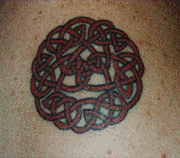
(Image credit: Chris DeVito’s tattoo of the knot on the cover of Discipline.)