You’ll note that I skipped one. 2012’s ALT was an interesting enough instrumental album, but nothing really to jump and shout about.
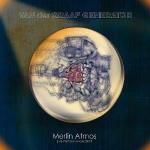
vdgg-maMerlin Atmos, recorded in 2013, is a live album featuring the trio line-up that had recorded ALT, A Grounding In Numbers, and Trisector. A such, it leans on these later albums,  It opens with Hammill’s solo epic Flight from the 1980 release A Black Box. It’s a proper full-side piece in multiple parts in the vein (sort of) of A Plague of Lighthouse Keepers (which takes up side 2 of Merlin Atmos‘ vinyl release).

There were two CD releases – a single and a double. The single includes the two epics and closes with a tight version of Hammill’s Gog, previously heard in a poor 1975 live recording as a bonus track on Still Life.

Disc one also features Lifetime and All That Before (Trisector) and Bunsho from A Grounding In Numbers.

It’s quite an interesting affair, a good balance of the old and the more recent trio work. It’s interesting that both this and Vital were recorded by lineups that weren’t the classic quartet. As such, David Jackson’s horns are especially missed on the older material. On the other hand, the recording is clean and the performances are as intense as one would expect.

The second disc (Bonus Atmos) features:

  • Interference Patterns, Over the Hill (Trisector)
  • Your Time Starts Now (A Grounding In Numbers)
  • Scorched Earth (Godbluff)
  • Meurglys III (World Record)
  • Man-Erg (Pawn Hearts)
  • Childlike Faith In Childhood’s End (Still Life)

They’ve been doing this work a long time and the renditions are generally tight. I think the solos, such as the keyboard adventure in the middle of Childlike Faith, seem a little tightly bound to the original versions. At two hours twenty, I don’t feel driven to compare the live tracks to their studio counterparts in the moment, but these versions are certainly satisfying. Hammill lets his vocals soar in a way he hasn’t on the recent studio recordings. I’d say it’s as good an introduction to their work as you’re likely to find.
A stronger effort in many ways than Trisector, but more lyrical weakness. Lines like ‘Mathematics / Just so “wow” it brooks belief’ (from track 2, ‘Mathematics’) are more common than one would like to admit. On the other hand, there a lot of musically strong numbers – track 3, ‘Highly Strung’ is one of those – Hammill, Banton, and Evans seem to be finding their places as a trio in a way that wasn’t evident on Trisector (even though the three had been playing together for decades).

Opener, Your Time Starts Now, is almost theatrical with sweeping organ fills, and big concepts about how the addressee hasn’t been getting on with it, but now must.

vdgg-agin-cdIt’s a poppier affair, at least in terms of song length. Five tracks clock in under three minutes; only four break five; and only one breaks six.

Snake Oil certainly speaks to the current dystopian zeitgeist, ‘Brainwashed and bound to believe in the orthodox text, slogans on t-shirts, / the punters can’t wait to be told
what to think of next’, from a slightly different angle to 2005’s Every Bloody Emperor.

Side note – I posted that song on FB last week and my mother shared it out. If even my mother (who loves Leonard Cohen, but otherwise listens to musical theatre, classical music, and a lot of NPR) would give Van Der Graaf a try, what would it take to get that song up on the charts?)

Smoke has a funky keyboard opening that slides in and out of something nearly disco (in a good way), but after slipping into something even weirder, they decided not to take it very far. Despite the line ‘You held your inattention’, two and half minutes is as far as they decided to take it before segueing into 5533, another song ostensibly about something mathematical (‘As the primacy of digits ticks the boxes / So the codes that they unlock begin to run’).

A Grounding In Numbers closes with All Over The Place, which might be as good a title for the album as the one they used. The longest track on the album, it leads with a nice harpsichord melody (that might be a counterpoint to the organ of Your Time Starts Now) but the whole song is still a little piecemeal, like they felt they had to do something proggy and multi-sectional.

Okay, this is a weird one. VDG’s first outing as a trio following another departure of David Jackson. It might reward further listening, but I’m not certain.

vdgg-trisector_eclipsed0308_adThe opener, Hurlyburly, is an instrumental which seems to declare in major chords where the band is going this time. One of the melodies echoes the rinky-dink of Freddie Cannon’s Palisades Park.

Interference Patterns is almost a parody of a VDG song – weird rhythms, off-the-wall subject matter, and a howling vocalist, all grinding to a halt for a solo in a different time signature. Lyrically, however, it’s a word salad lifted from a book of popular pseudophysics. Or at least that’s what it sounds like.

The Final Reel is a fairly straightforward song about an elderly couple choosing mutual suicide over slow decline and sounds much like a jazzy 70s rock ballad. It’s strange to hear a story from Hammill so devoid of nuance. This isn’t a bad thing, just strange.

Drop Dead is another song short on the poetry we’d come to expect. In a sense some men are always caught in adolescence / trying to crack the mystery girl cocoon.

Over The Hill is a proper VDG epic – 12 minutes 30 and more lyrics and tempos than usual, and like The Final Reel, seems to be about facing mortality (‘and there’s no time for hesitation as the stations of our lives are passing by’)

(We Are) Not Here, which closes Trisector, is another song about mortality, but one that sounds more like classic VDG – Hammill howling over insane keyboard and guitar noise about, well, things like ‘Light streaming through us blindly / we are not here for long’.

Musically, Trisector is good stuff, but it’s just not as interesting as their other work. I put it down with Godbluff.

Indeed, what a difference 27 years makes. Another interesting album. Far more listenable than most of their efforts. This release was divided into two discs. The first consists of six finished tracks, one of which (Boleas Panic) is an instrumental. The second is made up of ten improvisations. This album has more of an overarching theme that has to do, I think, with bearing up or sinking under the burden of history.

One of thevdgg-p first things one notices about this album is David Jackson’s horns, missing (for the most part) from the last two 1970s releases. They’re really quite integral to the Van Der Graaf sound and it was odd on the previous release to have them replaced with strings.
The opening track, Every Bloody Emperor, is one of the only politically charged songs in the band’s catalogue. While it was bloody appropriate to 2005, the beginning of Bush II’s second term, it seems even more so now:

Truth’s been beaten to its knees; the lies embed ad infinitum
till their repetition becomes a dictum
we’re traitors to disbelieve.

Nutter Alert seems to be a flip side of MC 900 Ft. Jesus’ The Killer Inside Me, the narrator of which is an absolute nutter. (I have a feeling I’ve mentioned The Killer Inside Me with reference to an earlier song, but I’m not certain.) Nutter Alert has the narrator indicating that he’s stuck listening to someone who is no longer fully with the programme:

Oh, but here comes that special nonsense
all the words out in a spurt,
the unhinging of the trolley
as the mouth begins to blurt…

Abandon Ship! is lyrically a little weak, but I quite like the interplay of the horns and guitars.

In Babelsberg seems to describe a walk through late 20th century Berlin and compares it to, perhaps, a pre-reunification version of the same city.

The light is getting dimmer,
the walls of history close in.
In Babelsberg they’re hunting
for a different Stimmung (mood, according to google translate)
that predates the war.

The title of the disc 1’s closing track, On The Beach, would suggest Neville Chute’s novel of the same title, about life in a post-nuclear war Australia, but lyrically, not so much. ‘We could have thrown in our cards / when the going got hard / but evidently we went on interminably’ seems to indicate another of Hammill’s tales of love that’s gone awry in that human way.

The improvisations of disc 2 seem to be more focused than those that made up, for example, the various sections of A Plague of Lighthouse Keepers. While the band members are striking out for the edges of what a song can hold, they manage to pull each piece back into a song.

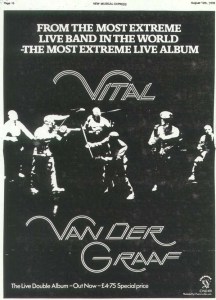
Vital is a weird one for me because it was the only Van Der Graaf I purchased as a kid. I honestly didn’t know what to make of it. I only knew about Van Der Graaf at all because of references to the 6 Bob Tour (Genesis/VDGG/Lindisfarne – all Charisma Records artists who toured together in ’71) in Armando Gallo’s Genesis: I Know What I Like, which I read cover-to-cover multiple times. So when I finally saw a Van Der Graaf album in the used bins (probably at Rhino on Westwood Blvd, but not sure), I grabbed it. I played it a couple of times but really had no idea. Listening to it now, nothing is familiar from listening to it then. I haven’t recognized any of the songs from delving into the catalog these last few weeks.

vdgg-vAll in all, it’s pretty good stuff. As with most of Van Der Graaf’s work, it’s pretty compelling and there’s no easy entry.

To give the uninitiated an idea of how truly contrary this band was, they opened (the album, if not the gig – one isn’t sure what the original set list was) with Ship of Fools, the b-side to a single (the previous year’s Cat’s Eye) that was only issued in France. Mirror Images would appear on a Hammill solo album the following year. The vocals are far forward in the mix and the arrangement is sparse, enabling better understanding than is often the case with VDGG’s music. On the other hand, it’s another seriously wordy Hammill lyric that requires a lot of parsing.

The album covers music from almost their entire history including a truncated Plague of Lighthouse Keepers (in a medley with Godbluff‘s The Sleepwalkers) and Pioneers over c. The violin and cello bring an interesting new dimension to the older work. Though David Jackson (sax/flute) had left the band during the recording of Quiet Zone/Pleasure Dome, he played this gig and the noise he brings to Pioneers contrasts nicely with the strings, especially in the song’s middle section. This performance opens side 3/disc 2 and received the greatest applause.

Sci-Finance (later released on a Hammill solo album) is a pretty hard track about big business. It’s mostly short on dynamics until the instrumental break which seems to be a competition between a violin, a horn, and a guitar.

Door, another non-album track (a demo version was later appended to Quiet Zone), has a spoken introduction in which Hammill tries to explain the song. It’s odd that it’s the only one on an album with more lyrically challenging pieces that would have been unfamiliar. This is another one with a great improvisational section comprising the second half of the piece. It’s followed by a song titled Urban/Killer/Urban, the middle of which is an instrumental version of the song that opens H To He Who Am The Only One. It’s an interesting way of including one of the band’s more recognizable songs.

And the whole adventure concludes with Nadir’s Big Chance, the punk-ish title track of a 1975 Hammill solo album. Lyrically it bears a disturbing resemblance toMirror Stars by The Fabulous Poodles (who, according to an image in Vital’s CD booklet, played the Marquee the same week Vital was recorded.