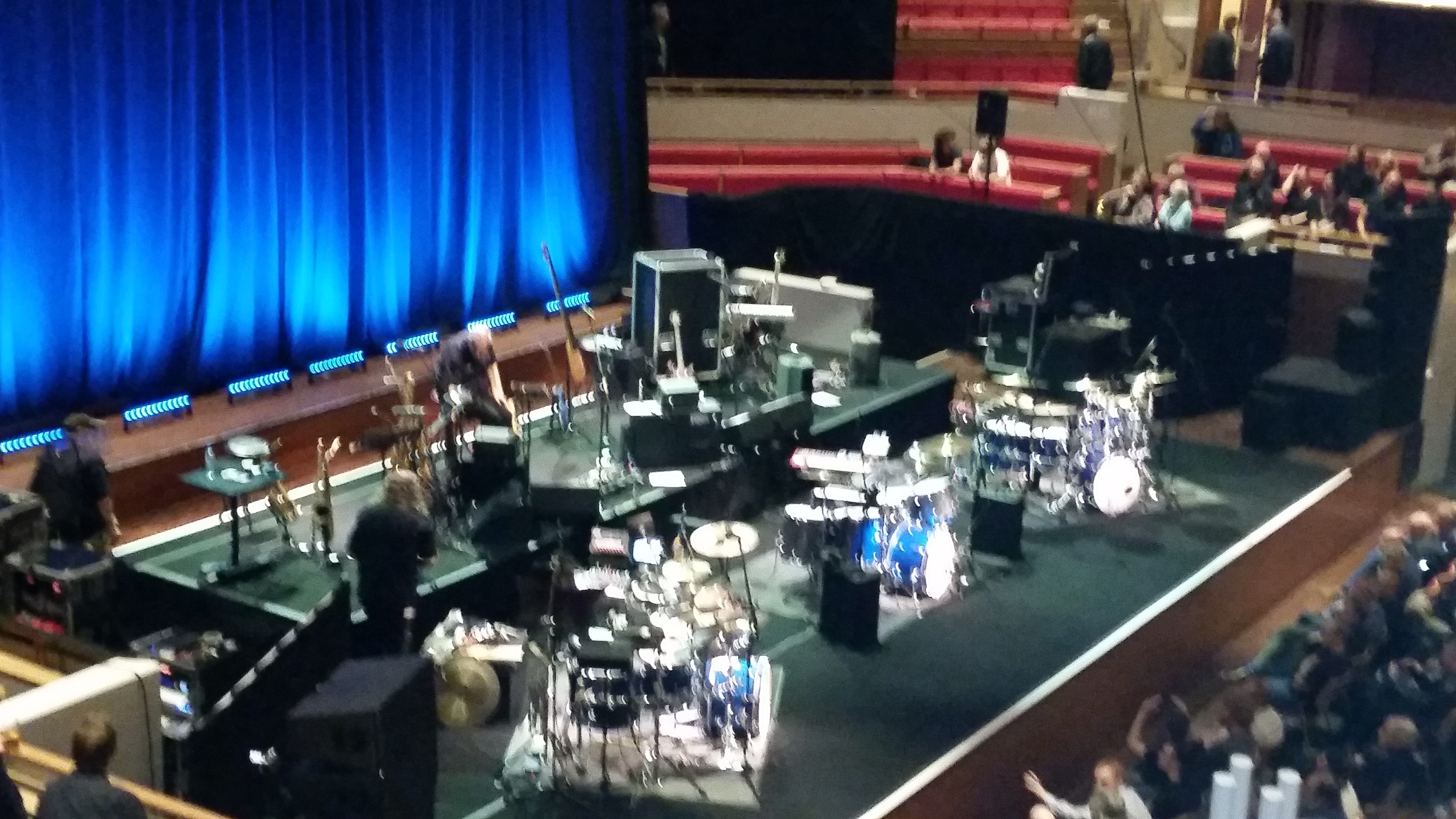
Setlist:
Larks’ Tongues in Aspic, Part One
Pictures of a City
Meltdown
Hell Hounds of Krim
The ConstruKction of Light
Banshee Legs Bell Hassle
Easy Money
Level Five
Epitaph
The Talking Drum
Larks’ Tongues in Aspic, Part Two
Starless
E: In the Court of the Crimson King
E: 21st Century Schizoid Man

As with most previous incarnations of King Crimson, the latest is a lineup of insanely talented musicians. In this case, the band is trying to take on the aspects of its entire history. Noting that Crimson is whatever guitarist and bandleader Robert Fripp says it is, it’s impressive to see and hear them incorporate several tracks from the band’s 1969 debut, In the Court of the Crimson King. The title track, added on this tour hadn’t been performed by the band since 1971; 21st Century Schizoid Man wasn’t played by the 80s incarnation, but has been a mainstay since the Thrak tour in 1996. (I saw them on that tour in Berkeley and Adrian Belew introduced it saying ‘I don’t think we’ve played this here before.’) Epitaph was added to the set last month, having not been performed since the initial tour for the album in 1969.

At the other end of the timeline are tracks from the final studio albums of the Adrian Belew-fronted editions of the band, an instrumental version of the title track of 2000’s ConstuKction of Light and Level Five from 2003’s The Power to Believe (between 2003 and 2010, there were a couple of tours with Belew and line-up changes, but no albums), and new pieces Hell Hounds of Krim and Meltdown.

While the renditions of Epitaph and Crimson King were both faithful, and sound very much of their time, Schizoid Man, with its combination of improvisation, treated vocals, and heavy guitar has always been the earliest example of jazz metal. Pictures of a City dates from 1969 as well, though it didn’t appear on record until the following year’s In the Wake of Poseidon. This is the only other track from King Crimson’s early progressive period in the set. The three albums that followed Crimson King all featured Mel Collins on saxophones and flutes, and the current tour is the first Collins has played with the band since 1972. (Not that he hasn’t been busy enough – his CV includes work with Camel, Roger Waters, and some Crimson-related acts including 21st Century Schizoid Band.)

The heart of the set, for me, were the pieces from the ’72-’74 golden age. Following the tour for 1972’s Islands, Fripp disbanded the group (one could cite ‘creative differences’), only to reform it a few months later with two percussionists, Bill Bruford from Yes and an absolutely insane bloke named Jamie Muir; John Wetton (bass/vocals); and David Cross (violin/mellotron). The three albums recorded by variations on this lineup, Larks’ Tongues in Aspic, Starless and Bible Black, and Red are classics, recently reissued in 15+ CD sets that include as much related live material as the band have in their archives. Following Red, there was no tour as Fripp disbanded the crew again. (This time it had a lot to do with an absolutely lousy record contract – lousy even by the standards of the time, from what I’ve read.)

Between ’74 and about 1980, Fripp appeared on a number of projects – producing Peter Gabriel’s second solo album, his own solo album Exposure, projects with Brian Eno, David Bowie’s Heroes album, Talking Heads’ Fear of Music, and a crew called The League of Gentlemen (with Sarah Lee who would join Gang of Four and Barry Andrews who was between XTC and Shriekback). LoG recorded one album in the runout groove of which was etched ‘The Next Step is Discipline’. Discipline was to be the name of Fripp’s next band which consisted of Fripp, Bruford, Tony Levin (bass, about whom more below), and Adrian Belew (guitar/vocals). When it came down to it, Fripp decided this was the next incarnation of King Crimson and retained the name Discipline only in the title of that lineup’s first album.

Belew is a gregarious character whose had already worked with Zappa, Bowie (the Heroes tour and Lodger album), and Talking Heads among others. He fronted the various lineups of KC between 1981 and 2008. These included the three different lineups that recorded Discipline, Beat, and Three of a Perfect Pair between ’81 and ’84, Vrooom and Thrak in the mid-90s and The ConstruKtion of Light and The Power to Believe between 2000 and 2003. Fripp decided he was after something else with the new group and did not invite Belew along. Oddly, Belew has fronted The Crimson ProjeKct with all six members of the Stick Men (Levin, Mastelotto [about whom more below as well], and guitarist Markus Reuter) and The Adrian Belew Power Trio. These shows leaned heavily on the 81-84 material as well.

The title track of Red, another piece of proto-heavy metal, and Larks’ Tongues in Aspic Part 2 were mainstays of KC sets from the 1981 reformation onward, but Starless (also from Red, but containing the refrain ‘Starless and bible black’) hadn’t been performed until this tour since the tours that led up to Red’s recording in ’74. The Talking Drum was a mainstay of the double-trio lineup of the mid-90s and briefly in 2008.

The current incarnation of King Crimson is an interesting bunch. Fripp as always seated upper right on guitar. Next is Jakko Jakszyk on guitar and vocal. Jakko has worked on an large number of projects since the early 80s including stints with Level 42 and Tom Robinson and work with a pre-Porcupine Tree Gavin Harrison. In 2001 he joined with members of the earliest KC incarnations to form 21st Century Schizoid Band. In 2010 he worked with Fripp on an album that, with contributions from Collins, Harrison, and Tony Levin became A Scarcity of Miracles, which is very much in the KC vein.

Tony Levin on bass and Chapman stick has been in most KC lineups since 1981. He first worked with Fripp on Peter Gabriel’s second solo album (which Fripp produced), and played on Fripp’s 1978 solo album Exposure. Next to Levin on the top row of the stage stood Mel Collins surrounded an array of horns.

 The front row of the stage on this tour is populated by three drummers. On the left is Pat Mastelotto who has recorded since the early 80s (including as a founding member of Mr. Mister who had two #1s that you might recall). He and Harrison both recorded with Barbara Gaskin in the early 80s. He’s been with Crimson since the mid-90s. Front and centre is one who might be the oddest member, Bill Rieflin. Rieflin is best known in some circles for his participation in a number of 90s era industrial acts including Ministry, Pigface, and KMFDM. However, he was also in The Minus Five with REM’s Peter Buck and took to the drumkit for REM’s last couple of albums/tours. His short-lived Slow Music Project featured Buck and Fripp. And finally, in front of Fripp, Gavin Harrison. At 52, Harrison is the youngest member of the current lineup, and is possibly best known for his membership in Porcupine Tree since 2002. He’s been a professional musician since the early 80s as well and has been in KC since 2008.

Mastelotto is the most physical and almost manic, while Harrison is the most fluid of the drummers. In the opening piece  of the set, Mastelotto took on the crazy percussion work originally done by Jamie Muir. (See this version from 1973 – Muir’s the one with the Van Dyke; Bruford is the one in overalls.) Watching Harrison’s playing is almost like watching water flow. While none of the three is an imprecise player, Rieflin is the most precise in terms of stature and attention. Sitting bolt upright most of the time, he looked almost uncomfortable, but worked with great synergy with the other two drummers and with the rest of the band. The band requested that the audience make no recordings or photos during the show and for the most part this was respected. Alas, the band has been vigilant about taking down videos posted from the tour. Early on, there was a medium-quality clip of 21st Century Schizoid Man that featured Harrison’s gorgeous drum solo. I have high hopes that a professional video or audio recording of this tour will be released sometime in the not too distant future.

Just because we don’t yet know the scale of the atrocities committed by Islamic State doesn’t make the events of their happening any less atrocious. We didn’t know the scale of those committed by Assad, Pinochet, the Khmer Rouge or Franco either.

The problem of comparison is that it diminishes for us what we address now. IS might be underequipped and relatively small – it surely lacks the engines of war machine construction that fueled Germany in the 30s. And the numbers they subjugate surely can’t match the 11 million destroyed in the Holocaust. Yet.

That said, let us try to keep before us that the scale of a persecution may be great or small, but it is the existence of persecution that should horrify us, not its scale.

Corbyn election shows Labour’s delight in losing, says Italian PM. Okay,  based entirely on this article, I don’t think Italy’s unelected prime minister, Matteo Renzi, is in a position to comment on Corbyn’s electability. (If I’m reading his history correctly, while Mayor of Florence, Renzi earned the leadership of the Democratic party – as such, he forced the PM, Enrico Letta, to resign last year in his own favour. https://en.m.wikipedia.org/wiki/Matteo_Renzi
He says it has nothing to do with Blairite or anti-Blairite. Well,  yes it does.
He’s left of centre,  but ‘takes on trade unions and forges alliances with conservatives to further his agenda.’ How has he done that? From the same wikipedia article, his ‘government brought the Jobs Act before Parliament, which provided for, among other things, the abolition of Article 18 of the Workers’ Statute, which protected workers from unlawful dismissal.’
Sounds like a Blairite to me. And that means someone who will claim the mantle of working for the working class to line his own pockets and forge his own legacy. Yes, I’m partisan about these things.

Clinton and Blair did the same thing and spent much of their times in office screwing the workers to the delight of Wall Street and London City bankers. And paving the way for Republican/Tory successors.

Blair took the UK into Iraq when no one else in the EU saw reason in it. This did wonders for the arms dealers and helped create the ISIL we’re fighting now. It did not help the working population of Great Britain.

Renzi refers to ‘the last one to be called Red,’ Ed Milliband, as if being branded anything at all by the Daily Mail is something to run from. The thing to run from is selling out your constituency. Blair’s natural constituency, as far as I can tell, was quite similar to Cameron’s, but he claimed to be Labour. Renzi’s words and actions (as reported by the Guardian) put him in the same category. Left by name, good ol’ public schoolboy by predilection.

His policies are not entirely without merit. I’ll note that he sacked the leaders of state-owned companies who weren’t meeting expectations, rather than privatising the companies outright (the way Blair and his successors did). He then replaced them with women. A positive move.

When Renzi praises Cameron for standing up to the refugee flood at Britain’s gates, he again betrays those who should be the focus of the leadership of the left, not to mention that of the free world.

And about that headline, ‘delight in losing’ is a clickbait quote. Heaven forbid Labour voters simply vote for someone who appeals to their better angels. In America, we have huge swaths of the electorate voting not only against their better angels but against their own self-interest.

In some additional fairness to Renzi, that same Wikipedia article also mentions his opposition to austerity measures which is always a good thing in a minister claiming to be on the side against the bankers.

That phrase is displayed over a beautiful Danse Macabre in Fuessen, Germany. Spoken by Death, it means ‘Say Yes, Say No, Dance We Must. In the context of Medieval morality, it makes perfect sense. The rich, the poor, the virtuous, and the vicious all die eventually, and as such were taught what might lay beyond. 
I recently wrote about the town of Mittenwald in which a museum display indicated that the museum used to be on Jew’s Lane, but that in 1938, the name was changed. Walking through Rothenburg, Germany was a little bit different than walking through Mittenwald. At various places, one could see evidence of the former Jewish community there. Judengasse still exists – or exists again – with a plaque indicating the lane as the site of the community that was first expelled in 1520. A plaque in the garden that had once been the Jewish cemetery ‘commemorate[s] our fellow Jews who were expelled between 1933 to 1938 from Rothenburg’. Only since 1990, according to a few such plaques, has excavation of the town’s Jewish past been addressed in earnest. 
Note that Rothenburg is an ancient, well-kept town on the Romantic Road. It attracts a large number of tourists from around the world. For some reason, the region is very popular with the Japanese – enough so that signs indicating places or events of interest are posted in German, English, and Japanese. 

As Rachel and I wandered through this medieval town’s historical re-enactment weekend (commemorating since 1974 a victory that occurred in 1274), and relieved the Kathe Wohlfart shoppe of about 150 euros worth of Christmas tree decorations, and heard tourists speaking English, German, French and Japanese, I asked her ‘Why here and not Mittenwald? Why does this town pay more than lip service to its historic Jewish community (and that community’s destruction – at least twice)? Her answer was short and to the point: ‘American tourists.’ [Note: I’m a secular Jew from the US married to a secular Christian from England.]

She had a good point. Mittenwald hosts a lot of tourists – any established town in the Tyrol region will do well with tourists from Germany, Italy, and Austria, but not necessarily beyond, except for the participants in the annual nordic sports competitions. Attendants at those won’t have much time for sightseeing, is my guess.
But we’re at it again. At the moment it’s the damning of refugees from the Middle East and Africa in the press and social media, not those fleeing the Nazis. Perhaps Rev. Niemoller’s cry about speaking out for the ones everyone is speaking against before there’s no one left to speak out for you will make itself heard through the din. Now the Germans are calling for the EU to divide up the refugees teeming (and dying) on its shores somehow equally, and take care of them. [Note: NOT migrants – they haven’t left their home countries by choice – nor are they likely to be able to return any time soon. They’re seeking refuge. The hint’s in the name.] 
Now there are a lot of reasons Germany is better equipped economically and otherwise to absorb a large number of refugees than Greece or some of the other member states. [An argument might be made that supporting large-scale refugee intake programmes in Greece in exchange for – I dunno – debt relief maybe, makes a lot of sense. It’s for another blog, however.] The quartet that gets on my nerves right now are the so-called Visegrad states: Poland, Hungary, Slovakia, and the Czech Republic. These countries are fighting both against the tide of refugees, but against EU efforts to address the issue. The former US ambassador to Hungary, Eleni Kounalakis, wrote an interesting NY Times editorial on the matter this week  in which she asserts that the Hungarian authorities have been stirring up anti-refugee sentiment since this crisis was in its infancy. The thing is, these countries have had native populations of Roma (aka ‘gypsies’ – a derogatory term) for centuries. When one speaks of the 11 million victims of the Holocaust, Jews made up the majority at six million, but the number of Romani victims is variously estimated at between 220,000 to 1,500,000. Since WWII, the Visegrad countries have made little or no effort to integrate this group into society, regularly demonising them and occasionally going so far as to engage in forced sterilisation. [Oddly similar to how the US has treated poor African Americans at various times and how Australia has treated its aboriginal population. Homework: Compare and contrast.] The main issue is that parties in these countries already have a history of demagoguing an underclass to cover for their various stances and policies. Or simply to whip up hate and drum up votes. We’re doing it in the US right now, and my adopted home of the Netherlands has its own bastards in this regard. They’re all playing the same game that’s epitomised in a joke making the rounds: A billionaire, six white unemployed white people, a black person stand at a table with a dozen donuts. The billionaire takes eleven donuts and tells the white people, ‘Look out – the black guy’s gonna take your donut.’
  Many Hungarians and people all over the world who are addressing refugee crises [we haven’t seen much of the US border with Mexico in the press lately, but trust me, that situation hasn’t changed] know what needs to be done now – normal people are offering up their homes and resources to help people in need. Of course these aren’t the ones in the news. While we have to hear from the Viktor Orbans, Donald Trumps, Nigel Farages, Petra Laszlos, and Rita Verdonks of the world first, we’ve danced this dance before and really don’t need to dance it again.

Adventures this week included a wander around central Innsbruck, Austria and a visit to Das Geigenbaumuseum (violin museum) in Mittenwald, Germany. 

In Innsbruck, Rachel took note of a plaque that honoured the Allied soldiers who liberated the city and Austria itself. ‘There’s a difference,’ she said, ‘between liberation and defeat.’ In the 30s, two of the main parties vying for control of the Austrian parliament with the Christian Socialists (also known as the Austrofascists) and the Nationial Socialists. When it looked like the National Socialists were going to win 40% of the vote in Innsbruck, Engelbert Dollfuss and the Austrofascists banned state and municipal elections. While Dolfuss was against reunification with Germany as long as the Nazis were in power, he was allied with Mussolini. His successor Kurt Schuschnigg (1934–1938) also maintained an anti-unificaiton stance, while also maintaining Dolfuss’ Catholic corporatist policies. Yes, the Nazis marched on Austria in 1938 and installed a puppet governmnent, but did so to cheering crowds. (Note: while all this info is nicked from Wikipedia, I’m entirely open to especially this last generalisation being shown as incorrect.)

So what are we doing in Germany and Austria? Our plan this year was to holiday in Scotland – enjoy a week of the Fringe and maybe drive about and taste some whisky. When the euro crashed, we decided to stay in the eurozone. We wrapped our holiday around my desire to re-visit Fussen, home of two of Mad King Ludwig’s crazy castles. In advance of that, we’re spending a week in Seefeld, Austria mostly hiking, taking in the spas, and enjoying the fact that mountains exist somewhere (just not in the Netherlands, where we spend most of the year. 

Back to Mittenwald and the museum: Interesting exhibits, but a dearth of postcards. The museum provides a history of the town by way the families who established the town as an instrument-making center in post-Renaissance central Europe as well as by description of the town as a trading centre between Italy and points north.

Rachel wasn’t interested in the violin museum, and I wasn’t keen on the Leutasch Geisterklamm (Leutasch Spirit Gorge) walk that she wanted to do. Metal walkways anchored several hundred feet up the side of a mountain – not so keen, me. I’d done a chair lift the day before and feel I have appeased the deities of my acrophobia for this trip. So I left Rachel at the entrance to her walk and drove the four kilometres to Mittenwald where we planned to meet a few hours later. 
  The museum is on Ballenhausgasse – as far as I can figure, Ballenhaus is the local equivalent of a customs warehouse where trade goods are stored until duties are paid. This makes some sense as the Ballenhaus is about 80 metres down the lane (Gasse) with a plaque on the wall. Both the house in which the museum is located and the balllenhaus are about 300 years old. 

The museum takes up two floors. The upper floor displays are concerned with the actual instruments, their makers, and the various processes used to create them. The ground floor’s are mostly concerned with the town’s and the museum’s history and are punctuated with banners containing text in German and in English. My interest in the entire experience took a dive with one particular text covering the history of museum. It was founded in 1930 and moved to its current location in 1960. Apropos of little, the display indicates that until 1938, Ballenhausgasse had been called Judengasse. Does that mean what I think it means? The word wasn’t translated on the English column of text. Yes. Jews Lane. 

Perhaps no explanation, beyond the year of the change, is really necessary. On the other hand, towns, villages, and cities all over this part of the world had thriving Jewish communities. And then they didn’t. The obliteration of the people in these places is a matter of established record. I don’t believe it’s been long enough to excuse with a mere, ‘Well, naming the street for the building just made more civic sense.’ The grafitti artists of Seefeld, 20 kilometres away know that fascism and its attendant horrors are a continuous threat.