I was sure I’d posted this, but had to dig back into my email for it. It’s an entry in Joe’s History of Jazz that talks (among several things) about the origins of free jazz. It’s rather appropriate given the passing yesterday of the great Ornette Coleman.
Poetry vs. Modern and Free Jazz
In conversation with my colleague Pavel about jazz, he said he didn’t like ‘modern’ jazz. But where do we draw the distinction? I think that for many, it’s a matter of what kind of jazz is easy to listen to. Is Night in Tunisia easy on the ears? Much bebop, and by extension, much improvisational music, is about the experience of the music, about letting it past the filters we apply when we use our senses. Improvisation insists that the experiencer, like the artist, not censor the art, not apply a judgment.
Listen to some Modern Jazz Quartet again – their music, especially at the time they took on their name, doesn’t demand a lot of those who drop their filters. Their version of One Bass Hit (track 1, a Dizzy Gillespie composition) is less invasive of the senses than most of what Miles, Dizzy, and Louis were doing. What came to jazz with bebop, I think, was dissonance. They played chords together than we don’t generally accept as musical. That’s not quite right. Dissonance in (Western) music refers to chords and other musical combinations that seem unresolved. This concept of dissonance doesn’t hold for music that doesn’t come out of the various European traditions.
Side note 1: One particular instance of dissonance, the tritone (an augmented fourth or diminished fifth), was called Diabolus in Musica, or the Devil in Music and rumour had it that the Catholic Church banned its use in for several centuries. Wikipedia suggests that this is hearsay, but the combination tends to sound eerie or scary. Liszt uses the tritone to suggest Hell in his Dante Sonata (track 2). I’m pretty sure some of Gyorgy Ligeti’s pieces used in 2001: A Space Odyssey (track 3,) and the creepy choir over the closing credits of The Omen employ tritones (alas, Spotify only has the shorter version used over the opening credits – still, it’s pretty creepy, track 4).
I can’t summarise the music theory to explain why dissonance generally requires resolution, but it just sounds weird when such things don’t resolve. Dissonance became more common in classical music in the late 19th century with post-Romantic composers like Bartok and Stravinsky. (There’s probably something to say here about the ballet of Stravinsky’s Rite of Spring causing a riot at its premiere, but I’ve shared a short piece from it anyway, track 5.)
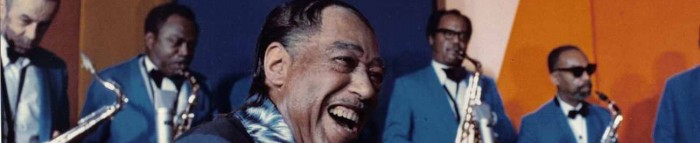
We hear the difference between traditional and modern jazz when we consider what the bebop and post-bop musicians were doing on the one hand and what Ellington and his co-composer Billy Strayhorn were doing from the 50s to the mid-70s. Ellington is seen, and saw himself, as carrying the European classical music tradition into the American idiom of jazz. Strayhorn, classically trained, worked in the same vein. From the 40s until Strayhorn’s death in 1967, they created dozens of works together, many of them performed and released as suites. Recently I heard the argument that the suites are collections of related short works that just as easily stand alone. This is a little specious, I think, because certainly the same thing can be said of many of the classical works to which Ellington would of compared his own. You can separate the movements of a Bach cantata, a Beethoven sonata, or a Puccini opera, but that doesn’t make the pieces from which they’re drawn less valid as complete works. (Track 6, Lady Mac, comes from Such Sweet Thunder, their 1957 suite on Shakespearean themes.)
I’m going to get a little ahead of myself here, but following on from traditional, modern, and the various bop eras of jazz (bebop, post-bop, hard bop), we get Free Jazz. One way to look at free jazz in this context is to consider traditional verse forms that are bound by both rhyme and meter. Pick a sonnet by Shakespeare or John Donne, for example, or this one by Thomas Hardy from (I think) the 1870s:
At a Lunar Eclipse
Thy shadow, Earth, from Pole to Central Sea,
Now steals along upon the Moon’s meek shine
In even monochrome and curving line
Of imperturbable serenity.
How shall I link such sun-cast symmetry
With the torn troubled form I know as thine,
That profile, placid as a brow divine,
With continents of moil and misery?
And can immense Mortality but throw
So small a shade, and Heaven’s high human scheme
Be hemmed within the coasts yon arc implies?
Is such the stellar gauge of earthly show,
Nation at war with nation, brains that teem,
Heroes, and women fairer than the skies?
(Track 7, read at 2 minutes 35 seconds) There’s five feet of one unstressed and one stressed syllable per line (iambic pentameter), 14 lines, with a fixed rhyme scheme (in this case ABBA/ABBA/ABC/ABC). This is an example of formal poetry (that which adheres to a strict format).
There are dozens of different such standards. In 1849, Tennyson published an epic poem called In Memoriam made up entirely of 4-line iambic tetrameter (4 feet rather than five) stanzas with the ABBA rhyme scheme. (It runs to over 100 pages and in college I found it astoundingly dull, but once in my 30s, I found it fascinating.)
Now go back to any of Shakespeare’s plays (or those of his contemporaries). The meter used in Elizabethan plays is the same, but it’s generally unrhymed (though you might get a rhyming couplet at the end of a long speech or the end of a scene) – this is Blank Verse:
How far is’t call’d to Forres? What are these
So wither’d and so wild in their attire,
That look not like the inhabitants o’ the earth,
And yet are on’t? Live you? or are you aught
That man may question? You seem to understand me,
By each at once her chappy finger laying
Upon her skinny lips: you should be women,
And yet your beards forbid me to interpret
That you are so. (Macbeth, Act 1, Scene III)
Now jump forward to the mid-20th century poets who rely on neither rhyme nor meter, but the rhythm of the words alone to carry the poetry. This is Free Verse. For example:
This Is Just To Say by William Carlos Williams (1934)
I have eaten
the plums
that were in
the icebox
and which
you were probably
saving
for breakfast
Forgive me
they were delicious
so sweet
and so cold
(Track 8 is Williams himself reading another of his pieces of free verse.) Blank verse might be akin to the first flights in bebop in which the mode (which is like a scale) governs the notes the players use in a piece and from which they rarely diverge, always returning to the theme. The players constrained their improvisations, no matter how high-flying those solos might seem.
In the 50s, we also saw the rise of the Beat movement in American letters, exemplified by Jack Kerouac, Allen Ginsberg, and William S. Burroughs, who all saw musical possibilities associated with their writings. Kerouac read from On the Road with Steve Allen backing him on piano and later recorded an album with him. Tracks 9 and 10 are Kerouac reading two pieces about jazz.
Ginsberg, who saw himself as an inheritor of Walt Whitman, often recorded his readings. His presentation plays up the rhythms inherent in his free verse. This 1959 recording of A Supermarket In California (track 11) is perhaps less musical than some of his later presentations.
While Burroughs wasn’t a poet, per se, he wrote a lot about the recorded word, recorded his readings, and made recording experiments, such as those found on Breakthrough in Grey Room from the 60s and 70s. He was well aware of the musical qualities of his own voice – you can get a taste of this in Burroughs Called the Law (track 12). In the 90s, Burroughs and Ginsberg both recorded albums with relatively modern musical accompaniment for the Island label.
The connections between the Beats and the jazz world are more varied than this, but I do want to point out that Kerouac, in On the Road, writes about seeing Slim Gaillard, whom you’ve already met…
‘… one night we suddenly went mad together again; we went to see Slim Gaillard in a little Frisco nightclub. Slim Gaillard is a tall, thin Negro with big sad eyes who’s always saying ‘Right-orooni’ and ‘How ’bout a little bourbon-arooni.’ In Frisco great eager crowds of young semi-intellectuals sat at his feet and listened to him on the piano, guitar and bongo drums.
…When he gets warmed up he takes off his undershirt and really goes. He does and says anything that comes into his head. He’ll sing ‘Cement Mixer, Put-ti Put-ti’ and suddenly slow down the beat and brood over his bongos with fingertips barely tapping the skin as everybody leans forward breathlessly to hear; you think he’ll do this for a minute or so, but he goes right on, for as long as an hour, making an imperceptible little noise with the tips of his fingernails, smaller and smaller all the time till you can’t hear it any more and sounds of traffic come in the open door. Then he slowly gets up and takes the mike and says, very slowly, ‘Great-orooni … fine-ovauti … hello-orooni … bourbon-orooni … all-orooni … how are the boys in the front row making out with their girls-orooni … orooni … vauti … oroonirooni
…” He keeps this up for fifteen minutes, his voice getting softer and softer till you can’t hear. His great sad eyes scan the audience. Dean stands in the back, saying, ‘God! Yes!’ — and clasping his hands in prayer and sweating. ‘Sal, Slim knows time, he knows time.’ Slim sits down at the piano and hits two notes, two C’s, then two more, then one, then two, and suddenly the big burly bass-player wakes up from a reverie and realizes Slim is playing ‘C-Jam Blues’ and he slugs in his big forefinger on the string and the big booming beat begins and everybody starts rocking and Slim looks just as sad as ever, and they blow jazz for half an hour, and then Slim goes mad and grabs the bongos and plays tremendous rapid Cubana beats and yells crazy things in Spanish, in Arabic, in Peruvian dialect, in Egyptian, in every language he knows, and he knows innumerable languages. Finally the set is over; each set takes two hours. Slim Gaillard goes and stands against a post, looking sadly over everybody’s head as people come to talk to him. A bourbon is slipped into his hand. ‘Bourbon-orooni — thank-you-ovauti …
One could argue that for all the radical aspects of Kerouac’s writing, he was essentially conservative. Ginsberg would later ally himself with the hippy movement (while Kerouac essentially drank himself to death, sadly). I bring the Beats in though, because the associations between the new jazz and the new poetry in the 50s were especially tight.
At the same time Ken Nordine’s Word Jazz albums played with this same concept, generally to humorous effect (track 13), though often disturbing. Nordine’s distinctive voice also found its way into advertisements.
These same associations saw a revival in the early 90s with the slam poetry scene (Mike Myers manages to parody both in So I Married An Axe Murderer (www.youtube.com/watch?v=GlkoQ4bUE5k).)
The main exponent of Free Jazz was saxophonist Ornette Coleman, though he was far from the only one. In the late 50s, his combos recorded a couple of hard bop albums for Prestige, and he signed to Atlantic in 1959. The second Ornette Coleman quartet recording for Atlantic, Change of the Century, featured Free (track 14), which gives an idea where the form is going.
The music they created was becoming more and more wild/requiring more and more listener involvement. In 1961 they branched out with the album (surprisingly titled, I’m sure you’ll agree) Free Jazz, consisting of two long movements. We’ll get there, because I’m obviously getting ahead of myself. There’s more in the 50s to cover before the 60s get weird. These albums opened new vistas regarding what jazz could be.
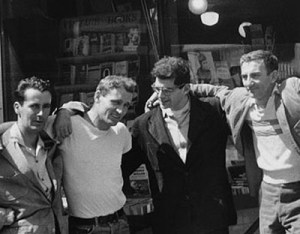 Note that bassist Charlie Haden and trumpeter Don Cherry have/had wide-ranging jazz careers as well as musical offspring. Haden, aged 76 is still active. [[ETA: I wrote this in October 2013. Haden passed away in July of last year.]] His son Josh Haden is a bass guitarist and singer and fronts the band Spain. His triplet daughters, Petra, Tanya and Rachel Haden, are all musicians. Petra and Rachel were in that dog; Petra was a member of progressive folk group The Decemberists; Rachel played in the rock band The Rentals. (Tanya is married to actor Jack Black, which is just weird, especially recalling that a Jack Black film was the impetus for this little history project.)
Don Cherry’s stepdaughters Neneh Cherry and Titiyo and his sons David Cherry, Christian Cherry and Eagle-Eye Cherry are also musicians. Neneh had a few pop hits, including 1989’s Buffalo Stance.