The blog entry I couldn’t recall yesterday on why the word feminist shouldn’t exist is here: https://ronniehurd.wordpress.com/2015/02/20/the-word-feminist-shouldnt-exist-heres-why/

He concludes:

I’m not saying to cut ‘feminist’ out of our lives cold-turkey, nor do I have any disdain for whypeople that use it to describe themselves. However, I do believe that by using ‘feminist’ to describe yourself, you’re feeding the idea that feminists should have to defend their position, when in reality it needs no defense. It implies that at some point you began to form feministic views in the same way you began to lean Democrat or Republican. One day, children will be embarrassed to have misogynistic and anti-gay relatives the same way we’re embarrassed to have racist ones now. Leave the long list of titles for the barbarians, the rest of us are just…people.

My friend Hope posted the following response to an anti-feminist rant singer Johnette Napolitano gave at a recent gig (copied in full with permission):

And what a shame that I was so terribly distracted by your little speech on feminism, and why you’re not a feminist.

I gather it started out on Twitter, and someone, whose opinion you discounted based on their age, called you out for eschewing the label “feminist,” while still espousing feminist ideals.

I’m 44. Maybe you’ll deem my opinion valid?

You said you weren’t a “feminist” but rather a “humanist,” and that you didn’t like “the woman box” — “woman musician,” “female singer,” “lady guitarist.”

You know why we need feminism? Because of “the woman box,” for starters. There are two kinds of musicians: “musicians,” and “female musicians.” Guess which one is the default setting? I’ll give you a hint: It doesn’t have ovaries.*

It’s like the brouhaha over “Black Lives Matter” versus “All Lives Matter.” Do all lives matter? Of course. But no one is saying that white lives don’t matter.

Feminism is about leveling the playing field and giving women equal opportunities as men. Are you seriously saying you’re opposed to that?

*Generalizing, of course. There are plenty of transmen, intersex men, XXY men, and other men who have or have had ovaries.

That nails it quite well, sadly. Another blogger, Amy Steele, called Napolitano on this as well.

Politics? Again?
I haven’t written on politics in a while. A couple of months ago I was working up something on feminism based on another entry I’d read on the subject of feminism. A male blogger whose name and article I don’t have to hand suggested that feminism is a strange word because supporting the rights of all to equal treatment under the law should be the default position. My aunt Karen, a professor of law and long-time writer on matters of gender, argues that there are three related terms: feminism, as above; antifeminism, the position that women are somehow less than men and should occupy only limited space in family, law, and discourse; and pre-feminism, the position of those who don’t yet recognise that women are disadvantaged by dint of gender in more ways than we know how to count and with one or two eye-opening experiences will move to the other side. She discussed a male student of hers (possibly in a family law course) married to a female naval officer – not a man likely to overlook or be daunted by a capable woman. I don’t recall precisely what Karen said her lecture covered, but the man was compelled to change his views on not only the issues faced by his wife but of all women struggling for acknowledgement in the working world. (My conversation with Karen was almost two months ago and I was certain I had notes on the matter, but I have lost them.) 

 I was alerted by a facebook link to http://tableflip.club/. This page contains a manifesto of sorts for women leaving the tech industry. I would direct you to read it – it runs about 500 words.

On a certain level I’m fascinated (and horrified) by the treatment women receive in the tech industry. The main thing that surprises me about Tableflip is that it hasn’t happened sooner. I’m pretty sure Ellen Pao’s recent court case has a lot to do with it, but that might only be because the verdict seemed so egregiously wrong, and it was so well-publicised. 

The writers also explicitly push back at the whole Lean In concept. When that book came out, I heard a couple of interviews with its author, Sheryl Sandberg. While astoundingly accomplished and obviously brilliant (Harvard, McKinsey, Google, FB, etc.), she seems generally unaware of how hard most people have to work to get even a tenth as far as she has. So I’m not too surprised that equally brilliant women who haven’t had quite Sandberg’s career path are keen to do something about it. 

 I’ve been in tech for about 15 years now – I started in customer support for a hot cable broadband firm that tanked in the year I worked there (coincidence is not causation). I was then mentored into technical documentation by a fantastic and fantastically capable woman. I did mostly contract work for a couple of years before I moved to Europe. In Prague I spent a few years at Systinet (now a subsidiary of HP), surrounded by about a hundred mostly young, mostly male developers out of CVUT (the Czech technical university). I recall three women: reception, HR, and a brilliant, intuitive Slovak woman named Bea. The company was ecstatic to have her – at one point she left to spend a period in Australia with no plan to return. When she returned to Prague about a year later, she didn’t have to ask twice. They may have asked her which team she wanted to work with. Alas she died of a very swift illness several years ago. Never got to see how far her brain would take her.

I don’t think Systinet mistreated its one female developer, but they didn’t work too hard to recruit more. 

I moved from there to Sun Microsystems (now a subsidiary of Oracle). I had a large number of female colleagues there – I think Sun nurtured its female staff, but most of the politics went on in California. I knew people who’d been with Sun for 10, 15, 20 years, but that doesn’t mean they weren’t subverted in their quests for advancement and equality. Just that I didn’t see it directly. The dozen or so mostly white males at the top of the company probably say enough about female advancement there, however. 

 In Nederland, I’ve worked primarily for two relatively old firms in which the same story plays out – very few female developers and no women above a certain level on the food chain. A couple of product owners, a few developers. My current company is a 30-year old producer of enterprise resource software. I’m pretty sure the highest woman there is a bold brash Afrikaner who holds a bespoke position between the product owners and the management team. I’m not sure whether the scenario plays out the same way here as it does in the Silicon Valley of the tableflip folks, but I have my suspicions. 

 The Tableflip manifesto gives a major hat tip to a blogger (new to me, but this isn’t surprising) named Amelia Greenhall who is fierce and articulate in her articles about how women are treated in the boardroom and the media and in her advocacy of how women can advance in the world on their own (not leaning in) terms. I’m now busily flipping through her blog and wishing I could follow every link. One of several neat things her writing provides is insight into the tech world from both developer and human standpoints. A long entry on twitter DM etiquette doesn’t just say, ‘don’t be a creep,’ but tells why DMs from new male followers creep out female twitter users. And next to that, she’ll post about how to get ahead (fairly!) in publishing and pop in some satire as well. (It took me a couple reads to get her piece on Uber investor Jason Calicanis.)

I’m sure the links from Ms Greenhall’s entries can keep me busy for an awfully long time, but the timesink involved will be a good diversion from the trio of Kos, AmericaBlog, and Crooks & Liars which generally keep me distracted. 

 And here’s to learning more, including
10 Simple Words Every Girl Should Learn
by Soraya L. Chemaly which also requires dissemination. I’d like to believe I’m slightly more aware of the male things I do that Chernaly finds so bloody frustrating, but I’m still far from excising them.

Blues and early rock and roll records brought over to the UK in late 50s and early 60s inspired young Englishmen no longer required to participate in national service. [http://en.wikipedia.org/wiki/Conscription_in_the_United_Kingdom#After_1945] to form bands.

The Rolling Stones for example: http://www.noisemademedoit.com/wp-content/uploads/2012/07/mick-jagger.jpg

In 1957, Parliament ended mandatory conscription with those born in 1939. The oldest Beatles (Ringo and John) were born in 1940. Two members of the Rolling Stones, Ian Stewart and Bill Wyman (ne Bill Perks) were old
enough to do national service. Wikipedia indicates that Wyman actually did, and took his stage name from a national service colleague. No member of The Who or the Kinks was old enough to do national service.

American soldiers stationed in the UK and Germany brought over the sounds of the blues. But the appreciation of English lads for American blues music spawned a scene that included Page, Clapton, Beck, the Yardbirds, the Rolling Stones, The Who, and (to a lesser extent, oddly enough), the Beatles. Poppier bands, including Gerry and the Pacemakers and Herman’s Hermits piggybacked onto the successes of these English blues-based rock bands in the US.

The paragraphs that follow fall into that well-known category of writing known as Rock Critic Clap Trap. I argue one point here, but it’s all but guaranteed I’ll be arguing another way next time.

My argument is that none of the British Invasion bands had vital and influential careers much into the 70s, save one. The Beatles were over by ’69 and their continued influence was based on their work as the Beatles, not the solo work. The last Stones album worth its salt is ‘72’s Exile on Main Street. Every album that came after is held up to Exile and found wanting.  (Love Emotional Rescue and Some Girls though I do, they don’t hold a candle.) The Who’s vitality carried through to the mid-70s, but with Keith Moon’s death (Not to be removed) in ’78, they were pretty much over (the ’82 stadium tour with the Faces’ Kenney Jones on drums and the Clash opening notwithstanding).

That one would be the Yardbirds.

Like the Stones, they started out as a bunch of white guys doing covers of American blues. Their first three albums, recorded between 64 and 65 leaned heavily on Chess covers. The first album featured guitarist Eric Clapton, a self-professed blues purist. The second and third also had Jeff Beck.

Their first album, 1964’s Five Live Yardbirds consisted entirely of American rock and blues covers including three Bo Diddleys, a Chuck Berry, and a Howlin’ Wolf. A later expanded edition (20 tracks compared the 10 on the original release) had one Keith Relf original, but added more of the blues covers. They handle the covers admirably but what’s most apparent to me is that they’re enjoying making the music. Relf’s original, Honey in Your Hips, relies on that Bo Diddley beat, and I think owes a bit to Carl Perkins (vocally) and Larry Williams (for the choice of lyrical content, such as it is).

In ’65, For Your Love was an amalgamation of single and EP tracks cobbled together for the US market in advance of an American tour.  The title track was the first of three hits for the Yardbirds penned by Graham Gouldman (later of 10cc among other acts). Its poppier leanings led to Clapton decamping for John Mayall’s Bluesbreakers. This album is also the first to feature Jeff Beck.

The following release, 1965’s Having a Rave-Up with the Yardbirds, also cobbled together for the US market contained songs from singles and the earlier albums, and both Beck and Clapton tracks. Two more Gouldman songs, Evil-Hearted You and Heart Full of Soul kept this album on the charts for almost nine months.

But 66’s The Yardbirds (aka Over Under Sideways Down and aka Roger the Engineer) featured all original material by the band. It opens with Lost Woman, a blues –based track that would have been pretty comfortable on the earlier albums. We know we’re heading into new territory with the sitar opening of Over Under Sideways Down. The album combines pop, two blues instrumental from Beck (The Nazz Are Blue, Beck’s Boogie), psychedelia
(Hot House of Omargarashid). The closer, Ever Since the World Began offers something oddly psychedelic before moving into something like folk blues and concludes without resolution which is still weird in pop and not done often, much less on the last track on side 2.

Somewhere between Over Under and the follow-up, Little Games (the final Yardbirds album until a 2003 regrouping), session musician Jimmy Page joined. For a short while, both Beck and Page shared duties in the band. The obligatory club scene in Antonioni’s classic Blow Up features them onstage together performing Stroll On. However, shortly after this, Beck was sacked (according to W’pedia) “both for being a consistent no-show and difficulties caused by his perfectionism and explosive temper” – an odd combination of reasons to be sure.

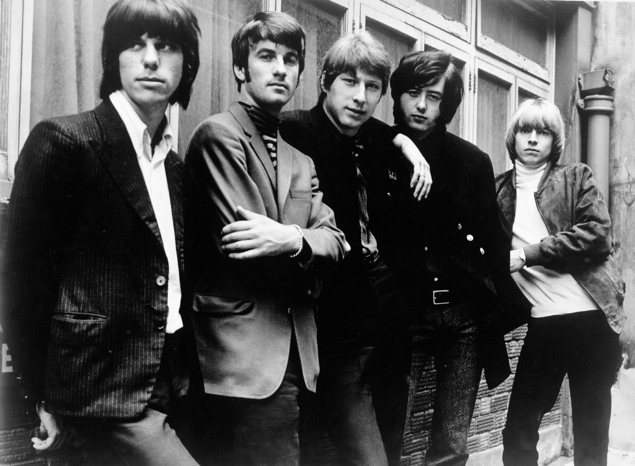
Rock Group "The Yardbirds"The Beck/Page band didn’t record very much else together, and Page, it seems, took a lot of control of the band. Seven of the ten tracks on Little Games bear Page writing or co-writing credits. The album leans towards harder electric blues than Over Under had done. Side one opens with two such hard blues before backing up a step into Page’s White Summer, a song that would be a live staple in Page’s next band. There were other switches in line-up as well – Bassist Paul Samwell Smith left to concentrate on music production and rhythm guitarist Chris Dreja took over the bass. (Among other things, Samwell-Smith was the music director for the movie Harold and Maude.)

There are detours into psychedelia and the pseudo-music hall of Stealing Stealing. Like White Summer, the guitar on Only the Black Rose presages the acoustic sounds Page would later pursue. By ‘68, the remaining original members of the band were keen to do other things. Clapton had gone on to form the psychedelic blues trio Cream with Jack Bruce and Ginger Baker and Relf and McCarty were more interested in folk music – they went on to form Renaissance with Relf’s wife Jane on vocals, though Keith Relf left that band after the first album.

Strangely, the last addition to the band, Page, was left with the contractual obligation to finish the ‘68 tour. Several vocalists were considered including Terry Reid, who had toured the US with Cream. Reid declined, but recommended an unknown named Robert Plant. Plant in turn recommended his friend John Bonham for the drum kit. The New Yardbirds were rounded out by a session bassist named John Paul Jones who had played bass on the Yardbirds single Happenings Ten Years Time Ago. This quartet finished the contractual tour of Scandinavia, but decided a new name was needed (for a variety of reasons) when they settled in to record an album in ’68. The phrase Lead Zeppelin was lifted from a comment Keith Moon had made regarding the group who recorded the song Beck’s Bolero (Beck/Jones/Hopkins/Moon/Page). A change of spelling set the stage for the band that would rule rock and roll for the next twelve years. (Sorry about that – more clap trap.)

She awoke hungry in the back of the cave where she had slept most of the cold seasons of the past decades. Her hair matted and short framed a face that didn’t seem rested, in spite of its sleep. No part of the cave was high enough for her to stand, so she crawled to a near wall where her sword leaned. She knelt before it, its haft forming a cross.

Aloud, she spoke, ‘Father in heaven, look after the king’s health, the souls of the knights on our quest, and grant me the patience and strength to see our quest to the end whoever may achieve it.’

She gave her devotions to this saint and that and to ‘Barren Mary made fertile by God, please bless this enterprise and shower this barren land.’ Her devotions had become rote too, as a prisoner’s routine, shake a shackle, drink the dirty water, drift in the snow.

idylls-of-the-king-9 She added a personal prayer for meat to thicken her gruel, thinking of a rat which had snuck several times recently into the cave. She remained, hands clasped in front of her mouth, eyes closed, for several minutes before offering a concluding, ‘Amen’.

Words came from her lips and to the front of her mind as they had every morning for as long as she had searched. She meditated in the same way on the chalice, passed between the disciples, the faces of each one coming clear to her mind in a dusty room over a Jerusalem in springtime flower.

CC-noncom

Read the rest of this entry »

The Listserve is an interesting proposition. If you sign up, you receive one email a day from one of the (currently) 23,846 other Listserve subscribers. And get the chance to be the one who sends an email on almost any subject you like to those other subscribers. The trick is you have 48 hours from when you receive the winning email to provide your post. A few days ago, I won the Listserve Lottery. I was on a very short holiday to the US and the evening before I opened the email, an aunt provided me the subject matter:

I live near the Hague in a lovely old university town, but I grew up in California. Most years around this time of year my wife and I visit family in Maryland for what we call Camp Pesach. When I was younger, we’d celebrate Passover with my mother’s parents, her three siblings, as many of our cousins in that part of the family who could make it (and as most lived on the east coast, this was really just an issue for my sister, my parents, and me). Last night over shabbat supper, my Aunt Karen recounted what was essentially my grandmother’s dying wish, that we continue to gather as a family, and not slip away from one another. So each year, Bobe’s four children, their spouses, her eight grandchildren and their spouses and children gather in a big house on Chesapeake Bay. It’s 28 of us this, the 20th, year of Camp Pesach. (For a variety of reasons we’re gathering a little early – we allow such concessions as we’re gathering from two coasts, two continents, and three or four states now.)

Back in the early days of this celebration, my sister and I compiled a Haggadah (the book of prayers and stories and songs that make up the Passover seder) for the family in small ring binders so that we could add new material, family photos, and so forth. This year she asked me and my uncle Dana for poems to add. I gather that his runs to four pages, mine to 18 lines:

Wandering, we pitch our tent again,
Gathering, our clan, about the flames,
Reclining, kings and queens, before the feast.

Ancient histories and new,
Far loved ones and near,
Recount – It would have been enough,
Shankbone, orange, and charoset,
Blood and frogs and bitter herbs.
Who knows one, I know one little goat.

We drove a stake into the desert
(For we did these things,
our grandparents, our aunts and cousins,
Twenty generations back or twenty days.
All at once, all of us)
We poked a stick into the desert floor.

Taking root, a willow, branch and leaf,
An oak, a spreading chestnut,
Under which we spread our feast.
-=-=-=

This is the first poem I’ve written in a few years and I’m rather pleased with it.