She awoke hungry in the back of the cave where she had slept most of the cold seasons of the past decades. Her hair matted and short framed a face that didn’t seem rested, in spite of its sleep. No part of the cave was high enough for her to stand, so she crawled to a near wall where her sword leaned. She knelt before it, its haft forming a cross.

Aloud, she spoke, ‘Father in heaven, look after the king’s health, the souls of the knights on our quest, and grant me the patience and strength to see our quest to the end whoever may achieve it.’

She gave her devotions to this saint and that and to ‘Barren Mary made fertile by God, please bless this enterprise and shower this barren land.’ Her devotions had become rote too, as a prisoner’s routine, shake a shackle, drink the dirty water, drift in the snow.

idylls-of-the-king-9 She added a personal prayer for meat to thicken her gruel, thinking of a rat which had snuck several times recently into the cave. She remained, hands clasped in front of her mouth, eyes closed, for several minutes before offering a concluding, ‘Amen’.

Words came from her lips and to the front of her mind as they had every morning for as long as she had searched. She meditated in the same way on the chalice, passed between the disciples, the faces of each one coming clear to her mind in a dusty room over a Jerusalem in springtime flower.

CC-noncom

Read the rest of this entry »

The Listserve is an interesting proposition. If you sign up, you receive one email a day from one of the (currently) 23,846 other Listserve subscribers. And get the chance to be the one who sends an email on almost any subject you like to those other subscribers. The trick is you have 48 hours from when you receive the winning email to provide your post. A few days ago, I won the Listserve Lottery. I was on a very short holiday to the US and the evening before I opened the email, an aunt provided me the subject matter:

I live near the Hague in a lovely old university town, but I grew up in California. Most years around this time of year my wife and I visit family in Maryland for what we call Camp Pesach. When I was younger, we’d celebrate Passover with my mother’s parents, her three siblings, as many of our cousins in that part of the family who could make it (and as most lived on the east coast, this was really just an issue for my sister, my parents, and me). Last night over shabbat supper, my Aunt Karen recounted what was essentially my grandmother’s dying wish, that we continue to gather as a family, and not slip away from one another. So each year, Bobe’s four children, their spouses, her eight grandchildren and their spouses and children gather in a big house on Chesapeake Bay. It’s 28 of us this, the 20th, year of Camp Pesach. (For a variety of reasons we’re gathering a little early – we allow such concessions as we’re gathering from two coasts, two continents, and three or four states now.)

Back in the early days of this celebration, my sister and I compiled a Haggadah (the book of prayers and stories and songs that make up the Passover seder) for the family in small ring binders so that we could add new material, family photos, and so forth. This year she asked me and my uncle Dana for poems to add. I gather that his runs to four pages, mine to 18 lines:

Wandering, we pitch our tent again,
Gathering, our clan, about the flames,
Reclining, kings and queens, before the feast.

Ancient histories and new,
Far loved ones and near,
Recount – It would have been enough,
Shankbone, orange, and charoset,
Blood and frogs and bitter herbs.
Who knows one, I know one little goat.

We drove a stake into the desert
(For we did these things,
our grandparents, our aunts and cousins,
Twenty generations back or twenty days.
All at once, all of us)
We poked a stick into the desert floor.

Taking root, a willow, branch and leaf,
An oak, a spreading chestnut,
Under which we spread our feast.
-=-=-=

This is the first poem I’ve written in a few years and I’m rather pleased with it.

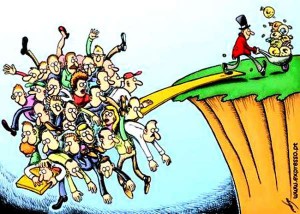
The DecodeDC podcast aired a discussion (episode 67) with English economist Richard Reeves of the Brookings Institution who talks about ways to measure the (in)equality of opportunity in America. His study divides the population into slices of 20% each – families who are in the top 20% of earners (about $150,000/year for a family of four) are 1s, the next 20% are 2s and so forth. The research found that if you’re a 1, your children will also be 1s and if you’re a 5, your children will remain in that state as well. Not too counter-intuitive, these days. He then brings up the obvious point that  there are several gaps: Marriage, Education, Neighourhood, and Race, like so:

  • Children raised by  two parents are more likely to move up than children raised by one.
  • Children raised by parents who earn degrees are more likely to move up.
  • Children raised in poor neighbourhoods are more likely to stay in them
  • Non-white children are more likely to remain in their quintiles or slip into lower ones than white children.

What I missed from the podcast clip (but is well-covered in Reeves’ own reporting below) was how these numbers have changed over the last hundred years.

income_inequalityMy guess was that 100 years ago, the numbers were a little better than they are now – mobility of immigrant populations especially was based a lot on making it by the sweat of their labours. However, poor blacks were more likely to remain poor blacks. There was probably a little more mobility in the post-WW1 boom time for non-blacks, but this was probably exaggerated, much as the mobility of the late 90s mini-boom was.

The period I’m most interested in is from 1945-1990, during which time there was a great deal more mobility and a much smaller gap between the richest and the poorest. The gap started to expand again during the Reagan years, but I think the real damage of his policies came after he left office. There were inklings in the Clinton years that things were going to go horribly wrong in the inequality department, but they only hit high gear in the Bush Jr. years.

Reeves goes into much greater detail regarding the history in his essay Horatio Alger: Equality, Opportunity, and the American Dream: ‘In the first half of the 20th century, after the closing of the frontier, the rapid growth of the nation slowed, with the result that both income and wealth gaps widened to European proportions, and the engines of upward mobility stalled.’

Post-WW2, the combination of social mobility programmes like the GI bill, and relatively high rates of taxation at the top of the scale meant that there was a bit more mobility, but that the wealth gap was much smaller.

As noted, the inequality trends returned with the Reagan years, but their trajectory was stunted somewhat by the stronger economy of the Clinton years. Bush Jr.’s tax cuts and financial deregulation (begun in the 90s – some of the fault does go back to Clinton) did in what was left of general upward mobility.

So those are some of the big political issues that affect the gap, but every day we see things that are built to make it bigger. Easy credit is one – possibly non-existent 100 years ago, but everywhere in the US today. (My ex worked in secure card customer service back in the 90s – people who had no business with plastic in their wallets were bankrupting themselves. There has been no effective tightening of those rules in the intervening 20 years either.)

Another one is health insurance. While Obama’s done astounding work making the cost of insurance lower and easier to bear for many, health insurance firms have always been for-profit ventures and this has exploded in the last 25 years or so. A business that raises rates even 10% year on year and predicates itself on denying the service it purports to be selling is not health, but is likely to be very profitable if the service it sells is required. Even if you pay into the system, in states that haven’t implemented ACA, one good accident can bankrupt you. (Combine that with the ever-relaxing rules on gun ownership and the goose that lays the golden eggs just got a dose of fertility drugs.)

Note that big medicine has fought single-payer health in the US for over 100 years. Didn’t think the argument went back that far? Franklin Pierce vetoed a bill calling for federally funded asylums for the blind, deaf, and insane in 1854. Both Theodore and Franklin Roosevelt supported plans for state-funded or federally funded health schemes which the American Medical Association opposed. The AMA and the insurance industry opposed Medicare and Medicaid, but President Johnson managed too push those through in the 60s. And all attempts to expand on those propositions has been vehemently opposed ever since. Even the summaries in Wikipedia of this fight churn the stomach.

The Tories have been taking these ideas and running with them. How to get more money out of the pockets of the middle classes in return for next to nothing? Privatise national health. For decades, everyone has paid into the NHS and for the last decade or so the NHS has been shrinking its services. My in-laws live in an area of scattered small villages. There used to be a good hospital relatively nearby. Shut. Should there be an emergency in any of half a dozen villages, and possibly more, it’s at least an hour to the nearest major hospital.

Have their taxes gone down? No. And even if they had, the whole point of health insurance (at the national or private level) is that of collective risk. And bearing a collective burden for the greater good. Sort of like vaccination, but that’s another discussion.

I’ve probably discussed tuition fees before – Ronald Reagan instituted tuition payments on the public college/university system in California back in the 60s. These were still low when I enrolled at San Francisco State University in 1985. $300/term for the first year. When I left in 1989, my final semester cost $1300. It’s now about $6300 per term. In the UK, all of the universities were free until Cameron found another way to reward the bankers. My wife’s degree from Cambridge had no tuition. She had to be brilliant enough to get in, but family wealth wasn’t a consideration. Now? £9000/term. Add interest to those student loans, and it’s a windfall.

So, yeah, the movement of wealth from the bottom rungs to the top is, among other things, about college, credit, and coronary risk. It’s also about the ownership of legislatures and electoral processes by moneyed interests (whose wealth isn’t decreasing).


Not necessarily in that order. On August 5, 1986, my father turned 48 years old. On that date, I was 19 years, 4 months and 8 days old. I took him to a club in Santa Monica to see two comedians. The first was a juggler and the more interesting of the two, at least from dad’s perspective. I think he juggled bowling balls and apples at the same time, though I might be mistaken. The second was the guy who did the sound effects with his voice in the Police Academy movies. I was quite taken with his use of a digital sampler. Dad, an engineer and patent attorney, told me after the show that the technology in the sampler was similar to or derived from that used in radar. I’ve never verified this. I wore a silk necktie given to me by my ex-girlfriend for the previous Hanukkah on which I managed to spill sour cream from my nachos.

heartA couple of weeks later, the night before I returned to San Francisco for my sophomore year at SF State University, we had an argument about what I was going to do with my life. I was having a hard enough time just being in school and trying to pass my general ed without figuring out my future, though I had some idea that I wanted to teach.

It was the last time I saw him, not counting the day before he was cremated.

We argued about my future at least once more on the phone, though probably two or three times in the seven weeks before I returned to LA for the funeral. He probably died of a heart attack. There was no autopsy. Though he had a family history of heart disease, he hadn’t been to a doctor in ages. His mother died of cancer less than a year before he died, though she, too, had had a heart attack at 48. (She was single-handedly running an ice cream parlour in DC and, from the stories I heard, living on coffee and possibly milk shakes.) His father had died about ten years before, though I don’t recall the cause. I want to say it was coronary artery disease, but I’d need to verify.

So, in case you haven’t done the math, in about four weeks, I will also turn 48. For a long time I had this division of my life into three parts: The first 19 years, the last 19 years, and the 10 in between (which didn’t quite conclude with my separation from my first wife – life’s not quite that poetic). I figured when I was much younger that if I got beyond 48 myself, then everything else would be whipped cream on top.

My wife is aware of my obsession with the upcoming birthday, and tries very hard to keep me from overdoing my workouts. She had an uncle who died relatively young whilst on the treadmill at his gym. He was also under doctor’s orders to exercise for health.

I eat relatively well, am a little overweight, run for fitness, and see my doctor at least once a year. The most recent labs were all within normal limits. Blood pressure still slightly low as it has been since I was 22. My plan is to stick around for a great deal longer – 10 weeks or so after my next birthday, Rachel and I will celebrate our 5th anniversary (and almost 11 years together). I look more and more at my other family members. My father’s sister is still kicking ass and taking names at 74 or so and my mother just celebrated her 75th. And my maternal grandparents both lasted well past 80, including 53 years together. My mother didn’t think she’d see an anniversary like that, but has been with my stepdad for 39. Well on the way, really.

I miss my father most when I dream about him. In dreams, I often try to make him happy with what I’ve made of my life. He was brilliant (Engineering Princeton, JD from Georgetown) and astoundingly clever, though sometimes not very smart. Only in his last few years (and with his third wife) was he on his way to being happy. For my part, my life overflows with happiness most of the time, and as long as I’ve brought a fraction of that to other people, I can go when it’s my time without regret.

A friend recently posted a list of her 2014 reads. I used to do the same rather religiously but haven’t in several years. I read much more slowly, but also more carelessly than I used to. I’m sure I’ve finished more than three books so far this year,  but possibly not.

So:
All the rage by Ian MacLagen. Great recount of 50 years in the music biz, punctuated by bouts of heavy drug use. Or perhaps it’s the other way around. (MacLagen played keyboards with the Small Faces/Faces,  the Stones and much later with Billy Bragg. Passed away late last year. Helluva life.)

Inherent Vice by Thomas Pynchon. Good stuff, though it is very much Spade meets Lebowski. Looking forward to seeing the movie. It takes place in LA in the wake of the Manson murders and had a number of settings I know from my childhood.

To kill a mockingbird by Harper Lee. Still potent, still a classic. Recent revelation that the novel had its genesis as a flashback in a different story of an adult Scout visiting home gives a stronger basis for the language the narrator uses. Much of Scout’s voice is too old,  but you never know how old.

Now working on a volume of short stories by Uri Kurlianchik,  one of the contributors to Red Phone Box called Israeli Storyteller. Some fantasy,  some horror. Quite compelling stuff. 

Debating whether to dive into Pynchon’s Bleeding Edge now or something else.