Here I look at Lady Day’s final years. She was madly prolific, and along with dozens of classic tracks, recorded two of vocal jazz’s definitive albums: Lady Sings the Blues and Lady in Satin.
Billie’s Blues – Part 1

http://open.spotify.com/user/bishopjoey/playlist/2isTukXm4f9hIU4y6kPGvn

1955    Music for Torching (Clef) /
1956    Velvet Mood (Clef)
Recorded: August 23 & August 25, 1955

Recorded only six months after Stay with Me, you can hear Billie’s voice start to falter in front of this tight combo.

Donald Clarke, in his biography of Lady Day, Wishing on the Moon, (2000) indicates that Billie was in general in a bad way in these years – the 1954 sessions were contentious due to various hangers on and alcohol. The man she was with, a “mafia enforcer” (according to Wikipedia) and pimp named Louis McKay, who took all the money she made and kept her in a state of malnutrition.

This collection very much adheres to the themes of unrequited love suggested by the title, and her phrasing is still pretty tight. On a JATP bill she shared with Ella Fitzgerald during this period, the second half of her set was a bit of a mess – something she blamed on Oscar Peterson (with whom she never worked again), though one guesses it was the drugs. I’m not sure whether this is the show that was released as Live at JATP. In ’54 she cleaned up briefly, but by the end of the year was using again.

Clarke (who isn’t exactly objective in his writing) states that the combo on Music for Torching is “one of the best line-ups Lady ever had.” The subject matter is, as always, love, about equally balanced between requited and not. Come Rain or Come Shine, A Fine Romance, I Get a Kick out of You, and Isn’t This a Lovely Day fall in the first category, though you can hear the longing in them. Isn’t This a Lovely Day, which closes side two, is especially poignant, with her voice playing off the Benny Carter’s alto sex just before a beautiful trumpet solo from Harry “Sweets” Edison.

On the other hand, Gone with the Wind, I Don’t Want to Cry Anymore and I Don’t Stand a Ghost of a Chance With You really point up the album’s title – these are songs about carrying a torch for a love that’s gone. Her phrasing is still the top, but the range is further diminished.

What’s interesting here is the production. Carter and Edison feel far from the microphones, giving the impression she’s singing in an empty room. When the guitar (Barney Kessel again) comes in, and then the piano, they’re much closer, as though replying to the one she’s addressing – the ghost made flesh – in the refrain: “If you’d surrender, just for a kiss or two, you might discover that I’m the lover meant for you, and I’ll be true. But what’s the good of scheming; I know I must be dreaming, for I don’t stand a ghost of a chance with you.” The piano solo (Jimmy Rowles, a graduate of Lester Young, Benny Goodman, and Tommy Dorsey among others, replacing Peterson) might be the reply the singer longs for, but the repeated refrain after the solo returns to the echoing horns.

Velvet Mood leans more towards the melancholy and the arrangements/production put the Billie’s voice more to the front and most of the tracks. The only up-tempo pieces are Please Don’t Talk About Me When I’m Gone (weird, given the lyrical content of the piece, though other arrangements are similarly upbeat) and Nice Work If You Can Get It.

I Gotta Right to Sing the Blues is, in many ways, an extended showcase for Kessel whose solo takes up the middle third of this six-minute track and is almost a blues sermon on its own.

1956 Lady Sings the Blues (Clef)
Recorded: June 6 & 7, 1956, September 3, 1954

Before you read further, listen to Strange Fruit. If you haven’t before, listen carefully. This had been one of Holiday’s signature tunes since its composition in the 1930s. There were times she was forbidden by club owners to sing it.

Around 1998, I took a three or 4-hour drive with a girl who acted and sang in musical theatre and had wide-ranging musical tastes. I had a few tapes in her car, including Live at JATP. At that late date, Strange Fruit still shocked on first listen.

That said, this album was my intro to Lady Day. I bought a Japanese cassette of it in 1986 and it spent a lot of time in my tape player. I’m not sure who recommended it to me – it’s nothing like anything I was listening to at the time, but from Chalie Shaver’s opening trumpet blast on the title track, I was hooked.

For this album, Holiday re-recorded eight earlier hits and four new songs (the title track, Too Marvelous for Words, Willow Weep for Me, and I Thought About You) to coincide with the release of her ghost-written autobiography. The arrangements reflect those of the earlier Clef albums. Songs of love and loss are punctuated by God Bless The Child, (for which, like the title track, Holiday shares a writing credit) about the importance of self-reliance, and Strange Fruit. Strange Fruit, an absolutely chilling song about lynching in the South, had been in Holiday’s repertoire since its composition in the late 1930s. The song and its writer, Abel Meeropol, have a very interesting history. A socialist, Meeropol later adopted the children of Julius and Ethel Rosenberg who were executed for passing nuclear secrets to the Soviets at the start of the Cold War. You can find a brief history of the song (and a long digression on the connections between Stalinism and the US Democratic party) here.

In terms of the arrangement of the album and the arrangements of the songs, it’s always struck me that the title track and Strange Fruit have these crazy trumpet blasts. Donald Clarke complains “the only studio recording of ‘Lady Sings the Blues’ has an introduction and a finish with a drum-roll and open trumpet, sounding like bullfight music. ‘Strange Fruit’ also gets open horn, and for once Shavers indeed sounds overbearing, partly because of the recording quality.”

Despite having been recorded in three different sessions (tracks 1-8 being the July, 1958 dates in New York, 9-12 coming from 1954 dates in California with no overlapping players), it comes off to me as being a unified whole. Again, this was my intro to her and I’d never heard anything like it. Critical dismissal of this or that aspect of it doesn’t really hit me. These are the versions I know best – earlier recordings, even though she’s in better voice, don’t sound as good to my ear.

1957 Songs for Distingué Lovers (Verve)
Recorded: January 3, 4, 7, & 8, 1957

Originally only six tracks, all from what’s become known as the American Songbook. The album includes one Rogers/Hart, two Johnny Mercers, a Gershwin brothers, and a Porter, rounded out by the Parrish/Perkins composition Stars Fell on Alabama. It continues the small group work she’d been doing in the 50s on Verve. The group includes several who are on the earlier sessions including Edison Webster, Kessel, and Red Mitchell.

And as had been usual at this point, the voices of the musicians seem to outshine Holiday’s own declining vocal talents, but again, her phrasing is still impeccable. She and Webster almost have a duet going on Mercer/Allen’s One For My Baby (And One More for the Road), a song that Frank Sinatra recorded for three different albums in the 50s, notably Frank Sinatra Sings for Only the Lonely the following year. (His 1947 version is much more upbeat, while the ’58 is much closer to Billie’s.)

I think this late version of Porter’s Just One of Those Things feels a little forced vocally, but it has several fantastic solos. Kessel, Edison, and Webster each provide beautiful solos that flow with the seemingly effortless playing they always displayed.

The closing I Didn’t Know What Time It Was has the vocal regret the lyrics seem to demand, when she sings “Yes I’m wise and I know what time it is now,” it’s sounds clear that she does.

BillieHoliday_AllOrNothingAtAll1958 All or Nothing at All (Verve)
Recorded: August 14 & 18, 1956, January 3, 7, & 8, 1957

From the same sessions that produced Songs for Distingué Lovers, you can hear the same diminishing voice, but excellent phrasing and the accompaniment is spot on. There’s not much to distinguish these last two albums from one another – it’s mostly a matter, I’m guessing, of what Verve chose to release. I don’t know if she was at the end of her contract (much as Miles was with Prestige) and met her obligations by letting them take what was useful from the sessions. In keeping with the album’s title, the songs alternate between those that deal in love and those that suggest love’s ending.

Weill and Nash’s Speak Low seems prescient, “Love is pure gold and time a thief / We’re late, darling, we’re late / The curtain descends, ev’rything ends too soon, too soon” and she handles it with the sadness and resignation the song demands.

Another interesting item is I Wished on the Moon, an unlikely song of requited love both because Billie seems rarely sang any so straight up romantic as this one, and because its lyricist, Dorothy Parker, was known for her caustic wit. (Compare the lyrics to I Wished on the Moon to Parker’s poem One Perfect Rose.)

Well, the romance doesn’t last long. I Wished on the Moon is followed by the Gershwin’s But Not For Me, in an upbeat, swinging arrangement. The fact remains, that this one is about the love others seem to have that the singer does not.

Berlin’s Say It Isn’t So begins with only Jimmy Rowles’ sparse piano for accompaniment. At the bridge Edison and Alvin Stoller join on trumpet and lightly brushed drums. Webster’s saxophone comes in for the final verse, bringing the mood up a little, but the retaining the song’s air of despair. Finally, the Gershwins’ Our Love Is Here to Stay brings the All back.

1958 Lady in Satin (Columbia)
Recorded: February 19, 20, & 21, 1958

Lady Day’s final album was in fact the first of her music I heard. Either my mother or my sister bought the album in ’81 or so. I wasn’t sure what to make of Ray Ellis’ orchestral arrangements. I first heard these songs before Linda Ronstadt brought fully orchestrated music back to the top 40 with her Nelson Riddle collaborations (What’s New, 1983; Lush Life, 1984; For Sentimental Reasons, 1986), and was mostly listening to rock and new wave at the time anyway.

On a certain level, one can accept the Penguin Guide’s comment that this album is “a voyeuristic look at a beaten woman,” but that’s rather unfair. Despite the complete loss of her upper range, the production keeps her vocals at the forefront of the music. Unlike the small sessions on Verve, the orchestra often act as more of a wall of sound behind the voice.

Hoagy Carmichael’s I Get Along Without You Very Well is oddly well served by its slightly broken vocals. I’ve forgotten you just like I should / What a fool am I to think my breaking heart could kid the moon.

For me, the standout track is Violets for Your Furs. The simple bass line carries Holiday’s voice though distant violin blizzards. The bridge features a beautiful interplay of strings and trombone (there are four on the album – not sure who plays that section) that evoke the winter day blue sky that she sings of.

It seems there were initially two editions of the album – the stereo version had eleven tracks and closed with I’ll Be Around. The mono version closed with The End of a Love Affair. The narrator of I’ll Be Around carries the same lyrical torch as that of I Get Along Without You Very Well – one that indicates, you know when you’re done with that floozy who’s caught your eye, I’ll still be there. It fits with the album, but it’s an odd note to close on.

The End of a Love Affair (which oddly has a stereo mix which is available on a 1997 reissue) seems to be tacked on as well. It’s a beautiful evocation of what the jilted lover feels. The instrumentalists are more the spotlight of the song as well, almost overpowering the vocals. The combination of songs and arrangements is wonderful, but when it came time to put the album together, the producers didn’t quite know what to do. But Beautiful or For All We Know might have been better choices, but they didn’t have me to make the perfect track listing.

After Lady In Satin, Holiday, Ellis, and a smaller group (fewer strings, no choir, but Harry Edison in the group) convened for sessions on which she said she wanted “to sound like Sinatra.” The recordings were completed in March, 1959. In July, her excesses took their final toll and she died at the age of 44. MGM released the album with the title Last Recordings, but I think they were just cashing in. It certainly swings with songs that she might have done justice to earlier in her career, but her voice is positively shot. It’s not so fitting a coda to her career as theprevious, but she takes chances with the selection. While You Took Advantage of Me and Baby Won’t You Please Come Home come off as a little bit embarrassing, Just One More Chance is really quite poignant, and All the Way showcases her phrasing and style. Alas, Ellis himself took over the production tasks and didn’t have the chops that Irving Townshend brought to Lady In Satin.


Prior to the 1950s, Billie Holiday recorded primarily singles. From 1952 until her death at the age of 44 in 1959, Lady Day recorded ten studio albums and three live albums, primarily for the Verve label (and its Clef subsidiary). She recorded her final album, 1958’s Lady in Satin, for Columbia.

This last period of her life was marked by a lot of personal strife, including abusive relationships, as well as heroin addiction, but even on that final album, she’s well in control of her talents, though her voice had lost a lot of its range.

The thing to remember about these albums is that, unlike her earlier work, these are their own set pieces, not standalone singles, or collections of singles. Of course, this isn’t true only of Billie’s work – it’s the nature of the music business in general in the 1950s– with the advent of LPs, artists, label, and producers began to conceive of pieces listeners would enjoy at a sitting, generally in front of a large console hi-fi system.

By this period, the recording art had become such that the instrumental solos get as much attention as Holiday’s vocals. I don’t think in recording she was ever less than generous with the people who played with her, but on these late albums the band members all get a chance to shine.

1952    Billie Holiday Sings / Recorded: March 26, 1952 (Clef)

This eight-song 10” (extended to 12 and renamed Solitude for the 12” 1956 rerelease) maintains a mostly upbeat take on love with gently swinging arrangements. On the one hand, producer Norman Granz keeps the instrumentation light and Billie’s voice to the front. On the other, her interplay with the musicians, notably Charlie Shaver’s muted trumpet on Solitude and Oscar Peterson’s piano on Blue Moon, highlight how well she used her voice as an instrument in much the way Ella and Sarah Vaughan did. I recall hearing her version I Only Have Eyes For You sometime in the 90s and falling in love with it. I was already familiar with a lot of her work, but only knew the slower 1959 version by the Flamingos.

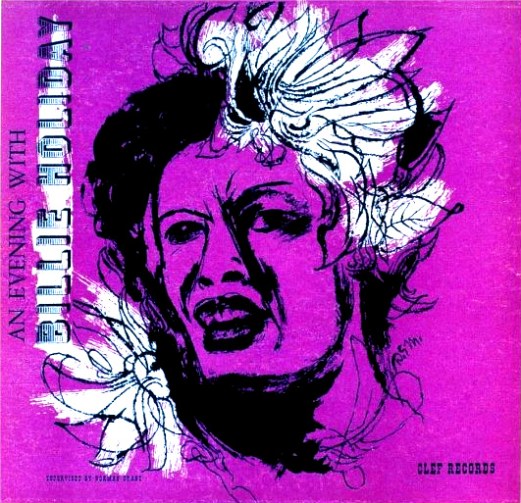
1953    An Evening with BilliImagee Holiday / Recorded: April 1, 1952 & July 27, 1952 (Clef)

This is an altogether more down affair than Billie Holiday Sings. Stormy Weather sets the tone – this is a collection of lost love and love on the rocks songs. While My Man, He’s Funny That Way, and Tenderly address love as a good thing, the tempo and timing are as sad as those on opener Stormy Weather. On the other side of the coin, closer Remember addresses a lover who has strayed, but with a much happier the tempo. This track also features a pair of really nice solos from Peterson and Barney Kessel. (At the time Kessel and bassist Ray Brown rounded out the Oscar Peterson Trio, though Kessel only stayed a year.)

1954    Billie Holiday / Recorded: April 1, 1952 & April 14, 1954 (Clef)

As you can see all three of these albums came out of sessions that occurred in a four month period, and with many of the same players on all sessions. That said, the musicians are all at the top of the game. The playlist has all eight tracks because they weren’t obviously available on Spotify in sequence. Listen, in particular to Everything I Have Is Yours. Billie and tenor man Flip Philips are engaging in a sweet dialogue. As with the first two sets, the songs strike a melancholy balance between love and lost love. The closing tracks, however, positively swing. What a Little Moonlight Can Do features another fantastic solo from Peterson and some sweet trumpet work from Charlie Shavers while I Cried For You, a defiant kiss-off to a faithless lover is notable for its building intensity.

1955    Stay with Me / Recorded: February 14, 1955 (Verve)

This seven-song result of a single recording session with Tony Scott’s orchestra and features on side A a couple of longer pieces (each well over six minutes) sandwiching a modern take on Fats Waller’s 1929 hit Ain’t Misbehavin’. (I’ve added a Waller rendition to the playlist as well, for a contrast.) These are strange recordings in that the solos really stretch out. Everything Happens To Me, with its line “I’m just a girl who never looks before she jumps” has the not quite defeated feeling of the classic recordings of Good Morning Heartache and Travelin’ Light off Lady Sings The Blues recorded the following year. The sequencing of the album reflects that of Billie Holiday, with two swingers on side B, I’ve Got My Love To Keep Me Warm and Irving Berlin’s Always, though it closes with a thoughtful rendition of Ellington’s Do Nothing ‘Til You Hear From Me.

For a period of time last year I worked for a hosting provider in the marketing department. They tasked me with explaining the concept of bandwidth for the corporate blog, but they never used it. As I’ve been gone for the better part of a year, I figured I might share it without issue.


In the past, you could only watch entertainment when and where the providers said, in front of your TV via terrestrial cable at a prescribed time. At the same time, gaming was primarily an offline pursuit. Because media consumption is now on-demand, on location, over the Internet, and 24/7, hosting customers are finding their own customers eating through bandwidth far more quickly than they did a few years ago, and that quickly scalable hosting infrastructures will be more and more important.

Some stats: In 2011, more than 100 million Americans watched online video content each day, a 43% increase over the previous year. At the beginning of 2012, more than 11% of all digital traffic was consumed over smartphones and tablets; a year later that number had jumped to 21%. In addition, mobile device penetration is increasing fast. In Australia, the US and the UK, smart phone user penetration topped 50%. This is expected to be true in most of western Europe by 2014.

In this blog we’ll talk about what bandwidth means and how video, gaming, and advancements in mobile internet are driving bandwidth consumption.

What Do We Mean When We Talk About Bandwidth

In the context of web or data infrastructure hosting, we’re really talking about two things:

  1. An amount of data traffic going over the network, usually measured in bytes (kB, MB, GB). When a hosting company offers “unlimited bandwidth” it means the amount of data traffic served is limited only by the port’s capacity.
    In general, the term “unlimited” has been replaced with the more accurate “unmetered”.
  2. The rate at which data travels over the network as measured in bits per second (kbps, Mbps, Tbps).

On an unmetered port, your data traffic limit is calculated by multiplying the rate of the port (in bits) by the number of seconds in the period you want to discuss and dividing by 8 because traffic is measured in bytes, but port capacity is measured in bits. By this measurement, the daily traffic limit on an unmetered 1 Gb port should be 10.8 TB.

However, maximum port traffic generally runs 80-90% of maximum capacity. This 10-20% overhead includes bandwidth used by the communication protocol and transactions at other hardware and software layers of network communication.

So, when an article or report asserts that consumer demand for bandwidth is increasing, it refers to:

  • Demand for data, generally from the consumer including on-demand streaming media (YouTube, Netflix, Spotify), audio and video downloads (Amazon, iTunes, Bandcamp), gaming (World of Warcraft), voice over IP, and IPTV.
  • Consumer demand for higher mobile and fixed broadband data rates
  • Supplier demand for networks with greater capacity, servers with greater processing power, and more storage.

Three things currently drive bandwidth consumption:

  • 24/7 entertainment on demand
  • Increased image quality
  • 3G and 4G mobile internet usage

Read the rest of this entry »

Joe’s History of Jazz
Lesson 5A

There’s no real delineation between the decades. Those zero years are just easy markers.

In the early 50s, Miles Davis didn’t exactly drop out of the scene, but following his return from a 1949 tour of Paris, fell into heroin addiction. For about four years he performed a bit, recorded quite a lot, and “lived the life of a hustler” (Wikipedia’s phrase – I don’t know what this means in context, however). In the late 1980s I read a biography of Miles that suggested he played in a recording session with Billie Holiday during this period, but I’ve never identified what those recordings might have been. He finally quit cold turkey in 1954. While his work from the late 40s and early 50s (addiction or no) show him to be a musician of incredible talent and vision. I’d argue that from 1955’s first quintet sessions through to 1975’s Agharta and Pangaea live albums, Miles was the center around which everything new in jazz revolved/evolved. (Between 1975 and 1981 he recorded little and didn’t perform in public at all, due primarily to illness and exhaustion. Many of his recordings and performances after returning to the public eye are less innovative and very much of their time, but there are still some intriguing gems in that late work.)

In 1951 he signed with Prestige records and recorded with a revolving cast of musicians that often included Art Blakey on drums and Sonny Rollins on tenor sax. Blakey later led the Jazz Messengers and Rollins led his own bands from 1957 onward.

Harold Arlen’s It’s Only a Paper Moon, from 1951’s Dig with Rollins was a hit in the 40s for Nat King Cole. While Miles’ lines hew to Cole’s vocal version, we get long improvisatory solos from Rollins and Davis.

On the subject of improvisation, in a recent interview with the All About Jazz web site, Kawabata Makoto of the Japanese psychedelic collective Acid Mothers Temple had this to say:

 AAJ: How do you go about staying creative as a musician? What inspires you to play?

 KM: I believe I haven’t created any music. Always, my cosmos teaches me what I should play. I don’t need to be inspired by anybody. I just try to be the best radio tuner for my cosmic that gives me music all the time. I try to play with “self-annihilation.” Any personal, egoistical idea makes the pure music [I think there might be a translation error in that last sentence. -JS]. I have to play without any of my personality or my own ideas. So I’ve tried to be a better tuner to receive and replay— to recreate—this music for people. But if I add any of my ego—my personal ideas of this music—this pure music will be a different thing. For example, if a musician gets any new technique, they want to show it to other people. Then this musician tries to add this new technique to his music. But I believe music must be played without any musicians’ egos. Music must be played as pure!

 While this may apply to certain more recent schools of music than 50s era Miles, Makoto is not the only one to suggest that he is only a conduit for his virtuosity. John Coltrane made similar assertions. It’s worth keeping in mind as we delve into the improvisational nature of jazz as the form moves on from 3-minute recordings to longer forms.

Bluing was recorded at one of two 1951 sessions from which the Dig album was compiled, though originally released as part of the Blue Period 10” album (along with Blue Room and Out of the Blue). At almost ten minutes long, Miles and Rollins both take the space to get into this Davis composition. Rollins’ tenor sax solo starts at about the 4 minute mark. He and Miles alternate for a bit before Jackie McLean’s alto comes in at about 6 minutes. Each one takes a route around the theme before Miles takes it back around the 8th minute. He finally restates the theme, introduced by Walter Bishop’s piano in the opening, in the piece’s closing bars.

Smooch, recorded in 1953 and released on Blue Haze is notable, again, for the line-up. Charles Mingus (who usually plays bass, but plays piano on this track) would soon record a string of influential albums starting with Mingus Ah Um in ’59. Drummer Max Roach, who founded the Debut record label together with Mingus in ’52 ,continued to record and perform with figures including Duke Ellington (1962’s Money Jungle, also with Mingus). Bassist Percy Heath and pianist John Lewis (not on this track, but on the rest of Blue Haze) had co-founded the Modern Jazz Quartet (usually abbreviated MJQ) the previous year and would continue to perform and record under that moniker on and off until the early 1990s.

Around the same time as the Blue Haze recordings, Dizzie Gillespie, Charlie Parker, Mingus, Roach, and pianist Bud Powell released Jazz at Massey Hall, Toronto. The show is remarkable for a number of reasons; one is that it was the last time Gillespie and Parker shared a stage. I’ve included a smoking rendition of Gillespie’s A Night in Tunisia (which you heard first back one of the 1940s entries). Again, we get extended solos from many of the participants – Powell’s is particularly tasty. I’d like to be able to point to the interplay between Powell and Mingus, but in the original release of the album, the bass was overdubbed because it had been too low in the mix. A later reissue removed the overdubbing. I’m pretty sure the one in the Spotify playlist is an overdubbed version.

Django, a Lewis composition and early MJQ recording, is a tribute to Django Reinhardt who passed away in 1953. Despite having no guitar, it has the feeling of some of Reinhardt’s tunes especially in the closing movement. I think it’s fair to say that this song progresses through distinct phases that might be called movements akin to those in a sonata. The song isn’t relaxed but has a distinct lack of hurry that’s very appealing.

Art Blakey, the drummer on the Dig sessions, first recorded under the name Art Blakey and the Jazz Messengers with the Café Bohemia albums recorded in 1955. Their rendition of the 1939 hit What’s New is almost a duet between Doug Watkins’ bass and Horace Silver’s piano – Blakey really only comes to the fore at the end of the song. On the other hand, the band’s rendition of Jimmy Van Heusen’s Like Someone in Love shows off each musician’s talent. Kenny Dorham’s trumpet work is well balanced against Hank Mobley’s sax. Dorham’s another journeyman who led his own small groups and was a sideman for many others. A few years later Mobley would join the Miles Davis Quintet for Someday My Prince Will Come (but I get ahead of myself).

Coming around the other way, we have John Coltrane whose tenor saxophone would grace the work of the first great Miles Davis Quintet from ’55 to ’57, was already recording in the early 50s. Between 1949 and 1951, Coltrane recorded several sessions with Dizzy Gillespie (including one which featured Dinah Washington, which I can’t find the Washington tracks on Spotify), but We Love to Boogie gives a taste of the power he was already showing pretty early in his career. The swinging Used to Be Duke, is from a 1954 stint with Johnny Hodges (an alto sax player who worked with Ellington in the 30s and participated in that great Benny Goodman show at Carnegie Hall). Miles admired Coltrane for, among other things his ability to play both loud and fast, while maintaining complete control of the instrument. You get a taste of that in both of these tracks.

There’s more to say about Coltrane and the other people who played with Miles during this very rich period. In a couple of massive sessions in 1956, Miles and Coltrane, pianist Red Garland, bassist Paul Chambers, and drummer Philly Joe Jones would record enough material for four albums, enough to fulfil Davis’ contract with Prestige and allow him to jump to Columbia Records in ’57.

Next up, however, we’ll visit Billie Holiday’s later work.

Lee Konitz, Florian Weber, Vivienne Aerts
Hooglandsekerk, Leiden 25 January 2014.


I’d been looking forward to this show since seeing the listing a few weeks ago. Konitz is one of only two surviving members of the Birth of the Cool sessions/gigs arranged by Miles Davis and Gil Evans. His two accompanists, vocalist Vivienne Aerts and pianist Florian Weber played the first set, mostly originals, as a duo. Both artists are deft at improvisation. Weber’s piano lines are melodic and full, but almost always unpredictable. His influences seem to include the modern jazz of the early 50s and the solo work of artists like Keith Jarrett.

While Aerts is Dutch, she sings in English. Her phasing is gorgeous and her interplay with Weber was a joy to watch and to hear. When she scats, it’s obvious she’s studied Ella, but also obvious is that she’s well trained in using her voice as an instrument. (Not surprising – according to her web site, she currently studies at Berkelee School of Music.) I can imagine some complaining about her occasional difficulties with English pronunciation, but such complaint is churlish given her impressive skills and the undeniable joy she exudes in singing.

His hair didn't look this good yesterday.After a break, Konitz and Weber took the stage. At age 87, he still has some serious chops. Early in the set, he marred otherwise interesting and intriguing performances of I’ll Remember April and Darn that Dream by blowing air through his lips at the end of each one. After those songs, though, his embouchure was much stronger. Nonetheless, Darn That Dream was an especial treat for me, as I know it well from its closing spot on the aforementioned Birth of the Cool. What was most impressive about this set was how the musicians challenged one another to do new things. The two have performed and recorded together several times over the last few years and are obviously comfortable with the challenges of improvising on the same stage.

The show concluded with all three performers doing a beautiful extended take on Carmichael and Mercer’s Skylark. Konitz expressed that he hated microphones and Aerts took this in stride. (Note the difficulty in this given the Hooglandsekerk’s very high ceilings.) I was glad we had seats near the front, because she did a really wonderful job.