
1994 Virgin
Just over ten years after the conclusion of the Three of a Perfect Pair tour, a new King Crimson release, featuring a six-man lineup, hit the streets, to much rejoicing. But back up. In 1993, Robert Fripp recorded and toured an excellent album with David Sylvian. Sylvian fronted new wave act Japan, after the demise of which he created some very cool, hard-to-classify downtempo solo albums. A Japan reunion in 1990, under the moniker Rain Tree Crow, did not fly. Robert Fripp had played on an earlier Sylvian solo album (Gone to Earth from 1986) and the new collaboration was successful. The band for the album featured bassist Trey Gunn and drummer Jerry Marotta. (Marotta and Fripp previously worked together on Peter Gabriel’s second solo album and Fripp’s Exposure.) Marotta, however, wasn’t able to tour the album. Enter session percussionist (an ex-Mr. Mister drummer) Pat Mastelotto. Check out this article in which Pat recounts flying to England from California on his own dime to audition for the gig.
At the conclusion of the Sylvian/Fripp tour, Fripp regrouped the King Crimson, augmenting the early 80s quartet of himself, Adrian Belew, Bill Bruford, and Tony Levin with Gunn and Mastelotto. The expanded lineup creates a more interesting sound for certain, though still most definitely Crimson. The first release of this line-up, the Vrooom EP introduces the new four-man rhythm section, an intriguing platform for the interplay of Belew’s and Fripp’s guitars.
Four of the six tracks would be reworked for the full LP release, Thrak. Cage and When I Say Stop, Continue only appear on Vrooom.
Despite the 10-year gap, there’s no grand departure from the earlier sound, save for a greater emphasis, I think, on the intense instrumentals. The 1981-84 quartet didn’t record anything new that had the sheer intensity of the songs Red, Fracture, or Larks’ Tongues In Aspic Pt II. Fripp made a return to this style in the songs Vrooom and Thrak, the latter forming the basis for many of the Thrak tour’s live improvisations. These sonic onslaughts are balanced with the ballad One Time and the funky Sex Sleep Eat Drink Dream which can be seen as descendants of songs like Two Hands and Sleepless respectively.
The Thrak album expands on this balance of the noisy and the quiet. It also features two of KC’s most beautiful tracks, Walking On Air and the aforementioned One Time.
Vrooom opens the album, the arrangement from the EP now divided into two parts, the second bearing the unwieldy title Coda Marine 475. I’ve always been confused that the second song of an hour-long cycle has the word Coda in the title, but there you are. Dinosaur is something of a pop-metal hybrid, like Sleepless or Thela Hun Gingeet, I suppose. Straightforward(ish) lyrics from Belew, ‘I’m a dinosaur, somebody is digging my bones’ might be an attempt to head off judgement of what the band are doing 10 years after their last album, and 25 after their first. (Noting that this is the 50th year of KC, this might be premature.) The song has the sort of soft-loud dynamic that Kurt Cobain (just a few years before) said Nirvana nicked from the Pixies, but it’s also a microcosm of the album as a whole.
Next is the ballad Walking On Air. Belew’s plaintive alto weaves what might be a love song. It’s Crimson, so you can never tell, but it’s one of the two or three most beautiful songs in their catalogue.
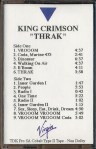 The instrumental B’Boom follows. After a short introduction, percussionists Bruford and Mastelotto go head to head. This is the first time KC had had two percussionists since that brief period around the recording of Larks’ Tongues In Aspic and this kind of interplay in Crimson got lost again after this album until Fripp regrouped with three drummers in the front line. The song, at least in its title, brings us back to a long improv performed on the LTIA Tour at the Zoom Club called Z’Zoom. (Note that the Zoom Club gig also included two more improvisations: Zoom and Zoom Zoom which together run for over an hour. The band might be referring back to them in the tracks Vrooom and Vrooom Vrooom. I might have to delve back into that recording.)
The title track, an intense and difficult metal epic follows, oddly reflecting the progression on LTIA from The Talking Drum into Larks’ Tongues In Aspic Part II. On the tour for this album, Thrak formed the basis for many extended improvisations. I’m not sure if I’ll delve into the Thrakattak album, which is comprised of several of these live improvs. I’ve tried before, but it’s an endurance test, sort of like listening to all four sides of Lou Reed’s Metal Machine Music without a break.
Thrak concluded side 1 on the cassette release which makes sense. The second half of the album is balanced as a suite between the two parts of Inner Garden, Radio I and Radio II, three pop songs, and the concluding iterations of Vrooom (Vrooom Vrooom and Vrooom Vrooom: Coda).
Inner Garden I and II, are short, nearly a cappella, vocals from Belew. The first leads into the very funky People, in which Trey and Tony battle out the bass line under a lyric that’s not too far removed from Foreigner’s Women. (‘People bowl, people rock, people pay to see two people box’ vs. ‘Women behind bars, women in fast cars, women in distress, see that woman with no dress.’ You be the judge)
Unlike Walking On Air, One Time is a little harder to grasp lyrically, but Adrian’s vocal is lovely and he doesn’t reach for anything beyond what the song calls for. It’s bookended by Radio I and Radio II which a reminiscent of the dissonant Ligeti pieces used in 2001: A Space Odyssey.
The vocal portion of the album concludes with Sex Sleep Eat Drink Dream, another slice of funk. Listen, what I’m calling funk is probably unfair to both the funk genre and to KC’s progressive metal leanings. This song and People may simply be funky because the bottom end of the songs is emphasised whereas in other pieces on the album, the guitars take precedence. Lyrically, it’s a bit of a word salad, but it’s prog, so that too is okay.
The album concludes with Vrooom Vrooom, a restatement of the Vrooom theme, and Vrooom Vrooom Coda which takes the high end of Coda Marine 475 and turns it inside out. It’s a really odd piece to conclude the album on, but it’s as musically intriguing as just about anything else here.
As I often do when writing these reviews, I’ve listened to the album pretty constantly for the last several days and have become more and more impressed with both the compositions and with the composition of the album as balanced halves. As a CD listener, the balance of things was lost on me when the album came out. I can appreciate what the band were after, even though in the decade since Three of a Perfect Pair, the LP format had slipped away.
I give it four stars.
Next up: The ConstruKction of Light.
 The opening Schizoid man pushes the needle to the red in terms of both saturation and energy. While the structure remains the same, the improvisations in the middle exceed what is expected. Mel Collins’ sax work is intense, and marred somewhat by drumming that seems to be, possibly, part of a different song. Fripp ropes everyone back in with some searing runs. Boz’s treated vocals are more menacing that we hear in later versions, which is somehow appropriate.
 Opening with four vocal tracks, none of which (on the face of it) is that demanding on the listener. Title track/opener, Three of a Perfect Pair is an interesting one because it stayed in King Crimson/Crimson ProjeKct set lists well into the 21st century, and as a fan, it’s easy to find that it’s just a little overplayed. Belew is right to be impressed with his ability to play the guitar in one time signature and sing in another, but it’s only because he’s the vocalist that this makes him unique in the band. The song itself being about the breakdown of a relationship seems an apt one as this incarnation of KC was on the verge of collapse at the end of the Beat sessions (and after the tour for this album, these four would not reconvene for 10 years).
 Side one closes out with Waiting Man, another distinctive Belew vocal which like the title track of the follow-up album seems to have the vocals in one time signature against instrumentation in another. Bill Bruford’s drumming on this piece (as with a lot of the percussion in this period of KC history) seems to owe a bit to Steve Reich’s phase works such as 1971’s
  Discipline runs the gamut from essentially downtown New York new wave to strangely beautiful downtempo work. Some pieces harken tot the noise mastered by the mid-70s line-up. What’s most interesting about this album (and its two successors) is that Fripp for the first time had a guitar foil in the band who was an equally forceful player. Belew also acted as frontman in a way the earlier singers (including Wetton and Lake) hadn’t. Belew never subsumed his vocal quirkiness to any greater KC ethos. This is also the first album with a co-producer from outside the band. Rhett Davies had recent credits with the second Talking Heads album, Dire Straits’ debut, and multiple Roxy Music and Bryan Ferry albums. It’s possible that he enforced on the band a certain rigid approach, despite what I’m about to say next.
 Joe Jots