Archives for category: yiddish

When I lived in that commune in Marin back in the 70s, we had a deck where we did aerobics. My clearest musical memory of that deck is of running in place and listening to the soundtrack to Tommy which we had on a reel-to-reel tape, for some reason. I don’t recall that we had any other tapes to play on that machine. (I also recall that that tape broke and someone spliced it.) My clearest song memories are of Elton John’s Pinball Wizard and Tina Turner’s Acid Queen. Oddly not Clapton’s recording of Eyesight to the Blind (the album’s only cover, though other Mose Allison songs were in the running, according to the Pinball Wizard episode (part 1 of 2, here, though the investigation of Tommy itself is in part 2) of A History of Rock Music in 500 Songs – the impetus for this blog entry) or several other memorable tracks. I’m sure Cousin Kevin and Uncle Ernie affected me given my own experience of abuse at Synanon and were worthwhile things to excise from my brain until later.

The key thing is that here was one of my formative experiences of rock and roll. We listened to a lot of music in the commune, but my other memories are of the MOR stylings of San Francisco’s KFRC, the only good station we could get in that far north. Silly Love Songs, Boz Scaggs’ Lowdown and Lido Shuffle, Love Will Keep Us Together, Knowing Me Knowing You, Don’t Go Breaking My Heart were all in heavy rotation in the year before I left in the Fall of ‘77. None of these had the sheer force of The Who’s music, even in the weird forms it took on the film soundtrack. I’d have the LP later on, and the original Who album as well. The original rock opera never grabbed me in the same way, though Daltrey’s rendition of Acid Queen certainly made its own impression.

I’m sure I’ve seen the movie all the way through at least once, maybe twice. All Ken Russell movies are strange, but the 70s stuff is out of this world. (Noting that his Altered States [1980] is one of my all time faves.) That said, watching a few clips on YouTube is enough to assure me I don’t really need to watch it again. In addition there are a dozen or so recordings of The Who performing Tommy in its entirety – this started no longer after their LP was released and continued through most of their subsequent tours, it seems. In general, I’m more interested in how they handle their other songs live than these. There was also a stage musical that I’ve never checked out either. That said, I’m now downloading the soundtrack and the original album.

Weirdly, my current book club reading is Michael Chabon’s The Yiddish Policemen’s Union which has an interesting plot point about a possible messiah that speaks in an odd way to Tommy’s own messianic aspect.

The poet Esther Shumiatcher Hirschbein was born in Belarus in 1899 and after many travels settled in Los Angeles in 1940. I was introduced to her via a translation of her 1956 poem Summer Awakening that appeared in the Forverts in 2021. A pshut shtikl ayzen (אַ פּשוּט שטיקל אײזן) is from the same 1956 collection, Lider (לידער). This is my own translation:

An unglowing piece of iron,
Burns like the sun in the desert;
Blooms like a cactus flower,
And like all the colored stones,
In the rays of the sun.
My plain piece of iron —
What joys do I learn from it?
Blood is the fire of life.
The sun is life alone.
Grass, with its green aspirations,
Is beauty for itself alone.

One of my Yiddish teachers shared this poem with us a couple of weeks ago and as a class we translated it well enough to get the gist. And to revel in the joy that we can get through 36 lines of poetry in our new language. (New? Several of us have been in the same zoom class for over three years.

A painting of the poet Itzik Manger by Arthur Kolnik in profile. Hair dark brown, red jacket, white shirt, blue background.

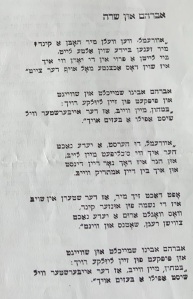
Itzik Manger is one of the lights of 20th Century Yiddish literature and while outwardly simple, his poems contain great richness. While I was happy with what achieved in the context of class, I wanted to bring my own poetic sensibilities to it. I went though a period of writing formal poetry and recognized in the Manger some of the formalism he was adhering to.

Some notes:
* Avreml is a dimunitive of Abraham.
* Avrom Avinu, Abraham our father, is a common epithet for Abraham, the first of the patriarchs. Similar epithets include Dovid HaMelech (David the King) and Moishe Rabinu (Moses our teacher).
* In Hebrew, the number 18 is spelled חי which are the first two letters of the word for life (חיים), and is symbolically related to it. One often gives gifts of money in multiples of 18 for this reason.

Avreml, when will you and I
have a child? We are so old.
Any woman as old as I,
Has eighteen children already.

Avrom our father smiled and laughed,
Blowing smoke from his pipe. Believe it,
My wife. If the good lord is so moved,
Even a broom will fire a round.

Abe, my love, every night you hear
Me cry, my body racked with sobs.
Hagar is only our servant,
I, dear Avrom, am your true wife.

Often the star in the window
I think is the soul of our child.
In the raindrops, in the shadows,
In the wind, wandering each night.

Avrom our father smiled and laughed,
Blowing smoke from his pipe. Believe it,
My wife. If the good lord is so moved,
Even a broom will fire a round.

When sometimes I see Hagar’s child
At play in the sun and the sand,
I caress the boy on his head,
And my hand becomes strangely sad.

When I take the child in my lap,
He smiles so good and so sweetly,
That my eyes grow damp and large,
And my blood becomes strangely sad.

Avreml, when will you and I
have a child? We are so old.
Any woman as old as I,
Has eighteen children already.

Avrom our father smiled and laughed,
Blowing smoke from his pipe. Believe it,
My wife. If the good lord is so moved,
Even a broom will fire a round.