1994 Virgin

Just over ten years after the conclusion of the Three of a Perfect Pair tour, a new King Crimson release, featuring a six-man lineup, hit the streets, to much rejoicing. But back up. In 1993, Robert Fripp recorded and toured an excellent album with David Sylvian. Sylvian fronted new wave act Japan, after the demise of which he created some very cool, hard-to-classify downtempo solo albums. A Japan reunion in 1990, under the moniker Rain Tree Crow, did not fly. Robert Fripp had played on an earlier Sylvian solo album (Gone to Earth from 1986) and the new collaboration was successful. The band for the album featured bassist Trey Gunn and drummer Jerry Marotta. (Marotta and Fripp previously worked together on Peter Gabriel’s second solo album and Fripp’s Exposure.) Marotta, however, wasn’t able to tour the album. Enter session percussionist (an ex-Mr. Mister drummer) Pat Mastelotto. Check out this article in which Pat recounts flying to England from California on his own dime to audition for the gig.

At the conclusion of the Sylvian/Fripp tour, Fripp regrouped the King Crimson, augmenting the early 80s quartet of himself, Adrian Belew, Bill Bruford, and Tony Levin with Gunn and Mastelotto. The expanded lineup creates a more interesting sound for certain, though still most definitely Crimson. The first release of this line-up, the Vrooom EP introduces the new four-man rhythm section, an intriguing platform for the interplay of Belew’s and Fripp’s guitars.

Four of the six tracks would be reworked for the full LP release, Thrak. Cage and When I Say Stop, Continue only appear on Vrooom.

Despite the 10-year gap, there’s no grand departure from the earlier sound, save for a greater emphasis, I think, on the intense instrumentals. The 1981-84 quartet didn’t record anything new that had the sheer intensity of the songs Red, Fracture, or Larks’ Tongues In Aspic Pt II. Fripp made a return to this style in the songs Vrooom and Thrak, the latter forming the basis for many of the Thrak tour’s live improvisations. These sonic onslaughts are balanced with the ballad One Time and the funky Sex Sleep Eat Drink Dream which can be seen as descendants of songs like Two Hands and Sleepless respectively.

The Thrak album expands on this balance of the noisy and the quiet. It also features two of KC’s most beautiful tracks, Walking On Air and the aforementioned One Time.

Vrooom opens the album, the arrangement from the EP now divided into two parts, the second bearing the unwieldy title Coda Marine 475. I’ve always been confused that the second song of an hour-long cycle has the word Coda in the title, but there you are. Dinosaur is something of a pop-metal hybrid, like Sleepless or Thela Hun Gingeet, I suppose. Straightforward(ish) lyrics from Belew, ‘I’m a dinosaur, somebody is digging my bones’ might be an attempt to head off judgement of what the band are doing 10 years after their last album, and 25 after their first. (Noting that this is the 50th year of KC, this might be premature.) The song has the sort of soft-loud dynamic that Kurt Cobain (just a few years before) said Nirvana nicked from the Pixies, but it’s also a microcosm of the album as a whole.

Next is the ballad Walking On Air. Belew’s plaintive alto weaves what might be a love song. It’s Crimson, so you can never tell, but it’s one of the two or three most beautiful songs in their catalogue.
The instrumental B’Boom follows. After a short introduction, percussionists Bruford and Mastelotto go head to head. This is the first time KC had had two percussionists since that brief period around the recording of Larks’ Tongues In Aspic and this kind of interplay in Crimson got lost again after this album until Fripp regrouped with three drummers in the front line. The song, at least in its title, brings us back to a long improv performed on the LTIA Tour at the Zoom Club called Z’Zoom. (Note that the Zoom Club gig also included two more improvisations: Zoom and Zoom Zoom which together run for over an hour. The band might be referring back to them in the tracks Vrooom and Vrooom Vrooom. I might have to delve back into that recording.)

The title track, an intense and difficult metal epic follows, oddly reflecting the progression on LTIA from The Talking Drum into Larks’ Tongues In Aspic Part II. On the tour for this album, Thrak formed the basis for many extended improvisations. I’m not sure if I’ll delve into the Thrakattak album, which is comprised of several of these live improvs. I’ve tried before, but it’s an endurance test, sort of like listening to all four sides of Lou Reed’s Metal Machine Music without a break.

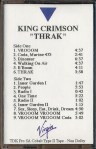
Thrak concluded side 1 on the cassette release which makes sense. The second half of the album is balanced as a suite between the two parts of Inner Garden, Radio I and Radio II, three pop songs, and the concluding iterations of Vrooom (Vrooom Vrooom and Vrooom Vrooom: Coda).

Inner Garden I and II, are short, nearly a cappella, vocals from Belew. The first leads into the very funky People, in which Trey and Tony battle out the bass line under a lyric that’s not too far removed from Foreigner’s Women. (‘People bowl, people rock, people pay to see two people box’ vs. ‘Women behind bars, women in fast cars, women in distress, see that woman with no dress.’ You be the judge)

Unlike Walking On Air, One Time is a little harder to grasp lyrically, but Adrian’s vocal is lovely and he doesn’t reach for anything beyond what the song calls for. It’s bookended by Radio I and Radio II which a reminiscent of the dissonant Ligeti pieces used in 2001: A Space Odyssey.

The vocal portion of the album concludes with Sex Sleep Eat Drink Dream, another slice of funk. Listen, what I’m calling funk is probably unfair to both the funk genre and to KC’s progressive metal leanings. This song and People may simply be funky because the bottom end of the songs is emphasised whereas in other pieces on the album, the guitars take precedence. Lyrically, it’s a bit of a word salad, but it’s prog, so that too is okay.

The album concludes with Vrooom Vrooom, a restatement of the Vrooom theme, and Vrooom Vrooom Coda which takes the high end of Coda Marine 475 and turns it inside out. It’s a really odd piece to conclude the album on, but it’s as musically intriguing as just about anything else here.

As I often do when writing these reviews, I’ve listened to the album pretty constantly for the last several days and have become more and more impressed with both the compositions and with the composition of the album as balanced halves. As a CD listener, the balance of things was lost on me when the album came out. I can appreciate what the band were after, even though in the decade since Three of a Perfect Pair, the LP format had slipped away.

I give it four stars.

Next up: The ConstruKction of Light.

Rob Cox in Reuters argues that ‘China Does It’ is a bad antitrust argument (6-minute read). But before I get into the arguments the biggest companies in the US and Europe make for maintaining their monopolies, I want to talk about how we are able and not able to occupy space in society.

I’ve had two discussions in the last few days that I want to connect. In one, my friend was complaining about nudity at Dutch spas. Nudity is generally the norm at spas in the Netherlands unless it’s a rare kledingsdag (clothing day). My friend complained that one should be able to wear a swimsuit or not. The issue is not one of prudishness, but that my friend has a surgical scar that a swimsuit hides. It’s not even that the scar is problematic. It’s the threat of unwanted intrusion in what should be a relaxing space that gets tiresome.

Another friend is an expert in her field and occasionally gives free practical courses associated with it to the public. And what is the first question raised in a recent class? Something about how and where she gained her expertise, or her interest in the subject at hand? No. It was ‘Where are you from?’ The adult child of Japanese immigrants born and raised in Los Angeles. Not that that part matters. Again, it’s the impertinence – and the unspoken question of whether my friend had a right to occupy the space at the front of that classroom.

These two experiences play into a larger narrative of how the spaces occupied by people are no longer personal. They probably haven’t ever been, really, but we had a couple of decades where it seemed that they might be. If one wasn’t paying very close attention.

Where to I fit into this narrative? As a cisgender, adult, heterosexual presenting (I’m out as bisexual in most areas of my life, but you can’t necessarily tell that by looking at me) white male, my right to occupy space is rarely questioned. Nor is most expertise I claim. I’m also Jewish which you can probably tell from my physical profile. I’m somewhat removed from the racism I’m about to discuss, but only just. It’s a topic for another entry.

On a good day, however, I might classify as an ally to those who face harassment and verbal and physical violence simply for being.

The right to occupy space. I read a tweet sometime in the last few days that read something like ‘A survey of transgender people asked “What is the one thing you would do if you had a day during which no one would judge or comment on your appearance?” The majority of respondents said “Go swimming.”‘ This Vox article (approx. 5-minute read) on a 2016 survey doesn’t have that nugget, but it tells quite a lot about how difficult it is to be trans and occupy space.

All of this is leading up to a connection I want to make to that Reuters article on big business in the west and China, but I’m going to toss in one more thing about swimming and occupying space. About twenty years ago I dated a black man who grew up in Detroit in the 70s. In response to a suggestion we go to the beach, he laughed me off, saying “Negroes don’t swim.” He didn’t share any of the history of the difficult efforts to integrate swimming facilities that continues. The New York Times ran a long article on the subject just last summer. In short, the right to occupy space unharassed in America is tenuous, and far more extensive than even some close followers of the news guess.

I could stop here and say, ‘look how enlightened I am for acknowledging my privilege’ and all the blah blah blah attendant to such a claim.

The Reuters editorial linked at the top of this entry has nothing to do with occupying space, except insofar as Facebook policies turn a continuing blind eye to the racism on its platform – not within the editorial’s scope. It has nothing to do with how we as a society address or don’t address our responsibilities to each other. It has nothing, really, to do with respecting the privacy and autonomy of people in their private and professional spheres. What struck me reading the arguments of people like Sheryl Sandberg (CEO, Facebook) and European Competition Commissioner Margrethe Vestager is the distance between how we look at business and how we look at humans. Both of these people argue competition policy as it relates to the Chinese.

It might be that financial reporting is always like this. If I read Reuters’ Breakingviews and the Economist as assiduously as I do popular news assessments of social policy, this wouldn’t surprise me. But reading Cox’s look at how large corporations address competition got me thinking about how to decrease concern with monopoly power and increase respect for each other in our common spaces. More to the point, I started thinking, again, how little discussions of monopoly power have to do with how humans interoperate in the world. I’m not arguing anything here that five millennia of (mostly privileged white male) philosophers and teachers (not to mention three seasons of The Good Place) haven’t argued better. But the question remains:

How do we get where we need to be?

There’s a collision of autonomy and respect and privacy and intrusion from so many different areas that any conclusions I draw are either meaningless, or pablum. The social media waters that we swim in constantly invite – and foster – invasion and misunderstanding. And outright hostility. Note again my generally unchallenged white male expertise. I know that I can step up and say that the status quo is untenable and quietly slip back into enjoying my position with respect to it. In my What If Future, the status quo is that no one is challenged in their right to occupy space, but gracious, that future is bloody far away.


And entirely unrelated: The one-two punch of The Talking Drum and Larks’ Tongues In Aspic Part Two on King Crimson’s Meltdown: Live in Mexico (Spotify link) is superb. To be played at maximum volume.

Brodsky was born on this date (May 24) in 1940. I’d only heard of his work, never read any, when one evening in 1999 or so, I heard a recording of him reading ‘A Song’ on NPR. In the twenty years since I heard that recording I can still remember its cadences. This video, with its accompanying Chopin, is close, but it’s not the same. He’d passed away two years before, but this poem enchanted me such that I went out the next day or the day after that and purchased the slim volume So Forth, published by his estate in 1996. I was reading a lot of poetry at the time.

In Moe’s books in Berkeley, someone saw me flipping through Robert Hunter’s Glass Lunch and asked if I’d read his translations of Rilke. Another poet who’s name I knew, but whose work I hadn’t read. Shortly thereafter I started consuming Rilke. The Duino Elegies and Sonnets to Orpheus did my head in, as I would have put it at the time, though not in Hunter’s translations which I found online. The Norton Press dual language editions. Housman, Stein, Wilde, and Sharon Doubiago carried me through those years as well.

My memory is that I bought the Brodsky at Moe’s (RIP) as well, but the bookmark inside insists it was Booksmith on Haight Street. I can vaguely picture myself paying for it there, probably having already exhausted the two used bookstores across the street. I don’t know if Austen was still a going concern at that point. I’d worked a couple of stints there, but after Jeffrey died and Brian took it over, it didn’t last too long. That spot might already have become another shoe store by ‘99. I don’t recall the name of the other used bookshop on the street, but for all the paperbacks crammed into the place I rarely if ever found a book there I wanted to buy. And I was voracious.

I’ve not opened So Forth in several years, and find that it still has a blue plastic sticker marking A Song on page 5. The name Joseph at the top of the front cover is sun faded, but the spine is intact, and the glue binding intact. Flipping through it, though, there’s no page that isn’t a joy to read. These poems reward reading aloud. Not to say I and my poor understanding of my iPad’s voice memo function do them justice, but here’s one called Ab Ovo which I quite like…

Note: Copyright in this poem is held, I’m certain, by the estate of Mr. Brodsky. I will remove this recording upon request.

So Forth can be ordered via the links on the publisher’s web site here.

Guinevere Turner writes in the May 6, 2019 New Yorker about growing up in a commune and discusses the differences between communes and cults. ‘(Leader Mel) Lyman never ordered his followers to kill anyone the way Charles Manson did, but if Lyman had asked, I’m pretty sure that they would have complied.’ (The Others)

That said, I spent some formative years in a commune/cult and not long after my family left, the leader of this cult did ask two of his followers to attempt murder.

Lance Kenton was about 21 (and the one thing said about him in every article on this subject is that he was the son of big band leader Stan Kenton) and Joe Musico, a damaged Vietnam war veteran aged about 28, under the direction of Synanon’s leader, Charles Diederich, used the rather ingenious method of cutting the rattles off of a rattlesnake before putting the snake into the mailbox of attorney Paul Morantz. They were found guilty and each served a prison sentence and probation time.

My family had all left Synanon by the close of 1977 and the snake incident didn’t occur until about a year later. (I should verify, but in my memory the Morantz attack, the People’s Temple mass suicide and the murders of Harvey Milk and George Moscone all ran together in the news. So perhaps by this definition, Synanon counts as a cult, or at least it did by that point. I have vague memories of an increased focus on self defense while I was still there, but that might be an amalgam of readings and memories and discussions that happened later.

From certain points of view, there might be objective assessments of the whole situation but 40 plus years later, I’m generally unwilling to dig into them. I don’t get much out of the subjective assessment either, given that it took me 25 of those 40 years to get to the other side of my own Synanon experience.

The death of Paul Morantz in 1978 would only have benefitted Chuck Diederich. Morantz had made something of a name representing individuals who had cases against Synanon and other such places based on mistreatment. And he’d won some pricey verdicts as well. It’s not as though there weren’t other lawyers going up against Synanon at the time, but Morantz had been successful and was showing no signs of stopping.

CED, according to one very biased account that insists on referring to Synanon members as ‘Synanites’ (a term we never would have used), spent a lot of time on the Wire, the closed-circuit radio network demonizing Morantz and calling on followers to do something about him.

Anyway, this brings me to the cult at the heart of the executive branch of the US government. The president’s fixer has just started a prison term for crimes that only benefitted the president. Diederich’s call for someone inside to to his dirty work sounds eerily like what we’ve heard from Trump and specifically from Cohen’s defense of his own actions. (Fall Guy – Michael Cohen’s Last Days of Freedom by Jeffrey Toobin in the same issue of the New Yorker.)

Mel Lyman’s Family organization – the cult to which Guinevere Turner belonged from birth to the age of about 12 afforded her a great deal of security and was home in a way that Synanon wasn’t really for me. Noting that I have friends who were there much longer than I was and who saw the other end of a period of distinct cruelty against those of us in the school. Their attitudes about the place are very different than mine or my parents’. For a period, the school was run by a guy who had no pedagogical background. This wasn’t uncommon – most people worked jobs inside that had no relationship to whatever training they may have brought in. Unless it was lucrative. My father was a patent lawyer and he continued doing the same work and gave most of his income back to the community. If not all. The fact that the person in charge of the school, Chris Benton, had not educational background didn’t set him apart from anyone else teaching us. His background however was as a drill sergeant. And corporal punishment wasn’t outside of his remit. (This despite the fact that Synanon had strict policies against physical violence, threatening physical violence, not to mention swearing and drug, alcohol, and tobacco use.)

I left at the age of 10 1/2 when my father and stepmother left in September of 1977 (my mother and stepfather had left in mid-‘76. The story behind all of the relationships is complex and for another blog entry), almost three years after entering. It took a long time for me to come to terms with the place. Psychoanalysis in the wake of my divorce helped, I suppose. And simply getting to middle age and that point where there’s no longer any profit to be had from carrying the baggage.

Turner made a certain kind of peace with her experiences on a return visit at the age of 18 – the casual sexism with which the men their expected to be waited on put paid to her longing to return to The Family’s way of life. She makes an interesting point about the probable profusion of cults in America:

If you haven’t heard of a cult, it’s because it didn’t go down in flames. Its members are just quietly doing what they do, which means that there are many more active cults today than we are aware of.

Manson and David Koresh’s group in the 90s (for another example) and Synanon went down in flames. Folks like Lyman’s group laid low. I’d suggest that the probability a cult will go down in flames is directly proportional to the degree it goes head to head with existing power structures. Synanon got under the skins of nearby residents no matter where it set up (for a variety of reasons – the fact that it sold itself as a drug rehab organization harking back to its roots is one) and there was a certain amount of that antagonism built into Chuck’s messiah complex.

The issue we’re running into here is that Manson, Koresh and Diederich, and let’s add Philadelphia’s MOVE commune to the list, all in their own ways got the goat of the power structures (and the media). Outright murder got Manson on the map. The others? Different in their different ways.

What do we get, though, with the Cult of Trump in which the leader is the power structure? Increasingly there seems to be no way of stopping him short of something that turns the rest of the structure against him. That has historically taken a long and very difficult time.

So I reread A Portrait of the Artist as a Young Man a couple of months ago and was struck by several things – mainly that having read it a couple of times over the last thirty years, I’d never read it very carefully.  The other is that Portrait is easily as brilliant as any of Joyce’s other work – I have tended to rate it rather lower than Ulysses (which I reread last year and also found to be far deeper and wider and taller than I had in the past).

A look at Stephen’s alienation in A Portrait of the Artist as a Young Man

Through the course of A Portrait, James Joyce builds a compelling argument for Stephen’s flight from Dublin. At every turn of his upbringing, city, family, or the church conspire against Stephen’s artistic freedom. One might argue that these elements conspire against his soul.

Prefects, professors, and deans all exercise the will of the church over Stephen in such away that he desires to pull out from under its authority. At one end, we have the church, in the form of Father Dolan and his swishing soutane and pandybat (chapter I), physically punishing Stephen for no other reason than sadism. This unreasoned sadism reflects that of the other boys at Clongowes Wood College, the Jesuit boarding school he is sent to at the age of about six. At the other end, we have an English dean of studies, a convert to Catholicism, who argues the words funnel and tundish with Stephen. The first is an offense against Stephen’s person, and perhaps against his self-mastery. The latter is an offense against his linguistic mastery, which is already a point of pride, ‘The little word seemed to have turned a rapier point of his sensitiveness against this courteous and vigilant foe’. (Chapter V)

jj-psSomewhere in between these two events, Father Tate, leading an English class, calls Stephen out for blasphemy in a sequence that evokes in the reader a sense of the secret mysteries of the church (chapter II). The teacher cites merely a fragment of a sentence, ‘”Without a possibility of ever approaching nearer.” That’s heresy.’ Stephen backs down, saying, ‘I meant ‘Without a possibility of ever reaching.’ The teacher accepts this, ‘O. That’s another story.’

Read the rest of this entry »