http://www.theguardian.com/world/2015/oct/30/more-than-20-dead-missile-attack-iranian-refugee-camp-baghdad
It’s a strange and dangerous time we’re living in. The article indicates that those killed  in this missile attack in Iraq were members of the MEK, an Iranian opposition group welcomed into Iraq by Saddam Hussein in the early 80s. No source in the article blames Iran, save for a member of the same group based in Paris. She’s adamant that all concerned know  it was Iran who made the strike.
Now that there’s a power vacuum in Iraq, those opposed to the government of Iran there are sitting ducks. (Much like the Kurds in Turkey and Syria now that Russia has joined the fighting there.) With the Revolutionary Iranian government a welcome party at talks about the future of Syria, and with a newly negotiated agreement between Iran and the US a done deal, it seems they have taken a free hand with regards their opponents. And as the MEK are right next door, they were an easy target. The situation reminds me of how Stalin got rid of Trotsky, but while Trotsky was easy to find and relatively easy to off, his murder was committed at close range with a small tool. The MEK was hit with missiles – they weren’t even given the benefit of looking their attackers in the eye. 

While I’ve been a reluctant supporter of the agreement to bring Iran in from the cold, I have a friend who has recently moved from Los Angeles to Jerusalem and she’s been adamant that this agreement is bad for the region and gives tacit support to the mullahs who have spent the 35 years since the revolution calling for the annihilation of Israel. This seems to be the first strike against foes outside Iran’s borders in a very long time. 

And, yeah, as noted above, the Russians are providing air support for Assad in his war against his own people. Dan Carlin recently noted that Putin is at least being forthright about wading in. (If you don’t listen yet to Dan Carlin’s Common Sense, I can’t recommend it highly enough.) He’s making a case for Russian legitimacy as a player in the region and in the current conflict. The US hasn’t been able to train a dozen fighters in the battle against Assad. We don’t even know what that means. Assad’s foes include long time opponents of the regime and new players like ISIS. The West doesn’t know how to distinguish these and hasn’t really made an effort to do so. Carlin makes the case that this is what accounts for the power vacuum in most of the places associated with the Arab Spring including Libya, Egypt, and, yeah, Syria.

And, as I’ve noted, none of this is new. Some of the issues date back to before World War I, others are closely related to other civil wars in the region – Lebanon’s for example. This is gonna sound like a hard left turn into one of my music posts, but bear with me for a minute. In 1984 (when Lebanon fell into chaos), The Human League released a single called The Lebanon. It was the first US single off Hysteria, and their first US flop in about 3 years. Part of the problem was the guitars, and part was the title. In England, that country nestled between Syria, Israel, and the Mediterranean Sea has an article. In the US, it’s simply called Lebanon. The lyrics are fairly simplistic, offering a verse each to a man who joins the army and a woman who simply recalls when life was easier, and a chorus that asked ‘Who will have won when the soldiers have gone / From the Lebanon’. I was in high school at the time working at an independent record store.  My boss asked me if I thought it would be a hit. I thought perhaps it would be top 30, as it didn’t have the bounce of Mirror Man or Don’t You Want Me. It peaked at 62.  Looking as deeply as Wikipedia offers into the history of Lebanon’s civil war (which lasted 15 years), it’s a surprise Syria didn’t sink into chaos a long time ago, but the factions in Lebanon were far more diverse and featured only a supporting cast from Syria.

I think brinigng Lebanon into my discussion is simply a way of saying the madness of Iran striking opponents in Iraq, and Russia taking out Syria’s opponents in Syria (not to mention of few of Turkey’s in Turkey who just happen also to be opponents of ISIS as well) is merely an extension of hte madness that region has experienced for decades.

Tom Robinson is best known in some circles as a DJ on BBC 6, in others as the leader of the Tom Robinson Band in the 70s which produced such great tracks as Up Against the Wall, Sing If You’re Glad To Be Gay, and Grey Cortina. He had a couple more hits in the 80s (War Baby, Atmospherics, a cover of Steely Dan’s Rikki Don’t Lose That Number), and continued to record in the 90s, including a gorgeous collaboration with Jakko Jaczsyk called We Never Had It So Good. Only The Now, his first album of new musical material since 1999’s Home From Home, is in many ways an album about mortality, and (as the title suggests) about living in this moment because we don’t know what we’ll lose in the next.
The first piece I heard was Don’t Jump Don’t Fall, a very personal address to a boy Robinson knew intimately who committed suicide. As it’s half spoken, I was quite worried that this album might be more Shatner-esque than one wants from someone of Robinson’s talent. I shouldn’t have feared, the album is as musical as one could wish for.

Most of Only The Now is comprised of meditations or addresses to mortality. In this category is a duet with Martin Carthy on the Beatles’ In My Life. Bringing something new to any Beatles title at this late date is hard work, but the two singers pull it off. They let their halting voices carry the pain of the lyrics over a sparse arrangement. At 65, Robinson and Carthy (74) have a greater share of people who have come in and out of their lives than Lennon had at 25, and they don’t make any effort to let it be otherwise.

Merciful God is a rocker about soldiers ‘doing the job that God put me here for’ that in arrangement wouldn’t have been out of place on Power in the Darkness or TRB 2, though it’s lyrically much more ambiguous than those early punk tracks. In contrast, The Mighty Sword of Justice is great old-fashioned hootenanny protest song in which Robinson, Billy Bragg, and folk singer Lisa Knapp address the topic of ‘one law for the rich and another one for the poor’.

The album’s one moment of sheer weirdness is Holy Smoke, a heavily produced song about using pages of the bible for rolling paper on which Ian McKellan provides the voice of God and a rap from Swami Baracus the dissenting view. McKellan also appears on One Way Street, another song about dying young, intoned with a certain Noel Coward-ish irony.

Cry Out, Home In The Morning, and the title track all speak to mortality in different ways. Home in the Morning is in the voice of someone planning to commit suicide and hoping his best friend will tie up the loose ends. It brings to mind Isherwood’s A Single Man. Cry Out is the other side, the pain of those whose friends must remember the names of those who have left. Both are in the first person. The title track, which closes the album is an entreaty to his children and listeners to live in the moment and not take any moment for granted.

I give it four stars. http://www.amazon.co.uk/Only-The-Now-Tom-Robinson/dp/B012ZFAP1G

Setlist:
Larks’ Tongues in Aspic, Part One
Pictures of a City
Meltdown
Hell Hounds of Krim
The ConstruKction of Light
Banshee Legs Bell Hassle
Easy Money
Level Five
Epitaph
The Talking Drum
Larks’ Tongues in Aspic, Part Two
Starless
E: In the Court of the Crimson King
E: 21st Century Schizoid Man

As with most previous incarnations of King Crimson, the latest is a lineup of insanely talented musicians. In this case, the band is trying to take on the aspects of its entire history. Noting that Crimson is whatever guitarist and bandleader Robert Fripp says it is, it’s impressive to see and hear them incorporate several tracks from the band’s 1969 debut, In the Court of the Crimson King. The title track, added on this tour hadn’t been performed by the band since 1971; 21st Century Schizoid Man wasn’t played by the 80s incarnation, but has been a mainstay since the Thrak tour in 1996. (I saw them on that tour in Berkeley and Adrian Belew introduced it saying ‘I don’t think we’ve played this here before.’) Epitaph was added to the set last month, having not been performed since the initial tour for the album in 1969.

At the other end of the timeline are tracks from the final studio albums of the Adrian Belew-fronted editions of the band, an instrumental version of the title track of 2000’s ConstuKction of Light and Level Five from 2003’s The Power to Believe (between 2003 and 2010, there were a couple of tours with Belew and line-up changes, but no albums), and new pieces Hell Hounds of Krim and Meltdown.

While the renditions of Epitaph and Crimson King were both faithful, and sound very much of their time, Schizoid Man, with its combination of improvisation, treated vocals, and heavy guitar has always been the earliest example of jazz metal. Pictures of a City dates from 1969 as well, though it didn’t appear on record until the following year’s In the Wake of Poseidon. This is the only other track from King Crimson’s early progressive period in the set. The three albums that followed Crimson King all featured Mel Collins on saxophones and flutes, and the current tour is the first Collins has played with the band since 1972. (Not that he hasn’t been busy enough – his CV includes work with Camel, Roger Waters, and some Crimson-related acts including 21st Century Schizoid Band.)

The heart of the set, for me, were the pieces from the ’72-’74 golden age. Following the tour for 1972’s Islands, Fripp disbanded the group (one could cite ‘creative differences’), only to reform it a few months later with two percussionists, Bill Bruford from Yes and an absolutely insane bloke named Jamie Muir; John Wetton (bass/vocals); and David Cross (violin/mellotron). The three albums recorded by variations on this lineup, Larks’ Tongues in Aspic, Starless and Bible Black, and Red are classics, recently reissued in 15+ CD sets that include as much related live material as the band have in their archives. Following Red, there was no tour as Fripp disbanded the crew again. (This time it had a lot to do with an absolutely lousy record contract – lousy even by the standards of the time, from what I’ve read.)

Between ’74 and about 1980, Fripp appeared on a number of projects – producing Peter Gabriel’s second solo album, his own solo album Exposure, projects with Brian Eno, David Bowie’s Heroes album, Talking Heads’ Fear of Music, and a crew called The League of Gentlemen (with Sarah Lee who would join Gang of Four and Barry Andrews who was between XTC and Shriekback). LoG recorded one album in the runout groove of which was etched ‘The Next Step is Discipline’. Discipline was to be the name of Fripp’s next band which consisted of Fripp, Bruford, Tony Levin (bass, about whom more below), and Adrian Belew (guitar/vocals). When it came down to it, Fripp decided this was the next incarnation of King Crimson and retained the name Discipline only in the title of that lineup’s first album.

Belew is a gregarious character whose had already worked with Zappa, Bowie (the Heroes tour and Lodger album), and Talking Heads among others. He fronted the various lineups of KC between 1981 and 2008. These included the three different lineups that recorded Discipline, Beat, and Three of a Perfect Pair between ’81 and ’84, Vrooom and Thrak in the mid-90s and The ConstruKtion of Light and The Power to Believe between 2000 and 2003. Fripp decided he was after something else with the new group and did not invite Belew along. Oddly, Belew has fronted The Crimson ProjeKct with all six members of the Stick Men (Levin, Mastelotto [about whom more below as well], and guitarist Markus Reuter) and The Adrian Belew Power Trio. These shows leaned heavily on the 81-84 material as well.

The title track of Red, another piece of proto-heavy metal, and Larks’ Tongues in Aspic Part 2 were mainstays of KC sets from the 1981 reformation onward, but Starless (also from Red, but containing the refrain ‘Starless and bible black’) hadn’t been performed until this tour since the tours that led up to Red’s recording in ’74. The Talking Drum was a mainstay of the double-trio lineup of the mid-90s and briefly in 2008.

The current incarnation of King Crimson is an interesting bunch. Fripp as always seated upper right on guitar. Next is Jakko Jakszyk on guitar and vocal. Jakko has worked on an large number of projects since the early 80s including stints with Level 42 and Tom Robinson and work with a pre-Porcupine Tree Gavin Harrison. In 2001 he joined with members of the earliest KC incarnations to form 21st Century Schizoid Band. In 2010 he worked with Fripp on an album that, with contributions from Collins, Harrison, and Tony Levin became A Scarcity of Miracles, which is very much in the KC vein.

Tony Levin on bass and Chapman stick has been in most KC lineups since 1981. He first worked with Fripp on Peter Gabriel’s second solo album (which Fripp produced), and played on Fripp’s 1978 solo album Exposure. Next to Levin on the top row of the stage stood Mel Collins surrounded an array of horns.

 The front row of the stage on this tour is populated by three drummers. On the left is Pat Mastelotto who has recorded since the early 80s (including as a founding member of Mr. Mister who had two #1s that you might recall). He and Harrison both recorded with Barbara Gaskin in the early 80s. He’s been with Crimson since the mid-90s. Front and centre is one who might be the oddest member, Bill Rieflin. Rieflin is best known in some circles for his participation in a number of 90s era industrial acts including Ministry, Pigface, and KMFDM. However, he was also in The Minus Five with REM’s Peter Buck and took to the drumkit for REM’s last couple of albums/tours. His short-lived Slow Music Project featured Buck and Fripp. And finally, in front of Fripp, Gavin Harrison. At 52, Harrison is the youngest member of the current lineup, and is possibly best known for his membership in Porcupine Tree since 2002. He’s been a professional musician since the early 80s as well and has been in KC since 2008.

Mastelotto is the most physical and almost manic, while Harrison is the most fluid of the drummers. In the opening piece  of the set, Mastelotto took on the crazy percussion work originally done by Jamie Muir. (See this version from 1973 – Muir’s the one with the Van Dyke; Bruford is the one in overalls.) Watching Harrison’s playing is almost like watching water flow. While none of the three is an imprecise player, Rieflin is the most precise in terms of stature and attention. Sitting bolt upright most of the time, he looked almost uncomfortable, but worked with great synergy with the other two drummers and with the rest of the band. The band requested that the audience make no recordings or photos during the show and for the most part this was respected. Alas, the band has been vigilant about taking down videos posted from the tour. Early on, there was a medium-quality clip of 21st Century Schizoid Man that featured Harrison’s gorgeous drum solo. I have high hopes that a professional video or audio recording of this tour will be released sometime in the not too distant future.

Just because we don’t yet know the scale of the atrocities committed by Islamic State doesn’t make the events of their happening any less atrocious. We didn’t know the scale of those committed by Assad, Pinochet, the Khmer Rouge or Franco either.

The problem of comparison is that it diminishes for us what we address now. IS might be underequipped and relatively small – it surely lacks the engines of war machine construction that fueled Germany in the 30s. And the numbers they subjugate surely can’t match the 11 million destroyed in the Holocaust. Yet.

That said, let us try to keep before us that the scale of a persecution may be great or small, but it is the existence of persecution that should horrify us, not its scale.

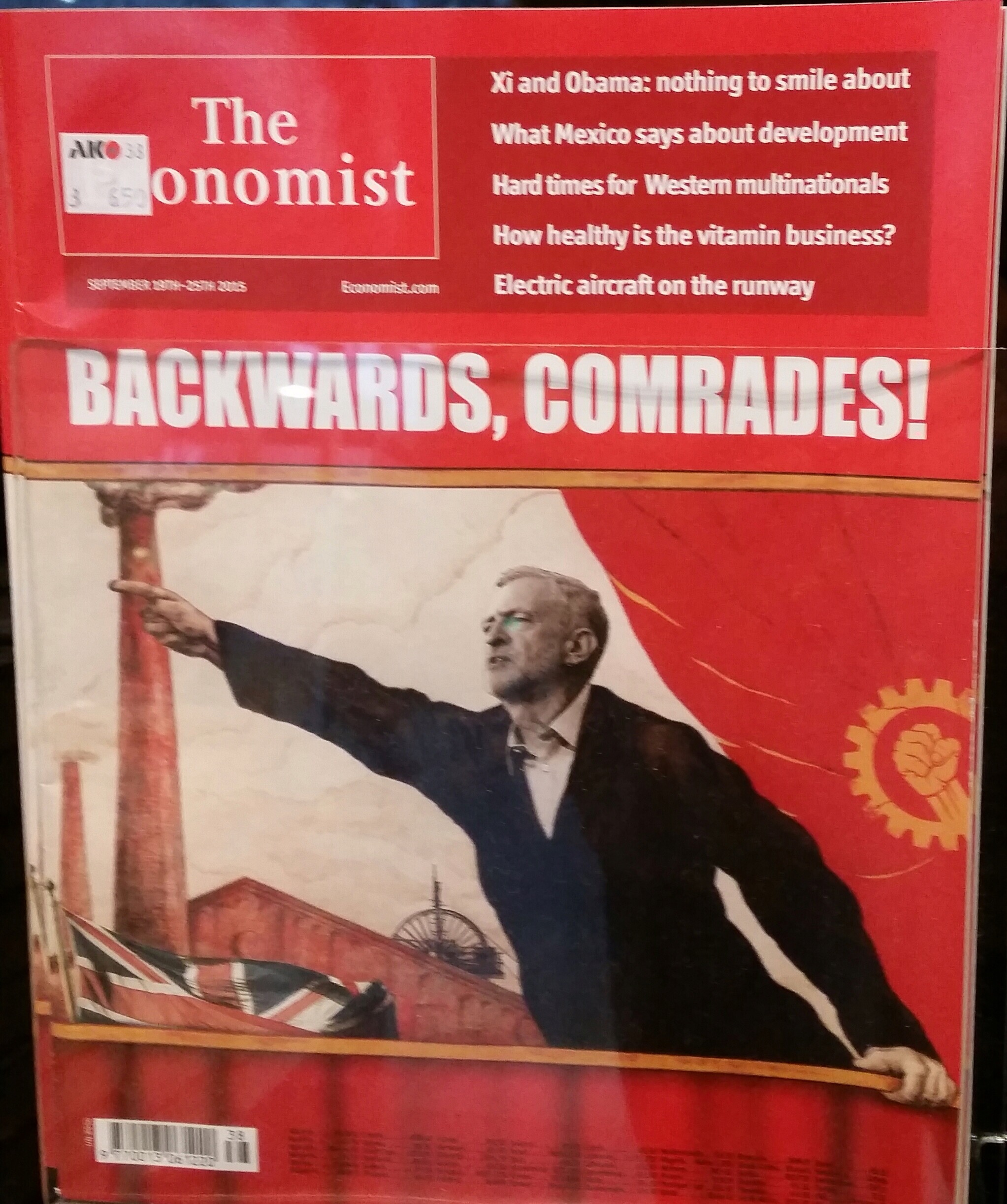
Corbyn election shows Labour’s delight in losing, says Italian PM. Okay,  based entirely on this article, I don’t think Italy’s unelected prime minister, Matteo Renzi, is in a position to comment on Corbyn’s electability. (If I’m reading his history correctly, while Mayor of Florence, Renzi earned the leadership of the Democratic party – as such, he forced the PM, Enrico Letta, to resign last year in his own favour. https://en.m.wikipedia.org/wiki/Matteo_Renzi
He says it has nothing to do with Blairite or anti-Blairite. Well,  yes it does.
He’s left of centre,  but ‘takes on trade unions and forges alliances with conservatives to further his agenda.’ How has he done that? From the same wikipedia article, his ‘government brought the Jobs Act before Parliament, which provided for, among other things, the abolition of Article 18 of the Workers’ Statute, which protected workers from unlawful dismissal.’
Sounds like a Blairite to me. And that means someone who will claim the mantle of working for the working class to line his own pockets and forge his own legacy. Yes, I’m partisan about these things.

Clinton and Blair did the same thing and spent much of their times in office screwing the workers to the delight of Wall Street and London City bankers. And paving the way for Republican/Tory successors.

Blair took the UK into Iraq when no one else in the EU saw reason in it. This did wonders for the arms dealers and helped create the ISIL we’re fighting now. It did not help the working population of Great Britain.

Renzi refers to ‘the last one to be called Red,’ Ed Milliband, as if being branded anything at all by the Daily Mail is something to run from. The thing to run from is selling out your constituency. Blair’s natural constituency, as far as I can tell, was quite similar to Cameron’s, but he claimed to be Labour. Renzi’s words and actions (as reported by the Guardian) put him in the same category. Left by name, good ol’ public schoolboy by predilection.

His policies are not entirely without merit. I’ll note that he sacked the leaders of state-owned companies who weren’t meeting expectations, rather than privatising the companies outright (the way Blair and his successors did). He then replaced them with women. A positive move.

When Renzi praises Cameron for standing up to the refugee flood at Britain’s gates, he again betrays those who should be the focus of the leadership of the left, not to mention that of the free world.

And about that headline, ‘delight in losing’ is a clickbait quote. Heaven forbid Labour voters simply vote for someone who appeals to their better angels. In America, we have huge swaths of the electorate voting not only against their better angels but against their own self-interest.

In some additional fairness to Renzi, that same Wikipedia article also mentions his opposition to austerity measures which is always a good thing in a minister claiming to be on the side against the bankers.