That phrase is displayed over a beautiful Danse Macabre in Fuessen, Germany. Spoken by Death, it means ‘Say Yes, Say No, Dance We Must. In the context of Medieval morality, it makes perfect sense. The rich, the poor, the virtuous, and the vicious all die eventually, and as such were taught what might lay beyond. 
I recently wrote about the town of Mittenwald in which a museum display indicated that the museum used to be on Jew’s Lane, but that in 1938, the name was changed. Walking through Rothenburg, Germany was a little bit different than walking through Mittenwald. At various places, one could see evidence of the former Jewish community there. Judengasse still exists – or exists again – with a plaque indicating the lane as the site of the community that was first expelled in 1520. A plaque in the garden that had once been the Jewish cemetery ‘commemorate[s] our fellow Jews who were expelled between 1933 to 1938 from Rothenburg’. Only since 1990, according to a few such plaques, has excavation of the town’s Jewish past been addressed in earnest. 
Note that Rothenburg is an ancient, well-kept town on the Romantic Road. It attracts a large number of tourists from around the world. For some reason, the region is very popular with the Japanese – enough so that signs indicating places or events of interest are posted in German, English, and Japanese. 

As Rachel and I wandered through this medieval town’s historical re-enactment weekend (commemorating since 1974 a victory that occurred in 1274), and relieved the Kathe Wohlfart shoppe of about 150 euros worth of Christmas tree decorations, and heard tourists speaking English, German, French and Japanese, I asked her ‘Why here and not Mittenwald? Why does this town pay more than lip service to its historic Jewish community (and that community’s destruction – at least twice)? Her answer was short and to the point: ‘American tourists.’ [Note: I’m a secular Jew from the US married to a secular Christian from England.]

She had a good point. Mittenwald hosts a lot of tourists – any established town in the Tyrol region will do well with tourists from Germany, Italy, and Austria, but not necessarily beyond, except for the participants in the annual nordic sports competitions. Attendants at those won’t have much time for sightseeing, is my guess.
But we’re at it again. At the moment it’s the damning of refugees from the Middle East and Africa in the press and social media, not those fleeing the Nazis. Perhaps Rev. Niemoller’s cry about speaking out for the ones everyone is speaking against before there’s no one left to speak out for you will make itself heard through the din. Now the Germans are calling for the EU to divide up the refugees teeming (and dying) on its shores somehow equally, and take care of them. [Note: NOT migrants – they haven’t left their home countries by choice – nor are they likely to be able to return any time soon. They’re seeking refuge. The hint’s in the name.] 
Now there are a lot of reasons Germany is better equipped economically and otherwise to absorb a large number of refugees than Greece or some of the other member states. [An argument might be made that supporting large-scale refugee intake programmes in Greece in exchange for – I dunno – debt relief maybe, makes a lot of sense. It’s for another blog, however.] The quartet that gets on my nerves right now are the so-called Visegrad states: Poland, Hungary, Slovakia, and the Czech Republic. These countries are fighting both against the tide of refugees, but against EU efforts to address the issue. The former US ambassador to Hungary, Eleni Kounalakis, wrote an interesting NY Times editorial on the matter this week  in which she asserts that the Hungarian authorities have been stirring up anti-refugee sentiment since this crisis was in its infancy. The thing is, these countries have had native populations of Roma (aka ‘gypsies’ – a derogatory term) for centuries. When one speaks of the 11 million victims of the Holocaust, Jews made up the majority at six million, but the number of Romani victims is variously estimated at between 220,000 to 1,500,000. Since WWII, the Visegrad countries have made little or no effort to integrate this group into society, regularly demonising them and occasionally going so far as to engage in forced sterilisation. [Oddly similar to how the US has treated poor African Americans at various times and how Australia has treated its aboriginal population. Homework: Compare and contrast.] The main issue is that parties in these countries already have a history of demagoguing an underclass to cover for their various stances and policies. Or simply to whip up hate and drum up votes. We’re doing it in the US right now, and my adopted home of the Netherlands has its own bastards in this regard. They’re all playing the same game that’s epitomised in a joke making the rounds: A billionaire, six white unemployed white people, a black person stand at a table with a dozen donuts. The billionaire takes eleven donuts and tells the white people, ‘Look out – the black guy’s gonna take your donut.’
  Many Hungarians and people all over the world who are addressing refugee crises [we haven’t seen much of the US border with Mexico in the press lately, but trust me, that situation hasn’t changed] know what needs to be done now – normal people are offering up their homes and resources to help people in need. Of course these aren’t the ones in the news. While we have to hear from the Viktor Orbans, Donald Trumps, Nigel Farages, Petra Laszlos, and Rita Verdonks of the world first, we’ve danced this dance before and really don’t need to dance it again.
Adventures this week included a wander around central Innsbruck, Austria and a visit to Das Geigenbaumuseum (violin museum) in Mittenwald, Germany. 

In Innsbruck, Rachel took note of a plaque that honoured the Allied soldiers who liberated the city and Austria itself. ‘There’s a difference,’ she said, ‘between liberation and defeat.’ In the 30s, two of the main parties vying for control of the Austrian parliament with the Christian Socialists (also known as the Austrofascists) and the Nationial Socialists. When it looked like the National Socialists were going to win 40% of the vote in Innsbruck, Engelbert Dollfuss and the Austrofascists banned state and municipal elections. While Dolfuss was against reunification with Germany as long as the Nazis were in power, he was allied with Mussolini. His successor Kurt Schuschnigg (1934–1938) also maintained an anti-unificaiton stance, while also maintaining Dolfuss’ Catholic corporatist policies. Yes, the Nazis marched on Austria in 1938 and installed a puppet governmnent, but did so to cheering crowds. (Note: while all this info is nicked from Wikipedia, I’m entirely open to especially this last generalisation being shown as incorrect.)

So what are we doing in Germany and Austria? Our plan this year was to holiday in Scotland – enjoy a week of the Fringe and maybe drive about and taste some whisky. When the euro crashed, we decided to stay in the eurozone. We wrapped our holiday around my desire to re-visit Fussen, home of two of Mad King Ludwig’s crazy castles. In advance of that, we’re spending a week in Seefeld, Austria mostly hiking, taking in the spas, and enjoying the fact that mountains exist somewhere (just not in the Netherlands, where we spend most of the year. 

Back to Mittenwald and the museum: Interesting exhibits, but a dearth of postcards. The museum provides a history of the town by way the families who established the town as an instrument-making center in post-Renaissance central Europe as well as by description of the town as a trading centre between Italy and points north.

Rachel wasn’t interested in the violin museum, and I wasn’t keen on the Leutasch Geisterklamm (Leutasch Spirit Gorge) walk that she wanted to do. Metal walkways anchored several hundred feet up the side of a mountain – not so keen, me. I’d done a chair lift the day before and feel I have appeased the deities of my acrophobia for this trip. So I left Rachel at the entrance to her walk and drove the four kilometres to Mittenwald where we planned to meet a few hours later. 
  The museum is on Ballenhausgasse – as far as I can figure, Ballenhaus is the local equivalent of a customs warehouse where trade goods are stored until duties are paid. This makes some sense as the Ballenhaus is about 80 metres down the lane (Gasse) with a plaque on the wall. Both the house in which the museum is located and the balllenhaus are about 300 years old. 

The museum takes up two floors. The upper floor displays are concerned with the actual instruments, their makers, and the various processes used to create them. The ground floor’s are mostly concerned with the town’s and the museum’s history and are punctuated with banners containing text in German and in English. My interest in the entire experience took a dive with one particular text covering the history of museum. It was founded in 1930 and moved to its current location in 1960. Apropos of little, the display indicates that until 1938, Ballenhausgasse had been called Judengasse. Does that mean what I think it means? The word wasn’t translated on the English column of text. Yes. Jews Lane. 

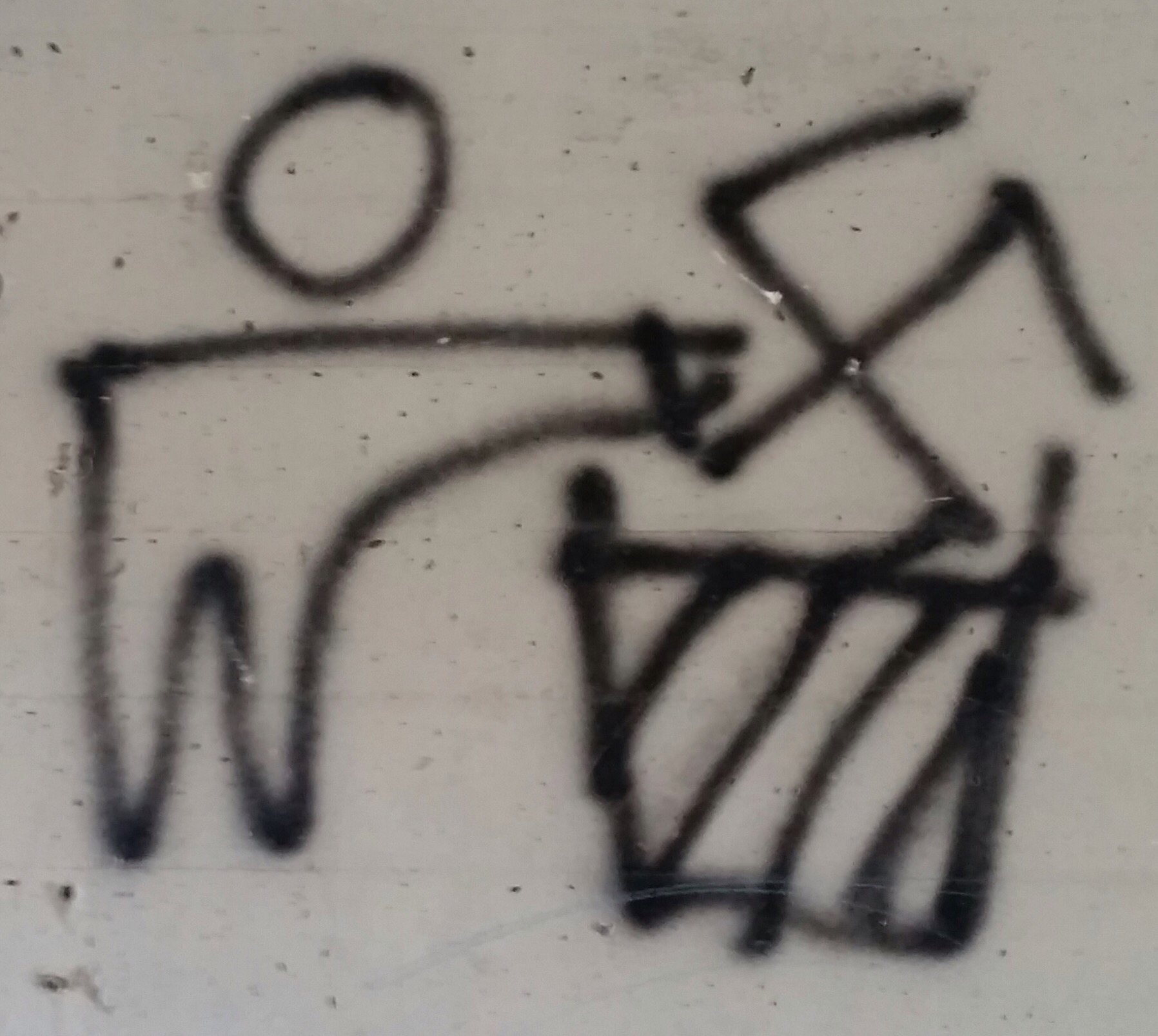
Perhaps no explanation, beyond the year of the change, is really necessary. On the other hand, towns, villages, and cities all over this part of the world had thriving Jewish communities. And then they didn’t. The obliteration of the people in these places is a matter of established record. I don’t believe it’s been long enough to excuse with a mere, ‘Well, naming the street for the building just made more civic sense.’ The grafitti artists of Seefeld, 20 kilometres away know that fascism and its attendant horrors are a continuous threat.

In the dream, I wake from a dream of swimming thinking of the story as I walk down streets paved with large rocks. It’s one of those dreams in which I’m in wide canals as the water gets higher and the current and waves throw me in the air and I come back into the water and float or swim some more. In this revery, I’m walking through the boulders thinking of another story about swimming. Both the town in the dream and the town I wake in have old crooked buildings. But the town I wake into is hotter and arid. I look at a ceramic display on a street corner with words from prayers in Hebrew and English and possibly other languages, and continue walking towards my flat thinking of writing about swimming, about learning to swim, and about water.

Canal-Walk-Foot-BridgeA man, thin, wizened, about 55, stops me and asks if I have money. He wears shorts that are a little baggy on him and a faded t-shirt, though he doesn’t seem like a bum. I think of the small wallet in my pocket which contains maybe 40 euros. He speaks to me immediately in English, which is odd. Tells me I’m brave for admitting about the money, and ask if I mind talking with him. The small avenues are paved like something out of Gaudi or Hundertwasser. As I would in waking life, I do talk to him even though I’d rather be walking home and thinking about writing and thinking about swimming.

We sit on a bench for a bit and he tells me that he makes naambords (signs that go next to the front door of Dutch houses with the family name and house number) – that he makes them just with street names and post codes for the city. He shows me a catalogue printed in colour on cheap paper. In it there’s a picture of very young him – maybe 20 wearing big glasses with plastic frames. It looks like an early 1980s photo of a radio shack geek. His parents encouraged him to do woodwork, as he had a passion for it. I tell him we’ve only this year bought a naambord, and I think of the slate one we actually have. He tells me it doesn’t matter. His name is something like Garry Barr.

I walk back home, thinking I want to write this story down. About the swimming dream and learning to swim and about meeting Garry Barr. The place I arrive at has a cave-like entrance that reminds me now of Tim Dedopulos’ place up from Nerudova (near Prague Castle). There’s a shop just inside and I ask after some chocolates, half-distracted because I want to go inside and write. I’m thinking of a ream of paper I’ve recently bought and of my typewriter. The shop is tiny and I ask if he has chocolate – the proprietor takes down a shoebox from a high shelf – there are white kit-kat bars that come in double packs with eight sticks. I know I don’t want that many, but they’re only a euro so I buy one. Whatever I’m carrying is bulky and I pass Jeff Rubinoff (an American friend of mine from Prague) who asks after the chocolate and I point him to the shopkeeper, instead of giving him half of what I’ve just bought. Even in my dreams, I’m greedy.

I’m a little anxious to start writing – I don’t want to lose the content of the dream and the discussion with Garry Barr. I have images still of swimming down wide canals with waves that toss me in the air and make me fear just a little bit breaking my legs as I hit the bottom, but that never happens in these dreams – the water is never too cold, and I never fear drowning more than just a little – it’s too exhilarating.

Down a short low corridor that feels a little like a cave, I enter a very small apartment, ready to eat a little of my chocolate bar and start typing. The room I enter is small, crowded and dark. My wife is ironing, and points to a bed on top of which a skinny girl of indeterminate age sleeps, wearing only a pair of panties. I’m disappointed because the noise of getting out the typewriter and the paper, even though I know where they are, will wake the girl. At this moment, I wake myself, needing to write.

228_inthrough_bag_israel_front

Israeli cover of Led Zep’s In Through The Out Door.

In August, 1979, in the midst of the punk revolution in the UK and after two years off the road (four since they’d last played in the UK), Led Zeppelin staged two huge shows in at Knebworth over two weekends in August, performing for about 400,000 people. These shows included the first live performances of Hot Dog and In The Evening from the forthcoming album In Through The Out Door. The album should already have been released, but there were production issues and it wasn’t released until the week after the second show.
The following year, the band toured Europe, but on the eve of the American tour the following year, drink finally did in drummer John Bonham. Given that lead singer Robert Plant’s son had died during the American leg of the 1977 tour (thereby putting the kibosh on the European tour for Presence), this was pretty much the last straw for the band and they called it a day.
In Through The Out Door is a curious affair. In terms of production, it’s cleaner than 1977’s Presence, but as a whole, it’s a less focused affair. I may feel this way only because my sister and I bought it the week it was released and played the hell out of it. I don’t think I owned a copy of Presence until I bought one of those dreadful tinny CDs in the mid-90s. (The mastering of the whole catalogue for CD in the late 80s was horrible. The range was shrunk, the warmth pulled into some kind of musical black hole, and even to someone who listens to most music on relatively cheap earbuds, the overall sound was painful.)
Of ITTOD‘s seven tracks, one is a straight-up country tune (Hot Dog), one could be boogie-woogie without too much effort (South Bound Suarez) and others sprawl into disco territory (Carouselambra, In The Evening). But from the faded in digeridoo of In The Evening to the slow blues of I’m Gonna Crawl, I find it their most interesting album – at least the most interesting that was recorded in one go. (Physical Graffiti reaches farther and has greater heights, but pulls on music the band had created over the course of the three previous albums.)
After 36 years, the new reissue is as pleasing as any vinyl I’ve ever owned. It’s the only one of the new reissues I’ve purchased so far (tempted by Physical Graffiti, to be sure, primarily for Night Flight and to listen to Boogie With Stu sped up to 45 the way my sister and did way back when).

https://www.washingtonpost.com/opinions/in-iraq-i-raided-insurgents-in-virginia-the-police-raided-me/2015/07/24/2e114e54-2b02-11e5-bd33-395c05608059_story.html

In this opinion column, Alex Horton, a gentleman who served two tours in Iraq at the height of the fighting recounts a raid on the apartment he was occupying in Virginia. Horton survived his encounter and was able to convince the officers there was nothing wrong. He then compares his training and the different strategies used in Iraq with those of the officers in Virginia. The long and short is that community engagement in both places saves lives, while an aggressive protect-the-badge-at-all-costs approach costs lives, generally those of civilians.

Nicked from http://creativecrista.wordpress.com/2013/02/04/concentration-of-media-ownership/In a followup tweet, Horton notes ‘Some folks said being white helped. Probably true. Cuffs weren’t tight. They were cordial after I said I taught a college course.’

Indeed, whiteness probably saved Horton’s life, given his description of the home invasion he experienced.

I don’t have much to add to the current debate on police tactics and brutality. The world in which Sandra Bland was murdered a couple of weeks ago is the world I grew up in. The LAPD’s record on race relations was appalling and only started to become less so in the aftermath of the Rodney King beating. And even then, the changes started to occur only because of a recording. I look forward to the day when all police behave as though their actions were part of the public record, whether or not their actions are recorded.

The Son of Baldwin page on Facebook cross-posted what I saw as an excellent response to murders of black people in police custody. Actually, he posts them daily, but a couple of days after Bland’s death, he shared a post from Diallo Kenyatta who suggests the Black community do four things to combat these murders. My feeling is that, as with the Civil Rights movements of the 60s, we should all participate in these. Kenyatta’s posts are also well worth following as well.

  1. Cancel the following Pro-Sport season, shut that shit completely down. We would not watch one game, hold one gathering or party, spend one red cent on any sports memorabilia, for an entire season for every single atrocity. Every single Black Ball-Chaster that played in a “Shut Down Season,” would permanently be Persona non grata in the Black community and culture; permanently. We could also develop the Pan-African Games, and Black Community Leagues the keep the talent and resources that emerges around sports within the Black community. We could do without even missing out on the athletics we love because there are countless opportunities to play and watch sports in our local communities.
  2. We’d target the biggest corporation or industry for any particular product or service for permanent sanctions. We’d, as a Race stop buying Nike; we could wear any shoe but Nike; then Adidas, then Puma, and on down the line. As we start our “Trickle Down Sanctions,” we invest the millions in savings in Black owned manufacturing infrastructure in Africa and the African Diaspora. We’d do the same for computers, cell phones, essential services, clothing brands, furniture, food products, etc. If they keep committing atrocities we keep adding permanently sanctioned companies, while preparing to fully replace the products or services with one offered by a Pan-African, cooperatively owned enterprise.
  3. We’d Implement a Holiday Divestment Program. We would shut down any holiday, refuse to observe or spend one fucking dime for every atrocity they commit, We don’t show up for the parades, we don’t buy presents, we don’t buy chocolate bunnies, or Valentine cards. We shut down and divest our time and money from any holiday that followed any atrocity. If that means we have to abstain from any Western Holiday, or Observance day, so be it; we take the funds we would have spent on that shit and roll it into building the Pan-African, cooperative manufacturing and service economy. We can also take that time to develop Pan-African Holidays, Rite-of-Passage Celebrations, Ancestral Feast and Festivals. We could strengthen our current cultural festivities and develop even more if we are not fucking around with European Whole-Lie-Daze anyway.
  4. For every one Black atrocity we can vow to divest from and close 1-10 non-Black owned businesses within our communities and vow to replace them with a Pan-African, cooperative enterprise; such action would only cost a few dollars per household.

I’d be surprised if we had long to wait for the next such atrocity, but I’m absolutely willing to put my money elsewhere in concerted effort with such boycotts.

Part of what we hear in the debate over police on civilian brutality is that the police have the right to protect themselves. I absolutely agree with this to a point. Members of the police force used to sign up, ostensibly, ‘to protect and serve’ (the motto of the Los Angeles Police Department). Now it seems that departments far and wide (though probably not all – there are a *lot* of police departments in the US) offer live action video games to officers (and in one case I read of recently, though can’t seem to cite in the moment, donors to the department). As a nation we buy into it because we consume this steady diet of fear. Is there that much to be fearful of? Real crime is at per capita levels not seen since the 60s. Less than one half of 1% of Americans were victims of violent crime in 2011 and 2013 (https://en.m.wikipedia.org/wiki/Crime_in_the_United_States). On the other hand, in the first 204 days of 2015, there were 204 mass shootings – crimes in which more than four people were injured by guns. http://www.washingtonpost.com/blogs/wonkblog/wp/2015/07/24/there-have-been-204-mass-shootings-and-204-days-in-2015-so-far/

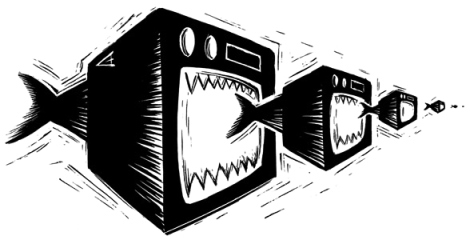
There is very little will at the top of the media food chain to lead a charge away from violence. The old editorial maxim, ‘If it bleeds, it leads,’ is truer today than it was when it was popularised in the late 80s. (I was sure the phrase had to date back to the 60s, though it was coined in ’82, the sentiment goes back at least to the days of Heart’s yellow journalism.) As with Kenyatta’s boycott, the only thing that will truly change the argument is our pocket books. Think of all that could be done with the hours we spend on line and in front of the TV.