The poet Esther Shumiatcher Hirschbein was born in Belarus in 1899 and after many travels settled in Los Angeles in 1940. I was introduced to her via a translation of her 1956 poem Summer Awakening that appeared in the Forverts in 2021. A pshut shtikl ayzen (אַ פּשוּט שטיקל אײזן) is from the same 1956 collection, Lider (לידער). This is my own translation:
An unglowing piece of iron, Burns like the sun in the desert; Blooms like a cactus flower, And like all the colored stones, In the rays of the sun. My plain piece of iron — What joys do I learn from it? Blood is the fire of life. The sun is life alone. Grass, with its green aspirations, Is beauty for itself alone.
One of my Yiddish teachers shared this poem with us a couple of weeks ago and as a class we translated it well enough to get the gist. And to revel in the joy that we can get through 36 lines of poetry in our new language. (New? Several of us have been in the same zoom class for over three years.
Itzik Manger is one of the lights of 20th Century Yiddish literature and while outwardly simple, his poems contain great richness. While I was happy with what achieved in the context of class, I wanted to bring my own poetic sensibilities to it. I went though a period of writing formal poetry and recognized in the Manger some of the formalism he was adhering to.
Some notes: * Avreml is a dimunitive of Abraham. * Avrom Avinu, Abraham our father, is a common epithet for Abraham, the first of the patriarchs. Similar epithets include Dovid HaMelech (David the King) and Moishe Rabinu (Moses our teacher). * In Hebrew, the number 18 is spelled חי which are the first two letters of the word for life (חיים), and is symbolically related to it. One often gives gifts of money in multiples of 18 for this reason.
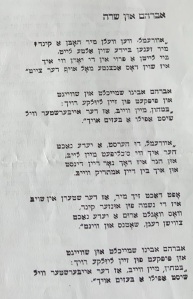
Avreml, when will you and I have a child? We are so old. Any woman as old as I, Has eighteen children already.
Avrom our father smiled and laughed, Blowing smoke from his pipe. Believe it, My wife. If the good lord is so moved, Even a broom will fire a round.
Abe, my love, every night you hear Me cry, my body racked with sobs. Hagar is only our servant, I, dear Avrom, am your true wife.
Often the star in the window I think is the soul of our child. In the raindrops, in the shadows, In the wind, wandering each night.
Avrom our father smiled and laughed, Blowing smoke from his pipe. Believe it, My wife. If the good lord is so moved, Even a broom will fire a round.
When sometimes I see Hagar’s child At play in the sun and the sand, I caress the boy on his head, And my hand becomes strangely sad.
When I take the child in my lap, He smiles so good and so sweetly, That my eyes grow damp and large, And my blood becomes strangely sad.
Avreml, when will you and I have a child? We are so old. Any woman as old as I, Has eighteen children already.
Avrom our father smiled and laughed, Blowing smoke from his pipe. Believe it, My wife. If the good lord is so moved, Even a broom will fire a round.
The wreath of shining laurel lie
upon your shaggy head
bestowing power to play the lyre
to legions of the dead (From Hunter’s Elegy for Jerry Garcia)
The Grateful Dead had two main lyricists – John Perry Barlow (who passed away last year) mostly composed with Bob Weir. Robert Hunter who passed away yesterday at the age of 78 mostly composed with Jerry Garcia (1942-1995). The Days Between is one of the last few songs Hunter and Garcia wrote and was only performed (though quite regularly) in the last two years of Garcia’s life. It’s one of those dancing about architecture songs – I could talk about it or you could just listen…
Robert Hunter wrote straight up poetry as well as lyrics for the Dead (and others) and the words are worth an investment on their own…
There were days
and there were days
and there were days between
Summer flies and August dies
the world grows dark and mean
Comes the shimmer of the moon
on black infested trees
the singing man is at his song
the holy on their knees
the reckless are out wrecking
the timid plead their pleas
No one knows much more of this
than anyone can see anyone can see
There were days
and there were days
and there were days besides
when phantom ships with phantom sails
set to sea on phantom tides
Comes the lightning of the sun
on bright unfocused eyes
the blue of yet another day
a springtime wet with sighs
a hopeful candle lingers
in the land of lullabies
where headless horsemen vanish
with wild and lonely cries lonely cries
There were days
and there were days
and there were days I know
when all we ever wanted
was to learn and love and grow
Once we grew into our shoes
we told them where to go
walked halfway around the world
on promise of the glow
stood upon a mountain top
walked barefoot in the snow
gave the best we had to give
how much we’ll never know we’ll never know
There were days
and there were days
and there were days between
polished like a golden bowl
the finest ever seen
Hearts of Summer held in trust
still tender, young and green
left on shelves collecting dust
not knowing what they mean
valentines of flesh and blood
as soft as velveteen
hoping love would not forsake
the days that lie between lie between
Brodsky was born on this date (May 24) in 1940. I’d only heard of his work, never read any, when one evening in 1999 or so, I heard a recording of him reading ‘A Song’ on NPR. In the twenty years since I heard that recording I can still remember its cadences. This video, with its accompanying Chopin, is close, but it’s not the same. He’d passed away two years before, but this poem enchanted me such that I went out the next day or the day after that and purchased the slim volume So Forth, published by his estate in 1996. I was reading a lot of poetry at the time.
In Moe’s books in Berkeley, someone saw me flipping through Robert Hunter’s Glass Lunch and asked if I’d read his translations of Rilke. Another poet who’s name I knew, but whose work I hadn’t read. Shortly thereafter I started consuming Rilke. The Duino Elegies and Sonnets to Orpheus did my head in, as I would have put it at the time, though not in Hunter’s translations which I found online. The Norton Press dual language editions. Housman, Stein, Wilde, and Sharon Doubiago carried me through those years as well.
My memory is that I bought the Brodsky at Moe’s (RIP) as well, but the bookmark inside insists it was Booksmith on Haight Street. I can vaguely picture myself paying for it there, probably having already exhausted the two used bookstores across the street. I don’t know if Austen was still a going concern at that point. I’d worked a couple of stints there, but after Jeffrey died and Brian took it over, it didn’t last too long. That spot might already have become another shoe store by ‘99. I don’t recall the name of the other used bookshop on the street, but for all the paperbacks crammed into the place I rarely if ever found a book there I wanted to buy. And I was voracious.
I’ve not opened So Forth in several years, and find that it still has a blue plastic sticker marking A Song on page 5. The name Joseph at the top of the front cover is sun faded, but the spine is intact, and the glue binding intact. Flipping through it, though, there’s no page that isn’t a joy to read. These poems reward reading aloud. Not to say I and my poor understanding of my iPad’s voice memo function do them justice, but here’s one called Ab Ovo which I quite like…
Note: Copyright in this poem is held, I’m certain, by the estate of Mr. Brodsky. I will remove this recording upon request.
So Forth can be ordered via the links on the publisher’s web site here.
So I reread A Portrait of the Artist as a Young Man a couple of months ago and was struck by several things – mainly that having read it a couple of times over the last thirty years, I’d never read it very carefully. The other is that Portrait is easily as brilliant as any of Joyce’s other work – I have tended to rate it rather lower than Ulysses (which I reread last year and also found to be far deeper and wider and taller than I had in the past).
A look at Stephen’s alienation in A Portrait of the Artist as a Young Man
Through the course of A Portrait, James Joyce builds a compelling argument for Stephen’s flight from Dublin. At every turn of his upbringing, city, family, or the church conspire against Stephen’s artistic freedom. One might argue that these elements conspire against his soul.
Prefects, professors, and deans all exercise the will of the church over Stephen in such away that he desires to pull out from under its authority. At one end, we have the church, in the form of Father Dolan and his swishing soutane and pandybat (chapter I), physically punishing Stephen for no other reason than sadism. This unreasoned sadism reflects that of the other boys at Clongowes Wood College, the Jesuit boarding school he is sent to at the age of about six. At the other end, we have an English dean of studies, a convert to Catholicism, who argues the words funnel and tundish with Stephen. The first is an offense against Stephen’s person, and perhaps against his self-mastery. The latter is an offense against his linguistic mastery, which is already a point of pride, ‘The little word seemed to have turned a rapier point of his sensitiveness against this courteous and vigilant foe’. (Chapter V)
Somewhere in between these two events, Father Tate, leading an English class, calls Stephen out for blasphemy in a sequence that evokes in the reader a sense of the secret mysteries of the church (chapter II). The teacher cites merely a fragment of a sentence, ‘”Without a possibility of ever approaching nearer.” That’s heresy.’ Stephen backs down, saying, ‘I meant ‘Without a possibility of ever reaching.’ The teacher accepts this, ‘O. That’s another story.’



 Somewhere in between these two events, Father Tate, leading an English class, calls Stephen out for blasphemy in a sequence that evokes in the reader a sense of the secret mysteries of the church (chapter II). The teacher cites merely a fragment of a sentence, ‘”Without a possibility of ever approaching nearer.” That’s heresy.’ Stephen backs down, saying, ‘I meant ‘Without a possibility of ever reaching.’ The teacher accepts this, ‘O. That’s another story.’
 Joe Jots