
Guinevere Turner writes in the May 6, 2019 New Yorker about growing up in a commune and discusses the differences between communes and cults. ‘(Leader Mel) Lyman never ordered his followers to kill anyone the way Charles Manson did, but if Lyman had asked, I’m pretty sure that they would have complied.’ (The Others)
That said, I spent some formative years in a commune/cult and not long after my family left, the leader of this cult did ask two of his followers to attempt murder.
Lance Kenton was about 21 (and the one thing said about him in every article on this subject is that he was the son of big band leader Stan Kenton) and Joe Musico, a damaged Vietnam war veteran aged about 28, under the direction of Synanon’s leader, Charles Diederich, used the rather ingenious method of cutting the rattles off of a rattlesnake before putting the snake into the mailbox of attorney Paul Morantz. They were found guilty and each served a prison sentence and probation time.
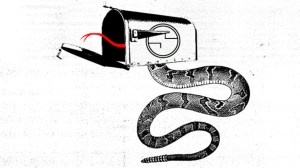 My family had all left Synanon by the close of 1977 and the snake incident didn’t occur until about a year later. (I should verify, but in my memory the Morantz attack, the People’s Temple mass suicide and the murders of Harvey Milk and George Moscone all ran together in the news. So perhaps by this definition, Synanon counts as a cult, or at least it did by that point. I have vague memories of an increased focus on self defense while I was still there, but that might be an amalgam of readings and memories and discussions that happened later.
From certain points of view, there might be objective assessments of the whole situation but 40 plus years later, I’m generally unwilling to dig into them. I don’t get much out of the subjective assessment either, given that it took me 25 of those 40 years to get to the other side of my own Synanon experience.
The death of Paul Morantz in 1978 would only have benefitted Chuck Diederich. Morantz had made something of a name representing individuals who had cases against Synanon and other such places based on mistreatment. And he’d won some pricey verdicts as well. It’s not as though there weren’t other lawyers going up against Synanon at the time, but Morantz had been successful and was showing no signs of stopping.
CED, according to one very biased account that insists on referring to Synanon members as ‘Synanites’ (a term we never would have used), spent a lot of time on the Wire, the closed-circuit radio network demonizing Morantz and calling on followers to do something about him.
Anyway, this brings me to the cult at the heart of the executive branch of the US government. The president’s fixer has just started a prison term for crimes that only benefitted the president. Diederich’s call for someone inside to to his dirty work sounds eerily like what we’ve heard from Trump and specifically from Cohen’s defense of his own actions. (Fall Guy – Michael Cohen’s Last Days of Freedom by Jeffrey Toobin in the same issue of the New Yorker.)
Mel Lyman’s Family organization – the cult to which Guinevere Turner belonged from birth to the age of about 12 afforded her a great deal of security and was home in a way that Synanon wasn’t really for me. Noting that I have friends who were there much longer than I was and who saw the other end of a period of distinct cruelty against those of us in the school. Their attitudes about the place are very different than mine or my parents’. For a period, the school was run by a guy who had no pedagogical background. This wasn’t uncommon – most people worked jobs inside that had no relationship to whatever training they may have brought in. Unless it was lucrative. My father was a patent lawyer and he continued doing the same work and gave most of his income back to the community. If not all. The fact that the person in charge of the school, Chris Benton, had not educational background didn’t set him apart from anyone else teaching us. His background however was as a drill sergeant. And corporal punishment wasn’t outside of his remit. (This despite the fact that Synanon had strict policies against physical violence, threatening physical violence, not to mention swearing and drug, alcohol, and tobacco use.)
I left at the age of 10 1/2 when my father and stepmother left in September of 1977 (my mother and stepfather had left in mid-‘76. The story behind all of the relationships is complex and for another blog entry), almost three years after entering. It took a long time for me to come to terms with the place. Psychoanalysis in the wake of my divorce helped, I suppose. And simply getting to middle age and that point where there’s no longer any profit to be had from carrying the baggage.
Turner made a certain kind of peace with her experiences on a return visit at the age of 18 – the casual sexism with which the men their expected to be waited on put paid to her longing to return to The Family’s way of life. She makes an interesting point about the probable profusion of cults in America:
If you haven’t heard of a cult, it’s because it didn’t go down in flames. Its members are just quietly doing what they do, which means that there are many more active cults today than we are aware of.
Manson and David Koresh’s group in the 90s (for another example) and Synanon went down in flames. Folks like Lyman’s group laid low. I’d suggest that the probability a cult will go down in flames is directly proportional to the degree it goes head to head with existing power structures. Synanon got under the skins of nearby residents no matter where it set up (for a variety of reasons – the fact that it sold itself as a drug rehab organization harking back to its roots is one) and there was a certain amount of that antagonism built into Chuck’s messiah complex.
The issue we’re running into here is that Manson, Koresh and Diederich, and let’s add Philadelphia’s MOVE commune to the list, all in their own ways got the goat of the power structures (and the media). Outright murder got Manson on the map. The others? Different in their different ways.
What do we get, though, with the Cult of Trump in which the leader is the power structure? Increasingly there seems to be no way of stopping him short of something that turns the rest of the structure against him. That has historically taken a long and very difficult time.
 production at the time and which I still haven’t seen), WS Burroughs’ Naked Lunch, and William Gibson’s Neuromancer with some extra outside references. A friend had recommended both the essay I reference in the second paragraph and Andre Breton’s Nadja. Those two, combined with a reread of both PK Dick’s Do Androids Dream of Electric Sheep and the Gibson after many years away from them, gave me a bunch of ideas that took shape over a couple of months. After receiving a piece of fairly easy criticism from a trusted friend that I didn’t quite know what to do with, I let the thing sit on my hard drive for a while (the better part of three years). I’ve reread it, done a couple of minor edits, and added a conclusion. I welcome your thoughts.

 Joe Jots