Archives for category: Writing

The Hebrew word for truth, אמת (emet), is interesting because each letter stands on a solid base – the two feet of the aleph and the tof, and the line of the mem in the middle of the word. In the context of the alef-bet, it forms a tripod, as well, as the alef and the tof are the first and last letters, and the mem sits in the middle. I had a Hebrew teacher when I was about 13 who explained this to me and contrasted it with the word for falsehood, שקר (sheker). Each letter of this word stands on one foot and the letters themselves are grouped at the end of the alef-bet.
With this this mind, I have a large tattoo of the word אמת on my left arm. Six or seven years ago, a Palestinian colleague confronted me saying ‘Your truth is a lie’. I had a few interactions with Nabil and tried to defend my own position with regards to the current Israeli administration. I did a poor job of it. (I’m a lousy marketeer – for all my love of music, I rarely manage to convince people to listen to music I like.) I’ve never managed to defend the position that Israel as a homeland for the Jewish people should have a right to exist. This, please note, is the sole tenet of Zionism – everything else is antisemitic bullshit. I will say that much of what Israel has done for decades is indefensible. (I’m not saying that Hamas’ behavior towards Israel is defensible either. It isn’t. There’s no equivalence)
But back to tattoos. I didn’t have a real connection to the person who did the Hebrew tattoo on me, but I chose the artist who did three or four others on my skin based on his well-documented talent. Freddy Corbin already had a very good reputation 30-plus years ago and earned the nickname Freddy Jesus for his skill with Catholic imagery. What sold me on Corbin’s work was a cover job in his portfolio. A man came to him with a large black SS logo on his arm. He designed and inked a sacred heart over the logo leaving almost none of the nazi image visible.
I’ve found myself thinking in the last few days of how I could have the Hebrew word on my arm covered. From the original philosophical standpoint, the tattoo is defensible. Even from an armchair Zionist perspective, I can still try. And I will not stop defending Israel’s right to exist. But, I continue to ask myself, does this defense – and does this tattoo – signify an implicit defense of the current governing structure?

Again, I’m not comparing my Hebrew text to a nazi logo – there is no comparison. In 1990, or so, the person with that nazi logo determined, or was made to see that the philosophy and hatred behind its symbolism were no longer meaningful to him and he did something to change that. For me, the aspiration towards truth, the aspiration that my words are solid like the tripod of the word, in form and in function, remains, no matter that I fail at it more than I succeed. The aspiration remains.
However, the symbolism of text in Hebrew characters remains a question for me. I’ll point to the band Godspeed You! Black Emperor, some of whose members are Jewish. Their music is mostly instrumental, and they let titles (both album and song) carry a lot of weight. In 2021 they released an album called G_d’s Pee At States’ End, on the CD of which was printed the Yiddish text מיר װעלן זײ איבערלעבן, We will outlive them, meaning antisemites in specific and haters in general. Last year they released a new album for which they were hard pressed to come up with a title. Its name? No Title As of 13 February 2024 28,340 Dead.
The number reflects the purported number of Palestinian dead in Israeli strikes on Gaza between 7 October 2023 and the date in the title – which itself was six months before the album’s release and nearly a year before the cease-fire in that conflict. The only spoken text on the the album is a poem read in Spanish on the song Raindrops Cast In Lead. (Gracious, can you imagine the guts behind that song title?)
As with the band, I too can contain multitudes – insisting on my continued existence as a Jew and being ambivalent about the nature of my truth, and outraged at what is done in its name.

Last night’s adventure was the first date on Italian progressives The Watch’s ambitious tour alternating performances of Genesis classics The Lamb Lies Down On Broadway and Foxtrot/Selling England by the Pound. And they pulled it off admirably, save for the occasional opening night glitch. The tour also celebrates the 50th anniversary of the release of The Lamb.

The Watch currently consists of Simone Rossetti (lead vocals, flute, keyboards, synthesisers), Valerio De Vittorio (keyboards, synthesisers, guitars, vocals), Mattia Rossetti (bass, guitars, vocals), Francesco Vaccarezza (drums, percussion, vocals) and Andrea Giustiniani (lead guitars). My friend Cheryl and I were stood right at the front of a mostly sold-out venue (Boerderij in Zoetermeer, a pretty friendly room that hosts a lot of prog/tribute acts) just to the right of Rossetti with Vittorio and Vaccarezza in clear sight.

Now, I listened to The Lamb a lot as a kid, though mostly the first two sides of this double-album set. I read the notes and lyrics assiduously, and the way Cheryl tells it, she listened a lot as well. It’s a daunting, musically ambitious album that had a lot of appeal to me for the crazy storyline (found in small print across the inside of the gatefold; if you only had the CD, it was impossible to read) and weird theatricality. For those unfamiliar with the plot, Rael, a small-time Brooklyn hood, finds himself trapped in a weird fantasy world, one step ahead of or behind his brother John. Each experience is told more than shown, but that’s fine, it’s prog rock. At certain points of the show, a voiceover gave the audience occasional snippets of that text.

The whole show was an admirable recreation of the album with no effects, save for lighting and a backdrop reminiscent of the album’s cover.

The sound mix from my perspective was good, but Giustiniani’s recreation of Steve Hackett’s intricate guitar work was too low. This may have had something to do with how close to the stage I was. Simone’s vocals took a little while to get up to the task – this might also have had to do with mixing, but he was also, I think a little nervous. After the third or fourth song, he was in full Peter Gabriel form. Extra shout-outs for backing vocals from Mattia and especially Francesco from behind the drum kit. Simone, as an Italian performing for a Dutch audience, didn’t do much of the between song banter that Genesis-era Peter Gabriel was known for. The exception was the introduction to Counting Out Time, a tale of teenage pre-sexual experience angst, solved with the help of a book on the the erogenous zones. This he read out from a sheet with admirable Dutch pronunciation. (This, however, was also an opening night glitch – he read it before Back in NYC, the song that precedes Counting Out Time. Whatever. He still gets points.)

The Lamb Lies Down On Broadway is an attempt at a rock opera (released not that long after Tommy and Quadrophenia), and makes attempts at theatricality in its bombast. The Watch held our attention from an otherwise bare stage for the duration. While the story might bog down a bit in the second half, the recreation was fantastic. And this music (prog, after all) is not easy. I spent much of the show watching Francesco’s drumming. There was a moment during The Waiting Room which brought me joy – he was concentrating on a pretty complex figure and when he completed it, his face had a huge smile. Whatever the phrase ‘nailed it’ is in Italian, he did.

After a fair amount of musical meandering, Rael emerges into daylight and the main show concludes with the pure 4/4 rock and roll joy of IT.

For the main set (broken by a short intermission), Mattia only played one instrument, a double neck bass/12-string (and several effects pedals). However, there were two more guitars on stage. What else are they going to play. After another short break, the band came back and Simone looked confused for a second, then tapped the tablet on his music stand before saying something like ‘ah, that’s the encore.’ Yes, he had a tablet and a couple of notes at his side, but barely looked at them through the whole show. Not that I blame any singer with a massive piece of music to sing the crutch of the occasional lyric sheet. The band kicked into The Musical Box, a multi-part epic from 1971’s Nursery Cryme (and possibly my favourite Genesis song, though there are other candidates) which they hit out of the park. (Here’s The Watch performing it at Boerderij two years ago.)

I left the venue with a massive grin on my face – Seeing this formative soundtrack of my adolescence performed in full by stunningly talented musicians who obviously also have a love for it was definitely one off the bucket list.

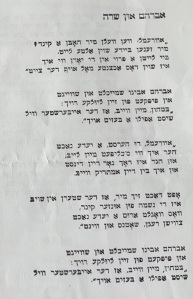
One of my Yiddish teachers shared this poem with us a couple of weeks ago and as a class we translated it well enough to get the gist. And to revel in the joy that we can get through 36 lines of poetry in our new language. (New? Several of us have been in the same zoom class for over three years.

A painting of the poet Itzik Manger by Arthur Kolnik in profile. Hair dark brown, red jacket, white shirt, blue background.

Itzik Manger is one of the lights of 20th Century Yiddish literature and while outwardly simple, his poems contain great richness. While I was happy with what achieved in the context of class, I wanted to bring my own poetic sensibilities to it. I went though a period of writing formal poetry and recognized in the Manger some of the formalism he was adhering to.

Some notes:
* Avreml is a dimunitive of Abraham.
* Avrom Avinu, Abraham our father, is a common epithet for Abraham, the first of the patriarchs. Similar epithets include Dovid HaMelech (David the King) and Moishe Rabinu (Moses our teacher).
* In Hebrew, the number 18 is spelled חי which are the first two letters of the word for life (חיים), and is symbolically related to it. One often gives gifts of money in multiples of 18 for this reason.

Avreml, when will you and I
have a child? We are so old.
Any woman as old as I,
Has eighteen children already.

Avrom our father smiled and laughed,
Blowing smoke from his pipe. Believe it,
My wife. If the good lord is so moved,
Even a broom will fire a round.

Abe, my love, every night you hear
Me cry, my body racked with sobs.
Hagar is only our servant,
I, dear Avrom, am your true wife.

Often the star in the window
I think is the soul of our child.
In the raindrops, in the shadows,
In the wind, wandering each night.

Avrom our father smiled and laughed,
Blowing smoke from his pipe. Believe it,
My wife. If the good lord is so moved,
Even a broom will fire a round.

When sometimes I see Hagar’s child
At play in the sun and the sand,
I caress the boy on his head,
And my hand becomes strangely sad.

When I take the child in my lap,
He smiles so good and so sweetly,
That my eyes grow damp and large,
And my blood becomes strangely sad.

Avreml, when will you and I
have a child? We are so old.
Any woman as old as I,
Has eighteen children already.

Avrom our father smiled and laughed,
Blowing smoke from his pipe. Believe it,
My wife. If the good lord is so moved,
Even a broom will fire a round.

The other night I had the time to finally watch Marco Porsio’s 2019 Swans documentary Where Does a Body End. First off: Five stars. Well done. Rock docs follow a certain pattern that this didn’t really deviate from – interview the principals, interview their comrades present and past. In this case the principal is Michael Gira, who founded Swans in 1981 or so and has been the only consistent member across 40-plus years. He was generous with his time and his own assessments of his strengths and faults. I was excited early on that there was a clip of Einsturzende Neubauten’s Blixa Bargeld expressing some praise. Alas, he only gets the camera once more near the end. Other key interviewees included Lee Ranaldo and Thurston Moore of Sonic Youth (who toured with Swans at the beginnings of both bands’ histories), and Jarboe. Jarboe drove up to NYC from Atlanta in ‘85 or so having written a fan letter (shared in the doc) to the band after hearing an early recording on college radio. She joined as keyboardist and occasional vocalist appearing first on the 1986 releases Greed, Holy Money, and Time is Money (Bastard). We learn from the doc that she and Gira were partners from that period until Gira disbanded Swans in 1997. (He would reignite Swans in 2010 without Jarboe. An impetus for the film was Gira’s announcement that the newer incarnation of the group would halt after four albums and the accompanying 2017 tour. Last year, a new lineup released an album and are touring – I’ve seen them twice this time out.) Her participation in the documentary is generous and alone worth the price of admission if you’re interested in how bands work.

Thurston Moore’s memories of their bands’ tours together is poignant in the descriptions of just how difficult life on the road was/is for independent acts. In his thoughts on the re-invigorated version of Swans, he admits to a little jealous that Gira’s band was still going, ‘He’s got Swans. I don’t have Sonic Youth.’ (This is a little disingenuous – Moore and SY’s bassist Kim Gordon had been a couple/married for 27 years until Moore fathered a child with their nanny. That put paid to SY.)

One of the most interesting thing about how the film is constructed is the wealth of live footage of the band, both their earlier incarnations and the more recent tours. I was amused of a clip from their 2011 appearance at the All Tomorrow’s Parties festival in London because I was there. Not that I could have picked myself out in the audience. My favourite clip (which I hope to find online) was Jarboe joining the new lineup in 2016 or so to perform Blood On Yr Hands (a highlight of the ‘95/‘97 tours.)

And of course I can write paragraphs and paragraphs about the interviews and the clips and so forth, but as always, it’s a case of dancing about architecture. Swans have always been about the intensity of the musical experience and their music isn’t for the faint of heart. I think Screen Shot is representative.

A friend I’ll call G recently wrote an impassioned post about the experience of growing up female, that this is a unique thing that trans women somehow dilute. Her post included also argued that the sheer average size of biological males argues against their right to occupy biological female space. They are incapable of knowing the fears and joys of being female, from the perspective of being biologically female from birth in the world.

As cisgender humans, G and I are incapable of occupying the spaces of other genders. Our experiences don’t allow for that – nature or nurture – but we can empathise with others’ experiences. I can start to imagine the fears of women making their way through public spaces where they’re catcalled – fears that as a cis-presenting male, I don’t live with. I can imagine those fears and be with those who have them in their space without, for example, denigrating their lived experience. Stating it this way is, I admit freely, very harsh to my friend’s position – possibly harsher than it needs to be. With that empathy I can try to a better human, advocate, partner, and friend.

I also didn’t grow up suffering any kind of gender dysphoria, but I can empathise with those who experience it now – who spend every moment with the feeling that the space they occupy, the space assigned to them, the roles society puts them in are wrong – and argue to make their existences easier and more aligned with who they are. I don’t need to live their experience to trust their lived experience. I was reading today about Brianna Titone, a trans woman in the Colorado legislature. Her childhood dream was to work for the FBI and she remained closeted until she aged out of admission to the Bureau at the age of 37. I can barely imagine the pain that cost her.

From my perspective, it matters what those initial experiences imprint on a person, but those experiences are both internal and external and shouldn’t be legislated back into the closet.

Paraphrasing from Thomas Hobbes’ Leviathan: We can’t know the inner experiences of other people, but we can know our own hearts and by this know the hearts of others. Not what their desires and needs and fears are, but the nature of desire and need and fear. (Hobbes presents this idea in the introduction to the Leviathan. The syntax is very old-school, but it’s four paragraphs worth reading.)

This is possibly the key to the argument. G knows the nature of her fears and needs and desires as she grew into womanhood – or does if she examines her own heart, just as I know mine. We can use that self knowledge to examine the fears and needs of those who grow in a body that doesn’t feel right. Or with desires that don’t align with what the so-called majority posits are the only legitimate paths for desire.

How do we make things equitable in the public square in the face of state after state legislating against trans existence? It’s truly fascistic, in my view, and sets the stage for a full rewrite of the sexual freedoms Americans have had since Griswold. Women are already suffering as a result of restrictions on procedures and medicines that are associated with abortion even if the mother’s ability to further bear children should she survive complications of a pregnancy gone awry. It’s a demonic state of affairs. A few years ago there was a case in Dublin where a woman’s pregnancy went septic – she was denied abortion and died as a result. In response, Ireland legalised abortion and at the time was seen as a latecomer to abortion rights in general. Since then, the US has gone backwards with alarming speed.

What does all of this have to do with trans rights? Good question. Affirming that a person has the right to determine where and how they are most comfortable in their body is one place – bodily autonomy is another. Gender affirming care is a phrase, like ‘woke’ and ‘political correctness’ that has been twisted out of all recognition. G has also argued that drag in general mocks femininity rather than embraces and exalts it. Was Barry Humphries, or Ian McKellen for that matter, mocking women? Do panto dames mock women by their very existence?

G has shared a point about drag being men in ‘woman-face’ and she’s not the only one of my friends to do so. What makes drag different than minstrel shows – Al Jolson singing Mammy in black face? The sidestepping of discrimination and thereby making fun of an underclass group is partially at the heart of each one. But drag has always seemed to me more celebratory of those things that make women different than men.

In considering the arguments against trans people, I’ve wondered if autism in a similar category as gender dysphoria? In both cases, societal and medical changes developments should make it more possible to live comfortably and successfully in the world than was possible ten, twenty, thirty years ago. I can hear a case that these are totally different – one is something that you can show in a medical diagnosis and is historically identified. And the other? Very much the same.

The main problem I have with my friends expressing anti-trans or anti-drag sentiment is that trans folks and queer people in general are in the legislative crosshairs in the US and elsewhere. And the last couple of years have seen a massive uptick in these things.

There are eight trans legislators in US statehouses. None in the US Congress. The silencing and outlawing a class of queer people is happening in at least half of the states with very few voices able to stand up on the other side. And when they do stand up, they’re often silenced. The case of Representative Zooey Zephyr in Montana comes to mind. She was ousted from her duly elected seat for speaking against an anti-trans bill and is still unable to return. The bill passed and was signed by the state’s republican governor.

I read the papers everyday and above the virtual fold, always, is something about the targets on the backs of gender non-conforming people. There’s the bill in Texas trying to legislate that people working for government dress to match the gender they were assigned at birth. (This is nothing new in Texas – I had a housemate 20 years ago who fought her previous employer, the Houston office of the Internal Revenue Service for the right to wear trousers to work. If I recall correctly, she had to take them to court.)

And the BBC reports that the Proud Boys (yes, the source of five seditious conspiracy convictions this week) are now targeting drag shows.

I’m not sure of the answers and I think my lack of certainty is me being played into a more fascistic position. I’m not active in drag (though I once dated the first drag queen to run for president, Joan Jett Blakk), and I’ve never watched Ru Paul’s Drag Race. Are a bunch of queer men dressing up and making their faces exaggerations of femininity problematic in ways that I as a queer-adjacent male can’t comprehend? Are we really that different, men and women (and all human points between and beyond), that we can’t bridge this divide without othering and criminalising a valued (or any) segment of the population, without devaluing any of us? It’s the devaluing of humans for something that’s inherent (heck, even if it’s for something as harmless as drag, that’s chosen) that gets me first, whereas othering people at all takes a piece of my heart and incinerates it while I still breathe.